
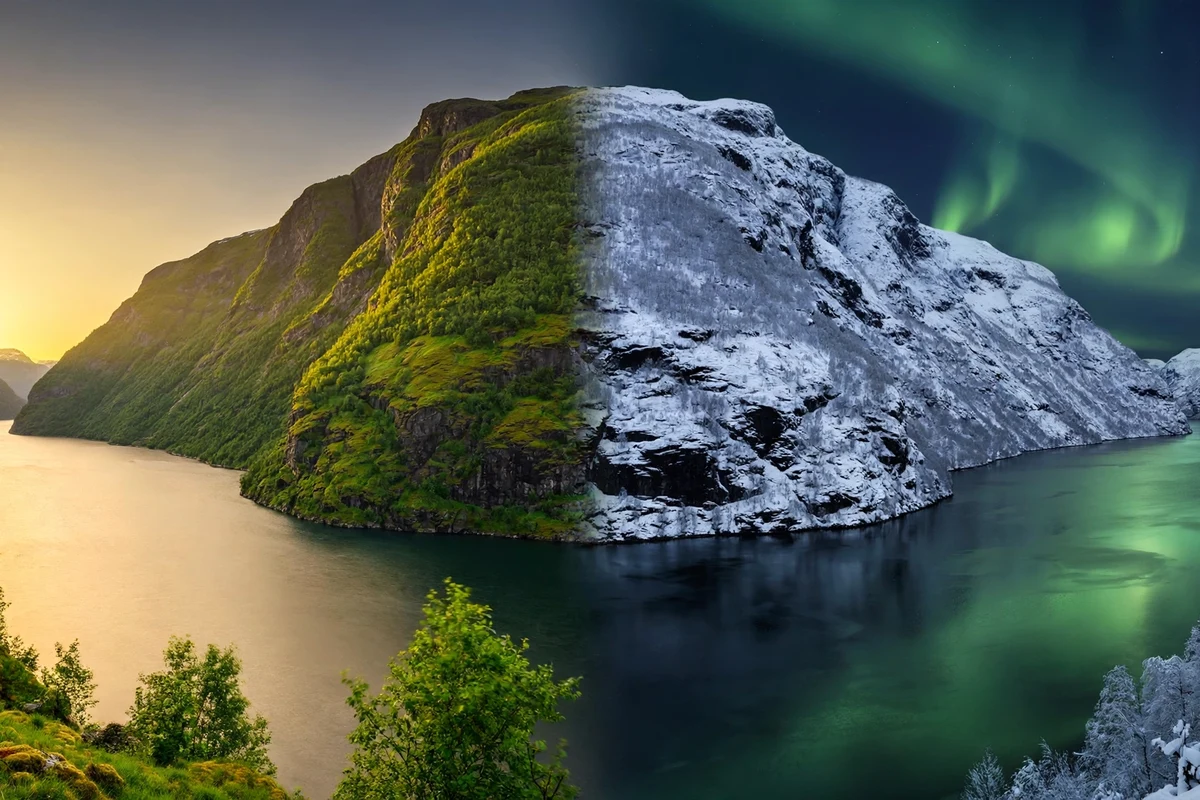
Summer vs Winter Norway Cruise: Midnight Sun vs Northern Lights
A summer vs winter Norway cruise is not the same holiday in different weather. It is two different trips on the same coastline. Summer brings long bright evenings, green mountains, waterfalls at full strength and every boat running. Winter brings snow on the cliffs, short blue days, quiet ports and dark skies that can fill with the northern lights. Neither season is wrong, but they suit different travellers, budgets and tolerances for cold and crowds.
The short answer
Pick summer for the classic fjord cruise: warm days, hiking, kayaking, long evenings on deck and the widest choice of ships and routes. June to August is the peak, with May and September as quieter, cheaper alternatives. Pick winter for the northern lights, snow and a quieter trip. Late September to March is the aurora season in the north, and November to January gives you the longest nights. The trade: short days, cold weather and fewer sailings in the western fjords. September and March are the compromise months; our best time to visit guide works through the same choice month by month.
Light: the real difference between the seasons
In Tromsø, the sun stays above the horizon from 20 May to 22 July, about nine weeks of midnight sun with the whole disc visible at midnight, according to the Norwegian Meteorological Institute through yr.no. Lofoten runs roughly 28 May to 14 July, and Bodø roughly 4 June to 8 July. South of the Arctic Circle there is no true midnight sun, but Bergen still gets around 19 hours of daylight at the end of June.
Winter is the mirror image: in Tromsø the sun sets for the last time on 27 November and does not rise again until 15 January, so the days from 28 November to 14 January have no sunrise at all. That is the polar night, though some sources give the span as 27 November to 15 January. It is not total darkness: for a few hours around midday the sky goes through a long blue twilight, and snow reflects what light there is. In Bergen the winter is far gentler, with about six hours of daylight in December. In practice, summer lets you watch the fjords sail past at 11 pm; winter means planning around a short midday twilight window.
Month by month: daylight, light and feel
The table uses Tromsø, where the light changes most dramatically; daylight figures are approximate. Bergen is milder: roughly 6 to 7 hours of daylight in December and about 19 hours at the end of June.
| Month | Daylight in Tromsø (approx.) | Light phenomenon | Typical feel |
|---|---|---|---|
| January | None until 15 Jan | Polar night ends | Twilight, snow, aurora |
| February | About 7 hours | Days return | Snow, longer days, lights possible |
| March | About 12 hours | Equinox | Snow, sunshine, aurora into April |
| April | About 16 hours | Bright nights | Thaw, no aurora, Geiranger not yet open |
| May | 20 hours, 24 from 20 May | Midnight sun starts | Waterfalls, blossom, thin crowds |
| June | 24 hours | Midnight sun | Longest days, green fjords |
| July | 24 hours to 22 July | Midnight sun ends | Warmest, busiest, midnight hiking |
| August | About 18 hours | Bright nights fade | Warm, quieter, dark nights return |
| September | About 13 hours | First lights | Autumn colour, fewer crowds |
| October | About 9 hours | Dark evenings | Golden hills, first snow, aurora |
| November | 4 hours, none from 28 Nov | Polar night starts | Whale season, blue twilight |
| December | No sun, twilight only | Polar night | Darkest month, snow, aurora |
Weather and temperatures
Norway’s coast is milder than its latitude suggests, because the Gulf Stream warms the sea. Figures below are 1991 to 2020 monthly means from the Norwegian Meteorological Institute.
In Tromsø the coldest month is February, with a mean of minus 3.2 degrees Celsius, an average low of minus 5.7 and an average high of minus 0.7. January averages minus 2.9 degrees and December minus 1.6. The warmest month is July, with a mean of 12.5 degrees, an average low of 9.3 and an average high of 15.6, while June averages 9.5, August 11.5 and September 8.0 degrees. A summer day on deck feels like a cool spring day elsewhere, and a winter day needs proper layers and a windproof shell.
Bergen is warmer in both seasons: February, the coldest month, averages 2.5 degrees, with an average low of 0.1 and an average high of 4.9, and January averages 2.6. July, the warmest month, averages 16.1 degrees, with an average low of 12.5 and an average high of 19.7, and June averages 13.8. Bergen is also famously wet, so pack a waterproof jacket whatever the season. Our packing list covers layering for both seasons, and the cost and budget guide sets out what to expect to spend on top of the fare. Cloud matters more than temperature for the northern lights: a cloudy night produces nothing, even when auroral activity is strong, so check yr.no the afternoon before any excursion.
Prices and crowds
Summer is the expensive season and winter the cheaper one, with one exception: the far north in winter, where Tromsø hotels and aurora tours are in high demand from November to March.
For big-ship fjord cruises, the main season runs from May to September, with peak fares in June, July and August. A 2026 guide puts a typical 7 night sailing from around 700 to 900 pounds per person for an inside cabin, with balconies from around 1,200 pounds. The 12 day Bergen to Kirkenes coastal round trip is priced from around 1,900 to 2,700 US dollars per person in the same guide, depending on season and cabin, with winter departures the cheapest, and Hurtigruten has run discounts of up to 30 percent on selected departures.
Crowds follow the same pattern. Geiranger in July can feel overwhelmed on a big cruise day, and Flåm, Bergen and Ålesund are busy all summer. In winter the same places are quiet, with empty viewpoints, though some hotels, cafes and attractions close or cut their hours and the excursion menu shrinks. If you like a lively ship with a full excursion menu, summer wins. If you like space and silence, winter wins.
Where each season sails
The two seasons do not reach the same places, and that catches first-time bookers out.
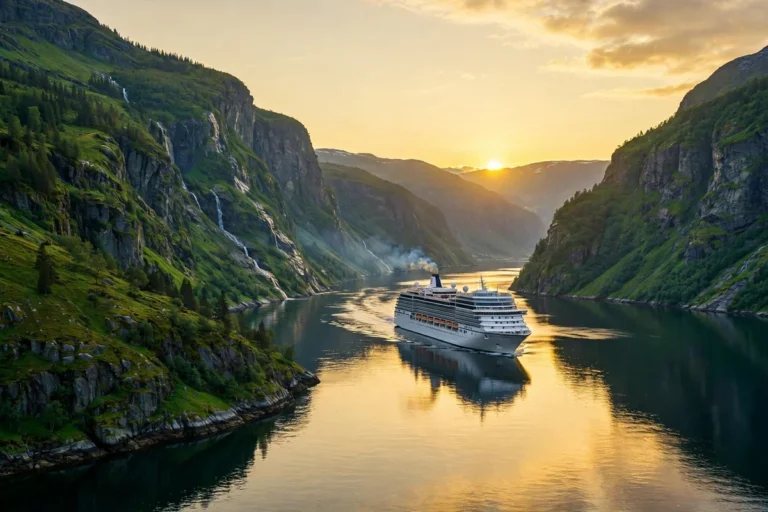
In summer, the big ships sail the classic western fjords, Bergen, Stavanger, Flåm, Geiranger, Ålesund and Olden, usually on 7 to 14 night round trips. P&O sails from Southampton from May to September, MSC Euribia runs weekly from Copenhagen and Kiel, and the coastal ships add a Geirangerfjord detour from June to August.
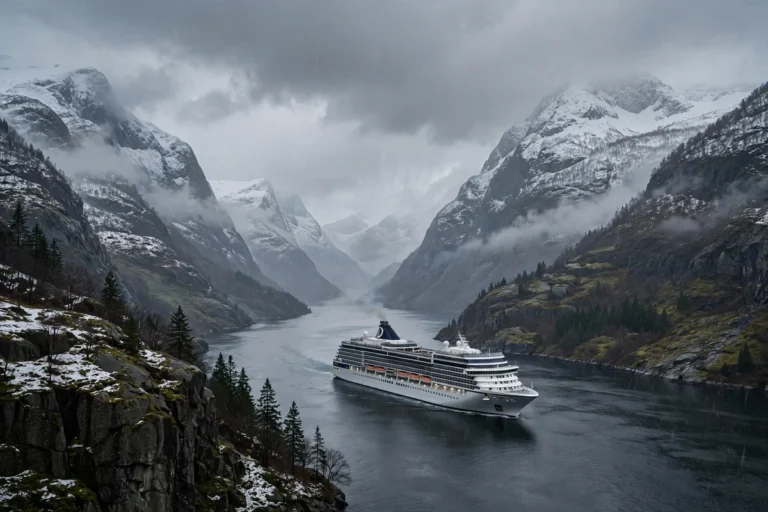
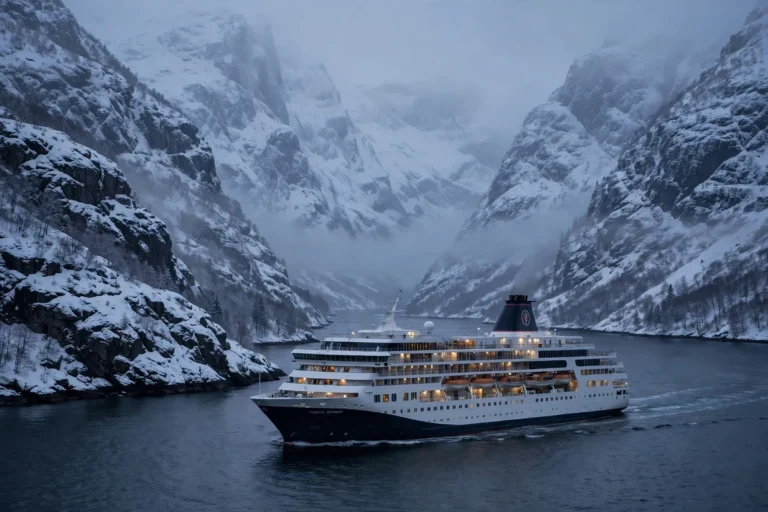
In winter, the big ships largely leave the fjords, and their place is taken by the coastal voyage and dedicated northern lights sailings to the far north. Hurtigruten and Havila sail Bergen to Kirkenes every day of the year, calling at 34 ports, and the route becomes a northern lights voyage in the dark months. The fjord detour changes too: in spring and autumn the coastal ships sail into Hjørundfjord instead of Geirangerfjord, visiting the village of Urke in the Sunnmøre Alps.
Geirangerfjord itself is a summer place for most travellers. The big cruise lines stop calling around the third week of September, the road over Trollstigen usually closes in the second half of October until May, and the Dalsnibba road closes earlier, generally in late September. If Geirangerfjord is the reason for your trip, go between late May and mid-September. If the northern lights are the reason, go north instead, and read our Tromsø northern lights guide before you book. One route works in both seasons: the Bergen to Kirkenes coastal express, the same 34 ports in July and in January.
What you can do in each season
Summer excursions are built around daylight, open water and snow-free trails. Hiking is the headline activity, from short viewpoint walks above Geiranger and Flåm to full-day routes in the Lofoten Islands; our best hikes guide covers the best routes from a cruise port. Kayaking and cycling run through the summer, and the Flåm Railway runs its full summer timetable. Whale watching near Tromsø is out of season in summer, as the herring move on to spawn and the whales move with them.
You can book the Bergen Mostraumen Fjord Cruise with Live Guide on Viator.
Winter excursions are built around snow and darkness. Dog sledding, snowshoeing, snowmobiling and cross-country skiing all run from the coastal ports in the north, and the ski and sail guide covers trips that pair a sailing with skiing ashore. The northern lights are the evening activity, usually on a chase tour from Tromsø, away from town lights. Whale watching is a winter activity in the north: Visit Tromsø gives the season as usually early November to late January, with orcas and humpbacks following the herring into the fjords around Skjervøy and Kvænangen. Sightings are never guaranteed.
You can book the Arctic All-in-One Night: Dog Sledding, Snowmobiling & Aurora on Viator.
Midnight sun vs northern lights: the headline draw
Every summer vs winter Norway cruise decision comes down to one question: which sky do you want?
The midnight sun is free, guaranteed and everywhere above the Arctic Circle in season. If you are in Tromsø between 20 May and 22 July, the sun does not set, and you need no tour, ticket or clear forecast to see it. What you get is time: hiking at 11 pm and a fjord cruise in golden light at midnight. The cost is sleep, so bring an eye mask: your cabin will be bright at 2 am.
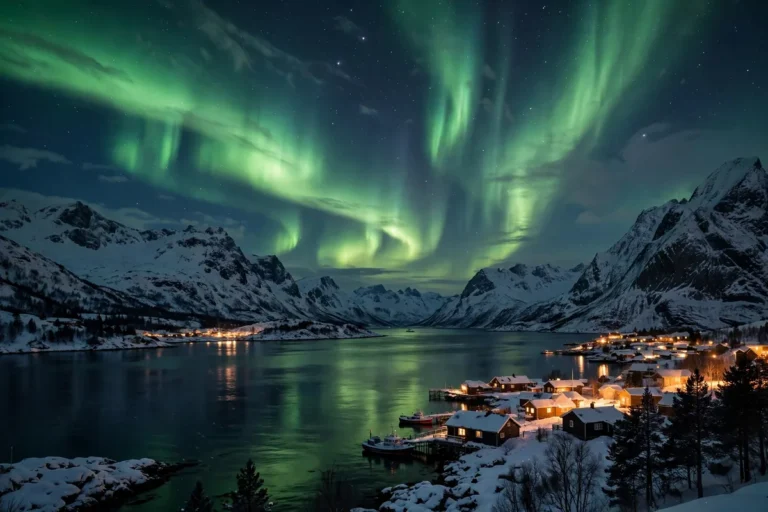
The northern lights are the opposite: free to look for, but never guaranteed, and only visible when the sky is dark and clear. Visit Tromsø gives the season as late August to early April, with organised tours usually running from September to early April and the lights most often active between about 20:00 and 02:00. The aurora is present all year, but in summer the sky never gets dark enough to see it, and cloud is the main obstacle. The Norwegian Centre for Space Weather at UiT in Tromsø notes that some aurora occurs above the city every other night on average, which describes activity, not what you will see through cloud. Give yourself at least three or four nights in the north, and treat any tour that promises a sighting with suspicion.
You can book the Tromsø Small Group Northern Lights Chase on Viator. You can book the Tromsø: Aurora Magic Northern Lights Tour with Photos on Viator.
Hurtigruten softens the risk with the Northern Lights Promise. On voyages of 11 days or more departing between 20 September and 31 March, if the lights are not officially sighted from the ship, you receive a complimentary 6 or 7 day Coastal Express voyage the following season, in an inside cabin with full board. The sighting is recorded by the ship’s deck officers, the ship’s decision is final, and the free voyage must be claimed within 28 days. Havila runs a similar promise on round voyages departing 1 October to 31 March.
Who each season suits
Summer suits first-timers, families, hikers, kayakers and photographers who want long days, green landscapes and a full excursion programme. It does not suit tight budgets or crowd-haters: July in Geiranger and Flåm is busy.
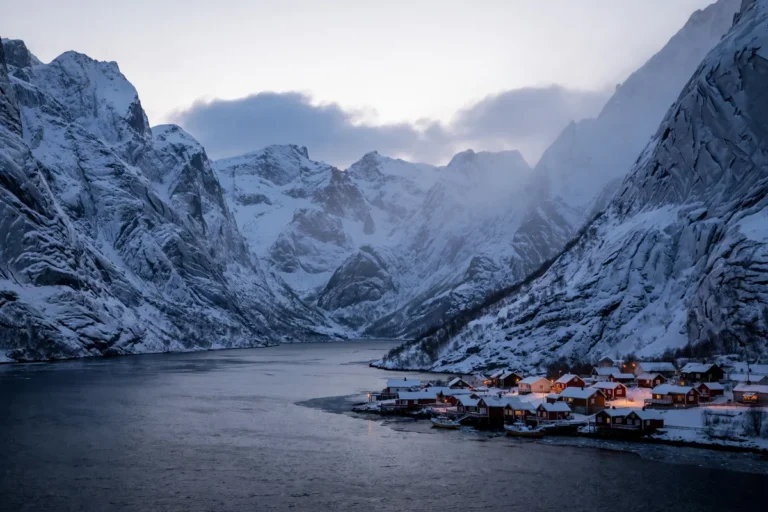
Winter suits aurora hunters, photographers who love low blue light, skiers, dog sledding fans and anyone who finds a snowy fjord more appealing than a green one. It suits people happy to plan around a short window of light and spend evenings looking at the sky. It does not suit anyone who wants to hike or see Geirangerfjord at its greenest, or travellers who struggle with cold or darkness. If you are unsure, ask yourself: 19 hours of daylight, or a chance of the northern lights? Your answer picks your season.
The shoulder seasons: May and September
May and September are the middle ground.
May gives you the start of the fjord season without the peak crowds. The waterfalls are at their strongest from snowmelt, the fruit trees in Hardangerfjord are in blossom from about mid-May, and the midnight sun starts in Tromsø on 20 May, though some high mountain roads may still be closed.
September gives you the end of the fjord season with autumn colour and the first northern lights. The boats still run full timetables into mid-month, the cruise ships thin out, hotel rates fall, and in the north the nights get dark enough for the aurora from late in the month. The coastal ships switch to Hjørundfjord, which is quieter than Geirangerfjord. The risk is rain, shorter days and the season winding down. A late September coastal voyage shows both faces of Norway at shoulder-season prices.
Summer vs winter at a glance
| Summer (June to August) | Winter (November to March) | |
|---|---|---|
| Headline draw | Midnight sun | Northern lights |
| Daylight in Tromsø | 24 hours, 20 May to 22 July | No sun 28 Nov to 14 Jan |
| Daylight in Bergen | About 19 hours in late June | About 6 hours in December |
| Tromsø mean temp | July 12.5 degrees | Jan minus 2.9, Feb minus 3.2 |
| Bergen mean temp | July 16.1 degrees | Jan 2.6, Feb 2.5 |
| Big-ship fjord cruises | Full season, May to Sep | Few or no sailings |
| Coastal voyage | Daily; Geirangerfjord Jun to Aug | Daily; Hjørundfjord spring and autumn |
| Excursions | Hiking, kayaking, cycling, swimming | Northern lights, dog sledding, skiing, whales |
| Prices | Highest, especially July | Lowest on coastal voyage; Tromsø hotels pricey |
| Crowds | Busiest, especially Geiranger and Flåm | Quietest, some places closed |
| Best for | First-timers, families, hikers | Aurora hunters, skiers, quiet-seekers |
Verdict
There is no single best season for a Norway cruise, only a best season for you. If you want the fjords at their greenest, the widest choice of ships and the longest days, go in summer, in June or September to dodge the worst crowds and prices. If you want the northern lights, snow and silence, go in winter, base yourself in the north and give yourself at least three or four nights.
If you can only take one Norway cruise, take it in summer: the fjords are the reason the country is famous, and summer shows them at their best, with every route open and every excursion running. Then, if the north calls you back, take the winter trip second, on the coastal voyage. For first-timers, our cruise tips for first timers and our Norway fjord cruises overview are the best place to start, and our sustainable cruising guide covers travelling lightly.
Frequently asked questions
Is a summer vs winter Norway cruise better for a first-time visitor?
For most first-time visitors, summer is the better choice. A summer vs winter Norway cruise comparison favours summer because every route is open, the days are long, the weather is mildest and the choice of ships is widest. Winter is better only if the northern lights are your main reason for going.
Can you see the northern lights on a summer Norway cruise?
No. The northern lights are present all year, but in summer the sky above the Arctic Circle never gets dark enough to see them. The season runs from late August to early April according to Visit Tromsø, so you need a sailing between late September and March, in the far north.
When is the midnight sun in Tromsø?
The full midnight sun in Tromsø runs from 20 May to 22 July, about nine weeks, according to the Norwegian Meteorological Institute through yr.no. Lofoten has a shorter window, roughly 28 May to 14 July, and south of the Arctic Circle there is no true midnight sun, though Bergen still gets around 19 hours of daylight at the end of June.
When is the polar night in Tromsø?
The sun sets for the last time on 27 November and does not rise again until 15 January, and the days with no sunrise at all run from 28 November to 14 January. Some sources give the polar night as 27 November to 15 January, counting from the last sunset to the first sunrise. It is not total darkness: there is blue twilight around midday.
Is a winter Norway cruise cheaper than a summer one?
Usually, yes, on the coastal voyage, where winter departures are the cheapest of the year. Most big-ship lines only sail the fjords from May to September, with no winter equivalent to compare. The exception is the far north, where Tromsø hotels and aurora tours are in high demand.
Can you cruise the Norwegian fjords in winter?
Yes, but not in the same way. The coastal voyage with Hurtigruten and Havila sails Bergen to Kirkenes every day of the year, calling at 34 ports, so the coastline is always reachable by sea. The big ships leave the fjords, the Geirangerfjord detour is replaced by Hjørundfjord in spring and autumn, and the excursion menu switches to northern lights tours, dog sledding, skiing and whale watching. If Geirangerfjord is your priority, go between late May and mid-September.

4 Comments