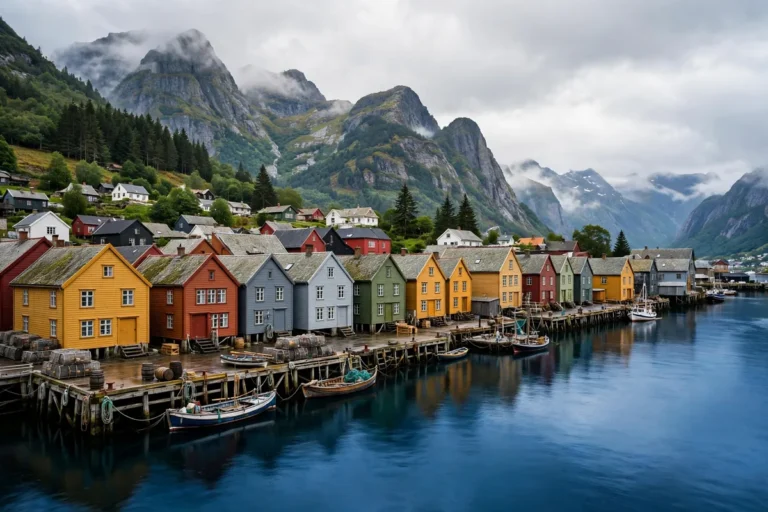
Stavanger Guide: Lysefjord, Pulpit Rock & Old Town
Stavanger is the odd one out among Norway’s fjord cities, and that is what makes it worth the trip. It is Norway’s oil capital, a compact harbour town on the south-west coast, and the base for two of the country’s most famous sights: the Lysefjord, a 42 km fjord with cliffs up to 1,000 metres high, and Preikestolen — Pulpit Rock — the flat-topped cliff 604 metres above the water that has become one of Norway’s most photographed places. The city itself is small, flat and easy to walk, with a white wooden old town, a 900-year-old cathedral and a harbour where the fjord boats leave from the same quays as the cruise ships.
Stavanger works differently from Bergen or Ålesund. The fjord here is reached by boat from the harbour, not by train, and the famous hike starts with a bus ride through a tunnel under the fjord. It is also the warmest and driest of the fjord cities, and the easiest to combine with a trip to southern Norway.
Why Stavanger works as a fjord base
Stavanger sits at the mouth of the Lysefjord, and the fjord is the reason most visitors come. Unlike the big western fjords, which need a train and a boat to reach, the Lysefjord starts almost at the city’s doorstep — the cruise boats leave from Strandkaien in the harbour and are under the cliffs within an hour. Preikestolen, the cliff above the fjord, is about an hour away by bus. That closeness makes Stavanger the most efficient fjord base in Norway for a short trip: you can see the fjord and climb the cliff in two days without a long journey to get there.
The city is also a proper base in its own right: hotels around the harbour, restaurants and cafés that stay open all year, an airport 20 to 30 minutes away, and a flat centre that is easy to walk. It feels like a town rather than a city, which suits a two- or three-day stay.
The main sights
Gamle Stavanger (Old Stavanger)
Gamle Stavanger is the old town on the western side of the harbour: about 170 white wooden houses along cobbled lanes, most of them built in the 1700s and 1800s when Stavanger was a herring and shipping town. It is free to wander, takes about an hour, and is quietest in the morning before the cruise-ship groups arrive. The houses are still lived in, so keep the noise down and the gardens are private — the charm is in the streets themselves, the window boxes and the view back across the harbour.
Stavanger Cathedral
Stavanger Cathedral (Stavanger domkirke) stands in the middle of the old town and is about 900 years old, the oldest cathedral in Norway still in use. It was built in stone from around 1125, and the interior mixes the original Romanesque stonework with later Gothic additions. It is a short visit — 20 minutes is enough — but it anchors the old town, and the small park around it is a good place to sit.
The Norwegian Petroleum Museum
The Norwegian Petroleum Museum (Norsk Oljemuseum) sits on the harbour at Kjeringholmen, a striking modern building that looks like an oil platform. It tells the story of Norway’s oil industry, from the first drilling in the North Sea to the present day, with interactive exhibits, a real drilling platform model and a film about life offshore. It is surprisingly engaging even if you have no interest in oil, and it explains the industry that built modern Stavanger. Allow two to three hours. It is open daily from 10:00 to 19:00 in summer (1 June to 31 August), and shorter hours the rest of the year. Adult admission is around NOK 150 — check the museum’s site for the current price.
Øvre Holmegate and the harbour
Øvre Holmegate, the colourful painted street above the harbour, is Stavanger’s best-known photo stop after the old town: a steep lane of houses painted in bright colours, with cafés and small shops. The harbour around Vågen is the centre of the city’s life — the fish market, the fjord boats, the cruise ships and the restaurants all sit within a few minutes of each other.
Sverd i fjell (Swords in Rock)
Sverd i fjell — three huge bronze swords stuck in the rock at Møllebukta, by the Hafrsfjord — marks the spot where King Harald Fairhair united Norway in 872. It is about a 30-minute bus ride from the centre (bus 16) and free to visit: a quick stop, but the fjord view is good.
The cruise port
Stavanger’s cruise ships dock in Vågen, the inner harbour, right in the centre of town. The main piers are Skagenkaien on the east side of the harbour and Strandkaien on the west side, with Skansekaien used when the others fill. You step off the ship and you are in the old town — the walk to Gamle Stavanger from Strandkaien takes about three minutes, and the cathedral is five minutes away. The Lysefjord cruise boats also leave from Strandkaien, so a cruise passenger can walk from the ship to the fjord boat in minutes.
Overflow ships use Børevigå, about a kilometre’s walk, or Mekjarvik, about 10 km away, where a shuttle runs. Tendering is rare.
Getting there and getting around
From the airport
Stavanger Airport Sola is about 15 km south of the city. The Flybussen airport express bus runs from the terminal to Fiskepiren in the centre in about 25 to 30 minutes, and a ticket costs around NOK 150 to 180. The local Kolumbus bus, route 42, takes 30 to 45 minutes and costs around NOK 45 for a single ticket in the city zone. A taxi takes 15 to 20 minutes and costs roughly NOK 400 to 600 — the driver must give you a fixed price before the journey.
By train, bus and boat
Stavanger Station is beside Breiavatnet lake, a flat five to 10 minute walk from the harbour. Trains run south to Kristiansand and east to Oslo. The Kystbussen from Bergen takes about four hours and 20 minutes on the fast service, crossing two fjords by ferry on the way, and the direct coach from Oslo takes about seven hours and 40 minutes. The bus terminal (Byterminalen) is next to the station.
Getting around the city
The centre is flat and compact, so walking covers almost everything — the old town, the cathedral, the harbour and the Petroleum Museum are all within 15 minutes of each other. Kolumbus buses cover the suburbs, the airport and the Sverd i fjell monument. A single Kolumbus ticket costs around NOK 45 in the city zone and is valid for 60 minutes; buy it in the Kolumbus app, because buying on board costs extra.
Fjord day trips from Stavanger
The Lysefjord cruise
The Lysefjord cruise is the easiest fjord trip in Norway. Rødne’s electric catamaran leaves from Strandkaien in the harbour and sails up the 42 km fjord to below Preikestolen and back in three to three and a half hours, passing the Hengjanefossen waterfall and the Vagabond’s Cave. The cliff rises 604 metres directly above the boat. An adult ticket costs around NOK 890 and a child ticket around NOK 445, and the cruise runs all year — in winter it sails Thursday to Sunday at 11:00, and daily from April. It does not land anywhere, so it is for seeing the cliff from below, not for standing on it.
Preikestolen (Pulpit Rock)
Preikestolen is the hike: an 8 km round trip, four to five hours, climbing about 350 metres to a flat plateau 604 metres above the Lysefjord, with no railings at the edge. The trail is free, open and unstaffed, and it starts at the Preikestolen Mountain Lodge, about three kilometres past Jørpeland. Getting there takes about 45 to 60 minutes by car through the Ryfylke Tunnel, or about an hour each way on the seasonal express bus from the bus terminal — the bus runs daily from about 1 May to 4 October, with a return ticket around NOK 550, and tickets are sold online in advance. Outside the bus season, and from November to April, you need winter equipment and a guide — the trail is not a winter walk without them. Note that the old Stavanger–Tau car ferry closed when the Ryfylke Tunnel opened on 30 December 2019, so older guidebooks that send you to the ferry are out of date.
Kjerag and the Lysefjord by car
Kjerag, the mountain at the end of the Lysefjord, is the harder hike: the Kjeragbolten boulder wedged between two cliffs is the goal, and the trail is steeper and longer than Preikestolen. It is a summer-only trip, best reached by car or an organised tour. The Lauvvik–Lysebotn car ferry runs the length of the fjord in about two and a half hours in summer.
The fjords further north, for comparison
Stavanger’s fjord is a different kind of fjord from the big western ones. The Sognefjord guide covers Norway’s longest fjord at about 205 km — a different scale from the Lysefjord’s 42 km — and the Geirangerfjord guide covers the narrow UNESCO fjord, 15 km long and about 260 m deep. Both are best reached from Bergen or Ålesund.
Where to stay
Stay around the harbour if you can. The hotels and guesthouses around Vågen put you within a few minutes of the old town, the fjord boats and the restaurants, and the area is lively in the evening. The streets around the cathedral and the bus terminal are a five-minute walk away and usually a little cheaper. Stavanger is small, so even a hotel a 15-minute walk from the harbour is still a good base.
How many days to allow
One day covers the old town, the cathedral, the Petroleum Museum and the harbour, and it is enough if you are passing through on a cruise. Two days is the sweet spot: a day for the city and a day for the Lysefjord cruise or the Preikestolen hike. Three days lets you do both the cruise and the hike. Do not try to do Preikestolen and the Lysefjord cruise on the same day — each one deserves its own day. If you are travelling on from Stavanger, the Norway in a Nutshell route between Bergen and Oslo is the classic way to see the western fjords.
What to skip
Skip the old Stavanger–Tau ferry route in any guidebook that still lists it — the ferry closed in 2019 and the tunnel replaced it. Skip trying to hike Preikestolen in winter without a guide; the trail is not a winter walk, and the bus does not run. Skip driving to the Preikestolen car park without checking the parking situation in summer — it fills up, and the car park fee is around NOK 275.
Best time to visit
May to September is the main season: the Preikestolen bus runs daily, the Lysefjord cruise sails daily, the days are long and the hiking trails are open. June and July are the busiest, and the Preikestolen trail can feel crowded by mid-morning — go early if you want the plateau to yourself. October to April is the low season: the fjord cruise still runs, but on a reduced winter timetable, the Preikestolen bus stops, and the trail needs winter equipment and a guide. Stavanger is the mildest of the fjord cities, with less rain than Bergen, so the shoulder seasons are more forgiving here.
Finding your way around
Key map links for arrival day:
- Skagenkaien — the main cruise pier, on the east side of Vågen
- Strandkaien — the Lysefjord cruise boats leave from here
- Stavanger Airport Sola — Flybussen to the centre, about 25 minutes
- Stavanger Station — trains and the bus terminal, by Breiavatnet lake
- Preikestolen — the trailhead is past Jørpeland, about an hour by bus
Fjord trips from Stavanger, compared
| Trip | How you get there | Time needed | Best for |
|---|---|---|---|
| Lysefjord cruise | Boat from Strandkaien | 3–3.5 hours | Seeing Preikestolen from below, no climbing |
| Preikestolen hike | Express bus + 8 km hike | Full day (7–8 hours) | Standing on the cliff itself |
| Kjerag hike | Car or summer bus | Full day | The boulder, for experienced hikers |
| Lauvvik–Lysebotn ferry | Car ferry the length of the fjord | About 2.5 hours one way | A slow, scenic fjord crossing |
| Sognefjord from Bergen | Train to Bergen, then fjord cruise | 2–3 days total | Norway’s biggest fjord, from the right base |
Frequently asked questions
Is Stavanger a good base for the fjords?
Yes — for the Lysefjord and Preikestolen, it is the only base that makes sense. The fjord cruise leaves from the harbour and the hike is an hour away by bus. For the big western fjords, Bergen or Ålesund are the right bases instead.
How do I get to Preikestolen from Stavanger?
Take the seasonal express bus from the bus terminal, about an hour each way, with a return ticket around NOK 550 — or drive through the Ryfylke Tunnel in 45 to 60 minutes. The hike itself is 8 km return and takes four to five hours.
Can I see Pulpit Rock without hiking?
Yes. The Lysefjord cruise from Strandkaien passes directly below the cliff, 604 metres above the boat, in three to three and a half hours. It runs all year, on a reduced winter timetable.
How far is the cruise port from the old town?
A few minutes. Ships dock at Skagenkaien or Strandkaien in Vågen, and Gamle Stavanger is about a three-minute walk from the gangway.
How many days should I spend in Stavanger?
Two days is the sweet spot: a day for the city and a day for the Lysefjord cruise or the Preikestolen hike. Three days lets you do both the cruise and the hike.