
Geirangerfjord Guide: How to Visit Norway’s Most Famous Fjord
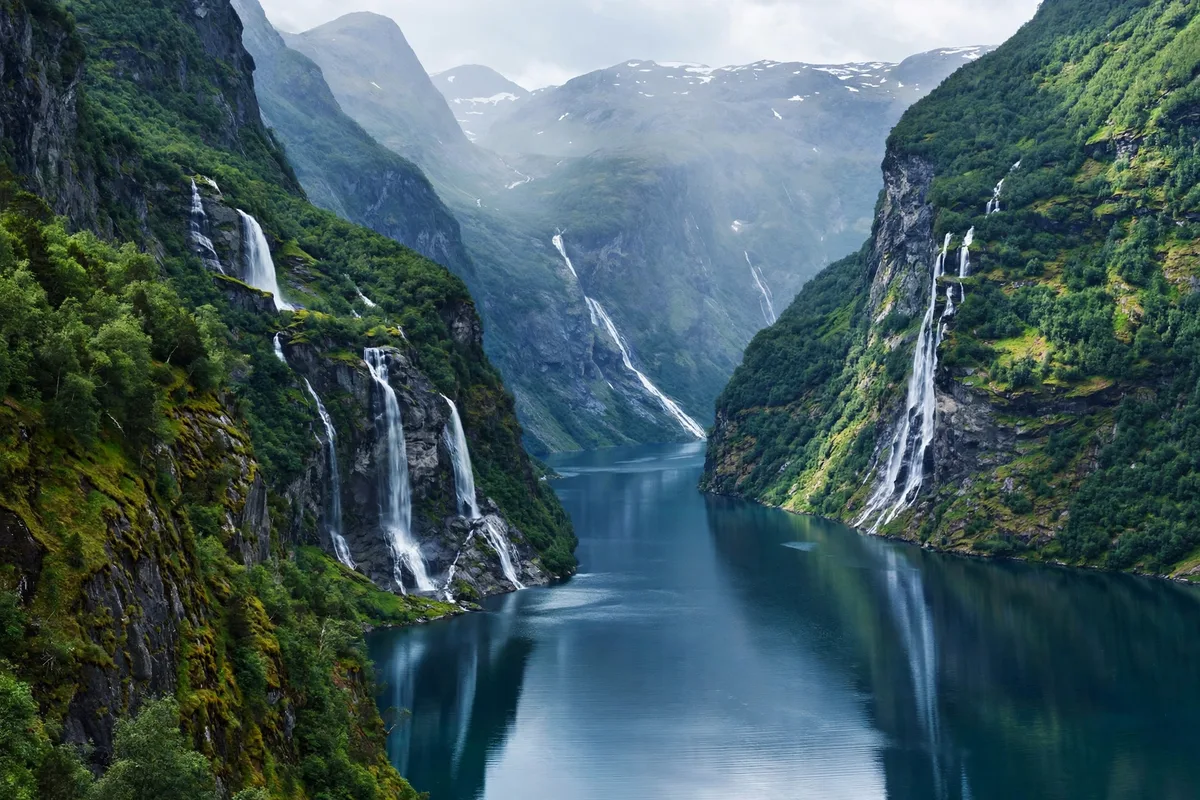
Geirangerfjord is the fjord most people picture when they think of Norway: a narrow strip of deep blue water between steep green walls, with waterfalls falling straight into it and a small village at its head. It is 15 km long, it has been on the UNESCO World Heritage List since 2005, and it is one of the most visited natural sites in the country.
It is also a small, seasonal place that rewards a bit of planning. The village has about 200 residents, the mountain roads close in winter, and on a summer day the crowds arrive all at once. This guide covers how to get there, what to see from the water and from above, what to do, when to go, and what it costs — so you can see the fjord properly instead of just passing through it.
What and where it is
Geirangerfjord is a branch of the Storfjord in western Norway, in Møre og Romsdal county. It runs 15 km from Hellesylt to the village of Geiranger at its eastern end, and it is about 260 m deep at its deepest. The fjord was inscribed on the UNESCO World Heritage List in 2005, together with the Nærøyfjord, as the West Norwegian Fjords. The listing covers those two fjord areas for their scenery and their record of glacial formation — not every fjord in Norway.
The waterfalls are what make it. The Seven Sisters fall in seven streams down the north wall, from a total height of 410 m, with the longest single drop about 250 m. Directly opposite, on the south wall, is the Suitor, a single broad fall. Further along the fjord is the Bridal Veil, a thin fall that catches the afternoon light. The old cliff farms are part of the picture too: Skageflå sits about 250 m above the water on the south side, and Knivsflå faces it beside the Seven Sisters. Both were farmed until the early 1900s and reached only by ladder from boats.
Sognefjord vs Geirangerfjord · Nærøyfjord guide
How to get there
There is no train to Geiranger, and the village is at the end of a mountain road. Most visitors arrive one of three ways.
By car from Ålesund. This is the usual route: 108 km, 2.5 to 3 hours including the Eidsdal–Linge ferry. Take the E136 out of Ålesund, then road 63 through Valldal to Eidsdal, the ferry across to Linge, and the Eagle Road — eleven hairpin bends with a 10% gradient — down into Geiranger. The Eagle Road stays open in winter, but the southern mountain road, over the pass from Stryn and Grotli, opens in May and closes in October. Fuel up in Ålesund: Geiranger has one fuel station, by the ferry quay.
By car ferry from Hellesylt. The ferry from Hellesylt sails the full length of the fjord into Geiranger, which makes the crossing itself the sightseeing. In summer there are eight departures a day from 1 June to 2 September, and four a day in May and September. The fare is about NOK 310 for a car and its driver, according to Wikivoyage. From Hellesylt, road 60 runs north to Ålesund or south to Stryn.
By cruise ship or Hurtigruten. Cruise ships call at Geiranger through the summer, and the village is one of Norway’s busiest cruise ports. Ships anchor in the fjord and tender passengers ashore. Hurtigruten calls at Geiranger on its summer service, roughly mid-April to mid-September, arriving in the afternoon and leaving about 45 minutes later, with passengers tendered ashore on a shuttle boat.
By bus, the connections are slow: Ålesund to Geiranger by bus takes 5.5 to 6 hours with changes, and the summer-only bus from Åndalsnes runs via Trollstigen. If you do not have a car, a coach tour from Ålesund or a cruise stop is the practical way in.
Bergen guide · Hjørundfjord guide
The viewpoints: seeing it from above
Three viewpoints give you three different versions of the fjord, and they are all on roads out of the village.
Flydalsjuvet is the closest, about 4 km from the village on the road towards Stryn. It hangs over the fjord with a straight-down view of Geiranger and the ships below, and it has the much-photographed rock ledge known as the Queen’s Chair. It is the easiest viewpoint to reach and the busiest.
Ørnesvingen, the Eagle Bend, is at 620 m on the Eagle Road, the highest of the road’s eleven hairpin bends. From here you look straight down the fjord towards the Seven Sisters on one side and the Suitor on the other, with the whole width of the fjord in one frame. It is on the road to Eidsdal, so you pass it on the way in or out if you drive from Ålesund.
Dalsnibba is the big one: 1,476 m above sea level, with a glass-floored skywalk that looks out over the fjord, the village and the mountains behind. It is the highest fjord viewpoint in Europe you can drive to. The road up is a narrow toll road, it opens in May depending on the weather, and it is closed in winter. On a clear day it is the best view in the area; when cloud sits on the mountain, the stop is often substituted on coach tours, so check the weather before you drive up.
Go early or late. The viewpoints are quiet before 10:00 and after 15:00, when the cruise passengers and coach tours have left. The light is also better then — the fjord runs roughly east–west, so the morning light favours the south wall and the afternoon light favours the north.
On the water: cruises, RIBs and kayaks
The fjord is best seen from the water, because the waterfalls and the cliff farms face the boats, not the roads.
The local sightseeing boats run from Geiranger village. The classic option is a 75-minute cruise on a smaller boat; the longer option is a 2-hour silent cruise on a hybrid-electric catamaran, new for 2026 and built for the fjord’s zero-emission rules. The longer cruise costs from about NOK 660, and runs from 1 June to 30 September. Fjord Tours lists a Geirangerfjord sightseeing cruise from NOK 695, running 19 May to 30 September. Both pass the Seven Sisters, the Suitor and the Bridal Veil, and the longer cruise covers the full length of the fjord.
A 2.5-hour round trip from Geiranger sails the fjord’s full length to Hellesylt and back, with an hour on your own in Hellesylt. RIB safaris run about 75 minutes with small groups, and get you closer to the waterfalls than the big boats do. Guided kayak tours run about 3 hours from the activity centre below the Grande Fjord Hotel, with dry suits when needed.
Since 1 January 2026, passenger ships under 10,000 gross tonnes must operate without direct carbon dioxide or methane emissions in the World Heritage fjords, including Geirangerfjord. Larger ships have until 1 January 2032. The sightseeing boats in Geiranger are now electric or hybrid, and they are noticeably quieter than the diesel boats they replaced. Big cruise ships can still call for now.
Norway in a Nutshell worth it?
On land: hikes and the village
The walks around Geiranger are short and steep, and they are the best way to get away from the village crowds.
The hike to Skageflå, the old cliff farm 250 m above the fjord, starts from a boat drop-off below the farm — the sightseeing boats will put you ashore there. It is the most rewarding walk in the area, and the farm itself is a small piece of fjord history. The Storseterfossen waterfall walk climbs from the village past a waterfall you can walk behind, and takes about 4 km return. The Flydalsjuvet viewpoint is also walkable from the village, though most people drive it.
Geiranger village itself is small: a harbour, a handful of hotels and restaurants, the Norwegian Fjord Centre — the visitor centre for the World Heritage site, which explains the geology of the fjord and the history of the farms — and the Geiranger church. There is one fuel station and a small supermarket. Most of the village’s services are seasonal, and accommodation is limited, so book ahead if you plan to stay overnight.
Best time to go
The season runs from May to September. The waterfalls are at their strongest in May and June, when the snow is melting, and the Seven Sisters are at their fullest then. July and August are the warmest months, with the most departures and the most people — the village has no bypass road, and most visitors arrive between 10:00 and 15:00 in July. September is the best compromise: the crowds thin, the light is lower and warmer, and the roads and boats are still running.
In winter, Geirangerfjord is a different place and a harder trip. The southern mountain road closes in October, the sightseeing boats stop, and the village is reachable only by ferry, with very little open. The fjord is still there, and it is quiet, but it is not a trip to plan casually. If you are travelling between November and April, the Sognefjord area — where the Flåm Railway runs every day, all year — is the more practical choice.
Where to stay and practical tips
Stay in Geiranger if you can get a room. The fjord empties of day-trippers in the evening, and the village is a different place after the last coach leaves. If Geiranger is full, Ålesund is the next best base — it is a proper town with hotels, restaurants and an airport, 2.5 to 3 hours away by car — and Hellesylt and Stryn are closer, smaller alternatives.
A few practical points: book the sightseeing cruise in advance in July and August, because the popular departures sell out; bring layers, because Dalsnibba at 1,476 m is much colder and windier than the village; use low gear on the Eagle Road descent, which has a 10% gradient; and check the road status on the morning you drive, because the mountain roads can close in bad weather even in season.
FAQ
How long do I need in Geirangerfjord?
Half a day is enough to see the fjord from a boat and one viewpoint. A full day lets you do the cruise, two viewpoints and a hike. Two days — one night in the village — is the version worth planning, because the evening and the early morning are when the place is at its best.
Can I visit Geirangerfjord in winter?
You can, but it is a different trip. The mountain road closes, the sightseeing boats stop, and the village is reachable only by ferry, with limited accommodation and services. The fjord is quiet and the snow is striking, but do not plan a winter visit the way you would plan a summer one.
Is Geirangerfjord better than the Nærøyfjord?
They are the two UNESCO fjords, and they are listed together for a reason. Geirangerfjord is wider, with more waterfalls and more viewpoints. The Nærøyfjord is narrower and steeper, and you see it from a boat on the way to Flåm. If you have time for one, Geirangerfjord is the more complete visit; if you are travelling from Bergen, the Nærøyfjord is far easier to reach.
Do I need to book the sightseeing cruise in advance?
In July and August, yes — the popular departures sell out. In May, June and September you can usually buy a ticket at the tourist information office in the village, but booking ahead costs nothing and removes the risk.
Are big cruise ships still allowed in Geirangerfjord?
Yes, for now. The zero-emission rule that started on 1 January 2026 applies to passenger ships under 10,000 gross tonnes; larger ships have until 1 January 2032. The small sightseeing boats are already electric or hybrid.


One Comment