
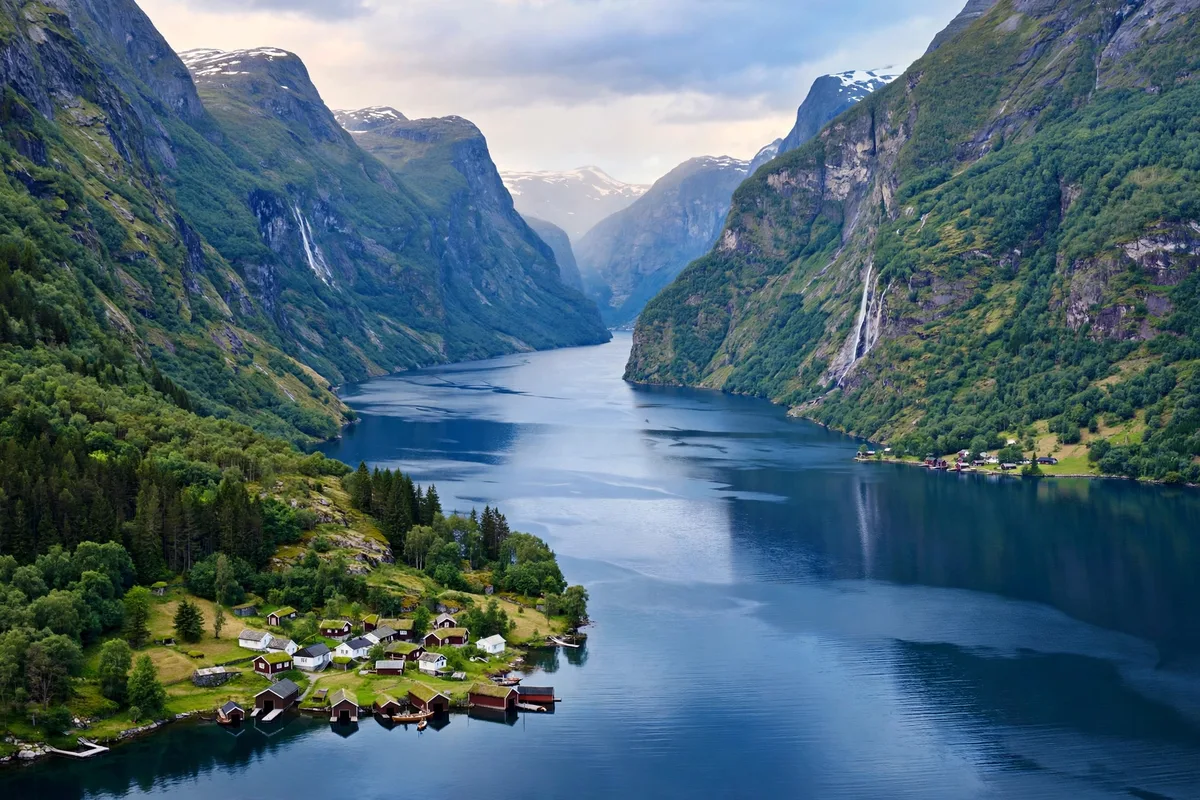
Sognefjord Guide: How to Visit Norway’s Longest Fjord
Sognefjord is Norway’s longest and deepest fjord: about 205 km from the coast to the village of Skjolden, and up to 1,308 m deep. Norwegians call it the King of the Fjords, and the nickname fits — no other fjord in the country comes close on either measurement, and it is the second-longest fjord in the world after Scoresby Sund in Greenland.
It is also the most varied fjord to plan a trip around. The main fjord splits into arms that feel like different places: the narrow, UNESCO-listed Nærøyfjord; the Aurlandsfjord, where Flåm and the Flåm Railway sit; the quiet Lustrafjord, with its green glacier water and the oldest stave church in Norway; and the Fjærlandsfjord, which ends at a book town under a glacier. This guide covers how to get there, the best ways to see it, the villages and viewpoints worth your time, when to go, and what it costs.
What and where it is
Sognefjord runs through Vestland county in western Norway, from the coast near Solund, north of Bergen, inland to Skjolden at the foot of the Jotunheimen mountains. It is about 205 km long and 1,308 m deep at its deepest, in the central part of the main fjord near Høyanger. For about 100 km of its length, from Rutledal to Hermansverk, the water is more than 1,000 m deep.
The fjord is not one straight inlet. It branches into arms, and the sights sit on different arms, so a good plan starts with the map rather than with a single village. The main arms are:
- Aurlandsfjord (29 km) — the arm that ends at Flåm and Aurland, and the start of the Flåm Railway.
- Nærøyfjord (about 18 km) — the narrow UNESCO-listed arm between Flåm and Gudvangen.
- Lustrafjord — the innermost arm, running to Skjolden, with Urnes Stave Church on its eastern shore.
- Fjærlandsfjord — the arm to Fjærland, the book town, under the Jostedalsbreen glacier.
- Lærdalsfjord, Sogndalsfjord and Årdalsfjord — shorter arms to Lærdal, Sogndal and Årdal.
Only the Nærøyfjord part of the area is a UNESCO World Heritage site, listed in 2005 together with Geirangerfjord as the West Norwegian Fjords. The Sognefjord as a whole is not listed — a detail worth knowing, because some guides blur the two.
Sognefjord vs Geirangerfjord · Geirangerfjord guide
How to get there
Most visitors start in Bergen, about 170 km from Flåm by road. There is no single best way in — it depends on whether you have a car, how much time you have, and which arm you want to see first.
By train, then the Flåm Railway. From Bergen, take the Bergen Railway to Myrdal (about 2.5 hours), then change to the Flåm Railway down to Flåm (about 55 minutes). The same line works from Oslo: Oslo to Myrdal is about 4 to 5 hours, then the Flåm Railway down. This is the most reliable car-free route, and it runs every day, all year.
By express boat from Bergen. Norled runs a passenger express boat along the main fjord. From 1 April to 31 October it sails daily between Bergen and Flåm, calling at villages including Vik, Balestrand, Leikanger and Aurland — roughly 5.5 hours end to end. From 1 November to 31 March the winter route runs daily between Bergen and Sogndal instead. The boat is the only way to reach several villages without a car, and it makes car-free village-hopping practical in summer.
By car. Bergen to Flåm by car takes about 2.5 hours via Voss. From Oslo, allow 4 to 5 hours. A car gives you the viewpoints and the side arms — Stegastein, the Aurlandsfjellet road, the Lustrafjord — that the boats and trains do not reach. It also means ferry crossings and narrow mountain roads, so check road conditions before you set out, especially outside summer.
By bus. Buses connect Bergen with Sogndal, Flåm and other Sognefjord destinations, with journeys of about 4 to 5 hours. Slower than the train or the boat, but useful for villages the boat does not serve.
Norway in a Nutshell worth it?
Ways to see the fjord, compared
Sognefjord is too big to see in one way. The table below compares the main options — most visitors combine two of them.
| Way to see it | What you get | Time | Best for |
|---|---|---|---|
| Nærøyfjord cruise, Flåm–Gudvangen | The narrow UNESCO arm, cliffs and waterfalls from the water | About 2 hours one way | First-time visitors; the classic fjord experience |
| Norled express boat, Bergen–Flåm | The main fjord end to end, village stops along the way | About 5.5 hours | Car-free travellers; slow travel with village stops |
| Flåm Railway, Myrdal–Flåm | 20 km of mountain railway, 865 m of descent, waterfalls | About 55 minutes | Rail travellers; pairing with the boat |
| Car, Aurlandsfjellet and Lustrafjord | Stegastein, the Snow Road, stave churches, glacier views | A full day or more | Viewpoints and side arms the boats miss |
| Kayak or RIB from Flåm | The Aurlandsfjord and Nærøyfjord at water level, close to the cliffs | 2–3 hours | Active travellers in summer |
Flåm and the Flåm Railway
Flåm sits at the inner end of the Aurlandsfjord, and it is where most visitors change between the railway and the boat. The village itself is small — a harbour, a railway station, a few hotels and cafes — and it exists largely to serve travellers. That is not a criticism: it makes Flåm the most practical base in the area, with the most departures and the most connections.
The Flåm Railway runs 20 km from Flåm up to Myrdal, climbing 865 m in about 55 minutes. It has run since 1940, and it is one of the steepest standard-gauge railways in the world. The line passes the Kjosfossen waterfall, where the train stops for photos in summer, and the views open out over the Flåm valley as you climb. A single ticket costs from NOK 399, up to about NOK 510 in summer, according to Vy. Book ahead in July and August — the popular departures sell out.
From Flåm, the Nærøyfjord cruise runs through the Aurlandsfjord and the narrow Nærøyfjord to Gudvangen, about 2 hours one way, and it runs in both directions. The fare is roughly NOK 520–595 one way, according to secondary sources — the operator uses dynamic pricing and does not publish a fixed fare, so treat that range as indicative and check the booking page for your date. The boats on this route are electric, and since 1 January 2026 passenger ships under 10,000 gross tonnes must operate without direct carbon dioxide or methane emissions in the World Heritage fjords, which include the Nærøyfjord.
Viewpoints and hikes
The best views of the Sognefjord are from above it, and the area has three that stand out.
Stegastein is the famous one: a 30-metre wooden platform that juts out over the Aurlandsfjord, 650 m above the water. It is about 30 minutes by car from Flåm, up a narrow road with hairpin bends from Aurland. The platform is part of the Aurlandsfjellet National Tourist Route, a 47 km road between Aurland and Lærdal. The road from Aurland up to Stegastein is open all year, but in winter it is closed beyond the viewpoint towards Lærdal. Go early or late in the day — the platform is small and the coach tours arrive in the middle of the day.
Molden is the hike. The summit is 1,116 m above sea level, above the Lustrafjord, and the walk takes about 4 hours return. From the top you look down the Lustrafjord in both directions, with the fjord arms and the mountains behind them. It is a proper mountain walk, not a stroll — bring boots, water and layers, and check the weather before you go.
Aurlandsdalen is the valley walk behind Aurland, sometimes called Norway’s Grand Canyon. It is a long day stage through a steep valley with waterfalls and old farms, and it is best walked in summer when the higher ground is snow-free. The valley is also a reminder that the fjord country was walked before it was driven: the old paths between the farms are still there.
For drivers, the Aurlandsfjellet road itself — the Snow Road, or Snøvegen — is worth the drive. It climbs from Aurland at sea level to 1,286 m in 17 km, then crosses an open high-mountain plateau to Lærdal. The road is usually open from June to October, depending on snow.
Villages and stops along the fjord
Aurland is ten minutes from Flåm and much quieter. It is the access point for the Stegastein viewpoint and the Aurlandsdalen valley, and it has a historic stone church and a handful of local food producers. If Flåm feels too busy, stay in Aurland instead.
Gudvangen sits at the inner end of the Nærøyfjord, where the boat from Flåm arrives. It is a small village with a Viking settlement, Njardarheimr, where craftspeople demonstrate Viking-age skills. From Gudvangen, buses run to Voss, where you can catch the train to Bergen.
Balestrand is the fjord’s artists’ village, a tourism destination since the 1800s. It has traditional wooden architecture, the historic Kviknes Hotel (established 1877), St Olaf’s English church, and art galleries. The express boat stops here year-round, and the village has a self-guided Culture Trail of about two miles. It is the best base on the main fjord if you want somewhere to stay that is not Flåm.
Vik is a quieter stop on the main fjord, worth a stop for the Hopperstad Stave Church, one of the oldest stave churches in Norway, built in the 1100s.
Sogndal is the largest town in the region, with about 8,000 residents, an airport with Oslo connections, and rental cars. It is the practical base for the Lustrafjord, Urnes and the Nigardsbreen glacier, rather than a destination in itself.
Fjærland, at the head of the Fjærlandsfjord, is the Norwegian Book Town: secondhand bookshops occupy converted barns and boathouses along the fjordfront in summer. The village also hosts the Norwegian Glacier Museum, and two arms of the Jostedalsbreen glacier — Bøyabreen and Supphellebreen — are visible from the valley. In summer you can arrive by boat from Balestrand.
The stave churches
The Sognefjord area holds two of Norway’s most important stave churches, and they are worth a detour.
Urnes Stave Church, on the eastern shore of the Lustrafjord at Ornes, is Norway’s oldest, built around 1130. It has been a UNESCO World Heritage Site since 1979 — a separate listing from the fjords themselves. The church is reached by a short ferry crossing from Solvorn, and it is open to visitors in summer.
Borgund Stave Church, near Lærdal, was built around 1180 and is Norway’s best-preserved stave church, with its original multi-tiered roof and dragon-head carvings. It sits beside the old King’s Road between east and west Norway, and it is the most visited stave church in the country.
Glaciers: Jostedalsbreen and Nigardsbreen
The Sognefjord reaches the edge of Jostedalsbreen, mainland Europe’s largest glacier, at about 474 square kilometres. Its most accessible arm is Nigardsbreen, near the village of Jostedal, where guided glacier walks run in summer. The walks take about 3 hours on the ice, with crampons and a guide provided. Book ahead in summer, and do not walk on a glacier without a guide — the ice is crevassed and the conditions change.
From Fjærland, the Bøyabreen glacier tongue is visible from the road, and short walks lead to viewpoints over it. The Norwegian Glacier Museum in Fjærland explains the ice and the landscape it carved, and it is a good stop on a wet day.
Best time to go
May to September is the season. May and June bring the strongest waterfalls, as the snow melts, and the light is at its best. July and August are the warmest months, with the most departures on the boats and the railway — and the most people, especially in Flåm. September is the best compromise: the crowds thin, the light is lower, and the boats, trains and roads are still running.
In winter, the Sognefjord is more practical than Geirangerfjord. The Flåm Railway runs every day, all year, the express boat runs to Sogndal, and the Nærøyfjord boat runs on a winter timetable with two departures a day from Flåm. The villages are quiet and some services close, but the fjord itself is still there, and the snow on the mountains makes the views sharper. If you are travelling between November and April, this is the fjord to choose.
What it costs
Sognefjord is not a cheap destination, but the costs are mostly transport, and they are easy to plan for. The figures below are 2026 prices from the sources noted — check the operator’s booking page for your date.
- Flåm Railway, one way: from NOK 399, up to about NOK 510 in summer (Vy).
- Nærøyfjord cruise, Flåm–Gudvangen, one way: roughly NOK 520–595 (secondary sources; the operator uses dynamic pricing and does not publish a fixed fare).
- Norway in a Nutshell package, adult: from NOK 2,698 (Fjord Tours).
- Glacier walk on Nigardsbreen: no price verified for this draft — check the operator’s page before publishing a figure.
Accommodation in Flåm and Balestrand is the other big cost, and it varies widely by season. Book early for July and August. Food is expensive by most visitors’ standards; self-catering accommodation and a supermarket stop in Sogndal or Voss help.
What to skip
Do not try to see the whole fjord in one day. It is 205 km long, the arms are separate, and the driving is slow. Pick one arm — the Aurlandsfjord and Nærøyfjord around Flåm, or the Lustrafjord and the glacier country around Sogndal — and give it two days.
Do not drive the Aurlandsfjellet road in bad weather, and do not assume it is open outside June to October. Check the road status on the morning you drive.
And do not book the Flåm Railway and the Nærøyfjord boat back-to-back with no slack. The railway is usually on time, but a missed connection means a long wait in Flåm, and the last boat of the day does not wait.
FAQ
How long do I need at Sognefjord?
Two days is the minimum for one arm done properly — a day for the Flåm Railway and the Nærøyfjord cruise, and a day for Stegastein and Aurland, or for the Lustrafjord and Urnes. Three to four days lets you add Balestrand, the glacier walk and Fjærland without rushing.
Is Sognefjord better than Geirangerfjord?
They are different trips. Sognefjord is bigger, quieter and easier to reach without a car, and it works in winter. Geirangerfjord is narrower, more dramatic in a single view, and more seasonal. If you have a week, do both; if you have a long weekend from Bergen, Sognefjord is the easier choice.
Can I visit Sognefjord without a car?
Yes — more easily than almost any other fjord in Norway. The train to Myrdal, the Flåm Railway, the Nærøyfjord boat and the Norled express boat connect Bergen, Flåm, Gudvangen, Balestrand and Sogndal without a car. A car only becomes necessary for Stegastein, the Aurlandsfjellet road and the Lustrafjord villages.
Is the Nærøyfjord part of Sognefjord?
Yes. The Nærøyfjord is an arm of the Sognefjord system, about 18 km long, and it is the part that carries the UNESCO World Heritage listing, together with Geirangerfjord. The Sognefjord as a whole is not UNESCO-listed.
Can I visit Sognefjord in winter?
Yes. The Flåm Railway runs every day, the express boat runs to Sogndal, and the Nærøyfjord boat runs on a winter timetable. Some villages and attractions close, and the mountain roads may be shut, but the fjord is still open and the crowds are gone.


2 Comments