
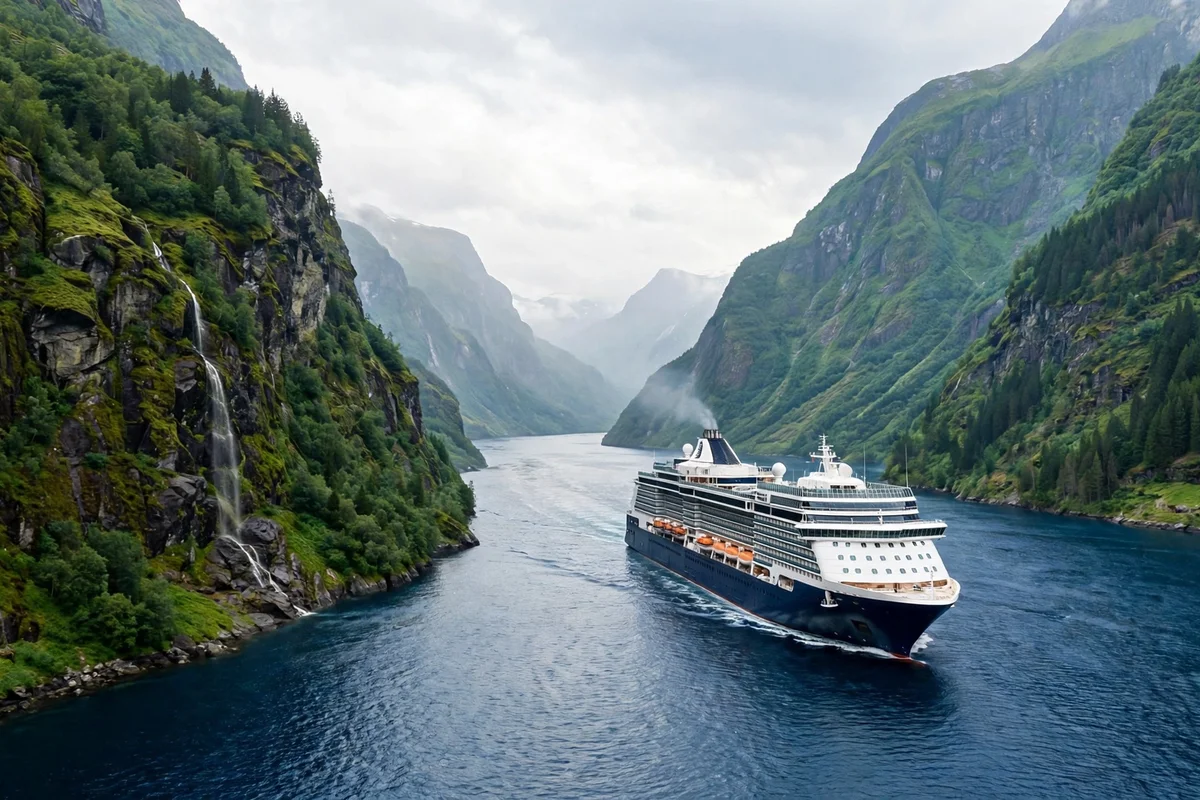
Norway Fjord Cruises: The Complete Guide 2026
A Norway fjord cruise is the easiest way to see the fjords properly. You unpack once, the ship carries you from one fjord to the next, and you wake up each morning somewhere new: a city quay, a village at the head of a fjord, or a stretch of open water beneath a cliff. No driving, no packing and unpacking, no working out the ferry timetable.
There are two kinds of trip, and they suit different travellers. The big-ship round trip sails from Southampton or another northern European port, visits three to five ports in a week, and comes back to where it started. The coastal voyage sails the length of the Norwegian coast from Bergen to Kirkenes and back, calling at more than 30 ports, and works as a working ship as much as a cruise. Day boats cover the third option: a few hours on one fjord, from Bergen, Flåm or Geiranger, without sleeping on board.
This guide covers all three. It explains the fjords, the ships, the ports, the lengths, the seasons, the costs and the 2026 rules, and it links to every guide on this site, so you can go deeper on any part of the trip.
The fjords, first
Norway has more than 1,000 fjords, but a cruise visits a small number of them, and the ones that matter are easy to learn. Start with these eight.
The Sognefjord is the longest and deepest fjord in Norway: about 205 km long and 1,308 m deep. It is the fjord the Flåm Railway and the Nærøyfjord branch off from, and the one most big-ship routes sail into. The Sognefjord guide covers it in full.
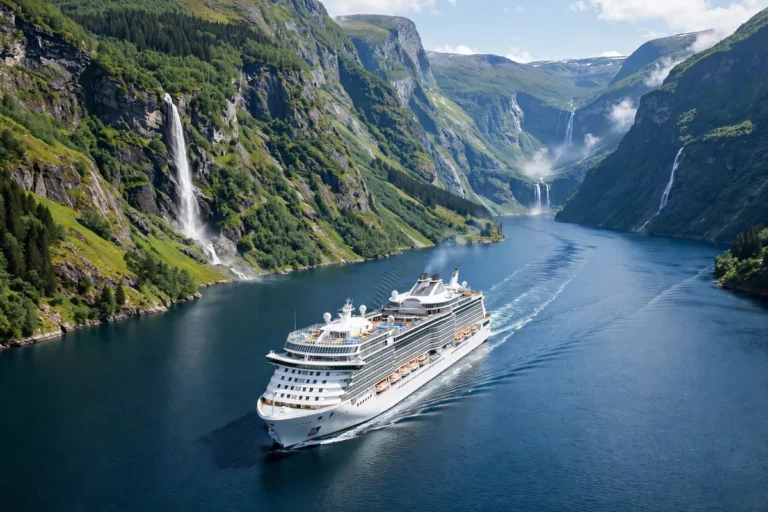
The Geirangerfjord is the most famous fjord in Norway, and the shortest on this list at 15 km. It is a UNESCO World Heritage fjord, with the Seven Sisters waterfall and the fjord farms on the cliffs above the water. The Geirangerfjord guide covers it in full, and the Sognefjord vs Geirangerfjord comparison sets the two against each other.
The Hardangerfjord is the fruit fjord, 179 km of orchards, waterfalls and the Hardanger Bridge, with the Hardanger Fruit and Cider Route running through the villages of Ulvik and Lofthus in May and September. The Hardangerfjord guide covers it in full.
The Nærøyfjord is the narrowest fjord in Norway, about 18 km long, with cliffs rising 1,400 m from water that is in places less than 250 m wide. The Flåm to Gudvangen boat runs through it all year, now on silent electric vessels. The Nærøyfjord guide covers it in full.
The Hjørundfjord is the quiet one, about 35 km of steep mountains and small villages, reached from Ålesund by the MS Bruvik day cruise. The Hjørundfjord guide covers it in full.
The Aurlandsfjord is the 29 km arm of the Sognefjord that ends at Flåm, up to 962 m deep, and the one the Flåm Railway climbs out of. The Aurlandsfjord guide covers it in full.
The Lustrafjord is the innermost arm of the Sognefjord, about 40 km, with the Urnes Stave Church and the Nigardsbreen glacier at its head. The Lustrafjord guide covers it in full.
The Lysefjord is the 42 km fjord south of Stavanger, with Preikestolen, the 604 m cliff, above it. The Lysefjord and Preikestolen guide covers the fjord and the hike in full.
Two facts matter for choosing a cruise. First, the fjords are not all the same: the southern fjords are green and settled, with farms and villages along the water, while the northern fjords are starker, with bare rock and fewer people. Second, not every ship visits every fjord: Geiranger and Flåm rarely appear on the same 7-night sailing, so check the port list before you book, not after.
The two ways to cruise
The big-ship round trip is the trip most people mean by a Norway fjord cruise. You board in Southampton, Dover or another northern European port, spend two days crossing the North Sea, visit three to five ports in four or five days, and sail home. The ships are large resort ships, P&O’s Iona, MSC Virtuosa, Cunard’s Queen Anne and the rest, with restaurants, shows, pools and cabins from inside to suite. The best fjord cruise guide compares the trip types in full.
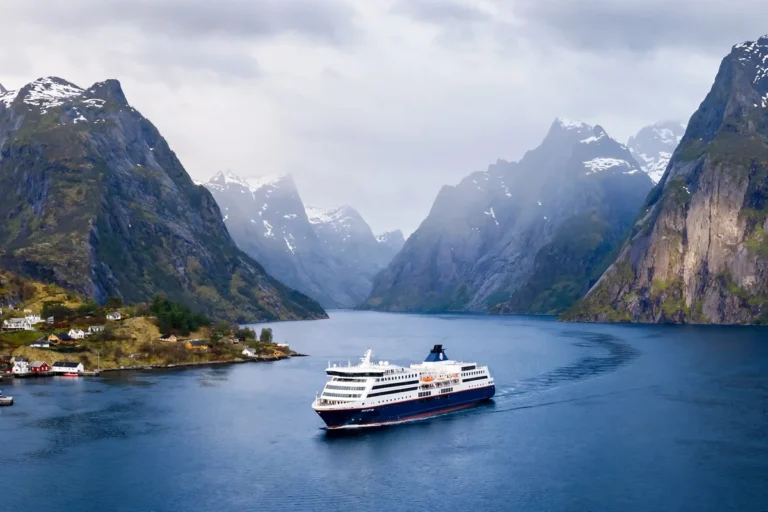
The coastal voyage is a different kind of trip. Hurtigruten and Havila run the Bergen to Kirkenes route, 12 days round trip, calling at more than 30 ports along the whole Norwegian coast. The ships are smaller, the pace is daily port calls, and the trip works as a coastal ferry as well as a cruise: locals board with cars and cargo, and the ship keeps to a timetable whatever the weather. There are no sea days, and the fjords come to you one at a time, day after day.
The day boats are the third option. From Bergen, the Mostraumen cruise runs about three and a half hours into the Osterfjord. From Flåm, the boat runs through the Nærøyfjord to Gudvangen. From Geiranger, the sightseeing boat runs the length of the Geirangerfjord in about 75 minutes. Day boats suit travellers who are already in Norway and want one fjord, not a week of them.
Big ship, coastal voyage or day boat, compared
| Big-ship round trip | Coastal voyage | Day boat | |
|---|---|---|---|
| How it works | Board in the UK or northern Europe, sail to Norway and back | Bergen to Kirkenes and back in 12 days, along the whole coast | A few hours on one fjord, from a town or village |
| Ports | 3 to 5, in 4 to 5 port days | More than 30, almost every day | 1 fjord, no overnight |
| Sea days | 3 on a 7-night sailing | None | None |
| Arctic | Only on 14-night sailings | Yes, Tromsø, Lofoten and the North Cape | No |
| Inside cabin from | Around £500 to £750 for 7 nights | Around $1,900 to $2,700 for 12 days, before flights | From around NOK 600 for a sightseeing boat |
| Best for | First-timers, families, no-fly holidays | Travellers who want the whole coast, and the Arctic | Travellers already in Norway, or short on time |
The ports
Bergen is the gateway city of the fjords, and the port most 7-night sailings call at. The ship docks close to the centre, Bryggen, the UNESCO-listed wooden wharf, is a short walk from the quay, and the Fløibanen funicular climbs Mount Fløyen for the view over the city and the fjord. The Bergen guide covers the city in full.
Stavanger is the usual first or last port on the southern routes, and the easiest Norwegian city to enjoy from a cruise ship. The quay is in the centre, the old town of Gamle Stavanger is a few minutes’ walk away, and the Lysefjord cruise sails beneath Preikestolen. The Stavanger guide covers the city in full.
Ålesund is the Art Nouveau town beneath the Sunnmøre Alps, on the routes that go furthest north in a week. The town centre is a short walk from the quay, and the climb up the 418 steps to the Aksla viewpoint is the thing to do. The Ålesund guide covers the town in full.
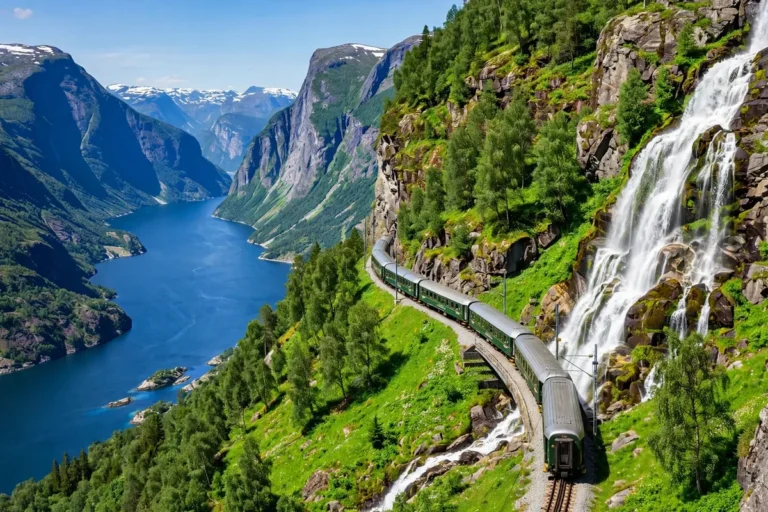
Flåm is the smallest port on the route and the most popular. The village sits at the head of the Aurlandsfjord, and the ship docks beside the railway station. The Flåm Railway climbs 20 km up the valley to Myrdal, about an hour each way, from NOK 399 for an adult single, with a five-minute stop at the Kjosfossen waterfall. The Flåm Railway guide covers the train in full.
Geiranger is the fjord most passengers remember. The ship sails the full 15 km length of the Geirangerfjord to the village, past the Seven Sisters waterfall. The excursions are the Dalsnibba viewpoint, high above the fjord, and the sightseeing boat to the waterfalls.
Olden is the glacier port, a small village at the end of the Nordfjord. The excursions are the Briksdal Glacier and the Loen Skylift, a cable car that climbs 1,011 m from the fjord to Mount Hoven.
Oslo appears on the longer sailings and on cruises that start or end in Norway rather than the UK. The city is a full day on its own: the Opera House, the Vigeland Sculpture Park and the museums on Bygdøy. The Oslo guide covers the city in full.
Tromsø is the Arctic city, on the 14-night sailings and the coastal voyage. It is the base for the northern lights in winter and the midnight sun in summer, with the cable car up Mount Storsteinen for the view over the city and the fjord. The Tromsø northern lights guide covers the city and the lights in full.
The North Cape is the goal of the 14-night sailing: the plateau at the top of Europe, with the globe monument and the Barents Sea below. The 14-day Arctic Circle itinerary covers the route in full.
Choosing a length
The length decides what you see, and the wrong length is the most common mistake on this trip. Seven nights shows you the southern fjords. Ten nights adds Geiranger and the coast north of Ålesund. Fourteen nights takes you past the Arctic Circle to the North Cape.
Seven nights is the standard trip, and the one most first-timers book: two sea days out, four port days, one sea day home, and back in Southampton on the eighth morning. The 7-day itinerary from Southampton covers the route day by day.
Ten nights is the sweet spot, and the length most experienced fjord travellers recommend. The extra three nights buy Geiranger and a slower pace in every port. The 10-day itinerary covers the route day by day.
Fourteen nights is the Arctic trip. The ship crosses 66°33′ north, sails the Lofoten Islands, calls at Tromsø, and reaches the North Cape. The 14-day Arctic Circle itinerary covers the route day by day.
The 7 vs 10 vs 14 day comparison sets the three lengths against each other by ports, sea days, Arctic, costs and seasons. If you are booking for the first time, the first-timer tips guide on this site covers the booking mistakes to avoid.
When to go
May to September is the fjord season for big ships. May is the quietest month, with the waterfalls at their fullest from the snowmelt. June and July are the warmest and the busiest, with the longest days and the most ships in port. August is warm but the crowds thin slightly. September is the best value month: the weather holds, the light is softer, and the ports are quieter.
The Arctic splits the year in two. The midnight sun runs from 20 May to 22 July in Tromsø, and the summer sailings, June to August, are midnight sun trips. The northern lights run from late September to March, and the winter sailings are northern lights trips, on the coastal voyage rather than the big ships. The polar night, when the sun does not rise, runs from 28 November to 14 January in Tromsø. The best time to visit the Norway fjords guide covers the seasons month by month.
October sailings exist on some lines, but the days are short and the mountain roads start to close. Winter fjord cruising means the coastal voyage, not the big ships: the fjords stay ice-free thanks to the Gulf Stream, and the Flåm Railway and the Nærøyfjord boat run all year.
What it costs
A 7-night fjord cruise from Southampton starts at around £500 to £750 per person for an inside cabin on a spring sailing, with balcony cabins from around £1,200. A 10-night sailing sits inside the broad £700 to £900 band. The coastal voyage, 12 days from Bergen to Kirkenes and back, runs from around $1,900 to $2,700 per person, before flights. The luxury 14-night North Cape sailings start from around $11,000 per person, and Viking’s 14-night Arctic Explorer starts from around $16,000 per person twin share.
The fare usually covers the cabin, meals in the main restaurants and the entertainment, but not the excursions. Budget for the excursions separately: the Flåm Railway costs from NOK 399, a fjord sightseeing boat costs from around NOK 600, and a realistic excursion budget for the week is £200 to £400 per person. Drinks, speciality restaurants and gratuities are extra on most lines.
The Norway in a Nutshell package, the rail and boat route from Bergen to Flåm, costs from NOK 2,698 for an adult in summer and NOK 2,482 in winter, and the Norway in a Nutshell guide covers whether it is worth it. The cost and budget guide covers fjord prices in detail, with sample budgets by trip type.
Book early for the best price and the best cabin. The popular summer sailings sell out, and the balcony cabins go first. If you can travel in May or September, you will pay less and see the fjords with fewer ships in port.
The 2026 zero-emission rule
Since 1 January 2026, passenger ships under 10,000 gross tons must operate with no direct carbon dioxide or methane emissions inside Norway’s five World Heritage fjords: the Nærøyfjord, Aurlandsfjord, Geirangerfjord, Sunnylvsfjord and Tafjord. The rule comes from Norway’s amended Environmental Safety Regulations, and the Norwegian Maritime Authority is responsible for it. Ships of 10,000 gross tons and above have until 1 January 2032. Biogas counts as an alternative fuel, and shore power is mandatory where a port has installed it.
What it means for a traveller is simple. The big ships can still call at Geiranger and Flåm, because almost every mainstream, premium and luxury ship is well over 10,000 gross tons, so the rule does not touch them until 2032. What it catches is the small end: yachts and small expedition ships under 10,000 tons, which must now be zero-emission or hold an exemption to enter the fjords at all. The small boats are going electric: on the Nærøyfjord, the Flåm to Gudvangen boat now runs on silent electric vessels, and Geiranger launched the hybrid-electric MS Geirangerfjord III for 2026.
It also means the fjords are quieter. The sightseeing boats make almost no noise, and the water is cleaner. If your sailing calls at Geiranger, check that the itinerary actually sails into the fjord rather than docking nearby: port calls have thinned out since the rule took effect.
Booking and first steps
Start with the ports, not the ship. Decide which fjords matter to you: Geiranger and Flåm on the short trips, the North Cape on the long one. Then find the sailing that visits them, and pick the ship for the price and the on-board experience.
Then check the practical things. UK, US, Canadian and Australian passport holders do not need a visa for Norway, for stays up to 90 days in any 180-day period. ETIAS, the new European travel authorisation, is not yet in operation (checked Nov 2026), and no start date has been announced. The visa guide on this site covers the rules in full, including the Schengen 90-day rule and what cruise passengers from visa-required countries need.
Pack for layers and rain, not for summer. A waterproof jacket with a hood, a fleece or down layer, and waterproof walking shoes cover almost every situation, even in July. The packing list guide on this site covers what to wear by season, with a checklist.
Book the excursions that sell out as soon as you can: the Flåm Railway, the Loen Skylift and the Geiranger sightseeing boats. For the rest, compare the cruise line price against booking direct: the railway and the fjord boats are often cheaper booked direct.
What to skip
Skip booking every excursion through the cruise line without checking the price first: the Flåm Railway, the Loen Skylift and the fjord boats are often cheaper booked direct, and the railway can be booked on its own. Skip the idea of seeing Geiranger and Flåm from the same sailing in seven nights: most routes offer one or the other. Skip the balcony upgrade if you are rarely in the cabin: the best fjord views are from the open decks, and the ship’s top deck is free. And skip packing for summer only: the North Sea crossing is cool and windy even in July, and Bergen is the rainiest city in Norway, so bring a waterproof jacket and a warm layer.
Finding your way around
Key map links for the ports and fjords in this guide:
- Bergen, Norway, the gateway city of the fjords
- Stavanger, Norway, the usual first or last port
- Ålesund, Norway, the Art Nouveau town beneath the Sunnmøre Alps
- Flåm, Norway, at the head of the Aurlandsfjord, home of the Flåm Railway
- Geiranger, Norway, the UNESCO fjord village
- Olden, Norway, the glacier port at the end of the Nordfjord
- Oslo, Norway, the capital, on longer sailings
- Tromsø, Norway, the Arctic city, on the 14-night route
- North Cape, Norway, the goal of the 14-night sailing
- Kirkenes, Norway, the turning point of the coastal voyage
Frequently asked questions
What is the best Norway fjord cruise for a first timer?
A 7-night big-ship sailing from Southampton, in May or September. It shows you the classic southern fjords, Stavanger, Bergen, Olden and Flåm or Geiranger, without flying, and it is the cheapest way onto the water. The 7-day itinerary guide on this site covers the route day by day.
How much does a Norway fjord cruise cost?
A 7-night sailing from Southampton starts at around £500 to £750 per person for an inside cabin on a spring sailing, with balcony cabins from around £1,200. Excursions cost extra: budget £200 to £400 per person for the week. The cost and budget guide on this site covers fjord prices in detail.
When is the best time for a Norway fjord cruise?
May to September for the fjords, with June and July warmest and September best value. June to August for the midnight sun in the Arctic, late September to March for the northern lights. The best time guide on this site covers the seasons month by month.
Which fjords does a Norway cruise visit?
The classic routes visit the Sognefjord, Geirangerfjord, Hardangerfjord and Nærøyfjord, with Bergen, Stavanger, Ålesund, Flåm and Olden as the ports. The 14-night sailings add the Arctic fjords, Lofoten, Tromsø and the North Cape.
Do I need a visa for a Norway fjord cruise?
UK, US, Canadian and Australian passport holders do not need a visa for Norway, for stays up to 90 days in any 180-day period. ETIAS is not yet in operation (checked Nov 2026), and no start date has been announced. Travellers from visa-required countries need a Schengen visa covering the whole trip, including the port calls.

One Comment