Lustrafjord Guide: Urnes, Skjolden & the Glaciers
Lustrafjord is the Sognefjord at its most inland, and its most rewarding. It is the innermost arm of Norway’s longest fjord, about 40 km of glacier-green water running from the main fjord to Skjolden, the village at the head of the system, 205 km from the open sea. On its shores stand Norway’s oldest stave church, the villages of Solvorn and Luster, and the roads to two of the country’s great glaciers and the Jotunheimen mountains.
This is the arm to choose if you have a car and a curiosity about the old Norway. There is no railway here and no fjord cruise from Bergen. What there is: a small car ferry across the fjord to a UNESCO-listed church from around 1130, a glacier you can walk on with a guide, and a mountain road over the roof of Norway to Lom. It is the quietest of the Sognefjord’s arms, and the one that rewards the effort of getting here.
The fjord in one paragraph
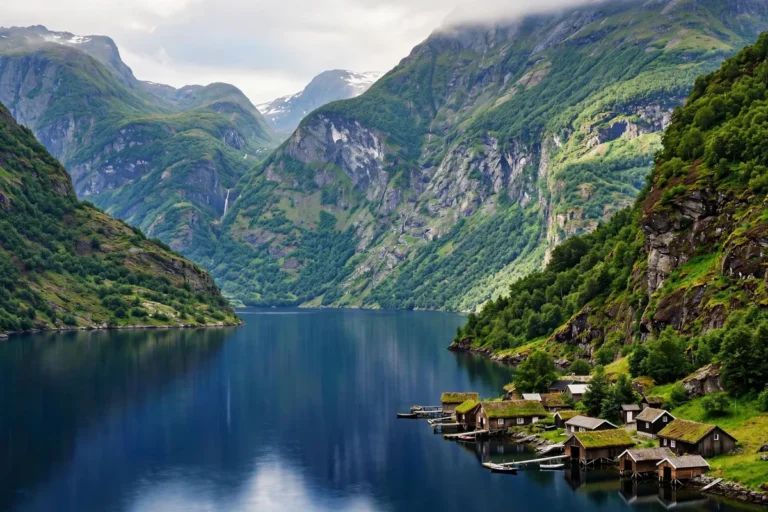
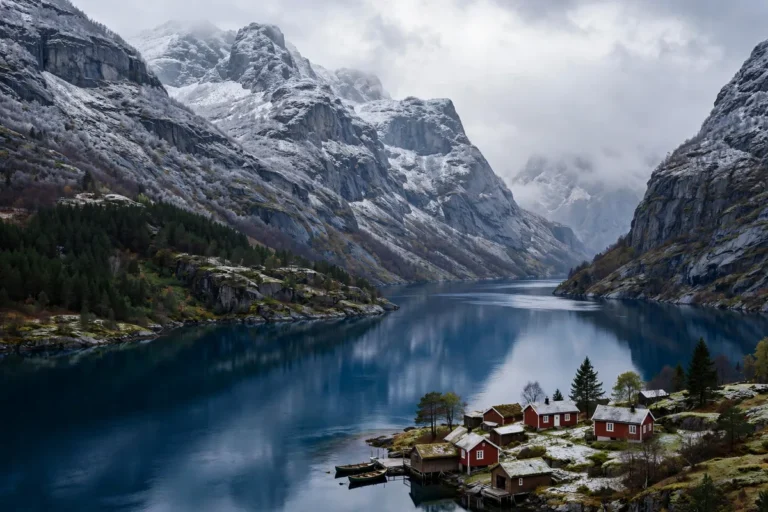
The Lustrafjord branches off the Sognefjord and runs north-east to Skjolden, through the municipality of Luster. The water here is a milky glacial green, fed by meltwater from the Jostedalsbreen ice cap, Europe’s largest mainland glacier, which hangs above the villages of Solvorn, Ornes and Skjolden. The fjord is about 40 km long, and the mountains around it are among the highest in the country: the Sognefjellet road climbs from Skjolden to 1,434 metres, and Jotunheimen National Park, with Norway’s highest peaks, begins just beyond the head of the fjord.
The fjord is also the most historic of the Sognefjord’s arms. Three of Norway’s famous stave churches survive around its inner end: Urnes on the eastern shore, Kaupanger further out, and Borgund, 30 km into the Lærdal valley. Urnes is the oldest of them all, and the only stave church on the UNESCO World Heritage list.
Urnes Stave Church
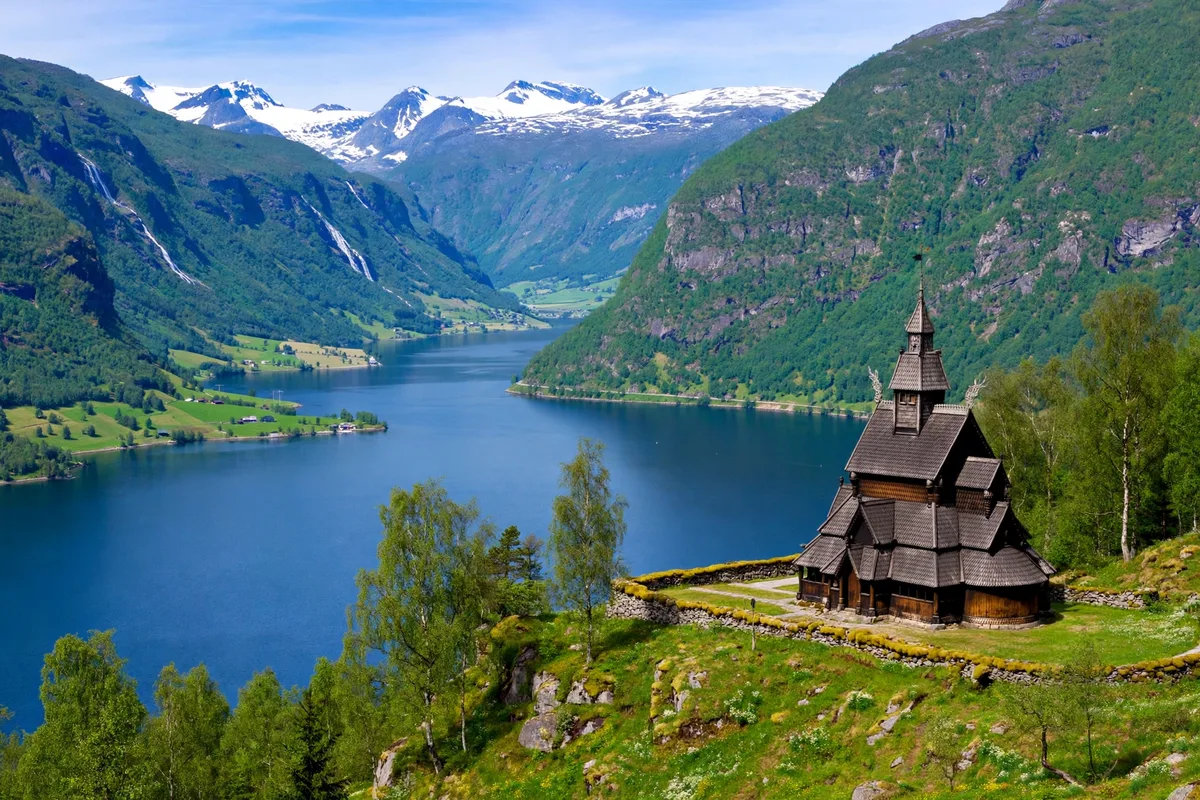
Urnes Stave Church stands on a green shelf above the Lustrafjord at Ornes, and it is the most important old building in Norway that most visitors skip. The church was built around 1130, making it the oldest of the 28 stave churches that survive, and its carved north portal is older still, roughly 1070, reused from an earlier building on the site. The writhing animal carvings of that portal gave their name to the Urnes style, an entire style of Nordic art. The church was inscribed on the UNESCO World Heritage list in 1979, the only stave church on the list.
Visiting takes planning. The church is open in summer only, from 2 May to 30 September, daily from 10:30 to 17:45, and closed on 17 May, Constitution Day. Entry is by guided tour only, about 20 minutes, with a maximum of 25 people per tour and 50 visitors inside per hour, so expect a wait at busy times. Go at the 10:30 opening or after about 16:00. Adult admission in 2026 is NOK 150, senior NOK 130, child and student NOK 100, and a family ticket NOK 350. Tickets are sold from a small white house a short walk from the church.
Getting there is half the experience. From Solvorn, on the western shore, a small ferry crosses the fjord to Ornes in about 20 minutes. The ferry runs year-round, roughly hourly in summer, and tickets are sold on board with no pre-booking. The adult fare is about NOK 70 to 75 one way, a car up to six metres about NOK 200 to 210, and children about NOK 35 to 37. The fares vary slightly between sources, so check the timetable and prices on the morning you go. From Ornes, a steep path climbs to the church, and the site is genuinely limited for anyone with mobility problems, so contact the church ahead if that affects you.
Skjolden: the village at the head of the fjord
Skjolden sits at the innermost end of the Lustrafjord, where the fjord meets the mountains, and it is the natural base for this arm. It is a small village with a hotel, the Skjolden Hotel, a campsite, a shop and a quay, and it is the access point for Jotunheimen National Park. The village is quiet, and that is its appeal: the fjord ends here, the road climbs from here, and the mountains start here.
From Skjolden, the Sognefjellet National Tourist Route climbs over the mountains to Lom in Gudbrandsdalen, one of the great drives in Norway, open in summer only. The road rises from sea level to 1,434 metres at Sognefjellshytta, past glaciers and high mountain lakes. Allow a full day for the drive, and check that the road is open before you set out.
Skjolden is also the starting point for the valleys of Mørkridsdalen and Fortunsdalen, two classic hiking areas near the head of the fjord, and for the road into Jostedalen, the valley that leads to the Nigardsbreen glacier.
Solvorn and the western shore
Solvorn is the prettiest village on the Lustrafjord, a cluster of old wooden houses on the western shore, opposite Ornes. It is the ferry village, and it is worth an hour on its own: the houses, the small harbour, and the view across the fjord to Urnes. Solvorn has a hotel and a café, and it is a good overnight stop if you want the fjord without the drive to Skjolden.
South of Solvorn, the road runs along the fjord to Gaupne and Luster, the villages at the mouth of the Lustrafjord, where the arm meets the main Sognefjord. Luster is the municipality’s centre, with a church and a shop, and it is the junction for the road to Skjolden and the road to Jostedalen. The whole western shore is a slow drive, with the fjord on one side and the mountains on the other, and it is the best way to see the arm from land.
Nigardsbreen: the glacier you can walk on
The Nigardsbreen glacier, in Jostedalen, is one of the most accessible glaciers in Europe, and it is the best day trip from the Lustrafjord. The glacier is an arm of the Jostedalsbreen ice cap, and its blue ice falls to a lake at the head of the valley, a drive from Skjolden through Gaupne and into Jostedalen.
Guided blue-ice hikes run on the glacier in summer, with crampons and a guide, and they are the only safe way onto the ice. The extra-short hike takes about three and a half hours and costs from NOK 640, and the short hike takes about four and a half hours and costs from NOK 885, both with Jostedalen Breførarlag, the local guide company. Book ahead: the hikes are popular, and the glacier is not a place to walk alone. The walk to the glacier lake, without going onto the ice, is free, and it is worth doing even if you do not take a guided hike.
The glacier is retreating, and the guides will tell you how far it has pulled back in their lifetimes. That is part of the experience, and part of the reason to go now rather than later.
Feigefossen waterfall
Feigefossen, near Feigum on the western shore, is the second-longest waterfall in Norway, falling 229 metres in a free drop to the fjord. It is best in spring, when the snowmelt is at its fullest, and it is visible from the road and from the fjord. The waterfall is about 13 km from Ornes along the fjord road, and there is a short path from the road to the base of the fall. It is a quick stop, but it is one of the most dramatic waterfalls on the Sognefjord, and it is easy to miss if you are not looking for it.
Kayaking the fjord
The Lustrafjord is calm enough to kayak, and the paddle from Skjolden to Solvorn is one of the best on the Sognefjord: a full day on flat water, past the farms and the stave church, with the mountains on both sides. The water is cold and the weather changes fast, so go with a guide or an organised trip unless you are experienced, and wear a life jacket. The paddle is the slowest way to see the fjord, which is the point.
Getting there and getting around
The Lustrafjord needs a car. There is no railway, and the buses are thin. From Bergen, drive via Voss and Lærdal to Sogndal, then along the Sognefjord to Gaupne and Skjolden, about five hours. From Oslo, drive via Lom and the Sognefjellet road in summer, or via Lærdal in winter, about five to six hours. From Flåm, drive via Aurland and Lærdal to Sogndal, about two hours.
Once you are there, the road along the western shore connects Solvorn, Gaupne, Luster and Skjolden, and the ferry connects Solvorn to Ornes. The Sognefjellet road from Skjolden to Lom is summer only, and the road into Jostedalen is open all year. Fuel up in Sogndal or Skjolden; the fjord has few petrol stations.
The Sognefjord guide covers the main fjord and its arms in full, and the cost and budget guide covers transport prices across the fjords.
Where to stay
Skjolden has the Skjolden Hotel and a campsite, and it is the best base for the glacier and the Sognefjellet road. Solvorn has a hotel and a café, and it is the prettiest overnight stop. Gaupne has a hotel and a campsite at the mouth of the fjord. Book ahead in summer: accommodation on this arm is limited, and the glacier hikes fill up. If you are travelling without a car, this is the hardest arm of the Sognefjord to see, and a guided tour from Sogndal or Flåm is the easier option.
How many days to allow
One day covers Urnes and the fjord road, if you drive from Sogndal or Flåm. Two days is the right amount: a day for Urnes and Solvorn, and a day for the Nigardsbreen glacier. Three days lets you add the Sognefjellet drive to Lom, or a slow day in Skjolden and the valleys. Do not try to do Urnes, the glacier and the Sognefjellet road in a single day; each one is a half day at least, and the roads are slow.
What to skip
Skip trying to see the Lustrafjord without a car; the buses are too thin and the ferry timetables too sparse. Skip Urnes at midday in July, when the tour groups arrive and the 25-person cap means a wait; go at opening time or late afternoon. Skip the glacier without a guide; the ice is not a place to walk alone. And skip the Sognefjellet road without checking it is open; it is a summer road, and it closes with the snow.
Best time to visit
May to September is the season. Urnes is open from 2 May to 30 September, the glacier hikes run from June, and the Sognefjellet road opens in summer. June and September are quieter than July and August, and the fjord is at its greenest in June. The waterfall is best in spring. October to April is the low season: Urnes is closed, the glacier hikes stop, and the Sognefjellet road is closed, but the fjord itself is still there, and Skjolden is a quiet winter base. The best time to visit the Norway fjords guide covers the seasons in full.
Finding your way around
Key map links for the fjord:
- Urnes Stave Church, at Ornes on the eastern shore
- Solvorn, Norway, the ferry village on the western shore
- Skjolden, Norway, at the head of the fjord
- Nigardsbreen, Norway, the glacier in Jostedalen
- Feigefossen, the 229-metre waterfall near Feigum
- Gaupne, Norway, at the mouth of the Lustrafjord
Ways to see Lustrafjord, compared
| Way to see it | How it works | Time needed | Best for |
|---|---|---|---|
| Drive the western shore | Car from Gaupne to Skjolden | Half a day | The fjord from land, at your own pace |
| Urnes by ferry | Solvorn to Ornes ferry, guided tour | Half a day | Norway’s oldest stave church |
| Nigardsbreen glacier hike | Guided blue-ice hike from Jostedalen | Half a day | Walking on a glacier |
| Sognefjellet drive | Skjolden to Lom over the mountains | Full day | The mountain road over Sognefjellet |
| Kayak from Skjolden | Paddle to Solvorn and Ornes | Full day | The fjord from the water, slowly |
| Cycle the fjord loop | 143 km loop from Skjolden | Full day | Fit cyclists, stave church and glacier in one ride |
Frequently asked questions
How do I get to Urnes Stave Church?
Take the small car ferry from Solvorn across the fjord to Ornes, about 20 minutes, then walk the steep path up to the church. The ferry runs year-round, roughly hourly in summer, and tickets are sold on board. The church is open 2 May to 30 September, and entry is by guided tour only.
How long is Lustrafjord?
About 40 km, from the main Sognefjord to Skjolden at its head. The Sognefjord itself runs 205 km from the open sea to Skjolden, which makes Skjolden about as far from the sea as a fjord can take you.
Can I walk on the Nigardsbreen glacier?
Yes, with a guide. Guided blue-ice hikes run in summer from about three and a half hours, from NOK 640, and the short hike takes about four and a half hours from NOK 885. Do not walk on the glacier alone.
Do I need a car for Lustrafjord?
Yes, really. There is no railway and the buses are thin. A car lets you drive the western shore, reach the glacier and drive the Sognefjellet road. Without one, a guided tour from Sogndal or Flåm is the easier option.
When is the best time to visit Lustrafjord?
May to September. Urnes is open from 2 May to 30 September, the glacier hikes run from June, and the Sognefjellet road opens in summer. June and September are quieter than July and August.