
Best Time to Visit the Norway Fjords: Month by Month
There is no single best month for the Norway fjords, because the fjords change completely with the seasons. June gives you waterfalls at full power and daylight past 10 pm. September gives you autumn colour, thin crowds and the first northern lights. January gives you snow on the cliffs and darkness at midday. The short version: for fjord cruises, hiking and the classic routes, come between late May and September, with June and September as the two best-value months. For the northern lights, come between late September and March, and base yourself in the far north. For the lowest prices, pick May or October and accept that some things will be closed.
Summer: the midnight sun and the peak season
Summer is when the fjords work at full capacity. From June to August every boat runs its full timetable, the mountain roads are open, the hiking trails are snow-free and the days are long. In Bergen the sun is up for around 19 hours at the end of June. The midnight sun itself needs the Arctic Circle. In Tromsø the sun stays above the horizon from 20 May to 22 July, so for about nine weeks there is no sunset at all. Further south you get very long bright evenings instead. If the midnight sun is the reason for the trip, go north of the Arctic Circle.
Summer is also the most expensive and most crowded season. Hotel rates in Bergen, Flåm and Geiranger peak in July, cruise ships fill the small fjord villages, and the most popular viewpoints have queues. The Geirangerfjord guide describes a village that can feel overwhelmed on a big cruise day. Snowmelt peaks in late May and June, so the waterfalls run at their fullest then.
The shoulder months: May and September
May and September are the two months this site recommends most often: almost everything is open, but the crowds and prices have not peaked.
May is the month of waterfalls and blossom. The snowmelt is at its strongest, the fruit trees in the Hardangerfjord are in blossom from about mid-May, and the fjord boats step up to summer timetables. Some high mountain roads are still closed: Trollstigen reopened on 27 April in 2026, the earliest opening on record, but in a normal year it opens in mid-May, and the road up to Dalsnibba above Geiranger usually opens in the second half of May.
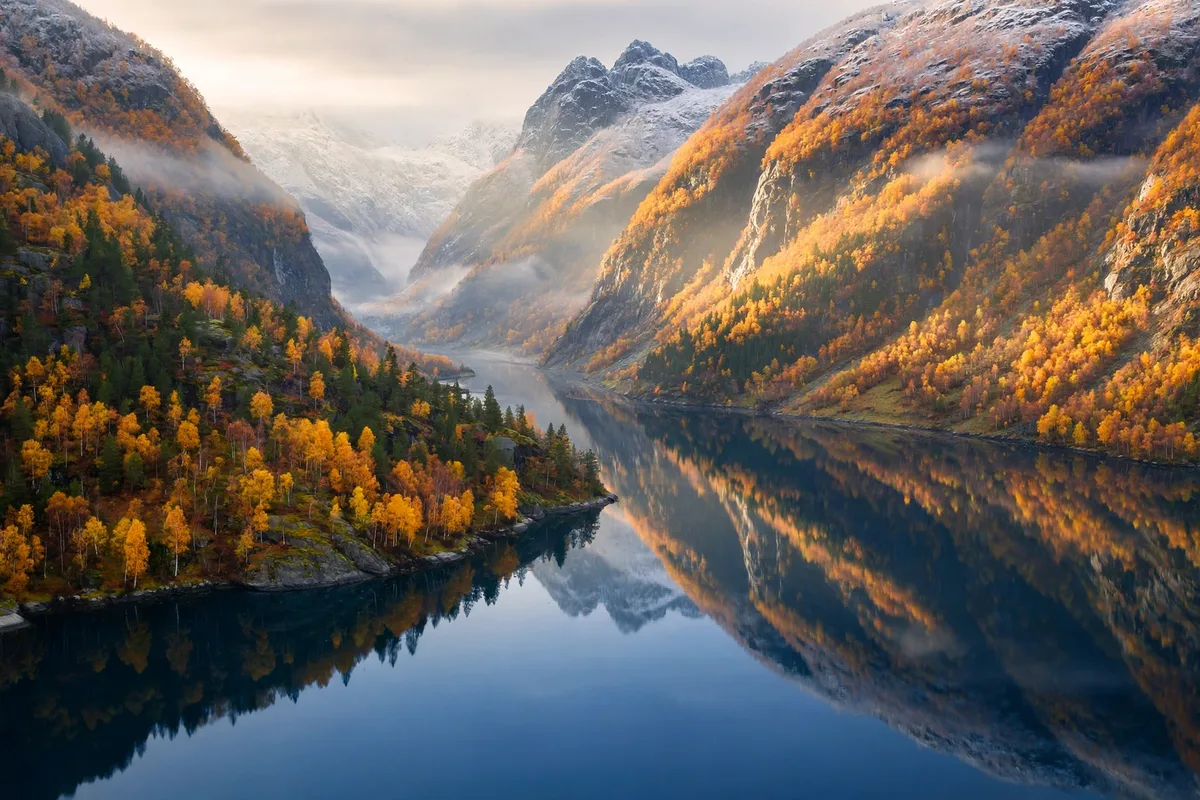
September is the mirror image. The boats still run full timetables into mid-month, the autumn colours arrive, and the first northern lights can appear from around 20 September in the north. Hotel rates fall and the cruise ships thin out. By the end of the month the Geiranger season is winding down: Dalsnibba closes at the end of September, and the Geiranger ferry stops for the winter.
Winter: northern lights and the polar night
Winter is a different trip entirely. From November to March the fjord country is quiet, the mountains are white, and the days are short. In Bergen the sun is up for only about six hours in December. In Tromsø the sun does not rise at all from 28 November to 14 January, a period called the polar night, though there is a blue twilight around midday. The sun sets for the last time on 27 November 2026 and returns on 15 January 2027.
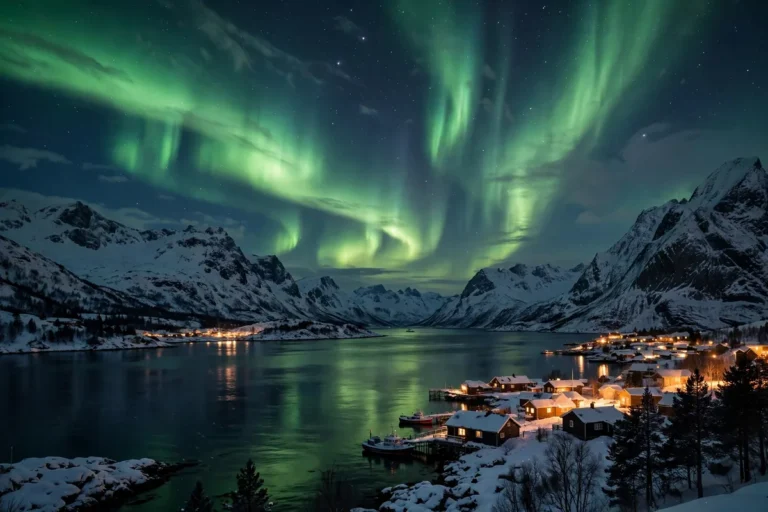
The northern lights need dark skies, and the season runs from late September to late March, with the longest and darkest nights from November to February. Tromsø is the easiest base, with direct flights and dark skies a short drive from the city. Give yourself at least three or four nights, because cloud cover is the biggest risk.
The Norway in a Nutshell route runs all year, and our Norway in a Nutshell worth it? guide works through the winter version in detail. The package costs from NOK 2,698 in summer and NOK 2,482 in winter (October 2026 to April 2027), with no departures on 24–25 December 2026 or 1 January 2027. The Flåm Railway runs all year, from NOK 399 a single and up to about NOK 510 in summer, and the Flåm to Gudvangen boat runs in winter too, at roughly NOK 520–595 one way and NOK 780–960 return, with dynamic pricing and no fixed fare published. Geiranger is the exception: the ferry stops entirely and the village largely shuts.
Month by month
January
The darkest month, and one of the best for the northern lights. The polar night runs until 14 January in Tromsø, then the sun returns on 15 January 2027. The Nutshell route and the Flåm Railway run. Good for aurora and winter scenery; poor for hiking and Geiranger.
February
Still deep winter, with slightly longer days and often the most reliable snow. Northern lights season is at its peak, and the Arctic north is busy with aurora tourists, so Tromsø hotels are not cheap even in winter. Good for aurora and skiing; poor for road trips.
March
One of the best months for the northern lights: the equinox often brings clearer skies, the nights are still long and dark, and there is enough daylight to fill the days. The boats are still on winter timetables. Good for aurora with milder conditions; poor for hiking.
April
The awkward month. The snow is melting, the landscape is brown and bare, and most summer services have not started. The fjord boats run winter timetables and the mountain roads are closed. Hurtigruten’s ships start sailing the Hjørundfjord, and Havila begins its Geirangerfjord detours.
May
The best all-round month for the fjords. The waterfalls are at peak snowmelt, the Hardangerfjord blossom is out from about mid-May, and the boats move to full timetables. Trollstigen and the Dalsnibba road usually open during May. Daylight stretches past 9 pm in the south.
June
The classic summer month. The midnight sun runs through June in the north, the days are at their longest, and every road, boat and trail is open. The waterfalls are still strong and the weather is at its mildest. Crowds build through the month, but June is quieter than July.
July
The warmest, busiest and most expensive month. Every boat, viewpoint and trail is open, the midnight sun runs until 22 July in Tromsø, and the weather is at its best. The cruise ships are at their peak and the small villages are at their fullest.
August
July without the worst of the crowds. The weather is usually still mild, the boats run full timetables, and the hiking is at its best. The midnight sun has ended, but the evenings are still long. Prices stay high, then fall in the last week.
September
The second-best month for the fjords, and the best month for value. The boats run full timetables into mid-month, the autumn colours arrive, the crowds thin out, and hotel rates fall. The first northern lights can appear from around 20 September in the north.
October
Autumn proper. The colours are at their best early in the month, the crowds are gone, and prices are low. The fjord boats move to winter timetables, the mountain roads close, and the Geiranger ferry stops. The Nutshell route runs on its winter fare.
November
The quietest month in the fjord country, and the start of the polar night in Tromsø on 28 November. The days are short and the weather is wet and grey in the west, but the northern lights season is in full swing.
December
Christmas in the fjords is quiet and dark, with snow on the mountains and lights in the villages. The polar night runs through the month in Tromsø, and the northern lights are at their best on clear nights. The Nutshell route runs except on 24–25 December 2026 and 1 January 2027.
When each fjord is at its best
Our Sognefjord vs Geirangerfjord comparison covers the two big ones in detail.
The Geirangerfjord, 15 km long and about 260 m deep, is a late May to September destination and nothing else. The ferry stops in winter, the Dalsnibba road closes at the end of September, and the village largely shuts. The Sognefjord, about 205 km long and up to 1,308 m deep, works all year, because the Nutshell route and the Flåm to Gudvangen boat run through winter. It is at its best from May to September. The Nærøyfjord, its narrow arm at about 18 km long, follows the same pattern.
The Hardangerfjord, 179 km long and about 850 m deep, has two peaks: mid-May for the fruit blossom, and September for the fruit harvest and the autumn colour. See the Hardangerfjord guide for the blossom and cider route.
The Lysefjord, near Stavanger, is a hiking fjord first. Preikestolen, the flat-topped cliff 604 m above the water, is an 8 km return hike that takes 4 to 5 hours. The main season runs from May to October, with June to September the safest window for going unguided. From November to April the stone steps ice over, so go with a guide, with crampons and a head torch. Our Stavanger guide covers the Lysefjord boats and the Preikestolen logistics.
Crowds and prices by season
Prices in Norway follow the seasons closely, and the differences are large enough to plan around. July is the peak: hotels in Bergen, Flåm and Geiranger charge their highest rates, the Nutshell package is at its summer fare from NOK 2,698, and the Flåm Railway single reaches about NOK 510. May and September sit a clear step below, and October to April is the cheapest period in the south.
The exception is the Arctic north: Tromsø hotels and aurora tours are in demand from November to February. Crowds follow the same curve: July brings the cruise ships, and the small fjord villages feel it most, since Geiranger, Flåm and Gudvangen are built for a few thousand people and can receive several times that on a cruise day. June and August are busy but manageable, and October to April is quiet everywhere except Tromsø. Start hikes before 8 am and visit the famous viewpoints early or late in the day.
What closes in winter
Winter does not close the fjords, but it closes the things around them. The Geiranger ferry stops entirely, and the village largely shuts. The mountain roads close: Trollstigen, the Dalsnibba road and the other high passes shut from autumn until late spring, with exact dates set by snow. The Stegastein Viewpoint above the Aurlandsfjord stays reachable by road in winter. The Dronningstien ridge walk and the Trolltunga hike are summer-only for unguided walkers. The Preikestolen trail stays open but needs a guide, crampons and a head torch in winter.
What stays open: the Nutshell route, the Flåm Railway, the Flåm to Gudvangen boat, the Bergen fjord boats including the Mostraumen cruise, the Lysefjord boats from Stavanger, and the Hurtigruten and Havila coastal ships, which run all year between Bergen and Kirkenes.
How to choose
Let the one thing you want most pick the month. If you want fjord cruises and the classic routes, go from late May to September. June is the safest choice, May the cheapest good month, and September the quietest. If you want hiking, go from June to September. If you want the midnight sun, go to Tromsø or the Lofoten Islands between 20 May and 22 July, or settle for very long evenings further south. If you want the northern lights, go between late September and March, stay at least three or four nights, and base yourself in the north. If you want the lowest prices, go in May or October and plan around what is closed. If you want Geiranger, do not go between October and April.
Before you book, check the specific dates: mountain road openings move with the snow, and ferry timetables change between seasons.
Best month by goal
| What you want | Best months | What to expect |
|---|---|---|
| Fjord cruises | May to September | Full timetables, all fjords open, best in June |
| Waterfalls at full power | Late May to June | Peak snowmelt, strongest falls |
| Hiking | June to September | Snow-free trails, long days, guided only in winter |
| Midnight sun | 20 May to 22 July | Tromsø, no sunset; long evenings further south |
| Northern lights | Late September to March | Darkest November to February, best in the north |
| Fewest crowds | May, September, October | Quiet trails and villages, some closures |
| Lowest prices | October to April | Cheapest in the south, except Tromsø in aurora season |
| Geirangerfjord | Late May to September | Ferry and roads closed outside the season |
Frequently asked questions
When is the best time to visit the Norway fjords?
For most people, late May to September, with June the safest single choice and May and September the best value. For the northern lights, go between late September and March in the far north.
Can I see the northern lights and the fjords on the same trip?
Yes, but not at their best at the same time. Late September and March are the overlap months: the fjord boats are still running or starting up, and the nights are dark enough for aurora in the north.
Is May too early for the fjords?
No, May is one of the best months. The waterfalls are at their peak, the blossom is out in the Hardangerfjord, and the boats are on full timetables. Check the road status before you drive to a high viewpoint.
What is closed in winter in the fjords?
The Geiranger ferry stops, the mountain roads close, and the village largely shuts. High hikes are guided-only in winter. The Nutshell route, the Flåm Railway and the main fjord boats all run through winter.
Is winter a good time to visit the Norway fjords?
It depends on what you want. Winter is the best time for the northern lights, snow scenery and low prices in the south, and the Nutshell route runs all year. It is a poor time for Geiranger and high viewpoints.
One Comment