
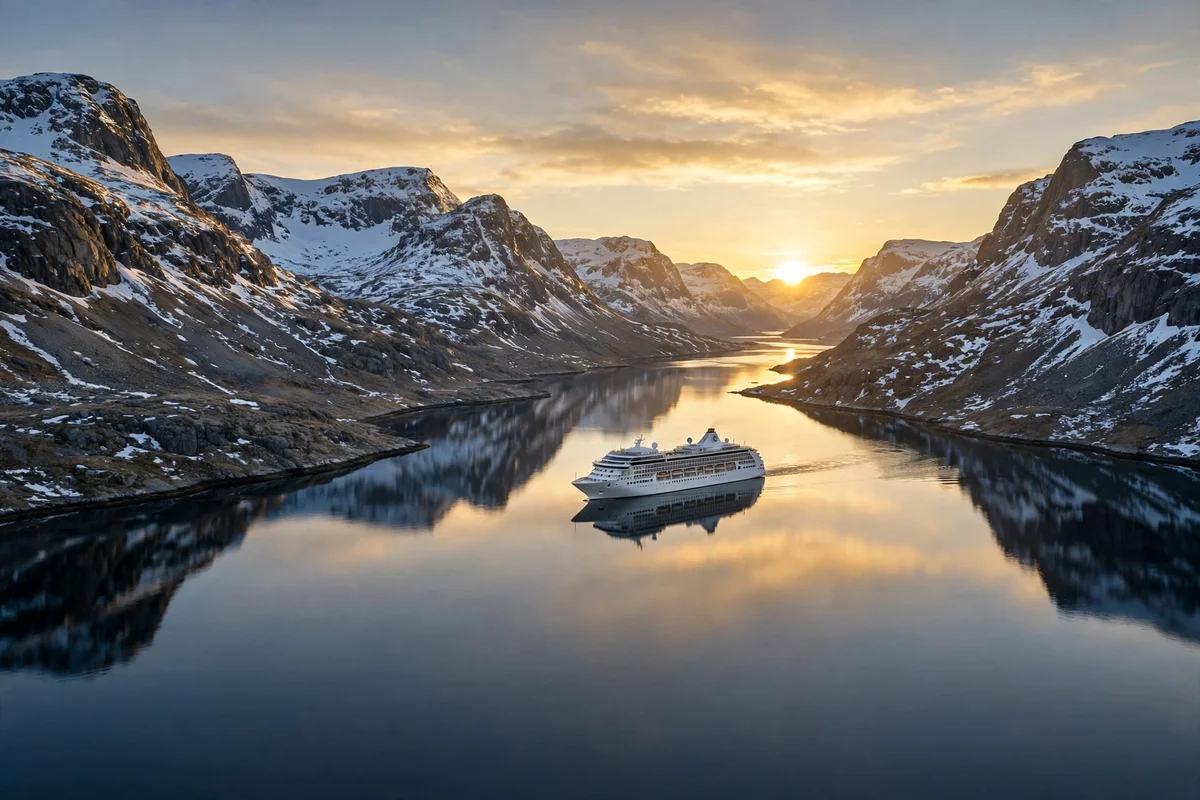
Norway Cruise Itinerary: 14 Days to the Arctic Circle 2026
Fourteen days is the trip that takes you past the Arctic Circle. Seven nights shows you the southern fjords and ten nights adds Geiranger, but neither reaches the Arctic. Fourteen nights does: the ship crosses 66°33′ north, sails the Lofoten Islands, calls at Tromsø, and reaches the North Cape, the northernmost point of mainland Europe.
There are two ways to spend the fourteen days: a big-ship round trip from the UK or northern Europe, usually 14 nights, that sails north to the North Cape and back, or the coastal voyage, Hurtigruten or Havila from Bergen to Kirkenes and back in 12 days, packaged with flights and hotels into a 14-day trip. This guide covers both, day by day, with the Arctic highlights, the lines, the costs and the seasons.
The 14-night North Cape route at a glance
A 14-night big-ship sailing is fifteen calendar days. The route below is the pattern of the classic North Cape round trip, as sailed by the luxury and premium lines from Dover and other northern European ports. The ports change from sailing to sailing, and some routes start in Southampton or Hamburg instead of Dover, but the shape stays the same.
Day 1: Dover, embarkation. Board in the afternoon and sail in the early evening.
Days 2–3: At sea, north through the North Sea. Two sea days on the way north, past the Shetland Islands, and the days are for settling in and for the first talks about the Arctic.
Day 4: Trondheim. The old Viking capital, with the Nidaros Cathedral, the largest medieval cathedral in Scandinavia, and the old town of Bakklandet, a short walk from the quay.
Day 5: Brønnøysund and the Arctic Circle. The ship crosses the Arctic Circle on the way north, and the crossing is marked on board: the captain announces it, and the ship passes the globe monument on the island of Vikingen. Brønnøysund, just below the Circle, is a small coastal town and the usual call for the day. From here on, you are in the Arctic.
Day 6: Svolvær, Lofoten. The capital of the Lofoten Islands, on the island of Austvågøya. The Lofoten archipelago stretches more than 100 km into the Norwegian Sea, with granite peaks rising straight from the water and fishing villages of red cabins on stilts. Svolvær is the base for the Lofoten excursions: the fishing villages of Henningsvær and Reine, and the mountain viewpoints.
Day 7: Tromsø. Norway’s most northerly city, about 200 miles inside the Arctic Circle, and the gateway to the Arctic. The Tromsø northern lights guide covers the city in full. In summer the ship calls in daylight that never ends: the Arctic Cathedral, the Polar Museum, and the Fjellheisen cable car up Mount Storsteinen. Tromsø is the liveliest stop on the route, and the best place to buy anything you forgot.
Day 8: Honningsvåg and the North Cape. The ship calls at Honningsvåg, on the island of Magerøya, and the excursion is the North Cape itself: a coach ride across the island to the plateau at the northernmost point of mainland Europe, with the globe monument, the cliffs, and the Barents Sea below. The North Cape is the goal of the whole trip, and it is worth the excursion fare. In summer the midnight sun is visible from the plateau, and the coaches run late into the night.
Days 9–10: Southbound, at sea and in port. The ship turns south after the North Cape, and the next two days are the quiet ones: a sea day, and a call at a small port on the way back, often Alta or Hammerfest. Alta is the base for the rock carvings, a UNESCO site, and for the northern lights in winter.
Day 11: Olden. The glacier port at the end of the Nordfjord, on the way south. The Briksdal Glacier walk and the Loen Skylift are the excursions.
Day 12: Bergen. The gateway city, with Bryggen, the Fløibanen funicular and the Fish Market. The Bergen guide covers the city in full. Bergen is the last port before the crossing home.
Day 13: At sea. A full sea day on the way home.
Day 14: Rotterdam or a sea day. Some sailings call at Rotterdam on the way back. Others spend the day at sea.
Day 15: Dover, disembarkation. The ship docks early in the morning.
The coastal-voyage version
The other way to spend fourteen days is the coastal voyage. Hurtigruten and Havila run from Bergen to Kirkenes and back in 12 days, calling at more than 30 ports along the coast, and the trip is sold as a 14-day package with UK flights and a night in Bergen at each end. The Hurtigruten North Cape Line runs a 14-night version from Hamburg, calling at Stavanger, Bergen, Træna, Senja, the North Cape, Tromsø, Reine and the Lofoten Islands, and Haugesund on the way back.
The coastal voyage is a different trip from the big-ship round trip. The ships are smaller, the cabins are simpler, and the ship calls at small ports the big ships never see: fishing villages, island communities, and the narrow sounds between the islands. The ship sails inside the skerries for most of the voyage, so the scenery is closer and the water is calmer.
The Arctic highlights
Four things make the fourteen days different from the week, and they are all north of the Arctic Circle.
Crossing the Circle. The Arctic Circle is the line at 66°33′ north, and crossing it is the moment the trip changes: the trees thin out, the mountains get sharper, and the sea gets colder. In summer the sun stops setting. In winter it stops rising.
Lofoten. The Lofoten Islands are the most photographed part of Norway: granite peaks, red fishing cabins, and white beaches, all under a low Arctic sun. The excursions to Henningsvær and Reine are the ones to book.
Tromsø. The Arctic city, with the cathedral, the Polar Museum and the cable car, and the best base for the northern lights in winter. It is the most northerly city of any size in the world, and its streets are busy late into the night in summer.
The North Cape. The plateau at the top of Europe, with the globe monument and the Barents Sea below. It is the goal of the trip: go in the evening if you can, when the light is at its best and the coaches are quieter.
The midnight sun and the northern lights
Midnight sun, June to August. The sun does not set in Tromsø from 20 May to 22 July, and the midnight sun season in Lofoten runs roughly from late May to mid-July. The summer sailings are midnight sun trips: the light never leaves, and the ship sails in daylight all night. June is the best month, with the longest days and the warmest weather.
Northern lights, late September to March. The aurora season runs from late September to March, and the winter coastal voyage is the best way to see it from a ship: the ship sails away from the town lights, and the sky is dark enough on clear nights. Tromsø is the base for the lights, and the winter voyage spends two nights there, northbound and southbound. The lights are never guaranteed, but the winter voyage gives you the most nights under a dark sky.
April and October are the quietest months: the light is changing, the ships are half empty, and the prices are lowest.
Which lines sail the Arctic
Seabourn runs a 14-day North Cape and Norwegian Fjords sailing from Dover, on Seabourn Quest, calling at Trondheim, Brønnøysund, Svolvær, Tromsø, Honningsvåg, Olden and Bergen, with Rotterdam on the way back. Seabourn is the luxury choice: small ships, all-suite cabins, and included excursions.
Viking runs a 14-night Arctic Explorer from Bergen to Reykjavík, on Viking Mars, calling at Geiranger, Lofoten, Tromsø and Honningsvåg, with an overnight stay in Longyearbyen in Svalbard.
Hurtigruten runs the North Cape Line from Hamburg in 14 nights, on MS Finnmarken, calling at Stavanger, Bergen, Træna, Senja, the North Cape, Tromsø, Reine and the Lofoten Islands, and Haugesund on the way back. It is the expedition choice: smaller ships, expert lecturers, and the coast itself as the destination.
Havila runs the 12-day coastal round voyage from Bergen to Kirkenes and back, with the newest ships on the coast. It is the modern coastal choice, and the 14-day packages add flights and Bergen hotel nights.
P&O and Cunard run 14-night fjord and Arctic sailings from Southampton in summer, with P&O’s longer sailings extending into the inland fjords and Cunard’s Queen Anne offering the premium option. Their 14-night sailings are fewer than the 7-night ones.
What a 14-day Arctic cruise costs
The price depends on which of the two trips you take. The coastal voyage is the cheaper way north: the 12-day round voyage from Bergen runs from around $1,900 to $2,700 per person, before flights. The big-ship 14-night sailings cost several times that: the luxury lines start from around $11,000 per person for a 14-day North Cape sailing, and Viking’s 14-night Arctic Explorer starts from around $16,000 per person twin share.
Excursions cost extra on most lines, except the luxury lines, which include them. Budget for the North Cape excursion, the Lofoten trips and the Tromsø cable car. The North Cape excursion is the most expensive single trip of the voyage. The cost and budget guide covers fjord prices in detail.
When to go
June to August is the midnight sun season, and the best window for the 14-night North Cape sailing. June is the best month. July is the busiest. August is quieter.
Late September to March is the northern lights season, and the winter coastal voyage is the trip for it. November to January is the darkest. February and March bring the light back, with long blue twilights and the snow still on the mountains.
May and October are the shoulder months: the ships are half empty, the prices are lowest, and the weather is uncertain.
Who the 14-day trip suits
The 14-day sailing suits travellers who want the whole of Norway, not just the fjords. It suits first-timers who want to see the Arctic properly, and it suits returning travellers who did the 7-night week and want the rest of the country. If fourteen nights is more than you can spare, the 10-day itinerary covers the classic fjords in a shorter sailing.
It does not suit travellers on a tight budget or a tight schedule: fourteen nights is a long time and a lot of money. It also does not suit travellers who get restless at sea: the North Cape sailing has four or five sea days, and the coastal voyage has none, so pick the coastal voyage if sea days are the problem. If the Arctic is the goal but the time is not, the 12-day coastal voyage is the shorter version of the same trip.
What to skip
Skip the 14-night sailings that spend the extra days at sea rather than in port: the value of the longer trip is Lofoten, Tromsø and the North Cape, so read the itinerary before you book. Skip the North Cape excursion booked independently: the plateau is a long coach ride from Honningsvåg. Skip packing for summer only: the Arctic is cool even in July, and the wind on the North Cape plateau is cold in any month. And skip expecting the northern lights in summer: the midnight sun means the sky never gets dark enough to see them, and the lights are a winter trip.
Finding your way around
Key map links for the ports:
- Dover, England, the usual departure port for North Cape sailings
- Trondheim, Norway, the old Viking capital
- Brønnøysund, Norway, just below the Arctic Circle
- Svolvær, Norway, the capital of the Lofoten Islands
- Tromsø, Norway, the gateway to the Arctic
- Honningsvåg, Norway, the port for the North Cape
- North Cape, Norway, the northernmost point of mainland Europe
- Bergen, Norway, the gateway city of the fjords
- Olden, Norway, the glacier port at the end of the Nordfjord
- Kirkenes, Norway, the turning point of the coastal voyage
- Reine, Norway, the fishing village in the Lofoten Islands
- Hamburg, Germany, the departure port for the Hurtigruten North Cape Line
The 14-day Arctic options, compared
| Option | Route | Nights | Arctic highlights | Price level |
|---|---|---|---|---|
| Big-ship North Cape round trip | Dover to North Cape and back | 14 | North Cape, Tromsø, Lofoten, Trondheim | Luxury, from around $11,000 |
| Viking Arctic Explorer | Bergen to Reykjavík | 14 | Geiranger, Lofoten, Tromsø, North Cape, Longyearbyen | Luxury, from around $16,000 twin share |
| Hurtigruten North Cape Line | Hamburg round trip | 14 | North Cape, Tromsø, Reine, Senja, Træna | Expedition, mid to premium |
| Havila coastal round voyage | Bergen to Kirkenes and back | 12 | Tromsø, Lofoten, North Cape, Kirkenes | From around $1,900–2,700, before flights |
| 14-day coastal package | UK flights plus 12-day voyage | 14 | Same as the coastal voyage, with Bergen nights | Coastal fare plus flights and hotels |
Frequently asked questions
What does a 14-day Norway Arctic Circle cruise cover?
The classic 14-night North Cape sailing covers Trondheim, the Arctic Circle crossing, Svolvær in the Lofoten Islands, Tromsø, Honningsvåg and the North Cape, then Olden and Bergen on the way south. The coastal voyage covers the same Arctic ports plus Kirkenes.
Which cruise lines sail 14-day Arctic Circle cruises?
Seabourn, Viking, Hurtigruten, Havila, P&O and Cunard. Seabourn and Viking run the luxury North Cape sailings, Hurtigruten runs the North Cape Line from Hamburg, and Havila runs the 12-day coastal round voyage.
How much does a 14-day Arctic Circle cruise cost?
The coastal voyage is the cheaper way north: the 12-day round voyage from Bergen runs from around $1,900 to $2,700 per person, before flights. The luxury 14-night sailings start from around $11,000 per person.
When is the best time for a 14-day Arctic Circle cruise?
June to August for the midnight sun, with June the best month. Late September to March for the northern lights, on the winter coastal voyage. May and October are the quietest and cheapest.
Can I see the northern lights on a 14-day Arctic cruise?
Only in winter. The northern lights season runs from late September to March, and the winter coastal voyage is the best way to see them from a ship. In summer the midnight sun means the sky never gets dark enough.

One Comment