
Norway Cruise Tips for First Timers
A Norway fjord cruise is a forgiving first cruise. The ports are close to the ship, the towns are walkable, English is spoken everywhere, and the scenery does the work. But a few decisions made before you book shape the whole trip: the length, the cabin, the excursions and the month. Get those right and the rest takes care of itself.
These are the tips that matter, from the booking to the last port day, based on how the fjord routes actually work.
Book early, and pick the right week
The first decision is the length. Seven nights shows you the southern fjords. Ten nights adds Geiranger and a slower pace. Fourteen nights takes you to the Arctic. The 7 vs 10 vs 14 day comparison sets the three lengths against each other, and the 7-day itinerary from Southampton shows the classic week day by day.
Book early. The popular summer sailings sell out, and the balcony cabins go first. Booking six to nine months ahead usually gets the best price and the best cabin choice. If you can travel in May or September, you will pay less and see the fjords with fewer ships in port. May is the quietest month, with the waterfalls at their fullest from the snowmelt. September is the best value month: the weather holds, the light is softer, and the ports are quieter.
Check the port list before you book, not after. Geiranger and Flåm rarely appear on the same 7-night sailing, so if one of them is the reason you are going, find the sailing that visits it. The same goes for the Arctic: no 7-night sailing reaches it, so if the midnight sun or the northern lights are the goal, book fourteen nights or the coastal voyage. The 14-day Arctic Circle itinerary covers the Arctic route in full.
Pick the ship for the ports
A big ship and a small ship see the same fjords, and the port time is the same. Pick the sailing for the ports, and pick the ship for the price and the on-board experience.
P&O runs the most 7-night Norway sailings from Southampton, on Iona, Britannia, Aurora and Arvia, from May to September. Iona carries about 5,200 passengers and is the biggest ship on the route. Fred. Olsen runs 8-night sailings on Borealis, which carries about 1,400 passengers, for a slower pace and fewer crowds on board. Cunard runs 7-night sailings on Queen Anne, the formal choice, with elegant dining rooms and a dress code in the evening. MSC runs 7-night sailings on Virtuosa, the value choice, with the lowest fares of the five lines. Ambassador runs smaller ships with a relaxed, no-frills style.
The best fjord cruise guide compares the trip types in full, including the coastal voyage, which is a different kind of trip altogether: Hurtigruten and Havila from Bergen to Kirkenes and back in 12 days, calling at more than 30 ports, with no sea days.
Choose the cabin honestly
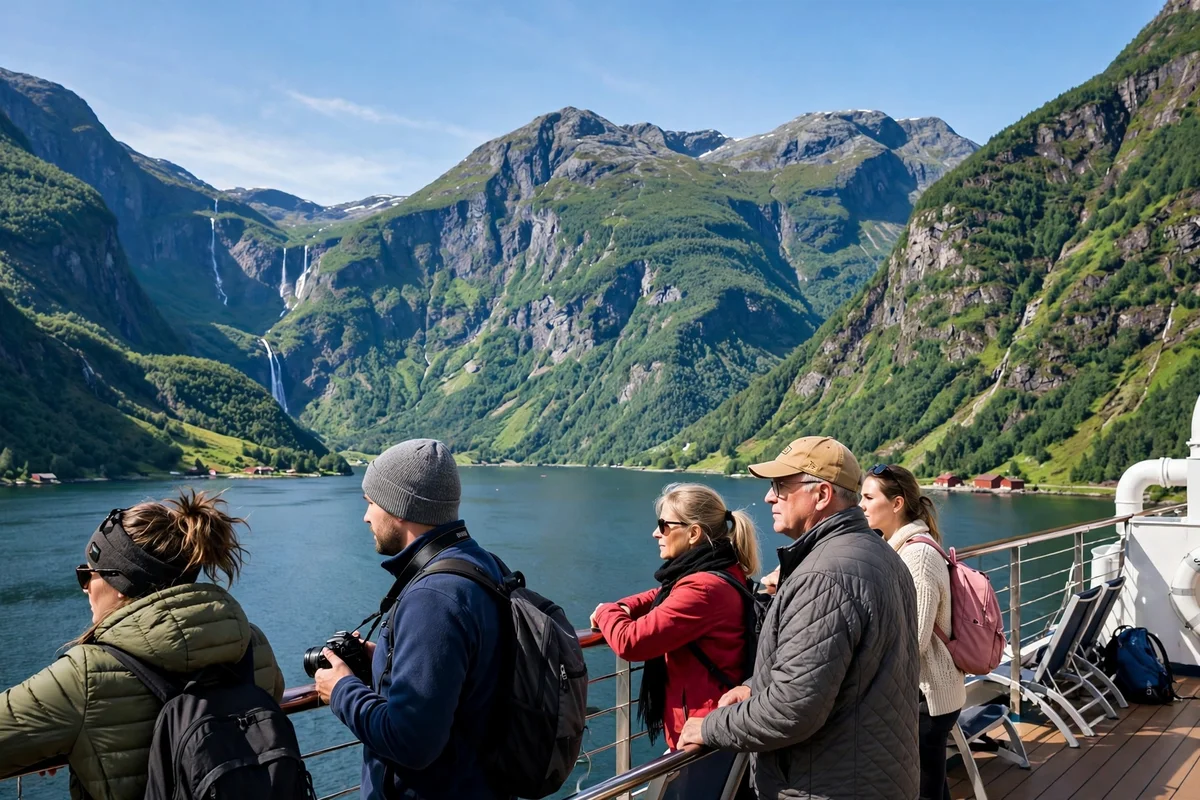
The cabin question is really a question about how much time you spend in it. On a fjord cruise, the answer is usually: not much. The best fjord views are from the open decks, and the ship’s top deck is free.
An inside cabin is the cheapest way onto the water, and it is fine if you use the cabin only to sleep and change. An oceanview cabin adds a window and natural light, which matters on the North Sea crossing, when the days at sea are long. A balcony cabin adds a private outdoor space, and it is worth it if you like watching the fjord sail past from your own chair, or if you travel in May or September, when the decks are cold and windy. A suite adds space and service, and it is the choice for a special occasion, not for the views: the suite balcony shows you the same fjord as the top deck.
Skip the balcony upgrade if you are rarely in the cabin. Spend the difference on excursions instead: the Flåm Railway, the Loen Skylift and the fjord boats are the parts of the trip you remember.
Inside, oceanview, balcony or suite, compared
| Cabin | What you get | Rough price, 7 nights | Best for |
|---|---|---|---|
| Inside | No window, lowest price | From around £500 to £750 per person | Travellers who use the cabin only to sleep |
| Oceanview | Window, natural light | Above inside, below balcony | Travellers who want daylight in the cabin |
| Balcony | Private outdoor space | From around £1,200 per person | Watching the fjords from your own chair |
| Suite | More space, extra service | Well above balcony | Special occasions, travellers who want space |
Prices are starting prices for a spring sailing, and they rise sharply in July and August. Confirm the fare for your date against the operator’s booking page.
Excursions: ship or direct
The excursions are where the money goes, and where the first-timer mistakes happen. The rule is simple: compare the cruise line price against booking direct, and book the ones that sell out early.
The Flåm Railway is the excursion to book first. It climbs 20 km up the valley from Flåm to Myrdal, about an hour each way, from NOK 399 for an adult single, with a five-minute stop at the Kjosfossen waterfall. It sells out, so reserve it as soon as you can, and check the direct price before you buy it through the cruise line. The Flåm Railway guide covers the train in full.
The Loen Skylift in Olden is the second one to book early: a cable car that climbs 1,011 m from the fjord to Mount Hoven, and it sells out on cruise days. The Geiranger sightseeing boats are the third: the 75-minute trip to the waterfalls, from around NOK 600.
For the rest, the ship’s excursions are convenient but not always the best value. The fjord boats, the railway and the Skylift are often cheaper booked direct, and the railway can be booked on its own. The North Cape excursion is the exception: book it through the cruise line, because the coaches are timed to the ship.
In port, the towns are walkable and the sights are close. Bergen’s Bryggen and the Fløibanen funicular are a short walk from the quay, and the Bergen guide covers the city in full. Stavanger’s old town is a few minutes from the quay, and the Stavanger guide covers the city in full. Ålesund’s Aksla viewpoint is a climb of 418 steps from the town centre, and the Ålesund guide covers the town in full.
Money: cards, cash and tipping
Norway runs on cards. You can pay by card almost everywhere, including on buses, in small cafes and at market stalls, and most travellers never touch cash. Bring a card with no foreign transaction fee, and tell your bank you are travelling, so a Norwegian transaction does not trigger a fraud block.
The currency is the Norwegian krone, NOK. Prices on shore are in kroner, and the excursion prices in this guide are in kroner for that reason. The Flåm Railway costs from NOK 399, the Nærøyfjord boat runs roughly NOK 520 to 665 one way, and the Mostraumen cruise from Bergen costs about NOK 890 for an adult. The cost and budget guide covers fjord prices in detail.
Tipping is not expected in Norway. Service staff are paid properly, and rounding up a bill is a kindness, not an obligation. On the ship, gratuities work differently: most lines add a daily service charge, or include it in the fare, so check what your line does before you board, and do not tip twice.
Embarkation day
Arrive at the port with time to spare. Boarding usually opens in the early afternoon, and the ship sails in the early evening, usually between 16:00 and 18:00. Use the first evening to find your way around the ship: the decks, the restaurants, the excursion desk and the place where the fjord views are best.
Your cabin may not be ready when you board, so keep a day bag with the things you need for the first evening: a jacket, medication, chargers and the documents. Pack the rest in the cases, and they will arrive at your cabin during the evening.
Check the excursion desk on the first evening, not the first morning. The popular trips sell out, and the desk is quietest on embarkation day.
Port days
Port days are 8 to 10 hours, and the ship moves on whether you are back or not. The all-aboard time is not a suggestion: be back at least 30 minutes early, and carry the ship’s port agent number, which is printed in the daily programme.
Start early. Geiranger is busy on cruise days, and the Dalsnibba viewpoint is quietest in the morning. The Flåm Railway is quietest on the first departure of the day. The Bergen funicular has the shortest queue before 10:00.
Dress for the weather you will get, not the weather you hope for. Bergen is the rainiest city in Norway, and the North Sea crossing is cool and windy even in July. A waterproof jacket with a hood and a warm layer go in the day bag every morning. The packing list guide on this site covers what to wear by season, with a checklist.
Sea days and the North Sea
A 7-night sailing has three sea days: two crossing the North Sea out, one coming home. The crossing takes about a day and a half, and it can be rough. The fjords themselves are calm, because the water is sheltered, but the open North Sea is not.
If you get seasick, the crossing is the time it happens. Book a cabin low down and in the middle of the ship, where the movement is least. Bring motion sickness tablets or acupressure bands, and take them before you feel ill, not after. Fresh air on deck and looking at the horizon help. The ship’s medical centre can help if it gets bad, and the crossing is over in a day and a half.
Sea days are also the best days on board: the pools, the shows, the restaurants and the reading, with nothing to rush to. Use them. The fjord days are busy, and the sea days are the rest.
Documents and entry
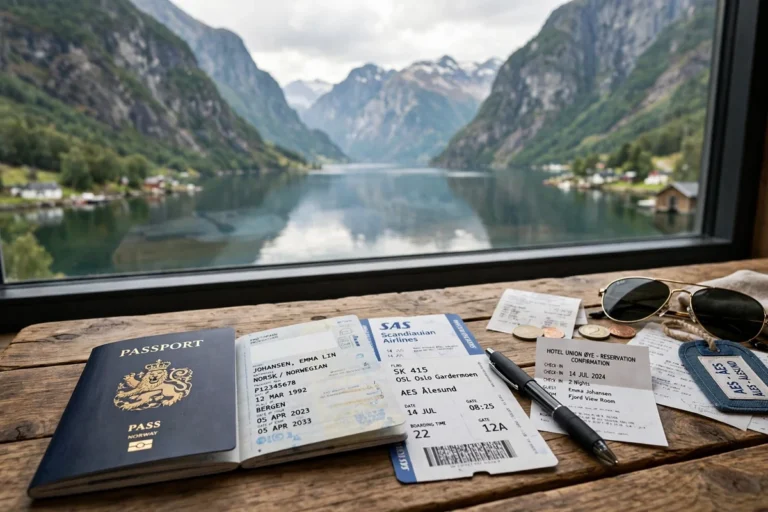
UK, US, Canadian and Australian passport holders do not need a visa for Norway, for stays up to 90 days in any 180-day period. Your passport must have been issued within the last 10 years and stay valid for at least 3 months after your departure date. ETIAS, the new European travel authorisation, is not yet in operation (checked Nov 2026), and no start date has been announced. The visa guide on this site covers the rules in full, including the Schengen 90-day rule and what cruise passengers from visa-required countries need.
Bring the passport even if you do not expect to need it. The ship holds it or a copy during the sailing, and you need it for the first port call. Keep a photo of it on your phone as well.
What to skip
Skip booking every excursion through the cruise line without checking the price first. Skip the idea of seeing Geiranger and Flåm from the same sailing in seven nights: most routes offer one or the other. Skip the balcony upgrade if you are rarely in the cabin. Skip packing for summer only. And skip the buffet on the first night if the main dining room is open: the dining room is the better meal, and the first night sets the tone for the week.
Finding your way around
Key map links for the ports in this guide:
- Southampton, England, the departure port for most 7-night sailings
- Bergen, Norway, the gateway city of the fjords
- Stavanger, Norway, the usual first or last port
- Flåm, Norway, at the head of the Aurlandsfjord, home of the Flåm Railway
- Geiranger, Norway, the UNESCO fjord village
- Olden, Norway, the glacier port at the end of the Nordfjord
- Ålesund, Norway, the Art Nouveau town beneath the Sunnmøre Alps
- Tromsø, Norway, the Arctic city, on the 14-night route
Frequently asked questions
What should a first timer know before a Norway fjord cruise?
Pick the sailing for the ports, not the ship. Check that the itinerary visits the fjords you care about, Geiranger and Flåm rarely appear on the same 7-night sailing. Book early, book the Flåm Railway as soon as you can, and pack a waterproof jacket even in July.
How early should I book a Norway cruise?
Six to nine months ahead for the best price and cabin choice. The popular summer sailings sell out, and the balcony cabins go first. May and September are the cheapest months, and the fjords are quieter then.
Is a balcony cabin worth it on a Norway fjord cruise?
It depends on how much time you spend in the cabin. The best fjord views are from the open decks, and the top deck is free. A balcony is worth it if you like watching the fjord from your own chair, or if you travel in May or September, when the decks are cold and windy.
Should I book excursions through the cruise line?
Compare the price first. The Flåm Railway, the Loen Skylift and the fjord boats are often cheaper booked direct. The North Cape excursion is the exception: book it through the cruise line, because the coaches are timed to the ship.
Do I need a visa for a Norway cruise?
UK, US, Canadian and Australian passport holders do not need a visa for Norway, for stays up to 90 days in any 180-day period. ETIAS is not yet in operation (checked Nov 2026), and no start date has been announced. Travellers from visa-required countries need a Schengen visa covering the whole trip.

One Comment