Ski & Sail in the Norwegian Fjords
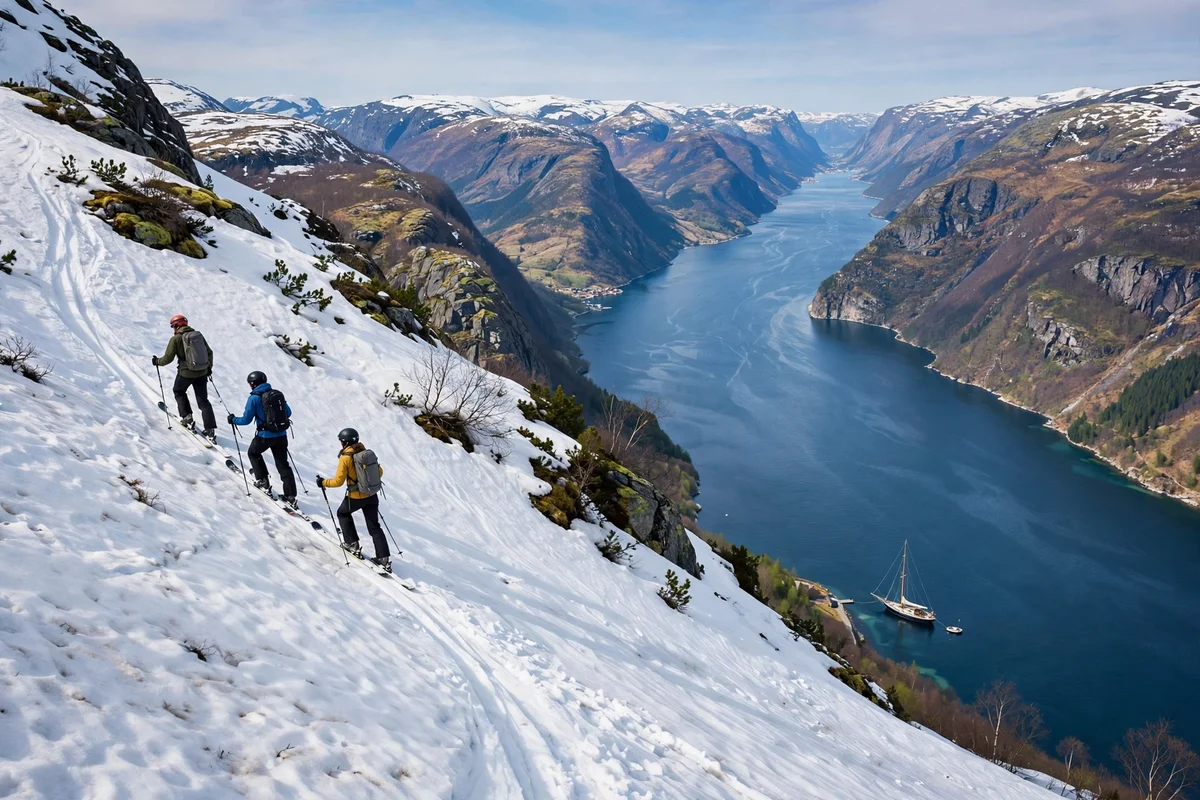
Ski and sail in Norway means living on a sailing boat and ski touring ashore each day. The boat is your floating base camp. Each morning it anchors in a new fjord or bay, you step ashore with skins on your skis, climb a peak, and ski back down to the water, often finishing almost at the shoreline. In the evening the boat sails on to the next anchorage while you eat, dry your kit and plan the next day with the guide.
The classic areas are Lofoten, the Lyngen Alps near Tromsø, and the Sunnmøre Alps around the Hjørundfjord. SeilNorge, one of the leading Norwegian operators in this niche, runs its ski and sail trips from February to June in Lofoten, Lyngen, Finnmark and Svalbard.
The areas at a glance
| Area | Base town | Typical trip | Season | Character |
|---|---|---|---|---|
| Lofoten | Svolvær | 5 or 7 days | Feb–May | Peaks straight from the sea |
| Lyngen Alps | Tromsø | 5 or 7 days | Late Mar–May | Biggest alpine terrain |
| Sunnmøre Alps | Ålesund | 5 days | Mar–Apr | Steep fjord peaks, shortest travel |
| Senja and Vesterålen | Tromsø or Harstad | 5 to 7 days | Late Feb–early May | Quieter islands |
| Svalbard | Longyearbyen | About a week | May | Arctic expedition sailing |
How a ski and sail trip works
A typical day starts with breakfast on board and a briefing from the ski guide. The guide has read the avalanche forecast, checked the weather and looked at the snow. Together with the skipper, the guide picks the peak for the day and the anchorage closest to it. You go ashore by tender or dinghy, put your skins on, and climb. The climb is the main part of the day, several hours of steady uphill skinning, then a descent that can run from the summit almost to the water.
You are part of the crew, not a passenger on a cruise ship. On SeilNorge trips, guests help run the boat, from steering and handling sails to cooking and keeping the deck tidy.
Lofoten: peaks straight from the sea
Lofoten is the best known ski and sail area in Norway. The islands sit above the Arctic Circle, and the peaks rise straight from the sea to around 1,100 metres, so the descent can run from summit to shoreline in one continuous line. You step off the boat, climb, and ski back to the water.
SeilNorge runs Lofoten trips in five-day and seven-day versions, starting in Svolvær. The five-day trips run at the start of the season, when the snow is colder and the powder is the draw. The seven-day trips give the boat more time to move around the islands, including Austnesfjorden, Trollfjorden and Raftsundet, the narrow strait cruise travellers know from the best fjord cruise routes. Northern Alpine Guides and the Lofoten Ski Lodge run a seven-day, six-night Lofoten trip with IFMGA certified mountain guides, with 2027 departures in late April and early May.
Lyngen Alps: the biggest terrain
The Lyngen Alps, east of Tromsø, are the most famous ski touring range in Norway. The peninsula is about 90 km long, flanked by the Ullsfjord to the west and the Lyngenfjord to the east, and the peaks are glaciated and alpine in character. The highest peak, Jiehkkevárri, reaches 1,834 metres.
SeilNorge calls Lyngen the ultimate classic for ski touring in Norway. Its Lyngen trips run in five-day and seven-day versions, and most start and end in Tromsø, with a couple starting or ending in Alta. The best time is late March, April and May. In May you can ski under the midnight sun, with daylight around the clock and snow still holding on most slopes. The trips cover the peninsula and the surrounding mountain islands, including Kågen, Arnøya, Vannøya and Ringvassøya.
Sunnmøre Alps: the fjord country option
The Sunnmøre Alps are the ski and sail area closest to the fjord country most cruise travellers visit. The range sits around the Hjørundfjord, south and east of Ålesund, and the peaks rise straight from the fjord to around 1,700 metres. Because most tours start at or near sea level, even a mid-height peak gives a long, continuous descent of 1,000 metres or more, finishing at the water.
Explore 62 North runs the best documented Sunnmøre trip: five days, Wednesday to Sunday, with four days of guided ski touring, starting and ending in Ålesund. The boat is SY Westland, a 45-foot expedition sailboat, and the ski guides come from Hjørundfjord Mountainguides. The trip sails from Ålesund harbour on Wednesday evening and aims to be back by 18:00 on Sunday, so guests can catch evening flights home. The base during the trip is the harbour at Sagafjord Hotell in Sæbø, where the boat can use showers, a sauna and a drying room.
Thursday is Nordre Sætretind, 1,365 metres, a neighbour of Kolåstinden, the peak known as the King of the Sunnmøre Alps at 1,432 metres.
Senja, Finnmark and Svalbard: going further
Senja, the large island south-west of Tromsø, is a quieter ski touring area, with sharp peaks and few footprints. SeilNorge describes Senja as a ski touring paradise from February to May, with summit to shoreline skiing and a sailboat as base camp, and gives late February to early May as the best time there. Its Ski and Sail Expedition from Svolvær to Tromsø takes in Senja and Vesterålen on the way north.
Finnmark, the far north-east of Norway, comes at the end of the mainland season. SeilNorge runs a northbound Ski and Sail Finnmark and Lyngen trip, and a seven-day Lyngen trip that pushes further north towards the end of the season, when the days are longest.
When to go
The season is driven by light as much as by snow. February has cold snow and short days, and in the far north you may still see the northern lights above the anchorage in early March. March and April are the core months: the snowpack is at its deepest, the days are long, and the weather is more settled than in midwinter. May brings the midnight sun in the north, long days everywhere, and spring snow that is firm in the morning and soft by the afternoon.
Do not book a ski and sail trip in summer. The boats are still sailing in June, July and August, but they are running hiking and sailing trips, not ski touring. If your dates are fixed to the summer cruise season, the best hikes and the kayaking and glacier walks are the mountain options, not ski and sail.
| Month | Light and snow | Best for |
|---|---|---|
| February | Short days, cold snow, northern lights possible | Lofoten powder |
| March | Longer days, deep snowpack | Lofoten, Sunnmøre, Lyngen opening |
| April | Long days, settled weather, spring snow | All areas, the peak month |
| May | Midnight sun in the north, slushy afternoons | Lyngen, Finnmark, Svalbard |
| June | Midnight sun, snow only at height | Svalbard, high Lyngen only |
Who it suits, and who it does not
Ski and sail suits confident off-piste skiers with ski touring experience. You need to ski variable snow, from powder to wind-packed crust to spring slush, often on slopes you have never seen before, with a pack on your back. You need to climb on skins for several hours a day, several days in a row. Explore 62 North puts it plainly: climb around 1,200 metres four days in a row, with medium to good skiing skills, and this is not a trip for beginners. SeilNorge and Boreal ask for solid off-piste skiing and good fitness, and grade their longer and more northern departures as more advanced.
It also suits travellers who are comfortable with uncertainty. The itinerary is a proposal, not a promise. The guide and the skipper change the plan for weather, snow, avalanche risk and the ability of the group. A peak you had your heart set on may be skipped, and a peak you had never heard of may turn out to be the best day of the trip.
Safety: avalanches, weather and the guide
Avalanche safety is the central safety issue, and it is the reason you book a guided trip rather than going alone. The Norwegian Avalanche Warning Service publishes a regional avalanche forecast daily from 1 December to 31 May, before 16:00, on Varsom.no and in the Varsom app. The forecast regions cover Lofoten and Vesterålen, Lyngen, Troms and Sunnmøre. Your guide reads the forecast every morning, reads the whole bulletin rather than just the danger level, and chooses the terrain for the day from it.
The coastal snowpack is different from the snow in the Alps. It reacts fast to wind and warming, and a slope that was safe in the morning can become dangerous by the afternoon as the sun works on it. That is why spring trips start early, and why the guide may pick a lower, gentler peak on a day with higher avalanche risk, as Explore 62 North does with Blæja in Sunnmøre.
What is included, and how to choose an operator
What is included varies by operator, but the shape is consistent. On a SeilNorge ski and sail trip, the trip includes the sailboat with an experienced skipper and a ski guide with local knowledge, guided backcountry skiing every day, accommodation on board in a shared double cabin with a ready-made bed, all food eaten on board, boat costs such as diesel, propane and harbour fees, a personal safety lifejacket, and instruction in boating and sailing. Travel to and from the start point, drinks such as wine and beer, and optional meals ashore are not included. Flights are never included.
Explore 62 North includes the boat, the guides, most meals on board, and dinners at two local farms, Christian Gard and Rekkedal, with three dinners on board. Flights, alcohol and personal kit are not included, and safety equipment can be rented.
What to pack
Pack light and pack soft. Cabins are small, and several operators ask for soft bags rather than hard suitcases, so your bag can be stowed under a bunk. Bring your touring skis, skins, boots, poles and helmet if you own them. If you do not, ask the operator in advance about rental in Ålesund, Svolvær or Tromsø: rental exists in the bigger towns, but it is limited, and it needs to be arranged before you arrive.
Your clothing needs to handle a full day out in Arctic spring conditions, from cold wind on a summit to warm sun on a south-facing descent. Bring a waterproof shell jacket and trousers, warm mid-layers, a thin down or synthetic jacket for stops, and gloves in two weights.
How to choose
Start with the area. Sunnmøre if you want the shortest travel and a five-day trip from Ålesund. Lofoten if you want the classic summit to sea islands and the most choice of dates. Lyngen if you want the biggest mountains and the longest season, and you have the fitness and experience for it.
Then ask about the season. February and early March mean cold snow and short days, and a chance of northern lights. Late March and April are the peak months, with the best balance of snow, daylight and settled weather.
What to skip
Skip a ski and sail trip if you have never ski toured. The boat cannot teach you to tour in a week, and the group cannot wait while you learn. Skip the trip if you cannot climb 1,000 metres a day for several days in a row: the fitness demand is real, and it does not go away because the scenery is good. Skip Svalbard as a first ski and sail trip. It is an expedition in Arctic waters, and it needs experience of both touring and boat life.
Finding your way around
Key map links for the ski and sail bases and areas:
- Ålesund, the start and end point for the Sunnmøre Alps trips
- Sæbø, Ørsta, the harbour base for the Sunnmøre trips at Sagafjord Hotell
- Hjørundfjord, the fjord at the centre of the Sunnmøre Alps
- Svolvær, Lofoten, the start point for the Lofoten ski and sail trips
- Tromsø, the start and end point for most Lyngen trips
- Lyngenfjord, the fjord east of the Lyngen Alps
- Longyearbyen, Svalbard, the start point for Svalbard ski and sail expeditions
- Bergen, the main gateway for travellers flying into fjord Norway
The areas, compared
| Area | Base | Trip length | Season | Peaks | Best for |
|---|---|---|---|---|---|
| Lofoten | Svolvær | 5 or 7 days | Feb–May | Around 1,100 m | Summit to sea, island hopping |
| Lyngen Alps | Tromsø | 5 or 7 days | Late Mar–May | Up to 1,834 m | Biggest terrain, longest season |
| Sunnmøre Alps | Ålesund | 5 days | Mar–Apr | Up to 1,717 m | Shortest travel, fjord peaks |
| Senja and Vesterålen | Tromsø or Harstad | 5 to 7 days | Late Feb–early May | Summit to shoreline | Quieter islands |
| Svalbard | Longyearbyen | About a week | May | Arctic peaks | Expedition, the latest season |
Frequently asked questions
What is ski and sail norway, and how does it work?
Ski and sail Norway is a guided trip where you live on a sailing boat and ski tour ashore each day. Trips run five to seven days, with a skipper and a certified ski guide on board.
When is the best time for ski and sail in Norway?
March and April are the peak months for most areas, with deep snow, long days and settled weather. February has colder snow and shorter days, and May brings midnight sun in the north and spring snow.
Do I need ski touring experience for a ski and sail trip?
Yes, for almost every departure. You need confident off-piste skiing, experience of ski touring, and the fitness to climb around 1,000 to 1,200 metres a day for several days in a row.
Which area is best for a first ski and sail trip?
Lofoten or the Sunnmøre Alps. Lofoten has the classic summit to sea skiing and the most choice of dates, in five-day and seven-day trips from Svolvær. Sunnmøre has a five-day trip from Ålesund, with the shortest travel from the south.
Is ski and sail in Norway safe?
It is as safe as the guide, the forecast and your own preparation make it. The guide reads the Varsom avalanche forecast every morning, the itinerary changes with the conditions, and you carry a transceiver, shovel and probe and wear a helmet.
Can I do ski and sail from a cruise ship port day?
No. Ski and sail trips run five to seven days, living on the boat, and they start and end in Ålesund, Svolvær, Tromsø or Longyearbyen. If you are on a cruise and want a mountain day ashore, the best shore excursions and the best hikes are the realistic options. For the summer season, our Day 5 companions cover cycling the fjords and fjord swimming and sauna, and sustainable fjord cruising covers the lower-impact choices for the cruise itself.