
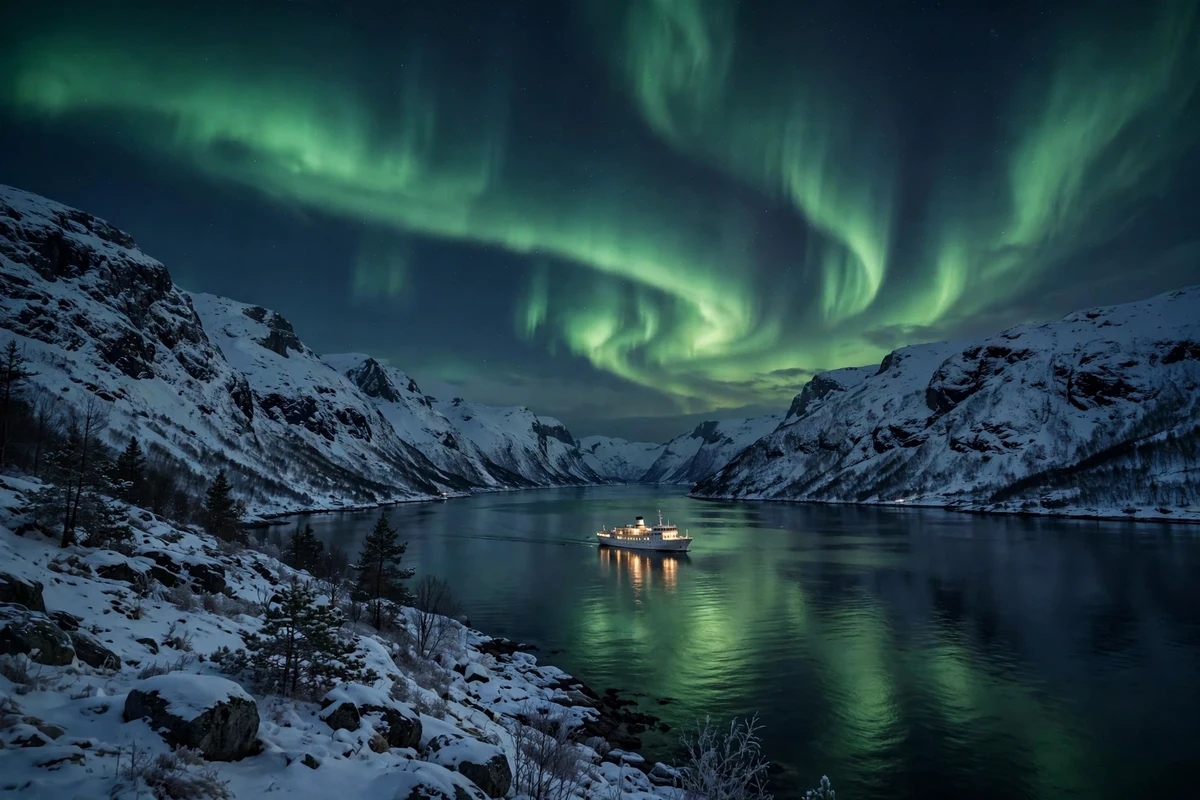
Northern Lights Cruise Norway: Ships, Routes & When to Go
A cruise booked for the northern lights is a different kind of trip from a land-based aurora holiday. You sleep, eat and travel on the ship, and the ship carries you north under the auroral oval night after night, while you watch the sky from the deck. There is no driving on icy roads at midnight. The trade is control: a ship cannot turn inland to chase a gap in the cloud.
The aurora happens above northern Norway on many winter nights, but the question is whether the sky is dark and clear. A ship helps here: once it leaves port there is very little light pollution, and over 12 days a coastal voyage passes through many local weather systems instead of sitting under one. A cruise also suits travellers who want the aurora as part of a wider winter trip. Choose the ship for the trip you want, not only for the lights.
This guide covers the ships and routes, the season and its dates, the two Promises, and what a night on deck is like. For the land-based side, see our Tromsø northern lights guide.
When to go: the aurora season and the dates that matter
The aurora is present over northern Norway all year. What changes is darkness: from late May to late July the sun barely sets, so the lights are invisible even when active. Darkness returns in the second half of August, and from then until early April any clear night can produce a display. Visit Tromsø gives the season as late August to early April; the main season runs late September to late March. The best hours are 20:00 to 02:00.
Dates are for Tromsø, about 69.6 degrees north, checked in November 2026.
| Period | Dates (Tromsø) | What it means for a cruise |
|---|---|---|
| Aurora season | Late Aug to early Apr | Any clear, dark night can produce a display |
| Main season | Late Sep to late Mar | The window most cruises use |
| Polar night, sun does not rise | 28 Nov to 14 Jan | No sunrise; blue twilight at midday |
| Sun sets for the last time | 27 Nov | Day before polar night |
| Sun returns | 15 Jan | First sunrise after polar night |
| Midnight sun, whole sun disc visible | 20 May to 22 Jul | No aurora |
| Best balance | Sep, Feb, Mar | Equinox months |
The polar night is not 24-hour blackness: for a few hours around midday the sky turns a deep blue. September and March are often the best months, not December, with higher activity around the equinoxes and often less cloud than midwinter. December and January give the longest darkness but also the most cloud. Our best-time guide covers the same trade-offs month by month.
The ships and routes
Northern lights cruises come in four kinds: coastal voyages, the North Cape Line, expedition ships, and large winter cruises from the UK.
Hurtigruten Coastal Express: Bergen to Kirkenes
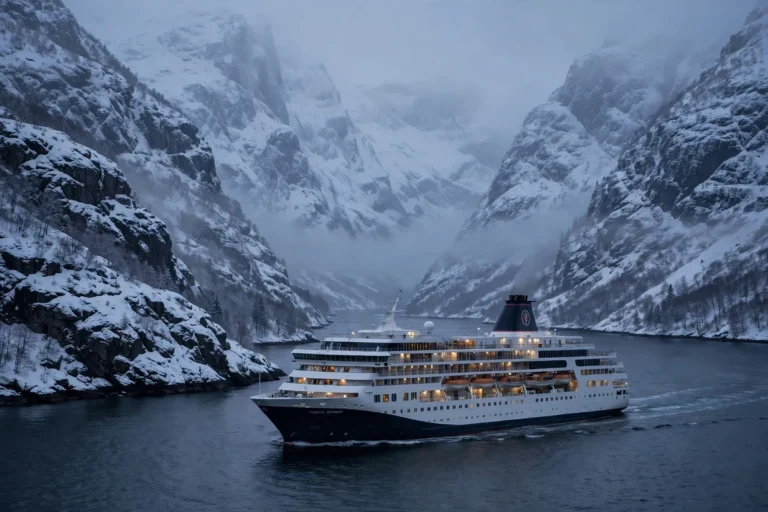
The Coastal Express is the original option, and for most people it is the right one. Hurtigruten has sailed Bergen to Kirkenes since 1893. The classic voyage is a 12-day round trip calling at 34 ports and covering about 2,500 nautical miles; one way, northbound takes 7 days and southbound 6 days. Seven ships work the route, MS Vesterålen, MS Kong Harald, MS Richard With, MS Nordlys, MS Polarlys, MS Nordkapp and MS Nordnorge, mid-sized working ships carrying a few hundred guests each with local passengers and cargo. The route crosses the Arctic Circle twice, and the northern half sits directly under the auroral oval. Our coastal express guide compares the three versions.
Havila Voyages: the same route, newer ships
Havila Voyages sails the same Bergen to Kirkenes route and calls at the same 34 ports. Its four ships, Havila Capella, Castor, Polaris and Pollux, were built between 2021 and 2023, each carrying 640 passengers, with up to four hours of silent, emission-free sailing. Havila’s ships are newer and quieter; Hurtigruten has the longer history, a larger fleet and daily departures. Both offer a Northern Lights Promise, covered below. Our sustainable fjord cruising guide compares the two on emissions.
Hurtigruten North Cape Line: Oslo to the North Cape
The North Cape Line is Hurtigruten’s Signature winter voyage: 15 days and 14 nights from Oslo to Honningsvåg, the port for the North Cape, and back, with a full day in each of 13 handpicked ports. MS Trollfjord sails all-inclusive with an expedition team. The line sails September to April, and a themed Astronomy Voyage adds a guest astronomer, aurora lectures and a visit to Tromsø’s planetarium. Fares were listed from £2,960 per person when checked in November 2026, as the lowest rate for a November 2028 sailing, so check the fare for your own departure.
HX expedition cruises and large winter ships
HX, formerly Hurtigruten Expeditions, runs Ultimate Norway, a 7-night expedition round trip from Tromsø aboard MS Spitsbergen (160 guests), entirely above the Arctic Circle, exploring the Lyngen Alps, Senja, Lofoten and Vesterålen. Published sailings ran from January to March 2026, so check HX for later-season dates.
Fred. Olsen runs In Search of the Northern Lights cruises round trip from Southampton, calling at Leknes, Alta, Tromsø, Narvik and Ålesund. The ship is Balmoral, about 1,250 passengers: a resort-style cruise where the aurora is one of several draws. A large ship’s deck lighting is brighter and its itinerary may spend aurora hours in port, but it is comfortable in bad weather.
Short evening cruises from Tromsø are a one-night option: boats leave in the evening and return after two to three hours, so book one for your first or second night.
You can book the Tromsø Electric Northern Lights Cruise on Viator. You can book the Northern Lights Cruise from Tromsø on Viator.
Northern lights cruise options compared
| Option | Route and length | Ship size | Aurora promise | Best for |
|---|---|---|---|---|
| Hurtigruten Coastal Express | Bergen–Kirkenes return, 12 days | A few hundred guests, 7 ships | Yes, 11+ days, 20 Sep–31 Mar | Most nights under the oval |
| Havila Voyages | Bergen–Kirkenes return, 12 days | 640 guests, 4 identical ships | Yes, 12-day round trip | Newer, quieter ships |
| Hurtigruten North Cape Line | Oslo–Honningsvåg return, 15 days | MS Trollfjord, ~500 guests | Yes, 11+ days, 20 Sep–31 Mar | Slow travel, long port days |
| HX Ultimate Norway | Tromsø return, 7 nights | MS Spitsbergen, 160 guests | Yes, future cruise credit | Small ship, active days |
| Fred. Olsen, In Search of the Northern Lights | Southampton return, ~14 nights | Balmoral, ~1,250 guests | No published promise found | Resort-style winter cruise |
| Evening cruise from Tromsø | Tromsø fjords, 2 to 3 hours | Small boat, up to 250 guests | Second-chance offers | One extra night on land |
The Northern Lights Promises: what they actually cover
Two operators offer a formal promise: a second chance, not a guarantee of seeing the lights.
Hurtigruten’s Northern Lights Promise applies to voyages of 11 days or more on the Coastal Express, the North Cape Line and Hurtigruten from Hamburg, departing between 20 September and 31 March, on new bookings through 31 March 2028. A sighting counts when deck officers record and announce it, and the ship’s decision is final. If none is recorded, you receive a free 6- or 7-day Coastal Express voyage the following season, in an inside cabin with full board. Claim it within 28 days of your return; flights and excursions are not included. Cabin upgrades cost extra; suite upgrades are not included.
Havila’s Promise applies to the 12-day Round Voyage, 1 October to 31 March. If the aurora does not occur, you get a free 6- or 7-day Voyage North or South the following season. It is only valid if you have activated the Northern Lights alert system on board, and the ship decides whether an event occurred. Order the free voyage within one month of your return. It covers the voyage only, not flights, and the cabin is an inside cabin, upgradable at extra cost.
HX gives a future cruise credit of up to 1,200 euros per person if there is no recorded sighting: more flexible than a fixed replacement sailing, but a credit, not a free cruise.
Remember: a faint sighting recorded by the crew counts, even if you were asleep and missed it, so keep the alert on. The free voyage is in the following season. The promise covers cabin and meals, not getting to the ship.
What seeing the lights from a ship is actually like
An aurora night has a pattern. In the afternoon you check the cloud and aurora forecasts. After dinner you dress warmly and go on deck, or wait in a lounge with the alert on. If the lights appear, the ship announces it and the decks fill quickly.
The display is the same as on land, but the setting changes it: the lights reflect in the water and the fjord walls frame the sky. What your eyes see is often paler than the photographs. Displays come and go in waves, so the people who stay out longest see the most.
Two points matter. A ship moves, and even a gentle roll blurs long-exposure photographs. And the weather changes as you sail: a cloudy evening in Tromsø can become a clear night off Senja. That is the real reason to book a longer voyage: more nights means more weather systems, and more chances for one to be clear.
Reading the forecast: Kp, cloud and the solar cycle
The Kp index measures geomagnetic activity from 0 to 9, averaged over three hours. In Tromsø, a Kp of 2 or 3 is often enough for a good display overhead, because the city sits under the auroral oval. Yr.no puts the Kp needed at Tromsø’s latitude, 66 to 74 degrees north, at Kp 0, so the global number is rarely the limiting factor this far north.
Cloud is the forecast that matters most. The aurora forms at roughly 100 kilometres altitude, far above any cloud, so the lights are there on many nights and the only question is whether you can see them through the cloud. Check the cloud forecast on yr.no every afternoon, and watch how it changes along the ship’s route rather than at a single port. The Norwegian Centre for Space Weather, run by the Tromsø Geophysical Observatory at UiT, publishes a nowcast and short-term aurora forecasts. NOAA’s 30-minute OVATION forecast is a useful third check.
The third factor is the solar cycle. The sun goes through a roughly 11-year cycle, and Solar Cycle 25 reached its maximum in 2024. Hurtigruten notes the 2026-27 season still benefits from elevated activity, declining toward the next solar minimum around 2031. But a quiet sun week with clear skies beats an active sun week under cloud.
Best viewing spots on board
The best spot is the highest open deck with the least light, usually the top deck or the observation lounge, away from the funnel and bridge lights. The forward decks give the widest view ahead; the aft decks are often darker. Walk the deck once in daylight so you know where the stairs and shelters are. Give your eyes 15 to 20 minutes to adapt, and avoid deck lights and lit windows. In strong wind, stand on the sheltered side or watch from a dark lounge window.
Photographing the aurora from a moving ship
Photographing the aurora from a ship is harder than from land, because of movement. A tripod steadies your camera, but it cannot steady the ship underneath it, so long exposures blur. Hurtigruten’s aurora photography advice, from Tom Kerss, starts from that problem: use a tripod, keep exposures shorter than on land, and take many shots.
As a starting point, shoot in manual mode, focus on a star or set the lens to infinity, use f/2.8 to f/4 and white balance daylight, and try 5 to 10 seconds for a bright display, 12 to 20 for a slow one, and 20 to 25 for a faint one, raising the ISO to compensate. Use a remote shutter or self-timer. For a phone, switch on night mode, turn off the flash, shoot in RAW if available, and brace the phone against a rail or use a small tripod. Cold drains batteries fast, so carry a power bank.
Take a few shots, then put the camera down and watch.
What to pack for a winter aurora cruise
Pack for standing still outside at night in Arctic winter. Wind on an open deck makes the cold feel sharper than the forecast; in Tromsø it is roughly minus 6 to minus 1 degrees Celsius in December to February. A warm, windproof outer layer, insulated trousers, warm boots with grip for icy decks, a hat, a scarf, and thin gloves you can operate a camera with under thick mittens will cover most nights.
Inside, the ship is warm, so bring layers you can peel off, and something to sleep in that you can throw a coat over in seconds, because the alert may come at 01:00. A head torch with a red light helps on deck. Our full packing list covers the kit season by season, and our tips for first timers covers life on board.
Realistic expectations and cost
No cruise can guarantee the northern lights; any operator that seems to promise a sighting is promising a second try, not a display. On a 12-day coastal voyage you have many nights under the oval, and the Norwegian Centre for Space Weather reports some aurora occurs above Tromsø every other night on average, but that is activity, not a clear-sky sighting. Cloud decides individual nights, so book the longest voyage you can afford and switch the alert on every night.
Fares change with cabin, departure date and how early you book, so this guide gives one checked starting point. The North Cape Line was listed from £2,960 per person when checked in November 2026, the lowest rate for a November 2028 sailing. A 12-day round trip in an inside cabin is usually the cheapest way to get the most aurora nights. The fare is only part of the trip: flights, transfers, excursions and drinks add up, and a free replacement voyage under a Promise still leaves you paying for flights. Our Norway fjord cruise cost and budget guide works through the full cost, and our complete guide compares the coastal routes with the summer fjord cruises.
Choosing your northern lights cruise
If the aurora is the main reason you are travelling, book the 12-day Coastal Express round trip with Hurtigruten or Havila, in February or March, and switch the alert on every night. That gives you the most nights under the oval and the Promise as a safety net. For a slower trip, choose the North Cape Line; for a small ship, HX’s Ultimate Norway; for a resort-style holiday, a large ship from Southampton, checking first how many nights it spends above the Arctic Circle.
Frequently asked questions
What is the best month for a northern lights cruise in Norway?
February and March are the best balance: long dark nights and often higher activity around the spring equinox. September is the autumn equivalent. December and January give the longest darkness but also the most cloud.
Can I see the northern lights from a cruise ship in summer?
No. From late May to late July the sun does not set in northern Norway, and the sky never gets dark enough. A northern lights cruise in Norway needs to run between late August and early April.
Which cruise is best for seeing the northern lights in Norway?
The 12-day Coastal Express round trip with Hurtigruten or Havila: the most nights under the oval, with a Northern Lights Promise. The North Cape Line is the slower alternative; HX’s Ultimate Norway is the small-ship option. Large ships from the UK spend fewer nights above the Arctic Circle.
Does the Hurtigruten Northern Lights Promise guarantee I will see the aurora?
No, a second chance, not a sighting. On voyages of 11 days or more between 20 September and 31 March with no recorded sighting, you get a free 6- or 7-day Coastal Express voyage the following season, in an inside cabin with full board, claimed within 28 days. Flights are not covered.
What is the difference between Hurtigruten and Havila for a northern lights cruise?
Both sail the same route and call at the same 34 ports. Hurtigruten has seven ships and daily departures; its Promise covers voyages of 11 days or more. Havila has four newer ships, and its Promise covers the 12-day round trip only and needs the alert switched on.
How many nights should I allow for a northern lights cruise?
As many as you can. A 12-day round trip gives up to 11 nights under the oval: if one night is overcast, the next may be clear. A 6- or 7-day leg halves your chances and does not qualify for the Promise. One evening cruise gives you one night only.
5 Comments