
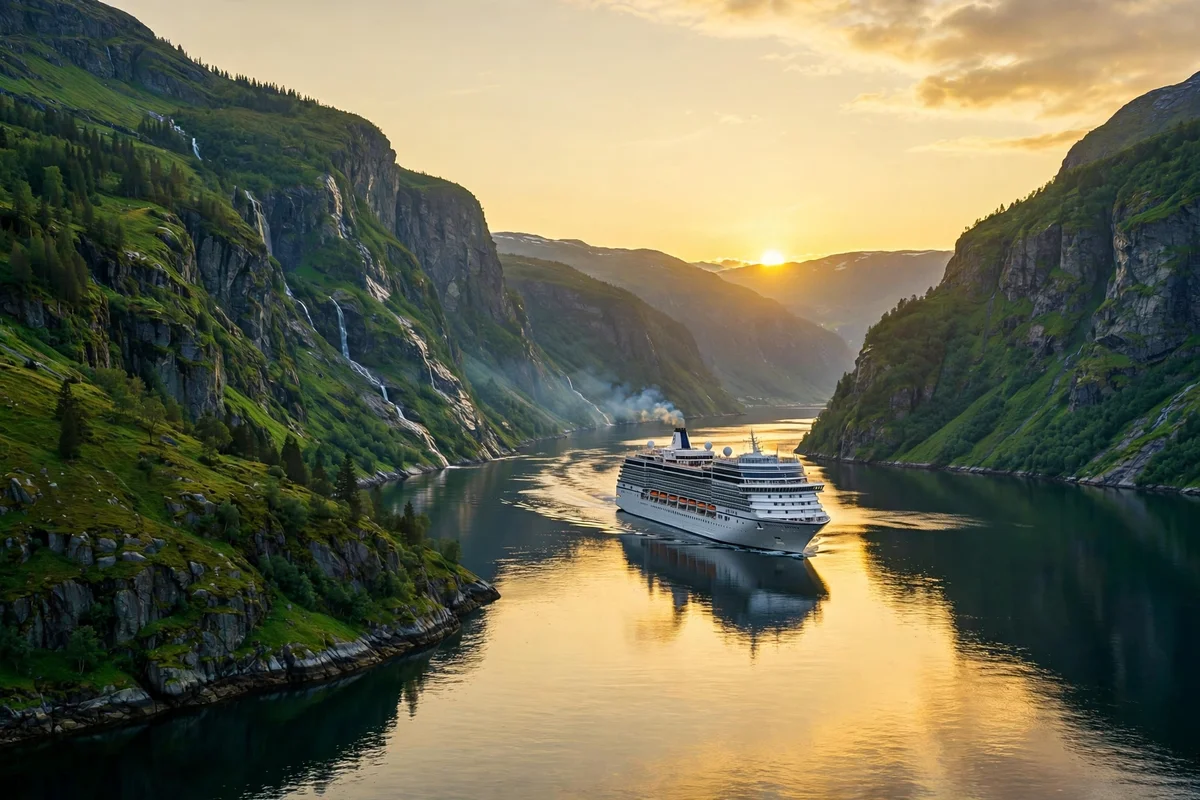
Midnight Sun Cruise Norway Guide: Where, When & How to See It
A midnight sun cruise is the only kind of cruise where the main event costs nothing, needs no ticket and cannot be cancelled by weather in the usual sense. Above the Arctic Circle, from late May to late July, the sun does not set at all. It circles the sky, dipping low toward the north at midnight and rising again without ever going below the horizon. From the deck of a ship you watch it happen over open water and steep fjord walls, in light that stays golden for hours.
The catch is geography. The fjords most first-time visitors picture, Geirangerfjord and Nærøyfjord, sit well south of the Arctic Circle, so they never get a true midnight sun. To see the sun at midnight you have to sail north, past Bodø and into the Lofoten Islands, Tromsø and the North Cape. That is a different cruise from the classic fjord sailing, and this guide covers how to choose between them.
For the wider seasonal choice, see our summer vs winter guide and our best time to visit guide.
When and where: the midnight sun dates
The midnight sun is a matter of latitude. The further north you go, the earlier it starts and the later it ends. The dates below are the standard figures published by Visit Norway, checked in November 2026. They shift by a day or two from year to year, and at the start and end of each period the sun only just grazes the horizon, so treat them as about, not exact to the day.
| Place | Latitude | Midnight sun | Length |
|---|---|---|---|
| North Cape (Nordkapp) | 71.2 degrees north | About 14 May to 29 July | About 11 weeks |
| Tromsø | 69.6 degrees north | About 20 May to 22 July | About 9 weeks |
| Lofoten Islands (Svolvær) | 68.2 degrees north | About 28 May to 14 July | About 7 weeks |
| Bodø | 67.3 degrees north | About 4 June to 8 July | About 5 weeks |
| Arctic Circle | 66.5 degrees north | About 12 June to 1 July | About 3 weeks |
| Longyearbyen, Svalbard | 78.2 degrees north | About 20 April to 22 August | About 4 months |
South of the Arctic Circle there is no midnight sun in the strict sense, but the nights are still very bright. Bergen gets around 19 hours of daylight at the end of June, and in the fjords it never gets properly dark in June and early July, only a long blue dusk around midnight. If your cruise stays in the western fjords, that bright summer night is what you get, and for many travellers it is enough.
The safest window, if you can choose freely, is mid-June to early July. Every viewing point north of the Arctic Circle has midnight sun then, the weather is at its warmest, and you are centred on the summer solstice on 21 June, when the sun sits highest at midnight. The edges of the season are riskier: in late May the sun is only just staying up, and by late July it is already setting again in Bodø and the Lofoten Islands, even though the nights stay bright to the eye.
One more date matters. The northern lights cannot be seen during the midnight sun, because the sky is far too bright for the aurora to show. Darkness does not return in Tromsø until the second half of August. You cannot have both on one trip, so pick the sky you want. Our northern lights cruise guide covers the dark-season alternative.
The ships and routes
There are three ways to see the midnight sun from a ship, and they suit different travellers.
The coastal voyage: Bergen to Kirkenes
The coastal voyage is the most reliable midnight sun cruise, because it sails every day of the year and spends the most time above the Arctic Circle. Hurtigruten and Havila sail Bergen to Kirkenes daily, calling at 34 ports, and the northbound leg crosses the Arctic Circle and then spends days in the midnight sun zone: Bodø, the Lofoten Islands, Tromsø and Honningsvåg, the port for the North Cape. The classic round trip is 12 days, northbound 7 days and southbound 6 days, and a summer sailing gives you several consecutive midnight suns rather than one.
The advantage of the coastal ships is time on deck at midnight. They are working ships, not floating resorts, so the deck is open, the light is the entertainment, and the ship sails through the Lofoten Islands and past the North Cape in the small hours. The trade is that the coastal route is not a fjord cruise in the classic sense: it calls at working ports, and the great western fjords, Geirangerfjord and Nærøyfjord, are not on its main route in summer, when the ships detour into Hjørundfjord instead. Our coastal express guide compares the Hurtigruten and Havila versions.
Google Maps: Tromsø
Google Maps: Bodø
Google Maps: Honningsvåg
Big-ship fjord cruises that go north
Some large cruise ships sail from the UK and northern Europe to the North Cape and the Lofoten Islands in summer, and those itineraries do give you the midnight sun. Others stay in the western fjords and never cross the Arctic Circle, so check the itinerary, not the brochure headline. The words to look for are Tromsø, Honningsvåg or North Cape, Lofoten, and a crossing of the Arctic Circle. If the ports are only Bergen, Flåm, Geiranger and Ålesund, you will get long bright evenings, not a midnight sun.
Big ships have the advantage of a full resort on board: restaurants, shows and a wide choice of cabins. The trade is that you see the midnight sun from a crowded deck or your balcony, and the ship may only spend one night in the midnight sun zone, so a cloudy midnight can cost you the whole experience. A coastal voyage gives you several nights to try again.
Expedition and small-ship cruises
Expedition ships and small coastal boats sail the Lofoten Islands and the northern fjords in summer, with Zodiac landings, kayaking and hikes ashore. These are the best option if you want to be on land at midnight, hiking a ridge or kayaking in golden light, rather than watching from a ship. They cost more per day than a big ship and carry far fewer passengers, so book months ahead for June and July. Our kayaking and RIB guide covers the small-boat excursions that run in summer.
What it is actually like at midnight
The midnight sun is not a sunset that lasts all night. Around 23:00 the light turns gold and the shadows stretch long. At midnight the sun is at its lowest, hanging just above the northern horizon, and the light is warm and sideways, the kind photographers wait all day for. Then it starts climbing again. By 02:00 it looks like late afternoon. There is no darkness in between, and no moment when the sky goes black.
On a ship, the best place to watch is the open deck on the north side, away from the ship’s own lights. Bring a warm layer: even in July the air at midnight in the north is cool, and the wind on deck cuts through a T-shirt. A hat and gloves are worth packing for a midnight deck watch, and a windproof jacket matters more than a heavy coat.
The strange part is not the light, it is the time. Your body expects dark, and without it you will not feel tired at 23:00. People stay up, walk the deck, order coffee at midnight and then wonder why they are exhausted the next day. The practical answer is routine, not willpower: decide a bedtime before you sail, draw the curtains, and treat midnight like evening, not like the middle of the night.
Where to watch: the best viewpoints
From the ship itself, the midnight sun is best where the horizon to the north is open water, not a fjord wall. That means the stretches between Bodø and Tromsø, the crossing to the Lofoten Islands, and the run to the North Cape, where the ship sails in open sea and the sun sits over the water at midnight.
If you go ashore, these are the viewpoints that reward the effort:
- Tromsø, Mount Storsteinen. The Fjellheisen cable car runs daily until midnight in season, from late May to late July, and the view from 421 metres covers the city, the fjords and the open horizon to the north. It is the easiest midnight sun viewpoint in Norway: a city base, a cable car, and a cafe at the top.
- Sommarøy, near Tromsø. A small island village about an hour west of Tromsø, with white sand beaches facing the open sea. It is the place to go for a midnight walk on a beach under the sun.
- The North Cape plateau. A 307-metre cliff at the top of mainland Europe, with nothing but sea between you and the North Pole. On a clear night the sun hangs over the Barents Sea at midnight. It is also the most exposed and the coldest viewpoint on this list, so dress for wind.
- Lofoten beaches. The north-facing beaches at Uttakleiv, Haukland and Skagsanden give you the sun over the sea with mountain ridges on both sides. Lofoten is the photographer’s choice, because the mountains frame the low sun.
- Bodø and the Saltstraumen area. The shortest midnight sun season on this list, but the easiest to reach from the south, and the maelstrom at Saltstraumen is at its strongest around the full and new moon.
Check the weather before you commit to a viewpoint. Cloud hides the sun even when it is technically above the horizon, and the coast is cloudy more often than the brochures suggest. A coastal voyage gives you several nights in the zone, which is the best insurance against one cloudy midnight.
You can book the Tromsø Summer Evening Cruise with Activities on Viator.
Sleeping, packing and photography
Sleep is the one thing most midnight sun travellers get wrong. Cabins on big ships often have blackout curtains, but light still leaks around the edges, and on a coastal ship the cabin can be bright at 02:00. Pack an eye mask, even if you never use one at home. It is the cheapest item on this list and the most useful. Earplugs help too, because the ship is active late and other passengers stay up.
Pack for two seasons at once. Days in July in the north average around 12 degrees in Tromsø, with lows around 9 and highs around 15, and Bergen and the fjords are warmer. That means a windproof shell, a warm mid-layer, and a hat, plus lighter clothes for a sunny afternoon on deck. Waterproofs are worth carrying: the fjord coast is showery even in summer. Sunglasses matter more than you expect, because the low sun sits in your eyes for hours at deck level.
For photography, the midnight sun is forgiving: the golden hour lasts for hours, not minutes. The sun is low and warm from about 21:00 to 03:00, so you have time to set up, move, and try again. The classic mistake is overexposing the sun itself; meter for the landscape, keep the sun near the edge of the frame, and use the fjord walls and the ship’s own shapes as foreground. A tripod helps on land, but on a moving ship a fast shutter matters more than a tripod. Our photography guide covers the best viewpoints and the settings that work from a ship.
Who a midnight sun cruise suits
A midnight sun cruise suits travellers who want long days outdoors, hiking, kayaking, fishing and walking at hours that would be dark anywhere else. It suits photographers, families with children who do not keep adult hours, and anyone who has always wanted to see the Arctic in summer. It suits first-time Norway visitors who want the fjords and the north in one trip, provided they pick an itinerary that actually goes north.
It does not suit everyone. If you sleep badly in light, or you need real darkness to feel rested, a week of midnight sun can leave you exhausted, even with an eye mask. If your main goal is the northern lights, this is the wrong season entirely: the lights are invisible from late May to late July. And if you want the fjords at their warmest and busiest, with every excursion running, the western fjords in July give you that without the Arctic crossing, and the long bright evenings there are close enough for most people.
If you can only take one Norway cruise, and the midnight sun is the reason, take the coastal voyage northbound in late June, give yourself at least a week, and plan your sleep like you plan your excursions. The sun will do the rest.
Frequently asked questions
When is the midnight sun in Norway?
It depends on latitude. In Tromsø the sun does not set from about 20 May to 22 July. At the North Cape it runs from about 14 May to 29 July, in the Lofoten Islands from about 28 May to 14 July, and in Bodø from about 4 June to 8 July. South of the Arctic Circle there is no true midnight sun, but Bergen still gets around 19 hours of daylight at the end of June.
Can you see the midnight sun from a fjord cruise?
Only if the cruise goes north of the Arctic Circle. A classic fjord cruise through Geirangerfjord, Nærøyfjord and Flåm stays south of the circle, so you get very long bright evenings, not a midnight sun. Look for Tromsø, the Lofoten Islands, Honningsvåg or the North Cape on the itinerary, or take the coastal voyage from Bergen to Kirkenes, which crosses the circle and spends days in the midnight sun zone.
What is the best month for a midnight sun cruise?
Late June, centred on the solstice on 21 June. Every viewing point has midnight sun then, the weather is at its warmest, and the sun sits highest at midnight. Early July is nearly as good. Late May and late July work at the edges of the season but the sun is only just staying up, and Bodø and Lofoten lose it by mid-July.
Can you see the northern lights on a midnight sun cruise?
No. The sky is too bright from late May to late July for the aurora to show, even when it is active. Darkness does not return in Tromsø until the second half of August, and the northern lights season runs from late August to early April. If the lights are the goal, take a winter cruise instead.
How do you sleep when the sun never sets?
Decide a bedtime before you sail and keep it. Pack an eye mask, draw the curtains fully, and avoid the deck after your bedtime. Cabins with blackout curtains help, but light leaks around the edges, so the mask matters more than the cabin grade. Most people adjust in two or three nights.
Is a midnight sun cruise expensive?
It is a peak-season trip, so expect peak-season prices: June and July are the most expensive months for Norwegian cruises, and Tromsø hotels and the most popular excursions book up months ahead. The coastal voyage is usually cheaper than a large cruise ship for the same number of nights, and travelling in late May or early July rather than the last two weeks of June can cut the cost. Book accommodation and the Fjellheisen viewpoint early if Tromsø is on your route.
One Comment