Norway Cruise Photography & Viewpoints Guide
The best fjord photography comes from four places: Stegastein, the glass platform 650 metres above the Aurlandsfjord; Flydalsjuvet, the roadside viewpoint above Geiranger; Dalsnibba, the mountain skywalk at 1,476 metres; and the water itself, where the Seven Sisters waterfall and Preikestolen are best seen from a boat. The light matters as much as the place: summer evenings are long and low, and winter days are short and blue.
You do not need a professional camera to photograph the fjords well. A phone is enough for most of the classic shots, and it is better than a camera in rain, on a small boat and at a crowded viewpoint. What you need is the right place at the right time, a clean lens, and a plan for the weather.
The viewpoints you can drive to
Stegastein
Stegastein is the best fjord viewpoint in Norway for a first-timer, because it is dramatic and easy. A wooden platform runs 30 metres out from the hillside and ends at a frameless glass wall, 650 metres above the Aurlandsfjord, with the fjord running north to south below you. The road from Aurland is cleared all year, so Stegastein works in winter too, and the platform is free to walk onto.
The best light is late afternoon, when the sun is low over the fjord and the water turns dark blue. Arrive early and the fjord is in shade; arrive at sunset in summer and the light is warm on the far wall. The platform is narrow and it gets busy, so step to the end, take your shot, and step back. A wide lens, or your phone’s widest setting, is what the view needs: the fjord is long, and a narrow lens cuts it off.
Flydalsjuvet
Flydalsjuvet is the closest viewpoint to Geiranger village, about 4 km away on the road towards Stryn, and it is the easiest to reach and the busiest. It hangs over the fjord with a straight-down view of Geiranger and the ships below, and it has the much-photographed rock ledge known as the Queen’s Chair. The viewpoint is free and roadside, and it is best in the afternoon and evening.
Flydalsjuvet is the classic cruise-ship photograph: the fjord, the village and the ship in one frame, if there is one in port. It is also the most crowded viewpoint in Geiranger, because every coach tour stops here. Go early in the morning or late in the evening and you will have it mostly to yourself. The ledge is the shot everyone wants, but the view from the rail is just as good, and it is safer.
Dalsnibba
Dalsnibba is the big one: 1,476 metres above sea level, with a glass-floored skywalk that looks out over the fjord, the village and the mountains behind. It is the highest fjord viewpoint in Europe you can drive to, and on a clear day it is the best view in the Geiranger area. The road up is a narrow toll road that climbs from Djupvasshytta, opens in May depending on the weather, and is closed in winter. The toll is around NOK 380 per car.
The best light at Dalsnibba is midday: at 1,476 metres the sun is high and the shadow is not the issue; cloud is. When cloud sits on the mountain, check the weather before you drive up, and do not go if the summit is in cloud. Bring layers: Dalsnibba is much colder and windier than the village. A polarising filter cuts the glare off the water and deepens the blue of the fjord.
Ørnesvingen, the Eagle Bend
Ørnesvingen, the Eagle Bend, is at 620 metres on the Eagle Road, the highest of the road’s eleven hairpin bends. From here you look straight down the fjord towards the Seven Sisters on one side and the Suitor on the other, with the whole width of the fjord in one frame. It is on the road to Eidsdal, so you pass it on the way in or out if you drive from Ålesund. The descent has a 10% gradient, so use low gear on the way down.
The Eagle Bend is best in the morning, when the light is on the Seven Sisters, and it is quieter than Flydalsjuvet because the coaches do not all stop here. It is a good place for a panorama: the fjord is wide here, and a phone panorama captures the full width that a single frame misses.
The views from the water
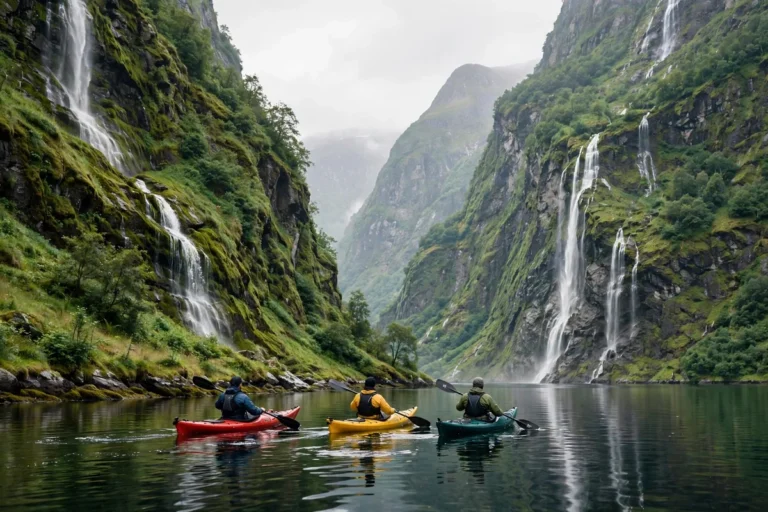
Some fjord views only work from a boat. The Seven Sisters waterfall, the Preikestolen cliff and the Nærøyfjord walls are all better from the water, because the scale only makes sense when you are small beside it.
The Seven Sisters
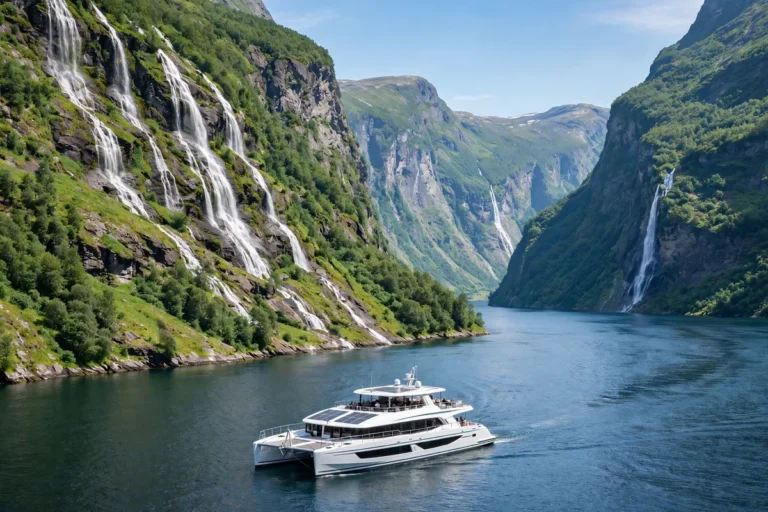
The Seven Sisters fall in seven streams down the north wall of Geirangerfjord, from a total height of 410 metres, with the longest single drop about 250 metres. Directly opposite is the Suitor, and further along the fjord is the Bridal Veil, a thin fall that catches the afternoon light. The sightseeing boats from Geiranger village pass all three.
The waterfalls are at their strongest in May and June, when the snow is melting. By late summer the falls are thinner, and in a dry year some of the seven streams disappear. Photograph them from the boat’s open deck, not through the window: the glass adds reflections, and the spray adds spots. Wipe the lens before each shot, and keep the camera under your jacket between shots.
Preikestolen from below
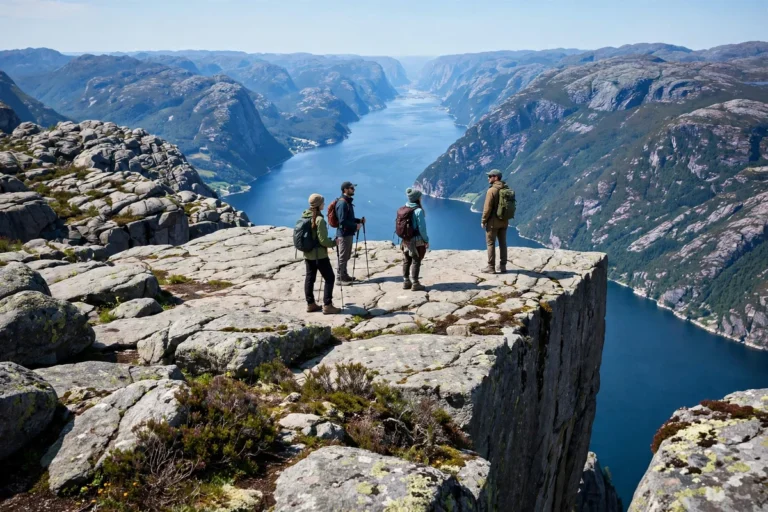
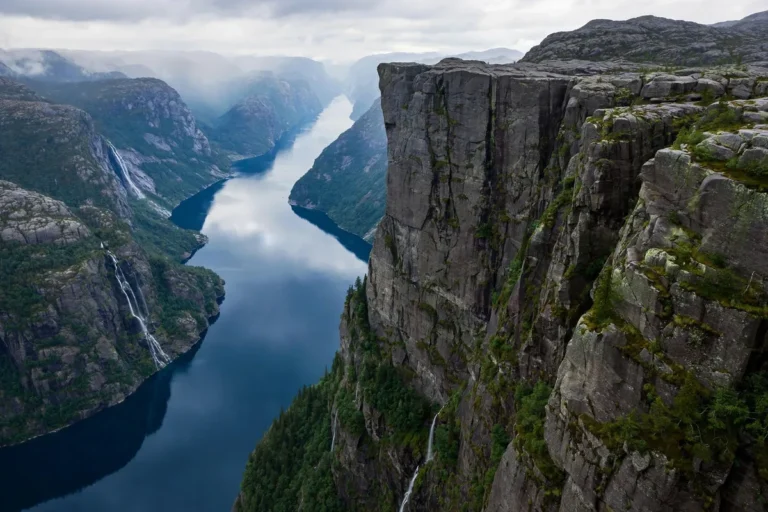
Preikestolen, the Pulpit Rock, rises 604 metres directly above the Lysefjord, and the best way to photograph it is from the water. The Lysefjord cruise from Stavanger sails up the 42 km fjord to below the cliff and back in three to three and a half hours, passing the Hengjanefossen waterfall and the Vagabond’s Cave. From the boat, the cliff fills the frame, and the scale of the rock is obvious in a way it never is from the top.
The cliff is best in the morning, when the sun is on the rock face, and the cruise is best on a clear day, when the top is not in cloud. A wide lens is what the shot needs, and a phone is often better than a camera here, because the boat is moving and the cliff is close.
The Nærøyfjord walls
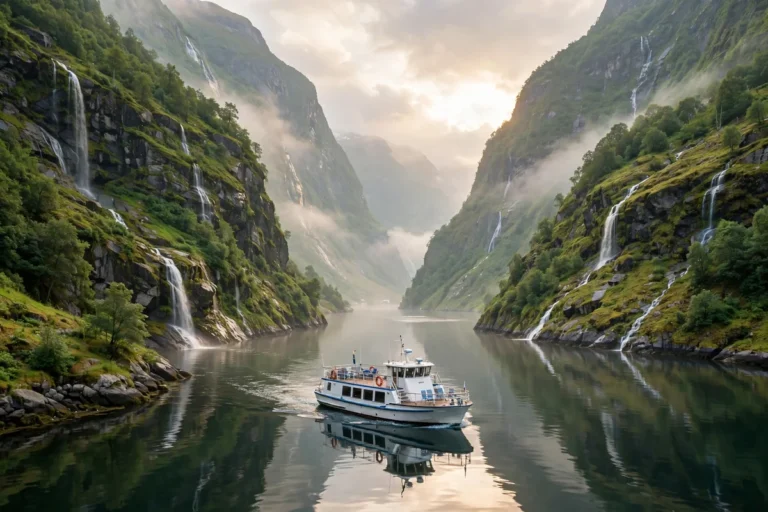
The Nærøyfjord is the narrowest fjord in Norway, about 18 km long and just 250 metres wide at its narrowest, with cliffs rising 1,700 metres on both sides. The boat from Flåm to Gudvangen is electric, quiet and low in the water, and the crossing takes about two hours one way. The walls are so close that a wide lens is the only way to get them in.
The light in the Nærøyfjord is tricky, because the cliffs shade the water for much of the day. Midday is the best time, when the sun is high enough to reach the water, and a cloudy day is not a bad day here: the soft light suits the green water and the dark rock better than harsh sun.
The Mostraumen strait
The Mostraumen cruise from Bergen sails through the Osterfjord, 27 km long, to the narrow strait at Mostraumen, where the boat squeezes through a tidal passage and passes under a waterfall. The strait is the shot: the rock walls close in, the water quickens, and the boat feels small. It is a three to three and a half hour cruise, and it runs all year, so it is the best fjord photography in winter.
Light: golden hour, midnight sun and winter
The fjords are a light problem before they are a camera problem. The mountains are high, the fjords run north to south, and the sun is low for much of the year, so the light changes fast.
In summer, the evenings are the best time: the sun stays low for hours, the light is warm on the cliffs, and the water turns dark blue. In late June the sun sets after 11 pm in the north. In Tromsø the sun does not set at all from 20 May to 22 July, and the midnight sun gives you golden light at midnight.
In winter, the light is low all day: the sun barely clears the mountains, the days are short, and the blue hour lasts longer than in summer. In Tromsø the sun does not rise from 28 November to 14 January, and the midday light is a blue twilight that suits the fjords well.
Shoot in the morning and the evening, and use the middle of the day for the boat, the train and the viewpoints that face the sun. Check the weather before you go to a mountain viewpoint: cloud on Dalsnibba or Stegastein ruins the shot.
Phone vs camera
A phone is enough for most fjord photography, and it is better than a camera in rain, on a small boat and at a crowded viewpoint. A phone is waterproof, it fits in a pocket, and its widest lens is wide enough for the fjords. Use the widest lens for the fjord, the standard lens for the village, and the zoom only for the waterfalls.
A camera is better when you want control: a polarising filter to cut the glare off the water, a longer lens for the waterfalls and the birds, and a tripod for the midnight sun and the northern lights. If you bring a camera, bring a zoom that covers the wide end as well as the long end, because changing lenses on a boat in spray is a bad idea.
Whatever you shoot with, clean the lens. Spray from the boat, rain on the viewpoint and fingerprints on the phone are the most common reason fjord photographs come out soft. Wipe the lens before each shot, and keep a lens cloth in a pocket, not in the bag.
What to pack
Pack light, because you will carry it on boats, trains and viewpoints. A phone and a power bank are the minimum: the cold drains batteries faster than you expect. A lens cloth, a waterproof bag for the boat, and a spare battery are the essentials.
Add layers and a waterproof jacket: the weather on the water is colder than the town. Add a hat and gloves in winter, and sun protection in summer, because the sun reflects off the water. A small tripod is worth it for the northern lights or the midnight sun, and binoculars are worth it for Runde.
Photographing from a cruise ship
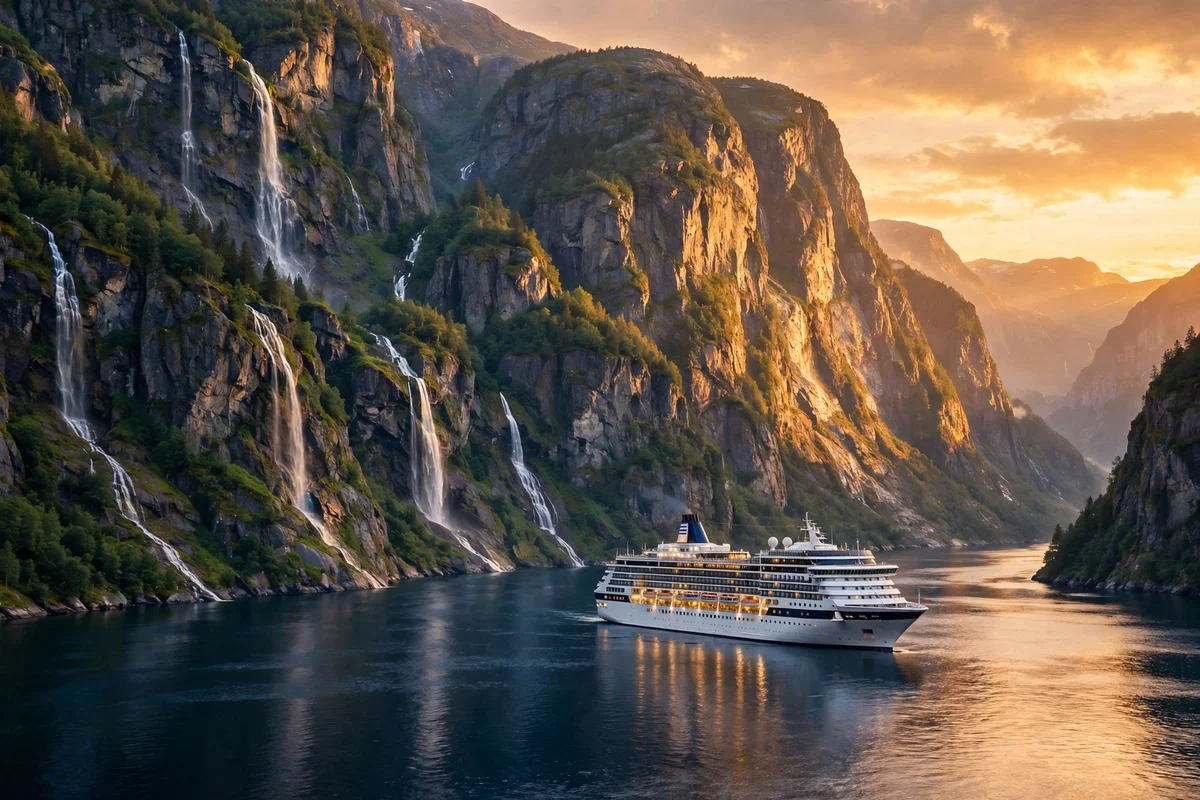
Photographing from a cruise ship is different from photographing from a small boat, because the ship is bigger, higher and slower. The best place is the open deck at the bow, where the view is unobstructed. The worst place is through the cabin window, where the glass adds reflections and the view is cut off.
Shoot early and late, when the light is low and the ship is moving slowly through the fjord. The rail is not a tripod: hold the camera steady, lean against the rail, and take several shots of the same scene, because the ship moves and the framing changes. In port, get off the ship and photograph it from the shore: the ship in the fjord, with the cliffs behind it, is a better photograph than the fjord from the ship.
What to skip
Skip midday for mountain viewpoints; the light is flat. Skip the cabin window; go to the open deck. Skip changing lenses on a boat in spray. Skip the idea that a bigger camera means a better photograph; the best fjord photographs are taken with a phone, at the right place, at the right time.
Finding your way around
Key map links for the viewpoints:
- Stegastein, the glass platform 650 metres above the Aurlandsfjord
- Flydalsjuvet, the viewpoint above Geiranger village
- Dalsnibba, the mountain skywalk at 1,476 metres
- Ørnesvingen, Geiranger, the Eagle Bend on the road to Eidsdal
- Preikestolen, the cliff above the Lysefjord, best seen from the water
- Flåm Station, the start of the Nærøyfjord boat and the Flåm Railway
The viewpoints, compared
| Viewpoint | Height | Access | Cost | Season | Best light |
|---|---|---|---|---|---|
| Stegastein | 650 m | Drive or bus from Aurland | Free, road open all year | Year-round | Late afternoon |
| Flydalsjuvet | About 365 m | Drive, 4 km from the village | Free | All year | Afternoon and evening |
| Dalsnibba | 1,476 m | Drive, toll road | Around NOK 380 per car | Roughly late May–late Sep | Midday |
| Ørnesvingen | 620 m | Drive on the Eagle Road | Free | May–Oct | Morning |
| Preikestolen from the water | 604 m cliff | Lysefjord cruise from Stavanger | Cruise fare | Year-round | Morning |
| Seven Sisters from the water | 410 m falls | Geirangerfjord sightseeing boat | Cruise fare | 1 Jun–30 Sep | Afternoon |
Frequently asked questions
What is the best viewpoint in Norway for fjord photography?
Stegastein, for drama and accessibility: 650 metres above the Aurlandsfjord, reachable by car all year, free to walk onto, and best in the late afternoon. Flydalsjuvet is the best roadside viewpoint in Geiranger, and Dalsnibba is the best on a clear day.
Can I photograph the fjords with a phone?
Yes. A phone is enough for most of the classic shots, and it is better than a camera in rain, on a small boat and at a crowded viewpoint. Use the widest lens for the fjord, clean the lens before each shot, and bring a power bank.
What is the best time of day to photograph the fjords?
Morning and evening, when the sun is low and the light is warm on the cliffs. Midday is best for the Nærøyfjord, where the cliffs shade the water, and for Dalsnibba, where cloud is the issue. In summer the evening light lasts for hours; in winter the blue hour lasts longer.
Is Dalsnibba worth it for photography?
On a clear day, yes: it is the highest fjord viewpoint in Europe you can drive to, at 1,476 metres, and the view is the best in the Geiranger area. In cloud, no: check the weather before you drive up.
How do I photograph the Seven Sisters waterfall?
From the sightseeing boat, on the open deck, not through the window. The falls are at their strongest in May and June, when the snow is melting. Wipe the lens before each shot, because the spray spots it.
What should I pack for fjord photography?
A phone and a power bank, a lens cloth, a waterproof bag for the boat, layers and a waterproof jacket. A small tripod is worth it for the northern lights and the midnight sun.