
Borgund & Urnes Stave Churches: Visiting Norway’s Wooden Churches
Two wooden churches, built within about fifty years of each other in the 1100s, still stand on the shores of the Sognefjord: one is the best preserved stave church in Norway, the other the only stave church on the UNESCO World Heritage List. Together, Borgund and Urnes give you the clearest picture anywhere of what medieval Norway built, believed and carved, and both are easy to reach on a Sognefjord road trip.
A stave church is a timber church built around upright posts, called staves, set into a frame of sills and wall plates. The technique grew out of Viking Age shipbuilding and timber craft. At one time there were more than a thousand stave churches in Norway; today only 28 survive, according to UNESCO, and two of the finest stand within a day’s drive of each other in the inner Sognefjord. If you are planning a trip around the Sognefjord, these two churches deserve a place on the route.
Borgund stave church: the best preserved of them all
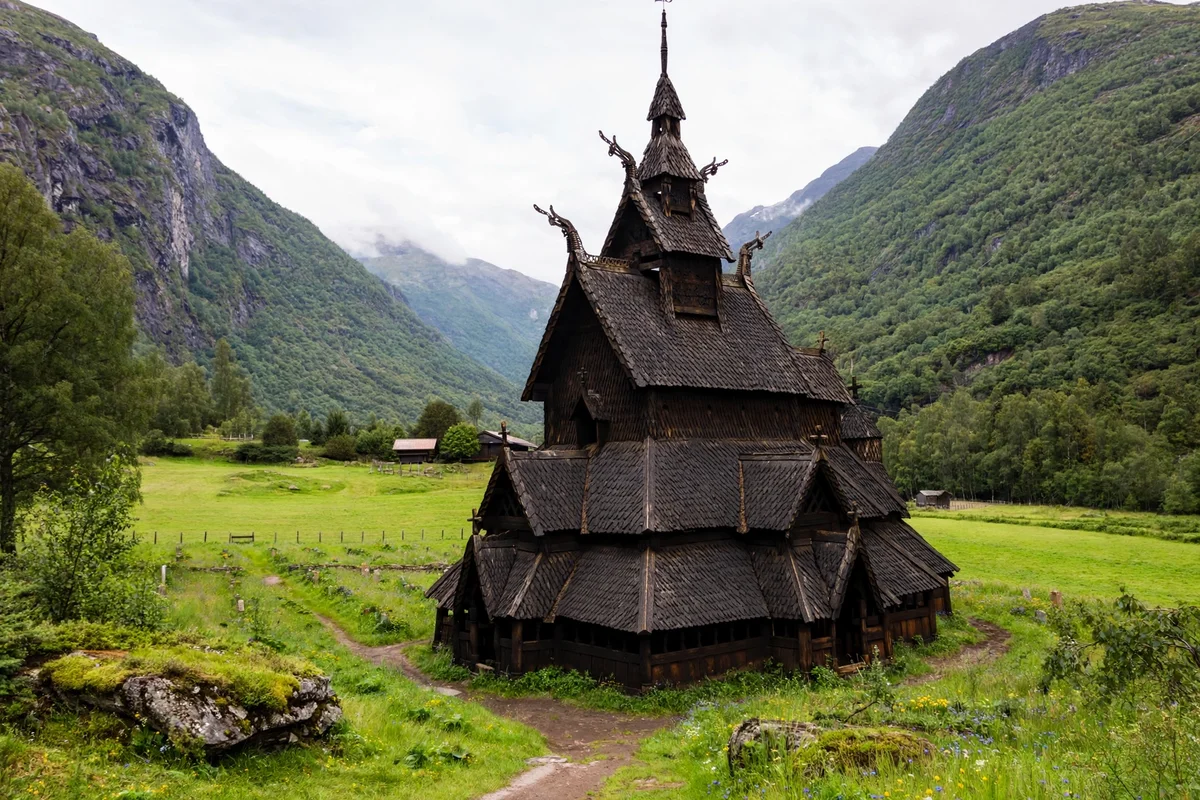
Borgund stave church stands in the village of Borgund in Lærdal municipality, in the Lærdal valley at the eastern end of the Sognefjord. Built around 1180 and dedicated to the Apostle Andrew, it is widely described as the best preserved of the 28 stave churches that survive in Norway, and it is often used as the model when other stave churches are restored.
What you see first is the roof. Tier upon tier of dark, tarred shingles rises in steps above the walls, topped by a small tower, with carved dragon heads along the ridge. The church is a triple-nave stave church of the Sogn type: a raised central room with lower aisles around it, all carried on massive wooden posts. The west portal, the main entrance, is richly carved, and runic inscriptions survive on the walls inside, left by medieval visitors. The church grounds also hold Norway’s only surviving free-standing stave-built bell tower.
You can book the Flåm Tour: Borgund Stave Church, Lærdal & Stegastein on Viator.
Borgund stopped being a working parish church in 1868, when a new church was built a short distance away. That move probably saved it. Many stave churches were demolished in the 1800s once they were replaced, but Borgund was bought in 1877 by Fortidsminneforeningen, the Society for the Preservation of Ancient Norwegian Monuments, which still owns and runs it as a museum. Most of the post-Reformation pews and pulpit have been removed, so the interior is closer to its medieval form than most churches you will see.
The visitor centre
Your ticket includes the visitor centre beside the church, with an exhibition about the role of stave churches in medieval religious life and a second exhibition, “Unique Viking Finds”, showing finds from the early Viking Age, dated to the 9th century. There is also a cafe and a souvenir shop, and note that the cafe and toilets sit inside the ticket area. Plan on 45 to 90 minutes for the church and the centre together.
Borgund opening hours and tickets
Borgund is a seasonal site. The official site published the following for 2025: open daily from 16 April to 12 October, 09:30 to 17:00, with shorter hours of 10:00 to 14:00 on 12 October, and closed on 17 May (Constitution Day) and 30 September. The 2026 season had not been published on the official site at the time of writing, so confirm the current dates at stavechurch.com before you travel.
Published 2025 ticket prices were NOK 130 for adults, NOK 110 for seniors over 65, NOK 90 for children under 16 and students, and NOK 300 for a family ticket. Individuals can buy tickets on arrival; groups of ten or more pay NOK 130 per person, must book in advance, and the last group tour runs at 16:45.
Getting to Borgund
Borgund sits directly on the E16, the main highway between Oslo and Bergen, which makes it one of the easiest stave churches in Norway to reach by car. It is about 28 kilometres from the centre of Lærdal, the small fjord town at the end of the Lærdalsfjord, and roughly an hour’s drive from Flåm, the fjord village at the end of the Aurlandsfjord, through the Lærdal Tunnel, at 24.5 kilometres the longest road tunnel in the world. In summer you can take the older Aurlandsvegen, or Snow Road, instead of the tunnel.
Public buses run between Flåm, Lærdal and Sogndal, with a few departures a day stopping near Borgund, so it is possible without a car if you plan around the timetable, and guided bus tours from Flåm stop at Borgund in summer. If you are building a wider Norway fjords road trip, Borgund fits naturally between Flåm and the eastern fjord villages, and it pairs well with a stop in Lærdal itself, a village of well-preserved wooden houses on the fjord shore.
Google Maps: Borgund stave church
Google Maps: Lærdal
Walk a stretch of the King’s Road
Right beside the church runs Vindhellavegen, a restored section of the Kongevegen, the King’s Road over Filefjell, the historic route that connected eastern and western Norway for centuries. The restored stretch won the Vakre vegar (Beautiful Roads) prize in 2014 and a European heritage prize from Europa Nostra in 2017. Allow at least an hour to walk a proper section of it.
Urnes stave church: the UNESCO-listed original
Urnes stave church stands on a hillside at Ornes, on the eastern shore of the Lustrafjord, the narrow arm of the Sognefjord that runs north toward the Jostedalsbreen ice cap. Built around 1130, it is the oldest surviving stave church in Norway, and in 1979 it became the only stave church ever placed on the UNESCO World Heritage List.
Urnes is the fourth church on this exact spot. Excavations have shown that two earlier earth-bound churches stood here before, the first built around 950, and the present building reuses carved wood from a church built in the 1070s. The most famous reused pieces are the carved panels of the north portal, which give their name to the “Urnes style”, the final phase of Viking Age animal ornament in Scandinavia: interlaced animals, serpents and a large lion-like creature locked in combat, in a flowing, ribbon-like style that art historians still use as the reference point for the period. UNESCO listed it under three criteria, for its architecture and for the large-scale reuse of elements from the earlier church.
Inside, the church is small and plain compared with Borgund, but the details repay attention: richly decorated cubic capitals on the stave posts, a Romanesque calvary group from around 1150, a 12th-century bishop’s chair and baptismal font lid, and a candlestick shaped like a Viking ship. The altarpiece dates from 1699. Fortidsminneforeningen has owned the church since 1881, and although it is no longer a regular parish church, it is still used for baptisms and weddings.
Unlike Borgund, Urnes has no large visitor centre: tickets are sold from a small white ticket house a short walk from the church, and the interior can only be seen on a guided tour of roughly 20 minutes, so build the tour into your schedule.
Urnes opening hours and tickets
The 2026 season at Urnes ran from 2 May to 30 September, open daily from 10:30 to 17:45, and closed on 17 May for Constitution Day. The official site still showed 2024 prices (adult NOK 130, senior NOK 110, family NOK 300, child and student NOK 90), while a 2026 visitor guide reported adult admission at NOK 150 and senior admission at NOK 130. Confirm the current price at stavechurch.com before you travel.
Getting to Urnes: the Solvorn ferry
Most visitors reach Urnes by ferry. The Solvorn to Ornes crossing is run by Lustrabaatane AS and takes about 20 minutes across the Lustrafjord, with tickets sold on board and no pre-booking. The ferry carries cars as well as foot passengers, but capacity is limited to 11 cars, so in peak season cars may have to wait for a later sailing. In summer, sailings run roughly hourly from 10:00 to 16:50, with earlier weekday departures from around 07:10. The ferry runs all year, but the church interior is only open in season.
Reported 2026 one-way fares were NOK 70 for an adult, NOK 35 for a child aged 4 to 16, NOK 200 for a car up to 6 metres, NOK 410 for a car of 6 to 7 metres, and NOK 125 for a motorcycle or moped. Confirm the current timetable and fares at en.lustrabaatane.no on the morning of your crossing.
Solvorn is about 45 minutes by road from Sogndal along the Rv55, and roughly 1 hour 30 minutes from Flåm via Aurland and Lærdal. From the Ornes ferry landing it is about a 10-minute walk uphill to the church. Budget about three hours for the round trip from Solvorn: the crossing, the walk up, the guided tour, the walk down and the crossing back. That makes Urnes a half-day visit, not a quick photo stop.
Google Maps: Urnes stave church
Google Maps: Solvorn
Google Maps: Sogndal
Visiting both churches in one trip
Borgund and Urnes sit on different arms of the same fjord system, and visiting both takes at least two days if you want to do them properly. Base yourself in Flåm or Lærdal for Borgund, you can ride the Flåm Railway one day and drive to Borgund the next, then move to Sogndal or Solvorn for Urnes, with the ferry an easy morning trip.
If you can only visit one, the choice depends on what you want. Borgund is the better pick for architecture and ease: the best preserved, with a visitor centre, and it sits on a main road. Urnes is the better pick for history and atmosphere: older, UNESCO-listed, with unique carvings, and the ferry crossing and the walk up make the arrival feel like part of the visit. Both churches are open from late May to September, the best time to visit the Norway fjords, when ferry and road connections run at their fullest.
The two churches also sit inside a wider medieval landscape. Hopperstad stave church, at Vik on the southern shore of the Sognefjord, was built around 1130 and restored in the 1880s and 1890s using Borgund as its model; it is the only preserved stave church whose original medieval chancel screen is still intact. Kaupanger stave church, near Sogndal, was built in the mid-12th century, is still in use as a parish church, and is the largest of the stave churches in the Sogn region. Neither is a substitute for Borgund or Urnes, but together the four churches show how one building tradition was adapted from village to village. The wider Viking Age story of the fjords continues in our guide to Viking sites in Norway.
Google Maps: Vik i Sogn
Google Maps: Flåm
Practical tips for visiting stave churches
Wear sturdy shoes: the ground at both churches is uneven, the walk up to Urnes is steep, and the King’s Road path at Borgund is a proper hillside trail. Bring a light jacket even in summer, since the interiors are unheated and the fjord wind at Ornes is cold. At Urnes, arrive by mid-morning: a 10:00 ferry from Solvorn puts you at the church for one of the first guided tours, when groups are smallest.
Photography rules vary, and flash and interior photography are commonly restricted at Fortidsminneforeningen properties, so ask the guide before you take photos inside. Remember that these are consecrated buildings and burial grounds, not just museums: the churchyard at Urnes holds grave markers spanning several centuries, and both churches are still used for occasional services and ceremonies, so keep voices low and stay on the paths.
Finally, treat opening hours and prices as seasonal. Both churches close outside the summer season, both close on 17 May, and both have changed their prices in recent years. The figures here were verified against the official stavechurch.com pages and 2026 visitor guides, but the official site is the final word, so check it before you travel, along with the ferry timetable at en.lustrabaatane.no.
Borgund and Urnes are not the biggest sights on the Sognefjord, and they do not need to be. They are two small wooden buildings that have outlasted nearly everything built around them, and standing inside them is the closest most travellers will come to the Norway of the 1100s.
Frequently asked questions
How old is Borgund stave church?
Borgund stave church was built around 1180, according to its official site, which makes it more than 840 years old. Some sources give a wider dating range of 1180 to 1250, but around 1180 is the date the church itself uses. It was dedicated to the Apostle Andrew and served as the village church of Borgund until 1868.
Is Borgund stave church UNESCO listed?
No. Borgund is not individually on the UNESCO World Heritage List. Urnes is the only stave church with that status, listed in 1979. Borgund is protected as a Norwegian cultural heritage site and is widely described as the best preserved stave church in Norway. Fortidsminneforeningen, the Society for the Preservation of Ancient Norwegian Monuments, bought it in 1877 and still runs it.
How do I get to Urnes stave church?
Take the Solvorn to Ornes ferry across the Lustrafjord, run by Lustrabaatane AS. The crossing takes about 20 minutes, tickets are sold on board, and there is no pre-booking. In summer, sailings run roughly hourly from 10:00 to 16:50, and from the Ornes landing it is about a 10-minute walk uphill to the church. Solvorn is about 45 minutes by road from Sogndal. The ferry runs all year, although the church interior is only open from 2 May to 30 September.
Can you go inside Borgund stave church?
Yes. Your ticket includes entry to the church and the visitor centre beside it, which holds exhibitions on stave churches in medieval religious life and on early Viking Age finds, and individual visitors can buy tickets on arrival. The interior is small and most of the post-Reformation fittings have been removed, so you see the medieval timber construction, the stave posts and the runic inscriptions. At Urnes, by contrast, the interior can only be seen on a guided tour of about 20 minutes.
How much does it cost to visit Borgund and Urnes?
Borgund’s published 2025 prices were NOK 130 for adults, NOK 110 for seniors over 65, NOK 90 for children under 16 and students, and NOK 300 for a family ticket. For Urnes, the official site showed 2024 prices of NOK 130 for adults and NOK 110 for seniors, while a 2026 visitor guide reported NOK 150 and NOK 130. Add the Solvorn to Ornes ferry, reported at NOK 70 one way for an adult in 2026. Confirm current prices at stavechurch.com and en.lustrabaatane.no before you travel.
Can I visit both stave churches in one day?
It is possible but rushed, and two days is a better plan. Borgund is about an hour’s drive from Flåm, while Urnes needs a half day from Sogndal or Solvorn once you count the ferry crossings, the walk up and the guided tour. A practical split is Borgund from Flåm or Lærdal on one day, then Urnes from Sogndal or Solvorn on the next. If you only have one day, pick Borgund for ease of access or Urnes for the UNESCO-listed carvings and the ferry crossing.





3 Comments