Norwegian Christmas Gifts: What Norwegians Give and How Giving Works
If you want to understand norwegian christmas traditions gifts, start with the timing. In Norway, the main Christmas celebration is Julaften, Christmas Eve, 24 December, not Christmas morning. The family eats its main dinner that evening, holds hands and dances round the Christmas tree, and only then opens the presents. Children wait all day for that moment, and in many families the wait is the point: the gifts arrive after dinner, in the evening, with the whole family gathered to watch each one being opened.
There is no single official list of what Norwegians give at Christmas. What lands under the tree depends on the family and how much it wants to spend. This guide explains how giving works instead: when the presents are opened, who brings them, what kinds of gifts turn up most often, what happens at a work Christmas party, where a visitor can buy a genuinely Norwegian gift, and what to bring if you are invited to a Norwegian Christmas dinner.
Norwegian Christmas Gifts at a Glance
| Part of giving | When | What happens |
|---|---|---|
| Advent calendars | 1 to 24 December | One small gift or sweet each day, often a calendar filled at home |
| Julebord gift exchange | November to December | A small gift for one colleague, often drawn by name in advance |
| Julaften dinner | 24 December, about 5pm | Family dinner, then dancing round the tree |
| The julenisse arrives | 24 December, after dinner | He knocks at the door with a sack of presents |
| Presents opened | 24 December evening | Opened one by one, with the family watching |
| Romjul visits | 25 December to New Year | Small gifts for hosts, and sweets for children going julebukk |
When the presents are opened
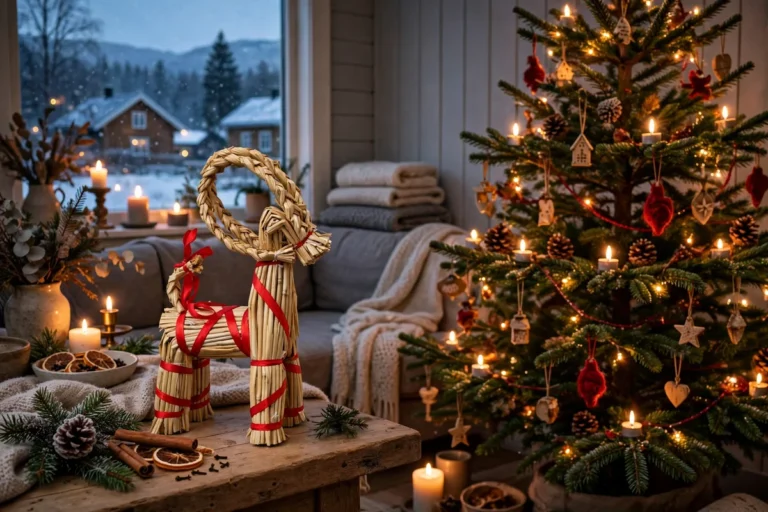
Gifts in Norway are opened on Christmas Eve, after dinner and after dancing round the tree. That order matters, and it is the same order our guide to Norwegian Christmas traditions follows: dinner at about 5pm, when the church bells ring Christmas in, then the family holds hands and walks round the tree singing carols, and then the presents come out.
The presents are usually placed under the tree before dinner. In many families, children may open one present before dinner, to make the wait bearable, and the rest wait until after the meal. Once the opening starts, it is unhurried: presents are opened one by one, with the whole family gathered to watch.
Christmas Day itself, 25 December, is quiet and private. There is no second round of presents in the morning, and shops stay closed.
The julenisse: he knocks at the door
The julenisse brings the presents on Christmas Eve. Today he looks much like the international Santa Claus: red suit, black boots, white beard and red hat. What is different is how he arrives. He does not come down the chimney in the night. He knocks at the front door in the evening, walks in carrying a sack full of presents, and asks whether there are any good children here.
The City of Oslo describes it in the same way: after Christmas dinner on 24 December, children wait for the julenisse to knock on the door with gifts, and the gifts are usually handed out in person on Christmas Eve rather than left under the tree overnight. In some families a relative plays the part, slipping out just before the knock and returning in costume, and children sing a song before they get their gift. When the sack is empty, he leaves through the door, as he came.
The julenisse as a Santa figure only became part of Norwegian tradition towards the end of the 1800s. The fjøsnisse, the barn nisse, is far older: a small farm spirit who lives in the barn, looks after the animals, and is given a bowl of porridge, nissegrøt, on Christmas Eve. He does not bring presents. He guards the farm.
Children also leave porridge out for the fjøsnisse: a bowl of risengrynsgrøt, rice porridge with butter, sugar and cinnamon, put out on Christmas Eve.
What Norwegians typically give
There is no fixed Norwegian Christmas gift list, and any article that prints one as settled fact is inventing it. What follows is the pattern that turns up again and again in descriptions of Norwegian giving: practical gifts, gifts made by hand, food, books and experiences, chosen for the person rather than for show.
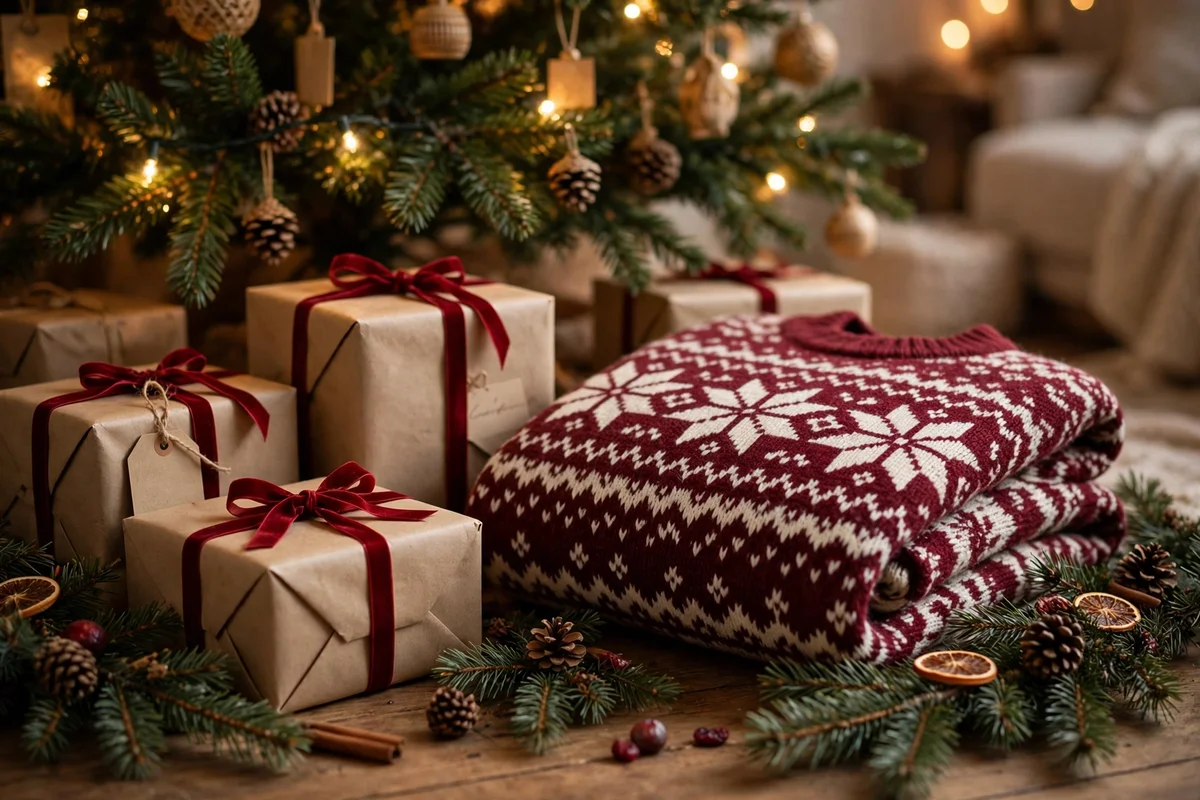
The strongest theme is practicality. Norway is a cold, outdoor country, and a gift that is warm, durable and useful is valued more than a gift that is only decorative. Knitwear is the clearest example: a Norwegian wool sweater, mittens, a hat or a scarf, often in a traditional pattern. The best known pattern is the Marius sweater, the Mariusgenser, designed in 1953 and inspired by the older Setesdal sweater, with its bands of red, white and blue, the colours of the Norwegian flag. More than five million copies of the Marius pattern have been sold, according to the pattern’s history, and the sweater is still knitted at home by grandmothers and sold in shops across Norway. A hand-knitted sweater is a substantial gift, and it is also a personal one: it takes hours to make, and the giver chose the pattern and the colours.
Food is a common gift. Smoked salmon, brunost, the brown cheese, cured meats, aquavit and a tin of home-baked pepperkaker all travel well and are eaten rather than stored. A tin of the seven Christmas cookies, syv slag, or a loaf of julekake, the Christmas bread, is a gift of time as much as of food. Our guide to Norwegian Christmas food has the full story.
Books are a frequent gift, and they fit the long dark evenings. A book is easy to wrap, easy to choose for a known reader, and it is read in the quiet days of romjul, between Christmas and New Year. This is a Norwegian habit, not a borrowed one from Iceland, where the book-giving evening has its own name and history.
Handmade gifts have a place that bought gifts do not always reach. A knitted garment, a carved wooden figure or a hand-painted ornament says that the giver spent time, not only money. That matters where the unwritten rule of Janteloven, the idea that nobody should put themselves above others, makes showy gifts uncomfortable. A thoughtful, modest gift lands better than a lavish one.
Experiences are increasingly common for adults who already have what they need: a ski pass, a concert ticket or a weekend trip needs no wrapping and adds no clutter. For children, the pattern is simpler: toys, games, books, clothes and sweets.
Grandparents, godparents, aunts and uncles also give presents, so the pile under the tree can be large in a big family. The opening is still one by one, so a large pile takes a long evening.
Advent calendars: a small gift every day
Giving in Norway does not start on Christmas Eve. It starts on 1 December, with the Advent calendar. Children usually have a calendar with one small gift for each day from 1 to 24 December, and many families fill a reusable calendar at home: a small toy, a sweet, a note, a chocolate. The daily gift is small on purpose. It is a countdown, not a second Christmas, and it keeps the excitement spread across the month instead of spent in one morning.
Adults have their own versions now, but the children’s calendar is the older custom. In some families, the small daily gifts are said to come from the nisse, and the porridge left out on Christmas Eve is the end of a month of small exchanges with him.
Julebord gifts: the work Christmas party
The julebord, the Christmas table, is the other place where Norwegians exchange gifts. It is a holiday banquet, usually a buffet of Christmas food and drink, held by workplaces, clubs and groups of friends through November and December. Our traditions guide covers the julebord itself; this section is about the gifts that go with it.
At a work julebord, the gift exchange is usually small and organised in advance. Colleagues draw names from a hat, or are assigned a name, and each person buys one gift for one colleague, keeping who bought it a secret until the exchange. The idea is the same as a Secret Santa in Britain or America: one gift each, a modest agreed limit, and a gift that is thoughtful or funny rather than expensive. The limit matters. A julebord gift that is too costly embarrasses the person who receives it and the person who drew a different name, so groups set a low ceiling and stick to it.
Not every julebord has a gift exchange. Some give every guest the same small gift, and some give nothing beyond the dinner. If you are invited as a guest, do not bring a large gift for the group, and if there is an exchange, the organiser will tell you the limit before you buy.
The same restraint applies outside the party. A small, practical gift for a close colleague is welcome. An expensive gift for a manager or a client can look like an attempt to buy favour. Keep it small and useful.
Where a visitor buys Christmas gifts
A visitor to Norway in December does not need to guess where to shop. The Christmas markets are the simplest place to start, and they are also the most enjoyable: wooden stalls, gløgg, crafts and food, with the gifts made by the people selling them.
In Oslo, Jul i Vinterland takes over Spikersuppa, the park strip along Karl Johans gate between the National Theatre and the Parliament, from 7 November 2026 to 3 January 2027, closed on 24 December. It is the largest Christmas market in Oslo, and the stalls sell souvenirs made in Norway, including handmade soaps, candles, postcards, posters and jewellery, with wool stalls in traditional Norwegian patterns and a Dale of Norway concept store just outside the market area. A second Oslo stop is the Christmas fair at the Norsk Folkemuseum, on the weekends of 5 to 6 and 12 to 13 December 2026, where more than 100 stalls sell handmade gifts, woollens and decorations. The Oslo Supermarked market at SALT, by the harbour, runs on the first two weekends of December, with more than 80 local makers. Our Oslo guide covers the city in full.
In Bergen, the Christmas market fills Festplassen from 20 November to 22 December 2026, with stalls selling handmade goods, food and art, a Ferris wheel and a big tree, a short walk from the harbour. Look here for a Marius-pattern sweater, hand-knitted socks, wooden ornaments and painted decorations. A few minutes away is Pepperkakebyen, the Gingerbread City, on show from 14 November 2026 to 10 January 2027 at byROMMET, Kong Oscars gate 24 to 26, with adult tickets at NOK 199, students at NOK 149 and children aged 3 to 15 at NOK 49 at weekends, free on weekdays. Our Bergen guide has the practical detail.
You can book the Bergen Food and Culture Walk on Viator.
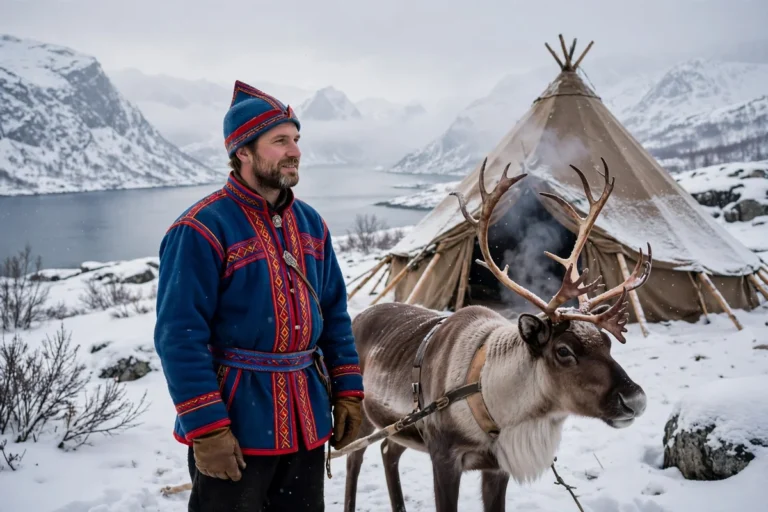
In Tromsø, there is no single market square. The whole downtown turns into Christmas Town Tromsø, with fairs at several locations. The Tromsø Christmas Market at Stortorget runs from 20 November 2026 to 3 January 2027, according to Visit Tromsø, and the Juleglede market at Jekta shopping centre runs from 6 November to 20 December 2026. Smaller markets run in Skomakergata, at Strandgata 34, from 2 November to 22 December 2026. The gifts here lean Arctic: warm wool mittens, knitwear, leather goods, Sami handicraft and local food such as cloudberry jam and smoked reindeer. Our Tromsø Northern Lights guide covers the city in the dark season.
Beyond the markets, three kinds of Norwegian gift are worth looking for in shops. The first is wool: a Marius sweater, a Setesdal-pattern sweater, mittens, a hat or a scarf, made from Norwegian wool and built to last. Check the label before you buy, because much textile production has moved out of Norway. The second is Norwegian design: glass from Hadeland Glassverk, an hour north of Oslo, ceramics, wooden serving boards and candle holders. The third is food: brunost, smoked salmon, cured meats, local cheese and aquavit.
Buy before Christmas Eve. Shops close early in the afternoon on 24 December, and most stay shut on 25 and 26 December. Bergen’s market closes on 22 December, so do not leave gift shopping until the last days.
What to bring to a Norwegian Christmas dinner
If you are invited to a Norwegian home for Julaften, bring a small gift for the host. That is the one gift rule a visitor needs to know, and it is the same rule our food guide gives: flowers, chocolates or a bottle, and arrive on time. The meal is served at a set hour, often around 5pm, after the church bells ring Christmas in, and a late guest holds up the whole evening.
A bottle of wine is the safest choice, and a good box of chocolates runs it close. Flowers are welcome too. Older etiquette guides for Norway warn against carnations, lilies or white flowers, and against wreaths, even at Christmas, because they are associated with funerals, and against an even number of flowers. Those warnings come from older etiquette pages, but a mixed bouquet in cheerful colours, or a bottle, is the safest choice.
Keep the gift small. A lavish present for a host you barely know can make the evening awkward. A gift that shares something of your own home is often the best choice: a food or drink from your country, a small craft, or a book.
If children will be there, check with the host first before bringing them a gift. A small box of sweets to share is safer than a wrapped present for one child.
Do not expect your gift to be opened at once. At Christmas it joins the pile under the tree and waits its turn with the rest.
Frequently asked questions
When do Norwegians open their Christmas presents?
On Christmas Eve, 24 December, after dinner and after dancing round the tree. The main meal is eaten at about 5pm, the family holds hands and walks round the tree singing carols, and then the presents are opened one by one, with the whole family gathered to watch. Christmas Day itself is quiet, with no second round of presents in the morning.
Who brings the presents in Norway?
The julenisse, the Norwegian Santa Claus. He knocks at the front door on Christmas Eve, walks in with a sack of presents, and hands them out in person. He does not come down the chimney. In some families a relative plays the part, and children sing a song before they receive their gift. The older fjøsnisse, the barn spirit, does not bring presents; he guards the farm animals and is given porridge on Christmas Eve.
What do Norwegians typically give at Christmas?
There is no official list, but the gifts that turn up most often are practical and personal: knitwear such as a Marius sweater, mittens or a scarf, food such as smoked salmon, brunost and home-baked pepperkaker, books, handmade gifts, and experiences such as a ski pass or a concert ticket. The emphasis is on thoughtfulness over extravagance, and a modest, well-chosen gift is valued more than a lavish one.
What is a julebord gift exchange?
At a work Christmas party, the julebord, colleagues often draw names in advance and each buy one small gift for one colleague, keeping the giver secret until the exchange. It works like a Secret Santa: one gift each, a modest agreed limit, and a gift that is thoughtful or funny rather than expensive. Not every julebord has an exchange, and the organiser will tell you the limit before you buy.
Where is the best place to buy Christmas gifts in Norway?
The Christmas markets are the best place to start. In Oslo, Jul i Vinterland at Spikersuppa runs from 7 November 2026 to 3 January 2027, with stalls selling Norwegian-made souvenirs, wool and design. In Bergen, the market at Festplassen runs from 20 November to 22 December 2026. In Tromsø, the market at Stortorget runs from 20 November 2026 to 3 January 2027, with smaller markets at Jekta and in Skomakergata. Look for wool, Norwegian glass and ceramics, wooden objects and local food.
What should I bring to a Norwegian Christmas dinner?
A small gift for the host: a bottle of wine, a good box of chocolates or a small bouquet of flowers. Keep it modest, arrive on time, and do not expect the gift to be opened at once; it joins the pile under the tree and is opened after dinner with the rest. Older etiquette guides warn against carnations, lilies, white flowers and wreaths, which are associated with funerals, so a mixed bouquet in cheerful colours, or a bottle, is the safest choice.