Viking Norway: Njardarheimr, Sagastad & Viking Sites in Fjord Country
The fjords were the Viking Age highways. Long before there were roads through western Norway, the fastest way to travel, trade and raid was by water, and the sheltered fjords gave Viking Age communities harbours, farmland and a direct route to the sea. That is why so many of the best Viking sites in Norway sit in fjord country: the villages, burial mounds and ship finds follow the water.
This guide covers the viking sites norway fjords are known for, starting with the two big ones, Njardarheimr in Gudvangen and Sagastad in Nordfjordeid, then the smaller and quieter places that reward a detour.
The Viking Age in brief
Historians usually date the Viking Age from the raid on the monastery at Lindisfarne in 793 to the Battle of Stamford Bridge in 1066, when the Norwegian king Harald Hardrada was killed in England. In Norway itself the period covers roughly 800 to 1050. Before this era, the land that became Norway was a patchwork of small kingdoms ruled by local chieftains and kings. The sagas credit Harald Fairhair with beginning the unification of the coastal districts after the Battle of Hafrsfjord, traditionally dated to about 872, although some historians now place the battle closer to 900. Either way, it was a slow process, and Norway was unified and split apart again several times before the process was complete around 1060.
The word “Viking” is also narrower than most people think. It originally described the activity of going on a voyage or raid, not a whole people. The people themselves were Norse: farmers, traders, craftspeople and sailors. Most of them never went raiding at all. They farmed, fished, built ships and traded across Europe in settlements along the fjords. The sites in this guide show both sides of that life: the ships and the burials, but also the houses, tools, crafts and everyday writing.
Njardarheimr Viking Village, Gudvangen
Njardarheimr is the single best Viking stop in fjord country, and it is also the easiest to reach. The village stands at the head of the Nærøyfjord in Gudvangen, a small village at the end of the narrow fjord arm that branches off the Sognefjord. Gudvangen is a stop on the fjord cruise between Flåm and Gudvangen, and it is also reachable by road and bus from Flåm and Voss, so it fits naturally into a day on the water.
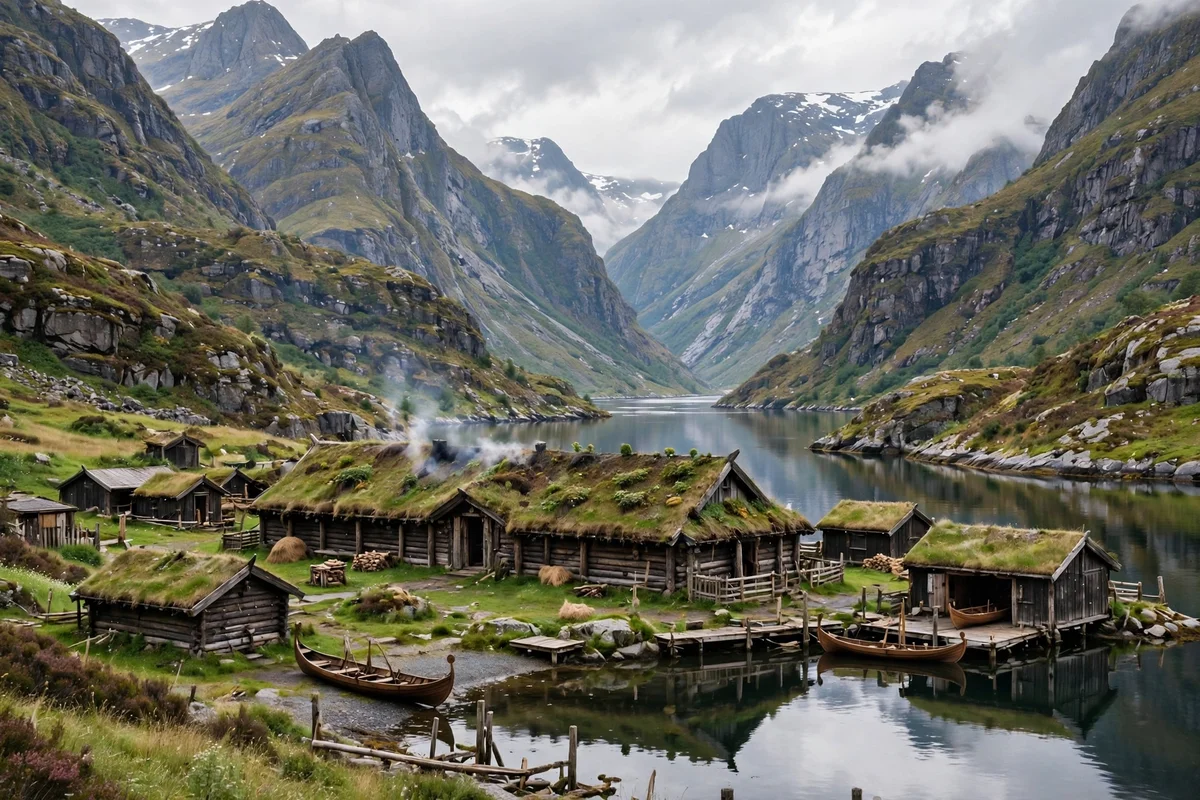
Njardarheimr, whose name means “home of Njord”, the Norse god of the sea, is a living history village. It is a full-scale reconstruction of a Viking Age settlement, built on the site of an annual Viking market, with longhouses, workshops and open spaces where costumed guides and craftspeople work in character. The idea is not to look at objects behind glass but to walk through a working village and see how the place functioned.
A visit usually starts with the Viking Experience, a guided tour of about 45 minutes that is included with the entrance ticket. Guides walk you through the longhouses and explain daily life: how houses were built, how food was cooked over an open fire, and how wool was spun, woven and iron forged. After the tour you can wander freely and try the activities yourself. Archery and axe throwing are the most popular, and there are also demonstrations of blacksmithing, weaving, wood carving and leatherwork.
You can book the Guided Tour Viking Village Naeroyfjord Cruise and Flam Railway on Viator.
There is a food court in the village serving Viking-inspired food, and a gift shop selling handcrafted goods made on site. Allow at least two hours for a visit, and more if you want to try the activities properly or eat in the village.
Practical notes: the village is open year-round, with longer hours roughly from April to October, and shorter hours in the winter months. Hours and prices change with the season, so check the official Viking Valley website before you go rather than relying on a guidebook figure. Gudvangen is small, and the village is a short walk from the quay where the fjord boats arrive, so it works well even on a short cruise stop.
Google Maps: Njardarheimr Viking Village Gudvangen
Sagastad Viking Centre and the Myklebust Ship, Nordfjordeid
If Njardarheimr shows you a Viking village, Sagastad shows you a Viking ship. The centre stands on the waterfront in Nordfjordeid, a small town at the end of the Eidsfjord, an arm of the Nordfjord. The building is a single large circular room whose size matches the original burial mound, and in the middle of it sits the Myklebust ship.
The Myklebust ship is the largest Viking ship ever discovered in Norway. It was found in a burial mound at Myklebust farm in Nordfjordeid, a mound the locals called Rundehågjen. The mound was about 30 metres across and almost 4 metres high, and in 1874 the archaeologist Anders Lorange from the Bergen Museum excavated it. Inside he found the remains of an enormous ship that had been burned during a funeral ceremony in the second half of the ninth century, together with high-status grave goods. More than 7,000 iron rivets and nails survived the fire, along with dozens of shield bosses, and from those remains archaeologists estimated the ship was about 30 metres long.
The burial is linked to King Audbjørn of Firda, who according to the sagas fell in battle around 870. Unlike the famous Oseberg and Gokstad ships, which were buried intact and survived, the Myklebust ship was deliberately burned on a funeral pyre, so no wooden hull survived. That is also why it is less famous than the Oslo ships: there was no intact ship to put in a museum.
The full-scale reconstruction was completed and launched on the fjord in spring 2019, the same year the centre opened on 10 May 2019. Visitors can board the ship inside the centre using a ramp, and walk its full length. The ship is about 30 metres long and about 6 metres wide, and archaeologists estimate it had around 24 pairs of oars. Around the ship, 16 exhibition stations cover Viking life, death, journeys, mythology and the archaeology of Nordfjordeid.
Sagastad is also a working ship, not just a display. The reconstruction is launched onto the fjord on special occasions, including an annual sea launch week in spring, when the crew rows it on the fjord. If your trip coincides with a launch, it is worth planning around, but check the centre’s own programme, as dates depend on the weather.
Practical notes: Sagastad is open daily from May to August, with more limited hours in spring and autumn, and it opens on cruise days in the off season. Hours vary by season, so check the official Sagastad website before travelling. Photography is allowed inside, including flash.
Google Maps: Sagastad Viking Centre Nordfjordeid
Google Maps: Myklebust Farm Nordfjordeid
The burial mounds of Nordfjordeid
Nordfjordeid rewards a slower look, because the Myklebust ship is not the only Viking Age remains in the town. The Myklebust farm once held five burial mounds, and the wider area around Nordfjordeid has other burial sites that the Sagastad exhibition covers. The mounds are low, grassy and easy to miss if you do not know what you are looking at, which is exactly why the centre matters: it gives you the story before you walk to the ground itself.
The Myklebust burial is also unusual in one specific way. It is the only known cremation ship burial discovered in Scandinavia. Most ship burials, including Oseberg and Gokstad, placed the ship in the ground intact. At Myklebust the ship was burned first, and the burned remains, including the cremated human remains placed in a bronze vessel, were then covered by the mound.
Bryggen and the rune sticks, Bergen
Bergen was founded around 1070, just after the Viking Age proper, but its oldest quarter, Bryggen, holds one of the most important Viking Age and medieval finds in Norway. The waterfront district of wooden warehouses is a UNESCO World Heritage site, and the buildings you see today are mostly Hanseatic, dating from after the German merchants established their office there around 1350. The Viking Age connection lies underneath them.
In 1955 a fire destroyed part of Bryggen, and the 13-year archaeological excavation that followed uncovered more than 100,000 objects from the wharf’s past, including about 670 runic inscriptions carved on wood and bone. These are the Bryggen inscriptions, and they changed what historians thought about runes. Before this find, runes were assumed to be used mainly for names and formal inscriptions. The Bryggen sticks showed everyday use: messages, ownership tags, love notes, insults, prayers and charms, carved on scraps of pine by ordinary people. Some date from as late as the 14th century, long after runes were thought to have died out. Many of the sticks are on display at the Bryggens Museum, built in 1976 on part of the site cleared by the fire, alongside the excavated remains of 12th-century buildings.
For the wider Bergen visit, see our Bergen guide.
Google Maps: Bryggens Museum Bergen
Hyllestad quernstone quarries and Millstone Park
Not every Viking site is a ship or a burial. At Hyllestad, on the northern side of the mouth of the Sognefjord, about 370 quarries are scattered across roughly 27 square kilometres of hillside, where quernstones and millstones were cut directly from the bedrock. Quarrying here began in the eighth century, and by the late Viking Age production had reached an industrial scale, with stones traded across Norway and beyond. The stones are made from garnet mica schist, a rock type that makes Hyllestad quernstones recognisable to archaeologists wherever they are found.
The scale is the point. In several quarries, unfinished quernstones are still attached to the rock where the carvers left them, and the landscape itself is visibly shaped by centuries of cutting. The quarries were nominated for UNESCO’s World Heritage list as part of the transnational Viking Age Sites in Northern Europe serial nomination, together with the Vestfold ship burials.
Millstone Park (Kvernsteinsparken) is the visitor site within the quarry area, a short walk from the centre of Hyllestad. It has paths through the quarries, a reception building with a small gift shop, an exhibition and activity house, and a smithy. Guided tours are offered Tuesday to Sunday during the summer season, roughly mid-June to mid-August.
Google Maps: Millstone Park Hyllestad
The Vestfold ship burials: Borre, Oseberg and Gokstad
Vestfold, on the western side of the Oslofjord, is not fjord country in the western Norway sense, but no guide to Viking sites in Norway is complete without it, and it is an easy addition if your trip starts or ends in Oslo. The region has the highest concentration of monumental Viking Age burials in Scandinavia.
At Borre, near Horten, the Midgard Viking Centre overlooks the Borre mounds, the largest collection of monumental Viking Age burial mounds in the Nordic region, with nine large mounds and many smaller ones spread across Borre Park. The centre has exhibitions and a reconstructed guild hall, and the mounds themselves are free to walk among.
The Oseberg mound, near Tønsberg, was excavated in 1904 and 1905 and contained a ship about 21.5 metres long, buried in the autumn of 834 with two women and a rich set of grave goods, including four elaborately carved sledges. The Gokstad mound, near Sandefjord, was excavated in 1880 and produced the first well-preserved Viking ship ever found, about 23.8 metres long, with timber felled around 890 and a burial dated to about 895 to 903. Both mounds were restored after excavation and can be visited, with information signs on site.
One practical warning: the ships themselves are not in Vestfold. The Oseberg, Gokstad and Tune ships were displayed for decades at the Viking Ship Museum on Bygdøy in Oslo, which is now closed while a new Museum of the Viking Age is built on the same site. The ships have been moved into the new museum, which is expected to open in 2027. Until it opens, the Historical Museum in central Oslo is the place to see Viking Age objects.
Myths worth leaving behind
A short word on what the Vikings did not do. Viking helmets did not have horns. No horned helmet has ever been found in a Viking Age burial or settlement; the image comes from 19th-century art and opera, not archaeology. Real Viking helmets were plain, usually iron, and designed to protect the head, not to impress an audience.
Vikings also did not drink from the skulls of their enemies, and they were not all tall, blond raiders. They were a mixed population of farmers, traders and sailors, and their society included enslaved people, something the sagas and the archaeology both record. The burial mounds, the rune sticks and the quarries all point to the same conclusion: the Viking Age was a working, trading, literate world as much as a raiding one.
Planning a Viking route through the fjords
The two main sites sit on different fjords, so plan them as separate stops rather than a single day. Njardarheimr pairs naturally with a Nærøyfjord cruise and the Flåm Railway, and many visitors combine all three in one day from Bergen. Sagastad pairs with a drive along the Nordfjord, and with the Ålesund area to the north. Bergen’s Bryggens Museum fits into any stay in the city, and Hyllestad works as a stop on a coastal drive between Bergen and the Sognefjord. Summer is the easiest season: Sagastad is open daily from May to August, and Njardarheimr has its longest hours from spring to autumn. For general timing, see our guide to the best time to visit the fjords.
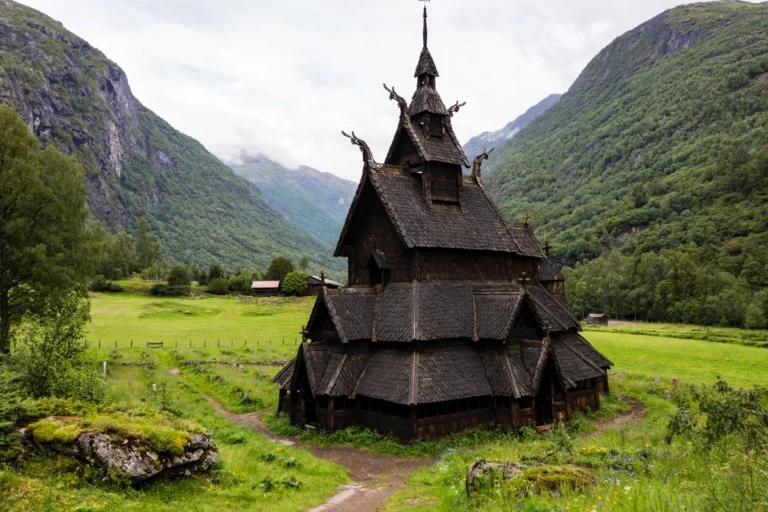
If you are travelling by car, the Viking sites also combine well with the fjords road trip routes, and with the stave churches and food traditions covered in our companion articles on Borgund and Urnes stave churches and what to eat in fjord Norway. For costs, see our Norway fjord cruise cost and budget guide.
Frequently asked questions
What are the best Viking sites in Norway’s fjords?
The two best are Njardarheimr Viking Village in Gudvangen, on the Nærøyfjord, and Sagastad Viking Centre in Nordfjordeid, on the Nordfjord. Njardarheimr is a living village with longhouses, crafts and hands-on activities, while Sagastad holds the full-scale reconstruction of the Myklebust ship. Bergen’s Bryggens Museum and the Hyllestad quarries are strong second stops.
Where is Njardarheimr Viking Village and how do I get there?
Njardarheimr is in Gudvangen, at the head of the Nærøyfjord, a branch of the Sognefjord. Most visitors arrive on the fjord cruise between Flåm and Gudvangen, and the village is a short walk from the quay. It is also reachable by road and bus from Flåm and Voss, and many day tours from Bergen include it along with the Nærøyfjord cruise and the Flåm Railway.
What is the Myklebust ship at Sagastad?
The Myklebust ship is the largest Viking ship ever discovered in Norway, about 30 metres long. It was found in a burial mound at Myklebust farm in Nordfjordeid, excavated in 1874, after being burned during a funeral in the second half of the ninth century. Because the ship was burned, no hull survived, so Sagastad displays a full-scale reconstruction built from the archaeological evidence, which visitors can board.
When is the best time to visit Viking sites in Norway’s fjords?
Summer, from May to August, is the easiest time. Sagastad is open daily in those months, and Njardarheimr has its longest hours from spring to autumn. Outside summer, hours are reduced and some outdoor activities may be limited, so check each site’s own website before travelling. Winter visits are possible but need more planning.
Did Vikings wear horned helmets?
No. No horned helmet has ever been found in a Viking Age burial or settlement. The image comes from 19th-century art and opera. Real Viking helmets were plain, usually made of iron, and built for protection.
Can I see the Oseberg and Gokstad ships?
Not at the moment. The Oseberg, Gokstad and Tune ships were displayed at the Viking Ship Museum in Oslo, which is closed while a new Museum of the Viking Age is built on the same site. The ships have been moved into the new museum, which is expected to open in 2027. Until then, you can visit the Oseberg and Gokstad burial mounds themselves in Vestfold, and see Viking Age objects at the Historical Museum in Oslo.