What to Eat in Fjord Norway: Local Food Guide
Fjord Norway is a place where the food makes as much sense as the scenery. The steep valleys leave little flat land for farming, the sea is cold and rich, and the winters are long. That combination shaped a kitchen built on fish, preservation, dairy and berries, and it still shapes what lands on your plate today. If you are wondering what to eat in Norway fjords, the short answer is seafood first, then cheese, berries and cider.
This guide covers the dishes to look for, the ones to approach with an open mind, and what cruise travellers can realistically eat ashore in Bergen, Flåm, Geiranger and Ålesund. Prices are left out on purpose, because menus and exchange rates change. Norway is not a cheap place to eat. See our Norway Fjord Cruise Cost & Budget guide for the numbers.
Salmon and trout: the first thing to try
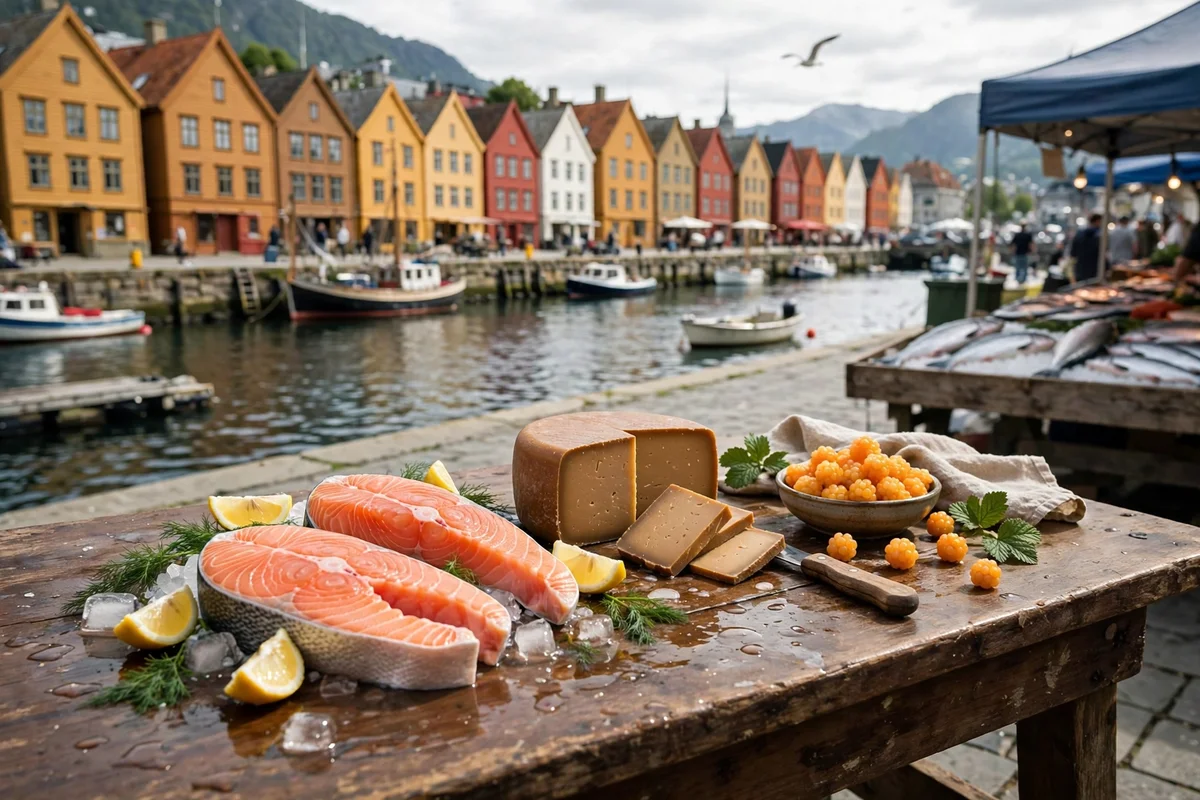
Salmon is the obvious starting point. Norway is one of the world’s largest producers of farmed salmon, and you will find it on almost every menu in the fjords, fresh, smoked, cured or grilled. Smoked salmon, røkt laks, is served on open sandwiches, with scrambled eggs at breakfast, or as a starter. Gravlaks is salmon dry cured with salt, sugar and dill, served in thin slices with mustard dill sauce. It is mild and clean tasting, and very different from smoked salmon, so try both.
Trout is the freshwater cousin, often served grilled or pan fried, and lighter and more delicate than salmon.
Cod, klippfisk and stockfish: the fish that built the fjords
Cod has shaped western Norway for centuries. Fresh cod is usually served boiled or steamed with potatoes, melted butter and grated carrot. It sounds plain on a menu and tastes far better than it sounds when the fish was caught that day.
The preserved versions matter more. Stockfish, or tørrfisk, is unsalted cod hung on wooden racks and dried by cold wind and sun, a method that goes back to the Viking age. Klippfisk is different: the cod is salted first, then dried, originally on flat rocks by the sea, which is where the name comes from, since “klippe” means cliff or rock. Production in Norway started around 1690, and it took off in Kristiansund and Ålesund in the 1800s. Today much of it is exported to southern Europe, where it becomes bacalao, the salt cod stew of Portugal and Spain.
That export story comes full circle in Ålesund, the natural place to try bacalao, a rich, tomato based stew of reconstituted klippfisk with potatoes, onion and peppers. XL Diner, on the harbour at Skaregata 1B, has focused on klippfisk since it opened in 1999. It is open Monday to Saturday from 5pm, closed on Sundays, so plan a dinner visit. Fisketorget Delikatesse, at Keiser Wilhelms gate 25 near the cruise pier, is a smaller fish shop and cafe where bacalao and fish soup are regulars. Google Maps: XL Diner Ålesund | Google Maps: Fisketorget Delikatesse Ålesund
Bergen fish soup: the dish to order in Bergen
If there is one dish that belongs to a single fjord city, it is Bergen fish soup, or Bergensk fiskesuppe. It is a light, creamy soup made from a fish stock, usually from cod, haddock or saithe, with finely shredded vegetables, fish balls and a spoonful of sour cream, seasoned with a little vinegar and sugar so the flavour leans slightly sweet and sour. It is not a thick chowder. The broth stays delicate, and the flavour comes from the stock rather than from cream.
The traditional version was made from the bones of young saithe and included pickled purslane, a leafy herb rarely used now, so the soup you are served will be a modern version of the old recipe. Bergen was designated a UNESCO Creative City of Gastronomy in 2015, and fish soup is one of the dishes the designation rests on.
Bergen Fish Market: the best first stop for food
The Bergen Fish Market, Fisketorget, sits on the harbour at Torget, a short walk from Bryggen and from most cruise terminals. Fish has been sold here since the Middle Ages. In summer, from May to September, outdoor stalls line the quayside with salmon, shrimp, king crab and smoked fish. In winter the trade moves indoors to Mathallen, the covered hall on the same square, completed in 2012.
The classic buy is a bag of cold water prawns, reker, peeled by hand and eaten with white bread and mayonnaise on a harbour bench, the way Bergen locals have eaten them for generations. The plated dishes at the outdoor stalls are convenient but widely reported as expensive, so several Bergen guides suggest buying from the counters inside Mathallen instead, where fish is sold by weight. You will also find cloudberry jam, brunost, cured meats and aquavit among the stalls. Hours vary by season, so check the day before you go. Google Maps: Bergen Fish Market | Google Maps: Mathallen Bergen
You can book the Food and Culture Walk on Viator.
Brunost: the brown cheese that confuses everyone
Brunost, literally brown cheese, is the food that surprises first time visitors most. It is made by boiling whey, the liquid left after cheese making, until the milk sugars caramelise, which turns it brown and gives it a sweet, fudgy, almost caramel flavour. It is sliced thin with a cheese slicer, the ostehøvel, a Norwegian invention from 1925.
The best known type is Gudbrandsdalsost, a mix of cow and goat milk, invented in the 1860s when Anne Hov boiled leftover whey with cream until it caramelised. Geitost is made from goat milk and tastes stronger. You will find brunost at hotel breakfast buffets all over Norway, on bread or on heart shaped waffles. Try it on a waffle with jam and sour cream, the classic combination, before deciding what you think of it.
Rakfisk: the dish for the brave
Rakfisk is fermented trout or char, salted and left to ferment in brine for months, then eaten raw in thin slices. It is served with lefse, a soft potato flatbread, sour cream, raw onion and sometimes mustard sauce. The smell is strong, the flavour is salty and intense, and it divides Norwegians as much as visitors. It is a speciality of inland valleys such as Valdres, but you will also find it on menus in the fjord region in season. It is an acquired taste. If you are curious, order a small portion as a starter and share it. If not, skip it without guilt.
Cloudberries and other berries: the gold of the fjords
Cloudberries, or multer, are the most prized berry in Norway. They grow on low plants in boggy marshland, ripen to a soft amber colour, and taste sharp and honeyed at the same time. They are sometimes called mountain gold, and they are genuinely hard to find fresh, because they fruit unpredictably and grow only in cold northern peatlands. The classic way to eat them is multekrem, cloudberries folded through sweetened whipped cream, traditionally a Christmas dessert.
You are more likely to meet cloudberries as jam than as fresh fruit. Cloudberry jam is sold at the Bergen Fish Market, in farm shops and in supermarkets, and it is served over brunost or with waffles. It is the most obvious edible souvenir from a fjord trip, though it is not cheap. Lingonberries, or tyttebær, are sharp and red, and they are served as a jam or puree alongside lamb and game. Under Norway’s right to roam, allemannsretten, you may pick wild berries for your own use.
Hardanger cider and fruit: Norway’s orchard
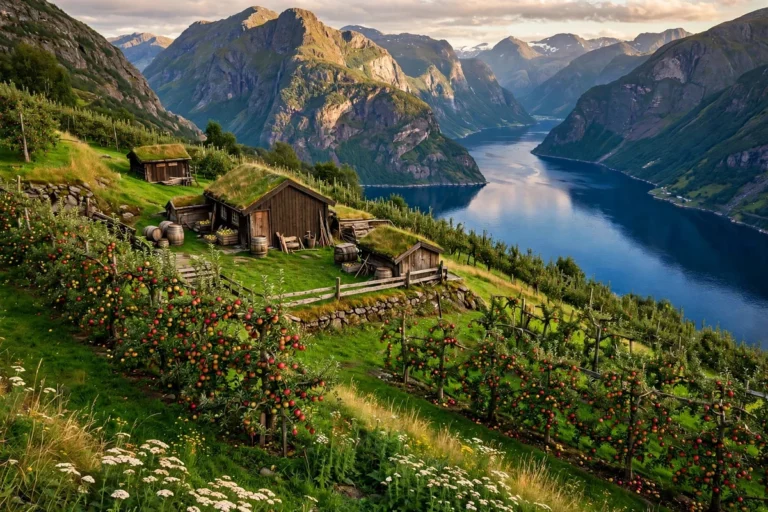
The Hardangerfjord is Norway’s orchard, and its apples are the base of a cider tradition that has grown fast in the last decade. Fruit farming here goes back to the 14th century, with apples brought from England by Cistercian monks in the 13th century. In 2013, Norway changed the alcohol law to allow small producers to sell directly from their farms, and that opened the door for the farm cideries you can visit today.
The protected designation “Sider frå Hardanger” was established in 2009, and it can only be used for cider produced entirely in Hardanger from apples grown in the region. Start in Ulvik, at the inner end of the Hardangerfjord, home to Norway’s only designated Fruit and Cider Route, the Frukt- og Siderruta. Three farms sit on the route and can be visited on foot: Ulvik Frukt & Cideri, Syse Gard and Hardanger Saft- og Siderfabrikk at Lekve. The last also has a farm restaurant seating around 80 people. Tastings run mainly from May to October, and several farms ask for pre-booking outside peak season, so call ahead.
More producers line the Sørfjorden shore between the Hardanger Bridge and Lofthus, including Aga Sideri, Lofthus Sideri and Store Naa Siderkompani. The Hardanger International Cider Festival, Siderfest, runs in Odda in early May. Our full route guide covers the farms in detail: Hardanger Fruit & Cider Route. Google Maps: Ulvik Frukt and Cideri | Google Maps: Hardanger Saft- og Siderfabrikk Ulvik
Farm cider is alcoholic, and Norway’s alcohol rules are strict: farm shops can sell their own cider, but stronger drinks are sold only through the state Vinmonopolet shops. The farms also sell non-alcoholic apple juice, which is excellent.
Lamb, reindeer and the food of the mountains
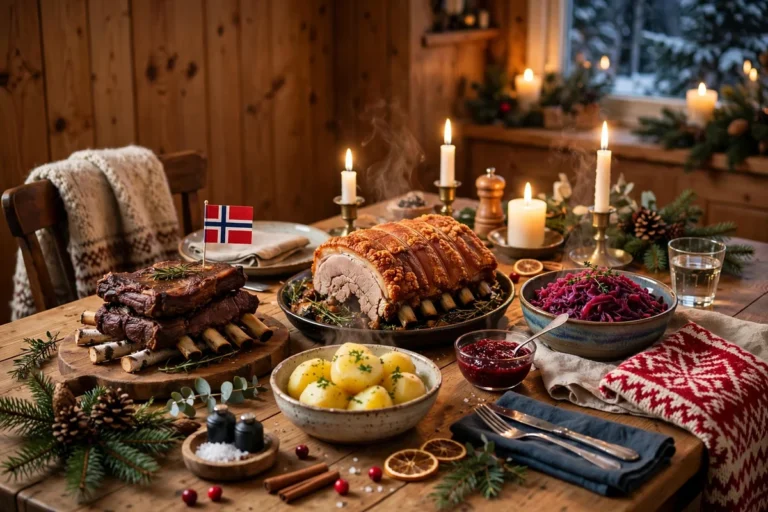
Not everything in fjord Norway comes from the sea. Lamb from the fjord valleys is a point of pride, and the animals graze on steep hillsides and coastal meadows. Pinnekjøtt, salted and dried lamb ribs steamed over birch sticks and served with mashed swede and potatoes, is the Christmas dish of western Norway. Fårikål, lamb and cabbage stewed slowly with whole black pepper, is often called Norway’s national dish. Reindeer also appears on menus, usually as a steak or stew, and it is lean, dark and rich. It is more associated with northern Norway and Sami food traditions: Sami Culture in Northern Norway. Farm shops along the fjord roads sell cured lamb, sausages and cheese, and they are worth a stop on a road trip: Norway Fjords Road Trip.
Waffles, svele and the coffee break
Norwegian food culture runs on coffee and something sweet. Heart shaped waffles, served with jam and sour cream or with brunost, turn up at mountain cabins, school events and cafes all over the country. They are thin, soft, best eaten warm, and the cheapest genuinely local snack you will find. Svele is the fjord region’s own version, a thick pancake from the Sunnmøre area around Ålesund, traditionally served on ferries and at community gatherings, with butter, sugar and brown cheese or jam. If you take a fjord ferry, look for svele on board. Skillingsboller, large cinnamon buns, are a Bergen speciality. Lefse, the soft potato flatbread, is served sweet with butter, sugar and cinnamon, or wrapped around a hot dog.
What cruise travellers can realistically eat ashore
Cruise days are short, so plan one good food stop per port rather than trying to eat everywhere. Most cruise ships dock close to the town centre in Bergen, Flåm, Geiranger and Ålesund, so the food is within walking distance, but the time is not unlimited.
In Bergen, start at the Fish Market for prawns and fish soup, then walk to Bryggen for a sit down meal if you have time. A food walking tour is the most efficient option if you have only a few hours: the Viator “Food and Culture Walk” starts at the Bergen Tourist Information at Strandkaien 3 and includes tastings of traditional Norwegian dishes in a small group.
In Flåm, the food is concentrated around the harbour at Flåmsbrygga, a short walk from the cruise pier and the Flåm Railway station. Ægir Gastropub is the best known restaurant in the village, combining local ingredients with Viking inspired dishes in a timber hall with a nine metre high fireplace. It serves à la carte dinner year round and lunch in summer, and its signature is the Ægir Viking Plank, five dishes paired with five beers from the brewery next door. Fjord Bistro, also at Flåmsbrygga, is a more casual option for lunch. Book ahead in summer, because Flåm has few restaurants for the number of visitors it receives. Google Maps: Ægir Gastropub Flåm | Google Maps: Fjord Bistro Flåm
In Geiranger, the village is small and the food options are few. CafèOlè, at Maraakvegen 19 in the centre of the village, is the easiest stop for coffee, cake, svele and a light lunch. It sits in a historic building dating from 1892 and is open seasonally from April to October. Google Maps: CafèOlè Geiranger Our Geiranger guide covers the timing: Geirangerfjord Guide.
In Ålesund, head for bacalao at XL Diner in the evening, or fish soup and bacalao at Fisketorget Delikatesse near the pier during the day: Ålesund Guide.
Many fjord restaurants close on Sundays or keep shorter hours outside summer. Check opening hours the day before, and eat early rather than late. The ship will not wait for a slow lunch.
Eating well on a budget
Norway is expensive, and food is where most visitors feel it first. Eat your main meal at lunch, when many restaurants offer a smaller and cheaper menu than at dinner. Buy prawns, bread and fruit at the market or supermarket rather than ordering plated seafood at a tourist stall. Drink tap water, which is excellent across Norway, instead of buying bottled water. Supermarkets such as Rema 1000, Kiwi and Coop are found in every fjord town, and they sell smoked salmon, gravlaks, brunost, lefse, cloudberry jam and crispbread.
Frequently asked questions
What food is fjord Norway known for?
Seafood first: salmon, cod, klippfisk and prawns, plus Bergen fish soup, bacalao in Ålesund and smoked and cured fish. Beyond seafood, the foods most associated with the fjords are brunost, cloudberries, Hardanger cider and apples, lamb, and waffles and svele.
What should I eat in Bergen?
Start with a bag of prawns and a bowl of Bergen fish soup at the Fish Market, then try smoked salmon or brunost on a waffle. Bergen is a UNESCO Creative City of Gastronomy, and the harbour area around Torget and Bryggen has the widest choice of food in the fjord region.
What is klippfisk and where do I try it?
Klippfisk is cod that is salted and then dried, originally on flat rocks by the sea. It is different from stockfish, which is dried without salt. The best place to try it is Ålesund, where it is served as bacalao, a tomato based stew with potatoes and peppers.
What is brunost and what does it taste like?
Brunost is brown cheese made by boiling whey until the milk sugars caramelise, giving it a sweet, fudgy, caramel like flavour. The best known type is Gudbrandsdalsost, a mix of cow and goat milk. It is sliced thin and eaten on bread or waffles, often with jam.
Can I visit a Hardanger cider farm?
Yes. The Fruit and Cider Route in Ulvik has three farms you can visit on foot: Ulvik Frukt & Cideri, Syse Gard and Hardanger Saft- og Siderfabrikk. Tastings run mainly from May to October, and several farms ask for pre-booking outside peak season. Non-alcoholic apple juice is available at the same farms.
Is food expensive in fjord Norway?
Yes, eating out in Norway is expensive by most visitors’ standards. Keep costs down by eating your main meal at lunch, buying prawns and bread at the market, drinking tap water, and making lunch from supermarket food such as smoked salmon, brunost and lefse. See our cost and budget guide: Norway Fjord Cruise Cost & Budget.



2 Comments