Best Fjords in Norway, Ranked
Norway has more than 1,000 fjords, and only a handful of them are the ones people travel across the world to see. This ranking covers the ten best fjords in Norway for a first-time visitor: the famous ones, the quiet ones, the longest, the deepest, the narrowest and the smallest. Each entry gives the length and depth where the figures are settled, what makes the fjord worth the trip, and how to get there.
The ranking is a judgement, not a measurement. It weighs scenery first, then how easy the fjord is to reach, what you can actually do there, and how crowded it gets in summer. A fjord that is hard to reach loses points even when it is beautiful, and a fjord with a boat, a viewpoint and a village beats one you can only look at from a road. Lengths and depths are approximate: sources disagree on several fjords, and where they do, this guide says so.
1. Geirangerfjord
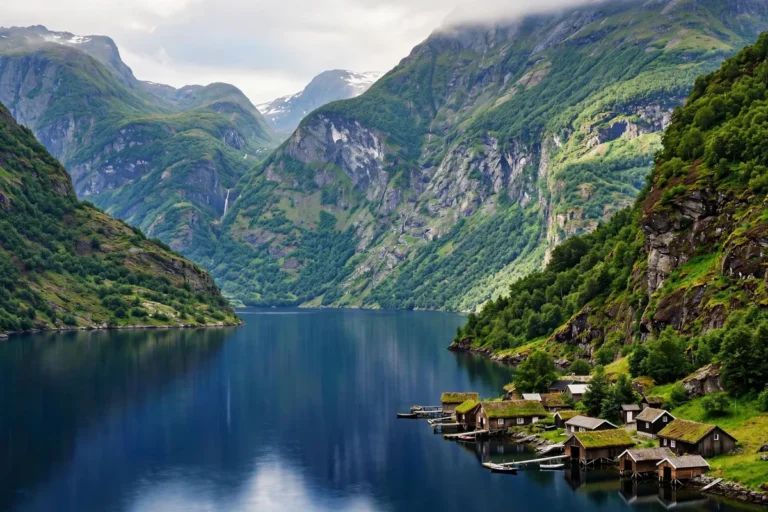
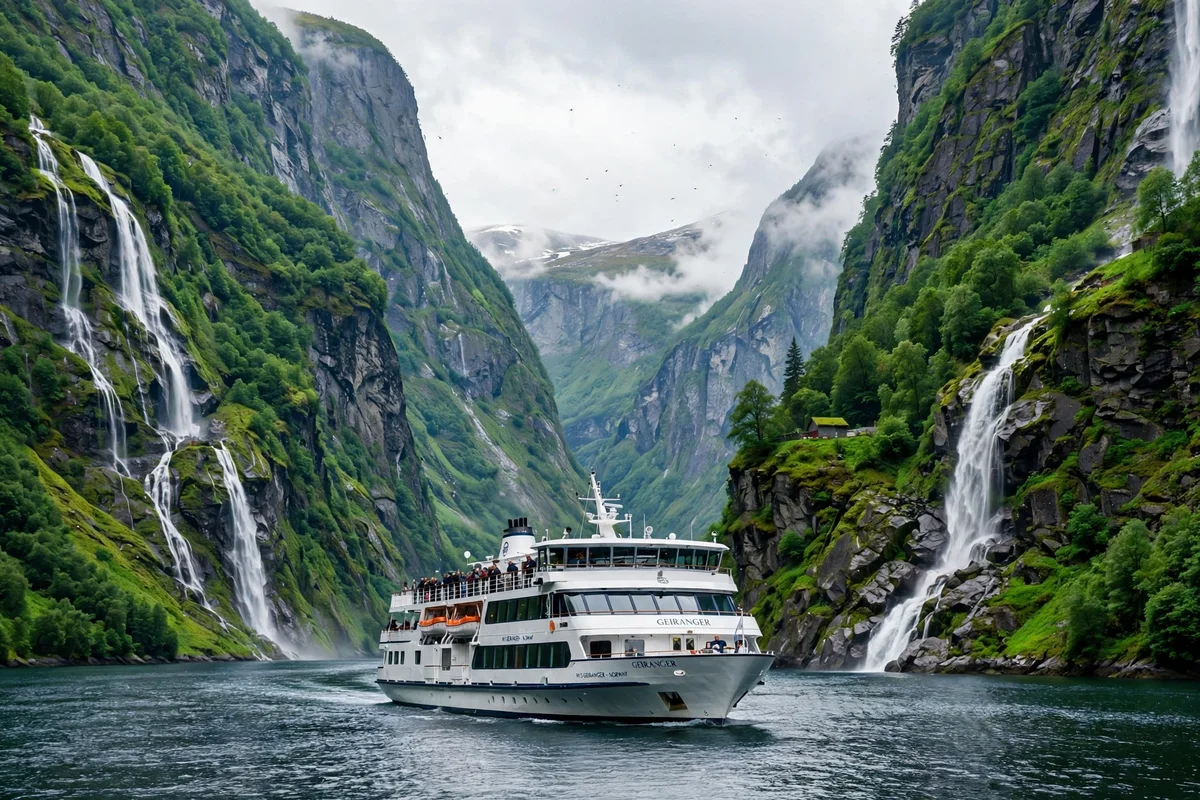
Geirangerfjord is the fjord most people picture when they think of Norway, and it earns the top place. It is 15 km long and about 260 m deep, a branch of the Storfjord in Møre og Romsdal, and it has been on the UNESCO World Heritage List since 2005, together with the Nærøyfjord, as the West Norwegian Fjords. The water is a narrow strip of deep blue between steep green walls, with waterfalls falling straight into it and a small village at its head.
The waterfalls are what set it apart. The Seven Sisters fall in seven streams down the north wall, from a total height of 410 m, with the longest single drop about 250 m. Directly opposite is the Suitor, a single broad fall, and further along the fjord is the Bridal Veil. The old cliff farms add to the picture: Skageflå sits about 250 m above the water on the south side, and Knivsflå faces it beside the Seven Sisters. Both were farmed until the early 1900s and reached only by ladder from boats.
Geirangerfjord is also the fjord with the most to do. The sightseeing boats run from the village, a 75-minute classic cruise or a longer 2-hour cruise on a hybrid-electric catamaran. Three viewpoints give three different versions of the fjord: Flydalsjuvet, about 4 km from the village; Ørnesvingen, the Eagle Bend, at 620 m on the Eagle Road; and Dalsnibba, at 1,476 m above sea level, the highest fjord viewpoint in Europe you can drive to. There are RIB safaris, guided kayak tours of about 3 hours, and short steep hikes to the cliff farms.
The cost is the crowds. Geiranger is one of Norway’s busiest cruise ports, and on a summer day the village, the viewpoints and the boats fill up between 10:00 and 15:00. More than 500,000 cruise passengers called at Geiranger and Hellesylt in 2024. Stay overnight if you can: the fjord empties of day-trippers in the evening, and the early morning is the best time to see it. The season runs from May to September, and the waterfalls are strongest in May and June.
Getting there takes planning. There is no train to Geiranger. By car from Ålesund it is 108 km, 2.5 to 3 hours including the Eidsdal-Linge ferry. The Fjord1 car ferry from Hellesylt has been suspended since 4 September 2026 until further notice. The crossing still runs with Vestlandske, about 65 minutes, tickets through Norway’s Best, and the boats carry cars as well as foot passengers, so check the current timetable before planning around it. Since 1 January 2026, passenger ships under 10,000 gross tonnes must operate without direct carbon dioxide or methane emissions in the World Heritage fjords, and the sightseeing boats in Geiranger are now electric or hybrid. Big cruise ships can still call for now; larger ships have until 1 January 2032.
Geirangerfjord guide – Sognefjord vs Geirangerfjord
2. Nærøyfjord
The Nærøyfjord is the narrowest fjord in Norway, and the most dramatic place to be on the water. It is about 18 km long, an arm of the Sognefjord in Vestland, and at its narrowest point, near the village of Bakka, it is only about 250 m wide. UNESCO gives the width range as 250 m to 2.5 km. The rock walls rise steeply on both sides, the water is calm, and the waterfalls fall straight into the fjord from the farms above. It has been on the UNESCO World Heritage List since 2005, together with Geirangerfjord.
The practical fact about the Nærøyfjord is that it is a boat route before it is anything else. There is no road along it, and the villages on its shores were reached only by water until a few decades ago. The way to see it is the scheduled boat between Flåm and Gudvangen, about 2 hours each way, running year-round. The boats on this route are electric, and since 1 January 2026 the World Heritage fjords have required passenger ships under 10,000 gross tonnes to operate without direct emissions, so the crossing is quiet: you hear the waterfalls and the birds instead of an engine.
The Nærøyfjord ranks second rather than first for one reason: it is a passage, not a destination. Geirangerfjord has the viewpoints, the hikes and the village to stay in. The Nærøyfjord has the boat, and the boat is superb, but the fjord itself has almost no road access and very few places to stay. What it does have is the Flåm Railway at one end, the Viking village of Njardarheimr at Gudvangen, the Stalheim viewpoint above the valley, and the village of Undredal, with the smallest stave church in Norway, on the Aurlandsfjord just outside the Nærøyfjord proper.
It is also the easiest UNESCO fjord to reach from Bergen. The usual route is the train to Myrdal, the Flåm Railway down to Flåm, the boat to Gudvangen, the bus to Voss and the train back to Bergen, the full Norway in a Nutshell loop, which takes a day. Large cruise ships do not enter the Nærøyfjord: it is too narrow, and the shallow sill at its mouth keeps big ships out. That is part of the appeal. The fjord belongs to small boats.
Nærøyfjord guide · Norway in a Nutshell worth it?
3. Sognefjord
The Sognefjord is the biggest fjord in Norway, and the one everything else is measured against. It is about 205 km long and 1,308 m deep at its deepest, which makes it the longest and deepest fjord in Norway, the longest in Europe, and the second longest in the world after Scoresby Sund in Greenland, at about 350 km. It is also the deepest fjord in Norway and in Europe. The fjord runs from the open sea near the coast all the way inland to Skjolden, and its arms include the Nærøyfjord, the Aurlandsfjord and the Lustrafjord.
Size is the point of the Sognefjord, and also its weakness in a ranking. No single viewpoint or boat trip shows you the whole fjord. What you see depends on which arm you choose: the narrow Nærøyfjord, the Flåm end of the Aurlandsfjord, the quiet Lustrafjord, or the main fjord itself from a cruise ship or the coastal express. That is why the Sognefjord ranks third here even though it is first by every measurement: the experience is spread out, and you need to pick an arm.
Large cruise ships do visit the Sognefjord, calling at Flåm, at the head of the Aurlandsfjord, and at Skjolden, at the fjord’s inner end. The inner narrow arms are small-boat only. The fjord is also the base for the Flåm Railway, the Stegastein viewpoint above Aurland, and the stave churches at Borgund and Urnes. The best way to see the Sognefjord is to choose one arm and do it properly, rather than trying to cover the whole fjord in a day.
Sognefjord guide · Flåm Railway guide
4. Hardangerfjord
The Hardangerfjord is Norway’s second longest fjord, about 180 km long and about 850 m deep, and the most varied. It runs from the coast near Bergen inland to Odda, and it changes character along its length: open water and islands near the mouth, orchards and fruit farms along its middle reaches, and steep waterfalls and glaciers at its inner end. It is the fjord of fruit blossom in May, when the orchards along its shores flower, and of cider in autumn, when the farms press apples and run tastings.
The Hardangerfjord is also the easiest big fjord to reach from Bergen. It is a day trip by car or bus, and cruise ships call at Eidfjord, at its inner end, where the Vøringfossen waterfall is a short drive away. The fjord has the Folgefonna glacier above it, the Trolltunga hike from Odda, and the fruit and cider route through villages such as Utne, Lofthus and Ulvik. It is less crowded than Geirangerfjord, and it works in every season: blossom in May, fruit in autumn, snow on the peaks in winter.
It ranks fourth because it has no single moment to match the Seven Sisters or the narrowest stretch of the Nærøyfjord. Its strength is variety over a long distance, and that takes more than a day to see properly. From Bergen with a car, it is the best fjord to explore at leisure.
Hardangerfjord guide · Hardanger fruit and cider route
5. Lysefjord
The Lysefjord is the fjord for a single cliff. It is 42 km long and over 400 m deep, running east from Stavanger into the mountains of Rogaland, and its fame rests on Preikestolen, the flat-topped cliff that rises 604 m directly above the water. The cliff is one of the most photographed places in Norway, and the hike to it, about 8 km return, is one of the country’s most popular walks.
The best way to see the Lysefjord is from below. The boat from Stavanger sails up the fjord to below Preikestolen and back in about 3 to 3.5 hours, passing the Hengjanefossen waterfall and the Vagabond’s Cave, with the cliff rising directly above the boat. Large ocean cruise ships do not enter the fjord itself; they dock at Stavanger, and the fjord is visited by small boat cruises and RIBs from the city. That keeps the water quiet, and the scale of the cliff is best felt from a small boat looking up.
The Lysefjord ranks fifth because it is a one-cliff fjord. Beyond Preikestolen and the boat trip there is less to do than on the Sognefjord or the Hardangerfjord, and it is a day trip from Stavanger rather than a place to stay. But for that one view, the cliff from below, nothing else on this list matches it.
Lysefjord and Preikestolen guide · Stavanger guide
6. Aurlandsfjord
The Aurlandsfjord is the fjord most visitors sail without knowing its name. It is 29 km long and about 962 m deep, an arm of the Sognefjord that runs from the main fjord to Flåm, and it is the water the Flåm-Gudvangen boat crosses before it enters the Nærøyfjord. It is also the fjord the big cruise ships enter: they call at Flåm, at its head, so ships do sail the Aurlandsfjord even though they cannot continue into the Nærøyfjord.
Its claim to a place on this list is the Stegastein viewpoint, 650 m above the fjord, with a platform that juts 30 m out over the water. It is one of the best viewpoints in Norway, and it looks down the full length of the fjord you are about to sail. Flåm, at the fjord’s head, has the Flåm Railway, the RIB safaris and the kayak tours, and the village of Undredal, with its goat cheese and small stave church, sits on its shore.
The Aurlandsfjord ranks sixth because it is usually seen as part of another trip, the Nærøyfjord boat or the Nutshell loop, rather than as a destination in itself. As a fjord it is deep, wide and handsome, and the Stegastein viewpoint alone justifies the drive. It is also the most practical fjord on this list for a cruise passenger: the ship docks at Flåm, and the fjord is right there.
Aurlandsfjord guide · Best fjord day trip from Bergen
7. Hjørundfjord
The Hjørundfjord is the quiet one. It is about 35 km long and cuts south from the Storfjord into the Sunnmøre Alps, and the peaks above it, Slogen, Saksa, Skårasalen and Jakta, rise to around 1,700 m. There is no road along most of it, no cruise-ship quay and no queue. The boat is small, the trip is slow, and the villages are the reason to go.
It is the fjord for travellers who have seen Geirangerfjord and want the same scale without the crowds. The Hjørundfjord cruise from Ålesund takes about 5 hours, and it is the closest thing to a private fjord in western Norway. The water is deep green below rock walls and hanging valleys, with farms on ledges above it. It is not a fjord for a first-time visitor with one day: it needs a base in Ålesund and a day set aside for it. But for a second fjord, after the famous ones, it is the best choice on this list.
Hjørundfjord guide · Ålesund guide
8. Lustrafjord
The Lustrafjord is the quietest arm of the Sognefjord, about 40 km long, running north from the main fjord to Skjolden. It is the fjord for a slow drive rather than a boat trip: the road along its shore passes farms, orchards and the village of Luster, and the mountains rise straight from the water on both sides. The Urnes stave church, a UNESCO site, stands above its eastern shore, and the Feigumfossen waterfall falls into the fjord near the road.
The Lustrafjord has no cruise terminal and no famous viewpoint, and that is why it is on this list. It is the Sognefjord at its calmest, and the best place to see the fjord system without a timetable. It is best reached by car from Sogndal or from Skjolden, and it pairs well with the Sognefjord’s other arms: the Nærøyfjord by boat one day, the Lustrafjord by car the next.
Lustrafjord guide · Borgund and Urnes stave churches
9. Nordfjord
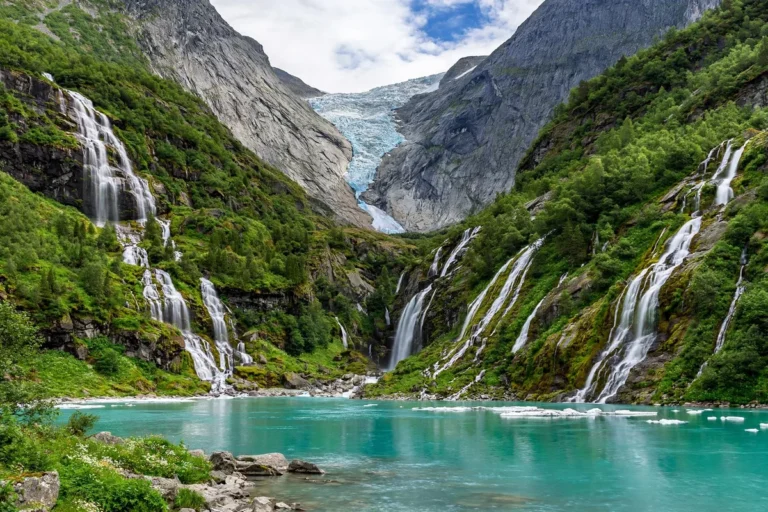
The Nordfjord is the long fjord of the north-west, 106 km long and 565 m deep, running from the coast near Måløy inland to Loen and Olden. It is the fjord for glaciers: the Briksdal glacier, an arm of the Jostedalsbreen ice cap, is a short trip from Olden, and the fjord’s inner end is walled by mountains and waterfalls. The village of Olden is a cruise port, and the Loen skylift rises from the fjord to the mountains above.
It ranks ninth because it is a long way from the main fjord bases. From Bergen it is a full day’s drive, and from Ålesund it is a long day trip. For a traveller already in the north-west, or on a cruise that calls at Olden, it is a strong fjord, and the glacier is the reason to go. For a first-time visitor choosing between fjords, the Sognefjord and Geirangerfjord are closer and easier.
10. Trollfjord
The Trollfjord is the smallest fjord on this list, and the most dramatic per kilometre. It is about 2 km long, only 100 m wide at its mouth, and 65 to 72 m deep, a narrow cut in the mountains of Austvågøya in Lofoten. The cliffs rise steeply on both sides, and the water is dark and still. It is visited by small cruise ships and RIBs from Svolvær, and by the coastal express on its way through Lofoten.
It ranks tenth because it is a short visit, not a day out: the boat passes through in minutes, and there is no village, no viewpoint and no hike at the fjord itself. But as a sight from the water, it is unlike anything else on this list. A fjord 100 m wide, with cliffs closing in on both sides, is the narrowest water most travellers will ever sail, and it is the reason the Trollfjord is famous far beyond its size.
The ten fjords at a glance
| Fjord | Length | Depth | Best for | How to get there |
|---|---|---|---|---|
| Geirangerfjord | 15 km | About 260 m | Waterfalls and viewpoints | Ålesund by car, or cruise ship |
| Nærøyfjord | About 18 km | Not published as a water depth | The narrowest fjord by boat | Flåm by train, then boat |
| Sognefjord | About 205 km | 1,308 m | The big fjord, arms and villages | Bergen by train and boat; Flåm |
| Hardangerfjord | About 180 km | About 850 m | Fruit, waterfalls, Eidfjord | Bergen by car or bus |
| Lysefjord | 42 km | Over 400 m | Preikestolen from below | Stavanger by boat |
| Aurlandsfjord | 29 km | About 962 m | Flåm, Stegastein | Bergen by train via Myrdal |
| Hjørundfjord | About 35 km | Deep, no figure published | Quiet water, Sunnmøre Alps | Ålesund by boat |
| Lustrafjord | About 40 km | No figure published | Quiet arm, stave church | Sogndal area by car |
| Nordfjord | 106 km | 565 m | Glacier, Olden | Ålesund or Bergen by car |
| Trollfjord | About 2 km | 65 to 72 m | A tiny fjord, Lofoten cruise | Svolvær by boat |
Which fjord should you choose?
The ranking answers a general question, but the right fjord depends on your trip.
For a first-time visitor with one day, the Nærøyfjord is the easiest choice: train to Flåm, boat to Gudvangen, bus back, all in a day from Bergen. For a first-time visitor with two or three days, Geirangerfjord is the fuller trip: the boat, the viewpoints and a night in the village. For a cruise passenger, the fjord is usually chosen for you: Geirangerfjord, Flåm on the Aurlandsfjord, Eidfjord on the Hardangerfjord, or Olden on the Nordfjord, depending on the itinerary. For a traveller with a car and a week, the Sognefjord system repays the time: one arm by boat, one by car, and the Hardangerfjord on the way back to Bergen. For a hiker, the Lysefjord pairs the boat with the Preikestolen walk. For a traveller who has seen the famous fjords and wants quiet water, the Hjørundfjord is the answer.
The best time to visit is May to September for all ten. May and June bring the strongest waterfalls, July and August the warmest weather and the most people, and September the best compromise of crowds, light and still-running boats. Our best time to visit guide covers the seasons in detail, and our best fjord cruise guide matches each fjord to the right boat.
What this ranking leaves out
Ten fjords cannot cover more than 1,000. This list covers the western fjords, the ones most visitors travel to see, and leaves out the fjords of the north, the Oslofjord near the capital, and the smaller arms of the Sognefjord system, such as the Fjærlandsfjord, which are worth a drive if you are already in the area. The fjords on this list are the starting point, not the whole country.
What is the best fjord in Norway?
For a first-time visitor, Geirangerfjord tops this ranking: the waterfalls, the viewpoints, the UNESCO listing and the range of boat trips make it the most complete visit. The Nærøyfjord is the best fjord to see from a boat, because it is the narrowest, and the Sognefjord is the biggest, at about 205 km long and 1,308 m deep. The right answer depends on your trip: one day favours the Nærøyfjord from Bergen, two or three days favour Geirangerfjord from Ålesund.
Which fjord should I visit if I only have one day?
The Nærøyfjord, from Bergen. Take the train to Myrdal, the Flåm Railway down to Flåm, the boat through the Nærøyfjord to Gudvangen, then the bus to Voss and the train back to Bergen, the full Norway in a Nutshell loop, which takes a day. If you are based in Ålesund instead, Geirangerfjord is the one-day choice: drive in, take the sightseeing boat, and see one viewpoint.
What is the longest fjord in Norway?
The Sognefjord, at about 205 km long. It is the longest fjord in Norway and in Europe, and the second longest in the world after Scoresby Sund in Greenland, at about 350 km. The Hardangerfjord is Norway’s second longest, at about 180 km.
What is the deepest fjord in Norway?
The Sognefjord, at 1,308 m deep at its deepest. It is the deepest fjord in Norway and in Europe. Its arms are much shallower: the Nærøyfjord’s water depth is not published as a single figure, and the Geirangerfjord is about 260 m deep.
Which fjord is best for a cruise?
It depends on the ship. Large cruise ships call at Geirangerfjord, at Flåm on the Aurlandsfjord, at Eidfjord on the Hardangerfjord and at Olden on the Nordfjord. The Nærøyfjord takes small boats only: it is 250 m wide at its narrowest, and big ships cannot enter. For a small-boat fjord cruise, the Flåm to Gudvangen boat through the Nærøyfjord is the classic trip.
Can you visit more than one fjord in a trip?
Yes, and the Sognefjord system makes it easy: the Nærøyfjord by boat one day and the Lustrafjord by car the next, both arms of the same fjord. From Bergen, the Hardangerfjord is a day trip and the Nærøyfjord is a day trip in the other direction. Geirangerfjord pairs with the Hjørundfjord from an Ålesund base, and the Lysefjord pairs with a stay in Stavanger.