
Sami Culture in Northern Norway: Tromsø & the Arctic
Tromsø sits in the middle of Sápmi, the homeland of the Sami, yet many visitors arrive, chase the northern lights and leave without ever learning that. The city has a Sami name, Romsa, and Sami language, history and daily life are part of the place, not a side attraction. Understanding Sami culture in Norway changes how you see the whole of the north: the fjords and the reindeer on the hillsides all sit inside a living Indigenous culture that has been here far longer than the cruise ships and the hotels.
This article explains who the Sami are, what their culture looks like today, where to learn about it in Tromsø, Karasjok and Kautokeino, and how to experience it as a respectful guest. If you are researching sami culture norway before a trip, start here: the Sami are a living Indigenous people, with their own languages, parliament, schools, artists and herders. They are not a chapter of history, and the best visits are the ones that treat them that way.
Who Are the Sami?
The Sami are the Indigenous people of Sápmi, a homeland that stretches across northern Norway, Sweden and Finland and onto the Kola Peninsula in Russia. The region was once called Lapland in English, a name the Sami themselves do not use for their homeland. Estimates of the total Sami population vary widely, from around 80,000 to more than 130,000, because each country records Sami identity differently and many Sami now live in cities far from the traditional herding districts. Roughly half of all Sami live in Norway.
Sami identity rests on language, family and self-identification rather than appearance. The Sami languages belong to the Uralic family, which also includes Finnish and Estonian, and they are separate languages rather than dialects of one tongue. Nine Sami languages are still in use to some degree, and Northern Sami is the most widely spoken. Many Sami no longer speak a Sami language, and those who do are almost all bilingual.
The Sami have lived in northern Scandinavia for thousands of years. Their traditional livelihoods have included coastal fishing, hunting, trapping and sheep herding, and the best known is semi-nomadic reindeer herding. Only a minority of Sami families herd reindeer today: reindeer are central to Sami culture, but most Sami live ordinary modern lives as teachers, nurses, artists and engineers, in towns and cities as well as in herding districts.
A History Visitors Should Know
Sami culture in Norway cannot be understood without a short look at its history, because much of what you see today is a revival. For much of the 19th and 20th centuries, Norwegian government policy pushed assimilation, often called Norwegianisation. Sami children were sent to boarding schools where their language was discouraged or punished, and Sami identity was treated as something to leave behind. The effects are still felt in families today.
Change came through decades of political organising. One turning point was the Alta controversy of the late 1970s and early 1980s, when plans for a hydroelectric dam on the Alta-Kautokeino river threatened Sami land and reindeer grazing. The protests became one of the most significant Indigenous rights battles in modern Norwegian history.
The Sami Act was passed by the Norwegian Parliament in 1987, and the Sami Parliament of Norway, the Sámediggi, opened in Karasjok on 9 October 1989. Norway, Sweden and Finland each have their own Sami Parliament, giving the Sami a formal voice in matters affecting their culture, language and way of life.
Reindeer Herding: The Heart of Sami Life
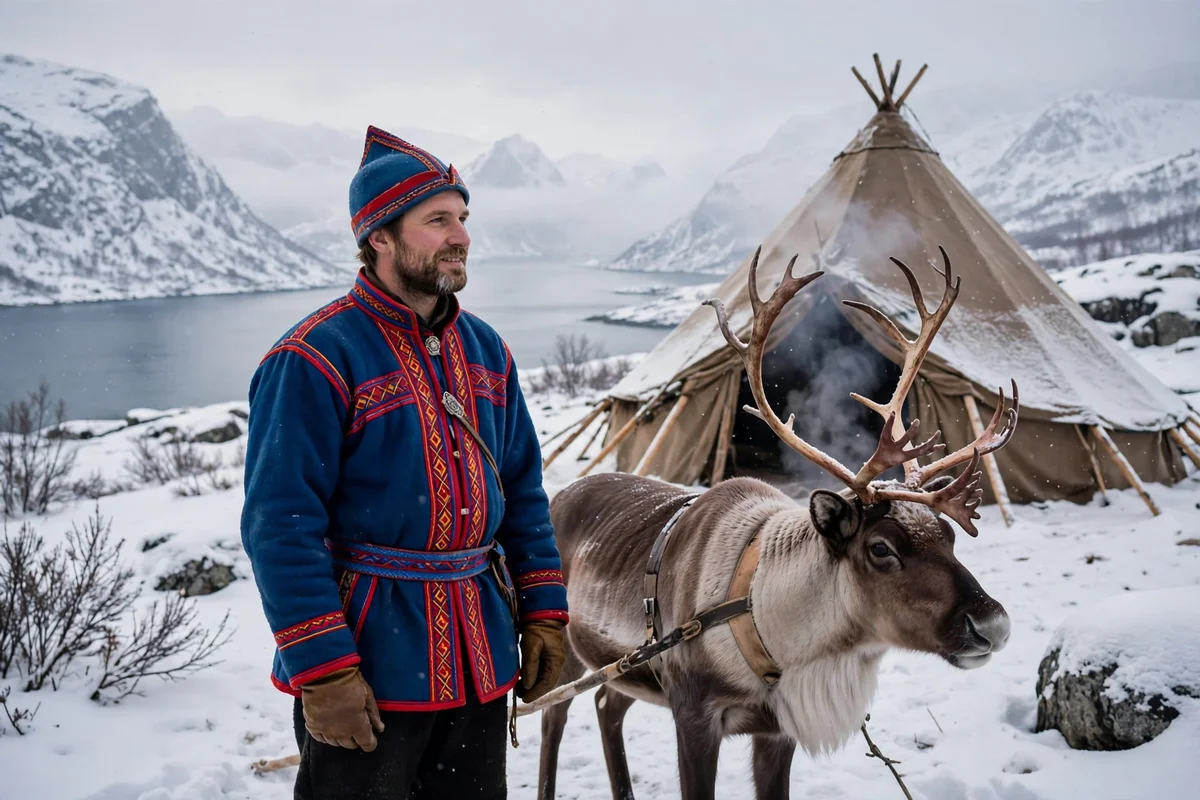
Reindeer herding is the best known part of Sami culture, and it is also the most misunderstood. Herding follows the seasons: in spring, herders move their animals towards summer grazing on the coast or in the mountains, and in autumn they bring them back inland for the winter. The animals provide meat, hides and antlers, and the work shapes the calendar and the knowledge of the land.
In Norway, reindeer herding is legally reserved for Sami in the herding districts, a protection that reflects its cultural and economic importance. Herding is hard, skilled work done in all weather, and it is under pressure from new roads, wind farms and cabins that can cut across grazing land and migration routes.
Reindeer are semi-domesticated, not tame pets. On a guided visit, follow your guide’s instructions about how close to stand and when to stay still, and do not feed reindeer anything of your own.
Joik: Singing a Person, a Place, a Memory
Joik, called luohti in Northern Sami, is the traditional vocal music of the Sami, and it is often described as one of the oldest living song traditions in Europe. A joik is not a song about a person or a place in the usual sense. It is closer to a musical portrait: each joik is meant to reflect or evoke a person, an animal or a landscape, like a name in sound. In northern areas, a person may receive their own joik, sometimes at birth.
Joik is traditionally chanted without instruments, and it does not rhyme or follow a fixed structure. It was passed down orally inside families and communities, learned by hearing it again and again around the hearth of the lavvu or the goahti, the turf hut. Joik was once tied to Sami spiritual practice, and that is one reason it was suppressed during the Christianisation of Sápmi and later under assimilation policies. Today it is alive again at festivals and concerts, and it is a central part of the Sami Grand Prix, an annual music competition held in Kautokeino, where joikers perform without accompanying instruments.
Modern Sami musicians have carried joik far beyond Sápmi; the singer Mari Boine of Norway is the best known example, and hearing a joik performed live by a Sami guide, in a lavvu with a fire going, is one of the most memorable parts of a good cultural visit.
Gákti, Duodji and the Lavvu
The gákti is the traditional Sami clothing, a tunic-like garment worn by both men and women. Its colours and decoration vary by region, family and occasion, and the patterns can signal where the wearer is from. The most familiar version is the deep blue tunic with red, yellow and green bands, often worn with a belt, silver jewellery and a four-cornered hat. The gákti is festive dress, worn on Sami National Day, at confirmations and weddings, and at cultural events. It is not a costume.
Duodji is the Sami craft tradition, and it covers far more than souvenirs. Soft duodji includes textiles, woven bands, tin thread embroidery, leather work and jewellery. Hard duodji includes knives, wooden cups known as guksi or kåsa, carvings and horn work. The materials are local: reindeer hide and antler, birch and other northern woods, wool and pewter thread. If you want to buy a Sami craft, look for the Sami Duodji trademark, which certifies that the item was made by a Sami artisan using traditional techniques.
The lavvu is the traditional Sami tent, a cone-shaped shelter of poles and canvas that is easy to move and quick to put up, which made it practical for a herding life on the move. The goahti is the more permanent turf hut. On a guided visit from Tromsø, you will usually sit inside a lavvu around a fire, drink coffee and eat bidos, a traditional reindeer stew, while your guide tells stories and performs a joik. For a wider look at what to eat around the fjords, including fish dishes and local specialities beyond Sami food, see our fjord food guide.
Tromsø: A Sami City
Tromsø is the best place for most visitors to start learning about Sami culture in Norway, because it is also the base for northern lights trips, fjord tours and the coastal voyage. The city stands on the island of Tromsøya, and its Northern Sami name is Romsa. Sami culture in the Tromsø area became less visible during the 20th century as assimilation took hold among the Coastal Sami, but today there is a Sami kindergarten and Sami language classes in some schools.
The best first stop is the Arctic University Museum of Norway, at Lars Thørings veg 10 near the southern tip of Tromsøya. Its permanent exhibitions cover Sami culture past and present, with more than 900 objects, alongside northern lights research and Arctic wildlife. Some visitors note that parts of the Sami section have limited English signage, so allow plenty of time and be ready to use a translation app on your phone.
The Arctic University Museum of Norway, Tromsø
Sami Week and Sami National Day
The biggest Sami celebration in Tromsø is Sami Week, held each year around Sami National Day on 6 February. The day marks the first Sami congress, held in Trondheim from 6 to 9 February 1917, when Sami from Norway and Sweden came together across national borders for the first time. Sami National Day was adopted at the Sami Conference in 1992 and first celebrated in 1993.
Sami Week in Tromsø runs for about a week and ends with the Norwegian championship in reindeer racing in the city centre, along Storgata, the main street, which draws thousands of spectators. The programme also includes lasso throwing, concerts, lectures, a traditional market and duodji stalls. The 2027 edition is scheduled for 31 January to 7 February, with the reindeer racing championship closing the week. If you are planning a February trip, Sami Week is the best time to see Sami culture at its most public, but book early: February is peak season in Tromsø. For daylight, temperatures and what else runs in winter, see our Tromsø northern lights guide and our guide to the best time to visit the Norway fjords.
Karasjok and Kautokeino: The Heart of Sápmi
Tromsø is the gateway, but the heart of Sami political and cultural life in Norway lies inland, on the Finnmark plateau. Karasjok, or Kárášjohka in Northern Sami, is the seat of the Sami Parliament of Norway. The striking parliament building, inaugurated in 2000, offers guided tours on weekdays, and it is the visible centre of Sami self-government.
Kautokeino, or Guovdageaidnu, is often described as the cultural capital of Sápmi. It is home to the Sami University of Applied Sciences, Sámi allaskuvla, where Sami is the main language of teaching and administration, and where duodji is taught as a university subject. The town is also home to the Sami Grand Prix music competition and to a strong reindeer herding community, where herders still follow the seasonal movements of their animals.
Karasjok and Kautokeino are not day trips from Tromsø. They are remote inland towns, reached by flights or long drives from Tromsø or Alta, and winter driving conditions demand respect. If you are travelling the length of northern Norway, the Bergen to Kirkenes coastal express is the classic slow way north.
How to Experience Sami Culture Respectfully
The best Sami experiences in the Tromsø area are guided visits run by Sami people, usually to a reindeer camp outside the city. A typical half-day visit includes meeting the herd, feeding the reindeer, a short reindeer sled ride when snow allows, lunch or coffee and bidos in a lavvu, storytelling and a joik performance. Transfers from central Tromsø are usually included, which matters in winter, when driving on icy roads is best left to locals. Book ahead in peak months.
You can book the Sami Culture and Short Reindeer Sledding from Tromso on Viator.
A few simple rules will make your visit better for everyone:
Ask before taking photographs of people, and accept a no without argument. Never photograph someone in a gákti as though they were a display; they are a person at work or at a celebration, not a photo opportunity. Do not touch a person’s gákti, jewellery or crafts without being invited to: these are personal and often handmade items, and some carry family meaning.
Listen more than you talk. Guides are sharing their own culture with you, and the stories they tell are theirs to tell. Asking a genuine question is welcome; arguing with the answer is not.
Buy from Sami makers. If you want a souvenir, choose authentic duodji with the Sami Duodji trademark, or buy directly from the artisan at a market. Choose Sami-run or Sami-guided experiences over generic tours that use Sami culture as decoration; if a tour cannot tell you who its Sami guides are, that is a warning sign.
Respect the animals. Reindeer are working animals, and sled rides depend on snow and on the animals’ condition. If a ride is shortened or cancelled for the animals’ sake, that is good practice, not a disappointment to complain about.
These are the same principles that apply to travelling lightly anywhere in the north. For more on low-impact travel, see our guide to sustainable fjord cruising.
When to Go and How to Plan
Sami culture is a year-round subject, but the season shapes what you can do. Winter, from late November to March, is the season for reindeer camps, sled rides, Sami Week and the northern lights, and it is also the busiest and coldest season in Tromsø, so book tours and accommodation well ahead. Summer brings the midnight sun and hiking, and it is the better season for a self-driven trip to Karasjok and Kautokeino. Spring and autumn are quieter, with fewer tours running.
Costs in the north are high, and a guided reindeer and cultural visit is a full half-day experience with transport, food and a guide included, so expect it to be one of the bigger line items in your trip budget. Our Norway fjord cruise cost and budget guide gives a sense of daily costs across the north.
You can book the Sami Cultural Tour With Reindeer Sledding, Lunch, From Tromso on Viator.
If you are combining Tromsø with the fjords further south, our guides to wildlife watching in the fjords, the best fjord hikes, ski and sail trips and fjord swimming and sauna cover the landscapes that Sápmi sits within. Sami history also makes a natural companion to our guides to Borgund and Urnes stave churches and Viking sites in Norway.
The Sami have been part of this landscape for thousands of years, and they are still shaping it: herding reindeer, teaching their languages, making duodji, singing joik and running their own parliament. A visit that starts with that understanding, and that listens before it photographs, is a better visit for everyone. Go to Tromsø, learn the name Romsa, and let Sami culture be the first thing you understand about the Arctic.
Frequently asked questions
Who are the Sami people?
The Sami are the Indigenous people of Sápmi, the homeland that stretches across northern Norway, Sweden and Finland and onto the Kola Peninsula in Russia. They have their own languages, which belong to the Uralic family, their own parliaments, and a culture built around reindeer herding, fishing, joik singing and duodji craft. Estimates of the total Sami population range from around 80,000 to more than 130,000, and roughly half live in Norway.
What is Sápmi?
Sápmi is the Sami name for the Sami homeland, the cultural region across northern Norway, Sweden and Finland and Russia’s Kola Peninsula. It is not a country with borders on a map, but a homeland defined by language, family and shared history. South Sami communities live as far south as Trøndelag, so Sápmi reaches well south of the Arctic Circle.
When is Sami National Day?
Sami National Day is on 6 February. It marks the first Sami congress, held in Trondheim from 6 to 9 February 1917, when Sami from Norway and Sweden met across national borders for the first time. The day was adopted at the Sami Conference in 1992 and first celebrated in 1993. In Tromsø, the day sits at the centre of Sami Week.
Can visitors meet reindeer and learn about Sami culture from Tromsø?
Yes. Guided half-day visits from Tromsø take you to a Sami reindeer camp outside the city, usually with transport included. A typical visit includes feeding the herd, a short reindeer sled ride when snow allows, lunch or coffee and bidos in a lavvu, storytelling and a joik performance. Book ahead in winter, and choose a tour run by Sami guides.
What is a joik?
A joik, or luohti in Northern Sami, is the traditional vocal music of the Sami, often described as one of the oldest living song traditions in Europe. Each joik is meant to reflect or evoke a person, an animal or a place, like a musical portrait, and a person may have their own joik. Joik is traditionally chanted without instruments, it does not rhyme, and it was passed down orally within families. It was suppressed under assimilation policies and is now a living part of Sami music.
Where is the Sami Parliament in Norway?
The Sami Parliament of Norway, the Sámediggi, sits in Karasjok, or Kárášjohka, in Finnmark. It opened on 9 October 1989, and its parliament building, inaugurated in 2000, offers guided tours on weekdays. Kautokeino, or Guovdageaidnu, nearby is home to the Sami University of Applied Sciences and is often described as the cultural capital of Sápmi.

One Comment