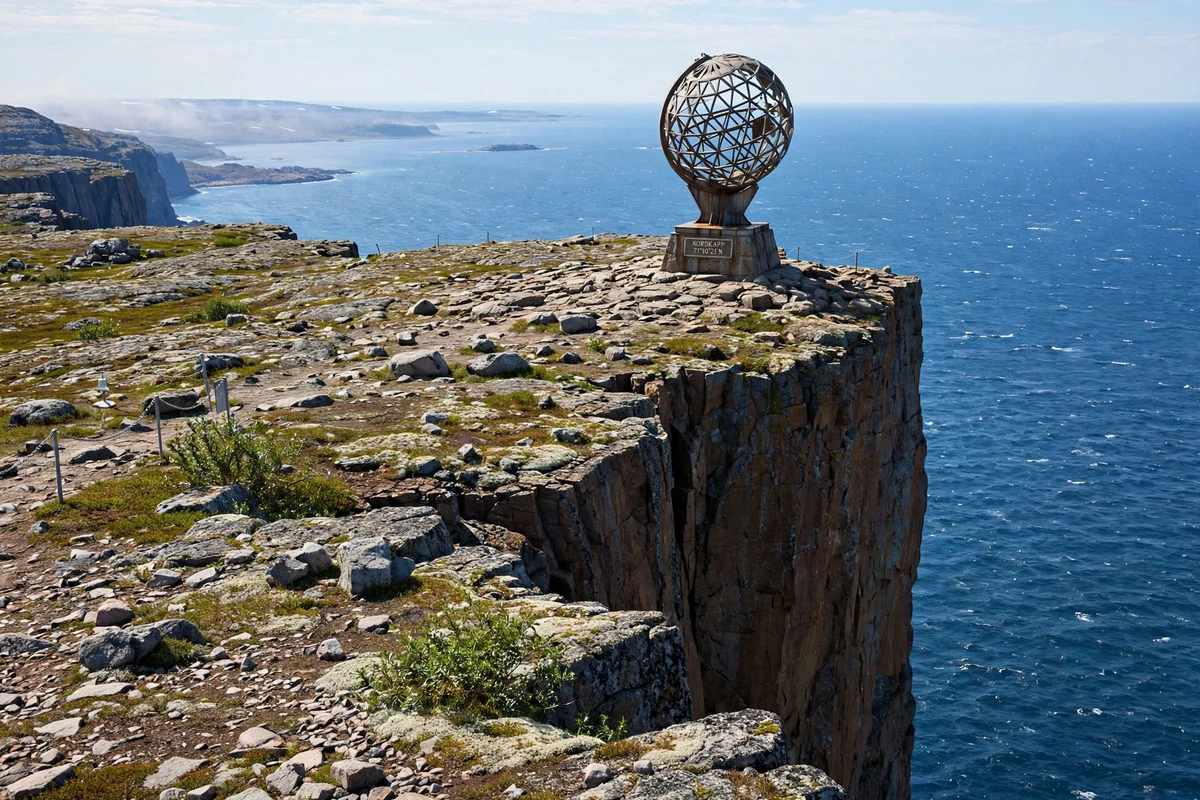
North Cape & Kirkenes: Arctic Extension Guide
A fjord cruise that stays in the south sees steep green valleys and small towns tucked under mountains. A cruise that keeps sailing north sees treeless tundra and towns where the light sets the rhythm of the day. The North Cape is a cliff at the end of a road across an island, reached from Honningsvåg. Kirkenes is a working Arctic town near the Russian border, and the place where the coastal voyage turns around and heads south again.
This guide covers both in the order a coastal voyage reaches them. Our Lofoten guide and Tromsø guide cover the two stops before them, and our Bergen to Kirkenes guide covers the voyage itself.
The North Cape: the cliff at the end of the road
The North Cape (Nordkapp in Norwegian) is a cape on the northern coast of Magerøya, an island in Finnmark. It sits at 71 degrees 10 minutes north, about 2,102 km from the North Pole, where the Norwegian Sea meets the Barents Sea. The cape is a 307 m high cliff with a large flat plateau on top, and the E69 road ends there, which makes it the northernmost point in Europe that can be reached by car.
The landmark is the globe monument, a steel globe on a plinth. Beside it stands North Cape Hall, the visitor centre built into the rock in 1988, with a cafe, a restaurant, a post office, a souvenir shop, a small museum and a panoramic cinema. Fog can close over the plateau in summer while Honningsvåg below stays clear, and wind is a constant.
The cape is often described as the northernmost point of Europe. That is not quite right. The neighbouring headland of Knivskjellodden reaches about 1,450 m further north than the plateau. Both points are on Magerøya, an island connected to the mainland by road, so neither is the northernmost point of mainland Europe either: that is Cape Nordkinn (Kinnarodden), near the village of Mehamn, about 70 km east. The North Cape keeps its fame because it is the point a road reaches, with a centre, a monument and a view, while the true northernmost points need a hike or a boat. Magerøya is reached through the Nordkapp Tunnel, about 6.9 km long, and the E69 then runs north across open tundra.
Honningsvåg: the town that makes the cape possible
Honningsvåg is the town where cruise passengers land for the North Cape. It sits on the southern coast of Magerøya, about 34 km south of the cape, and it is the administrative centre of Nordkapp municipality, with a population of about 2,400 to 2,500 people. It is a working fishing town with a harbour, a main street, a church and a small museum, and the whole centre can be walked in well under an hour. Ships berth alongside in the town, and the tourist information point and the bus departures for the cape are a short walk from the pier.
The drive from Honningsvåg to the cape takes about 35 to 45 minutes each way. Most cruise passengers make it as a ship excursion or on a cruise-timed local bus, and the standard visit allows about an hour to an hour and a quarter at the plateau, which is enough for the globe, the cliff path and the hall. A few lines run a late-evening sailing timed for midnight at the cape, with a return after midnight. In town, the Nordkapp Museum and Honningsvåg Church, built in 1885, fit the time left after the cape.
In winter, the last section of the E69 is not open to ordinary traffic. From about October to April the road runs only in scheduled convoys behind a snowplough, so a winter call needs the ship excursion or a convoy-timed tour.
Knivskjellodden and the bird cliffs
For travellers with a full day on Magerøya, Knivskjellodden is the walk that settles the northernmost-point question on foot. The trail starts from a signed car park on the E69 about 7 km south of the North Cape plateau, crosses open tundra marked with red T marks, and reaches the promontory about 9 km later. The round trip is about 18 km and takes about 4 to 5 hours in good conditions, with some sources giving 5 to 6 hours. The ground is spongy tundra, rocky in places and boggy after rain, and the route is exposed to wind and fog throughout. At the end, a cairn and a sign-in book mark the point, with the Barents Sea on three sides and the North Cape cliff visible back to the south-east.
This hike does not fit a standard cruise call: it needs a full day ashore and summer weather, roughly June to September. The other Magerøya excursion is the bird safari to Gjesværstappan, off Gjesvær, about 21 km from the E69 junction. The islands hold one of Norway’s largest seabird colonies, with puffins, guillemots and gannets nesting in summer, and boats sail close without landing. On a full-day call, pair the cape with the bird cliffs; on a short call, pick one.
Kirkenes: the town at the end of the coastal voyage
Kirkenes is the town at the far north-eastern end of Norway, on a peninsula along the Bøkfjorden, an arm of the Varangerfjord. It lies about 400 km north of the Arctic Circle, a few kilometres from the Norwegian border with Russia, and just east of the 30th meridian east, which puts it further east than Istanbul. The town itself has a population of 3,404 (2023), and the wider urban area reaches almost 8,000 people. It sits at the end of the E6 from Oslo, about 2,500 km to the south.
Kirkenes is the northern turnaround point of the coastal voyage. Hurtigruten’s Coastal Express and Havila Voyages both sail the Bergen to Kirkenes route, calling at 34 ports. The full round voyage takes 12 days, and the northbound leg takes about 6 nights, sold as a 7-day voyage. Hurtigruten gives Kirkenes a port stay of about 3.5 hours in the morning, and Havila ships arrive at about 09:00. Passengers on the northbound-only leg disembark here, and southbound passengers join here. There is no luggage storage at the port.
The town is small, flat and walkable, and the centre is about 2 to 3 km from the port. Most excursions collect passengers at the pier, and a pre-booked tour is the practical choice, because taxis are limited and the sights that matter are outside the town. The town was almost completely destroyed in the Second World War, after close to 350 Soviet air raids. Andersgrotta, the bomb shelter carved into the rock under the town, is open to visitors, and the Borderland Museum covers the border region.
The Snowhotel, king crab and huskies
The Snowhotel Kirkenes, part of Snow Resort Kirkenes at Bjørnevatn, is the town’s best-known attraction, and it is open all year. Unlike most ice hotels, which are built each winter and melt in spring, the Snowhotel 365 is kept frozen by a cooling system, so its snow and ice suites stay intact through the summer. The hotel has 13 ice suites, carved and decorated by ice sculptors, with an ice bar, and the temperature inside is about minus 4 degrees Celsius at any time of year. Day visitors can tour the hotel, and overnight guests sleep in the ice suites or in the warm Gamme cabins on the same site. The resort sits about 6 to 10 km from Kirkenes town, depending on the route measured, and transfers run between the resort, the town centre, the harbour and the airport.
The king crab safari is the other signature Kirkenes excursion, and it runs all year. Red king crab, with a leg span of up to 2 m, live in the Barents Sea off this coast, and the safari takes visitors out by boat in summer and by snowmobile sled in winter to pull up the pots, then cooks and serves the catch. Book ahead, because the popular slots sell out around ship arrivals, and the excursion takes several hours.
Husky sledding is the third Kirkenes activity: dog sleds run on snow in winter, while in summer the resort offers husky visits and cart rides. Kirkenes is an activity base, not a sightseeing town: the day works when it has one booked excursion at its centre.
The border: what a visitor can and cannot do
Kirkenes sits a few kilometres from the border with Russia, and the border shapes the town in ways a visitor notices at once: bilingual road signs, and a mixed Norwegian, Sami, Kven, Finnish and Russian heritage. The only legal crossing point on the Norwegian-Russian border is Storskog, about 15 km south-east of Kirkenes, and it is a controlled border post, not a tourist sight to walk across. Guided border tours visit viewpoints and historic sites near the border, and Havila’s post-voyage programme includes a guided tour that comes within a few metres of the border, with a clear statement that crossing is not permitted.
Norway closed the border to Russian tourists in May 2024, and in October 2023 it banned the entry of Russian-registered vehicles with fewer than 10 seats, so a cruise passenger should not plan to cross it. The three-country border point at Muotkavaara is about 100 km south by road plus a 10 km walk, and it is forbidden under both Norwegian and Russian law to walk around the border marker there. A guided tour is the right way to see this country.
When to go: midnight sun and polar night
The Arctic extension is ruled by light. At the North Cape, the midnight sun can be seen from about 14 May to the end of July, with sources giving the end date as 29 or 31 July, and the polar night runs from about 20 November to 22 January. At Kirkenes, the midnight sun runs from mid-May to late July, with one local source giving 19 May to 25 July, and the polar night runs from late November to mid-January, with one local source giving 28 November to 15 January. The northern lights season at Kirkenes runs from about late August to mid-April. Our midnight sun guide, northern lights guide and best time to visit guide cover the seasons in more detail.
Summer, from late May to July, is the midnight sun season and the busiest time, when the North Cape road is open and the bird cliffs are nesting. Winter, from December to March, is the northern lights, king crab and husky season, when the cape road runs only in convoy. March and April suit travellers who want daylight with snow still on the ground. November to mid-December is the least rewarding window: polar night plus early winter storms.
| Place | Midnight sun | Polar night | Northern lights |
|---|---|---|---|
| North Cape | About 14 May to end July | About 20 Nov to 22 Jan | Sep to mid-Apr, best in dark months |
| Kirkenes | Mid-May to late July | Late Nov to mid-Jan | Late Aug to about 15 Apr |
| Tromsø | About 20 May to 22 Jul | About 27 Nov to 15 Jan | Sep to mid-Apr |
How the two fit a fjord cruise
The North Cape and Kirkenes are not alternatives to each other; they are two different kinds of extension, and they fit different trips. The North Cape is a half-day shore excursion from a cruise call at Honningsvåg. Kirkenes is the end of the coastal voyage, and it works as a turnaround, a disembarkation point, or an overnight stay before a flight south. A fjord cruise that includes both will almost always be a coastal voyage, not a round-trip fjord cruise from Bergen or Southampton, because the big round-trip ships rarely sail as far as Kirkenes. The 14-day Arctic itineraries that do reach the far north build the extra days around the coastal route, and our 14-day Arctic itinerary guide shows how that shape works.
| North Cape | Kirkenes | |
|---|---|---|
| Reached from | Honningsvåg, 34 km, 35 to 45 min each way | Coastal voyage turnaround, or flight to Kirkenes airport |
| Time needed | Half a day, about 3 to 3.5 hours for the standard excursion | Half a day for one excursion, a full day or overnight for two |
| Best season | Late May to July for the midnight sun | Dec to Mar for lights and snow, May to Jul for midnight sun |
| Signature experience | The globe on the 307 m cliff | King crab safari and the Snowhotel |
| Works as | Shore excursion on a passing cruise | Turnaround, disembarkation or overnight stay |
Northbound, the ship reaches Tromsø on day five, Honningsvåg and the North Cape on day six, and Kirkenes on day seven. Southbound, Kirkenes is the starting point, and the ship calls at Honningsvåg again, so a traveller who missed the cape northbound gets a second chance. Both Hurtigruten and Havila sell port-to-port tickets, so a traveller can sail one leg, spend nights on land, and board the next ship. The full round voyage takes 12 days, and the northbound leg takes about 6 nights.
A cruise that ends in Bergen can still add the North Cape as a single excursion, if the itinerary includes a Honningsvåg call. Kirkenes needs more: a 3.5-hour port stay is enough for one excursion, but not for the king crab, the Snowhotel and the border tour together. Travellers who want both places properly should plan the coastal voyage.
Planning a cruise day in the far north
At Honningsvåg, with about 4 hours, take the North Cape excursion straight off the ship and keep the town for the time left on return. With a full day, add a bird boat to Gjesværstappan. At Kirkenes, with about 3.5 hours, pick one excursion: the king crab safari, the Snowhotel visit, or the border tour. With a full day, combine two. With an overnight, add a husky or snowmobile safari, and fly south the next morning.
Three points apply to every plan here. First, allow a margin: the E69 can be fog-bound at the plateau even in summer, so be back in Honningsvåg an hour before all-aboard, and treat the ship excursion as the safer choice when the call is short. Second, book the king crab safari and the Snowhotel visit ahead, and check the weather on the morning of the trip. Third, dress for the plateau, not the port: layers, a windproof jacket, gloves and a hat belong in the day bag in every season.
The North Cape and Kirkenes are the end of the map for a fjord cruise, and that is their appeal: a cliff with a globe on it at the end of a road across a treeless island, and a small town at the end of a voyage, where the hotel is made of ice all year and the border is a few kilometres away.
Frequently asked questions
How do cruise passengers reach the North Cape?
From Honningsvåg, about 34 km south of the cape. The drive takes about 35 to 45 minutes each way, and most passengers take a ship excursion or a cruise-timed local bus. The standard visit allows about an hour to an hour and a quarter at the plateau, for the globe monument, the cliff path and North Cape Hall.
Is the North Cape the northernmost point of Europe?
No, not quite. The North Cape is the northernmost point in Europe that can be reached by car, at the end of the E69. The neighbouring headland of Knivskjellodden reaches about 1,450 m further north, and the northernmost point of mainland Europe is Cape Nordkinn, near Mehamn, about 70 km east.
Can you hike to Knivskjellodden on a cruise day?
No, not on a standard call. The hike is about 18 km round trip from a car park on the E69 about 7 km south of the cape, and takes about 4 to 5 hours in good conditions. It needs a full day ashore, a car or a lift to the trailhead, and summer weather, so it fits an overnight stay on Magerøya rather than a cruise call.
How long does a coastal voyage ship stay in Kirkenes?
About 3.5 hours on Hurtigruten’s Coastal Express, with Havila ships arriving at about 09:00. That is enough for one excursion, such as the king crab safari, the Snowhotel visit or a border tour. For two excursions, or the king crab and the Snowhotel together, stay overnight and fly south the next morning.
What is the Snowhotel Kirkenes, and is it open in summer?
The Snowhotel Kirkenes is a hotel of snow and ice at Snow Resort Kirkenes, near Bjørnevatn, with 13 ice suites kept at about minus 4 degrees Celsius. Unlike most ice hotels it is open all year, because a cooling system keeps the suites frozen through the summer. Day visits run all year, and overnight guests sleep in the ice suites or in warm Gamme cabins.
Can cruise passengers cross the Russian border from Kirkenes?
No. The only legal crossing point is Storskog, about 15 km south-east of Kirkenes, and it is a controlled border post. Guided border tours visit viewpoints and historic sites near the border and come within a few metres of it, but crossing is not permitted, and Norway closed the border to Russian tourists in May 2024. See the border country with a guide, and do not attempt to reach the border line on your own.