Norwegian Christmas Traditions for Kids: The Nisse, Julebukk and Christmas Books
Norwegian Christmas is a children’s season as much as a family season, and norwegian christmas traditions for kids are the parts children remember longest: the red-capped nisse in the barn, the bowl of porridge left out on Christmas Eve, the straw goat on the windowsill, the singing at the neighbours’ doors after Christmas, and the smell of gingerbread. This guide is written for parents. It explains the two nisser, how to leave porridge out, how to make a straw julebukk, how the door-to-door singing works, where to see Bergen’s gingerbread city, and which Christmas books about Norwegian Christmas are worth reading together. For the full adult overview, see our guide to Norwegian Christmas traditions, and for what is on the table, see our guide to Norwegian Christmas food.
Norwegian Christmas traditions for kids at a glance
| When | What children do |
|---|---|
| 1 to 24 December | Open an Advent calendar, one small gift a day |
| 13 December | St Lucy’s Day procession at school or kindergarten |
| Advent weekends | Bake pepperkaker and build gingerbread houses |
| 23 December | Lille julaften, the tree is decorated |
| 24 December | Julaften: porridge, dinner, dancing round the tree, the julenisse knocks |
| 25 December to New Year | Romjul, children go julebukk |
| 31 December | New Year’s Eve, nyttårsbukk in Bergen |
| 14 November to 10 January | Pepperkakebyen in Bergen |
The julenisse and the fjøsnisse
Norway has two very different figures called nisse. The julenisse brings the presents on Christmas Eve. Today he looks much like the international Santa Claus: red suit, black boots, white beard and red hat. He knocks at the door in the evening and asks whether there are any good children here, then hands out the presents from his sack. In many families a relative plays the part, slipping out just before the knock, and children sing a song before they get their gift. The julenisse as a Santa figure only became part of Norwegian tradition towards the end of the 1800s.
The fjøsnisse, the barn nisse, is far older and entirely Norwegian. He is a small, shy farm spirit who lives in the barn, looks after the animals and calms the horses at night. He wears a long red cap and a long white beard, but otherwise bears little resemblance to Santa Claus. He does not bring presents. He guards the farm, and children are taught that he must be looked after at Christmas.
| Figure | Where he lives | What he does |
|---|---|---|
| Julenisse | Arrives from outside on Christmas Eve | Brings presents, knocks at the door |
| Fjøsnisse | In the barn, all year | Guards the farm animals |
Leaving porridge out for the fjøsnisse
The most hands-on nisse tradition for children is also the simplest: leave a bowl of porridge out for the fjøsnisse. On many farms a bowl of porridge, nissegrøt, is still put out in the barn on Christmas Eve. If he is forgotten, folklore says he takes revenge with mischief.
Families without a barn do the same thing at home. A small bowl is left on the doorstep or by the front door on Christmas Eve, with a pat of butter on top. The porridge is risengrynsgrøt, rice porridge served with butter, sugar and cinnamon, the same porridge many families eat for lunch on Christmas Eve. A single blanched almond is hidden in the lunch pot, and whoever finds it wins a prize, usually a marzipan pig.
Let a child stir the pot, put the butter on top, and carry the bowl out to the step. The butter matters: the fjøsnisse expects a generous pat. In the morning the bowl is usually empty. Visiting families can try it in a hotel or cabin too.
Making a straw julebukk
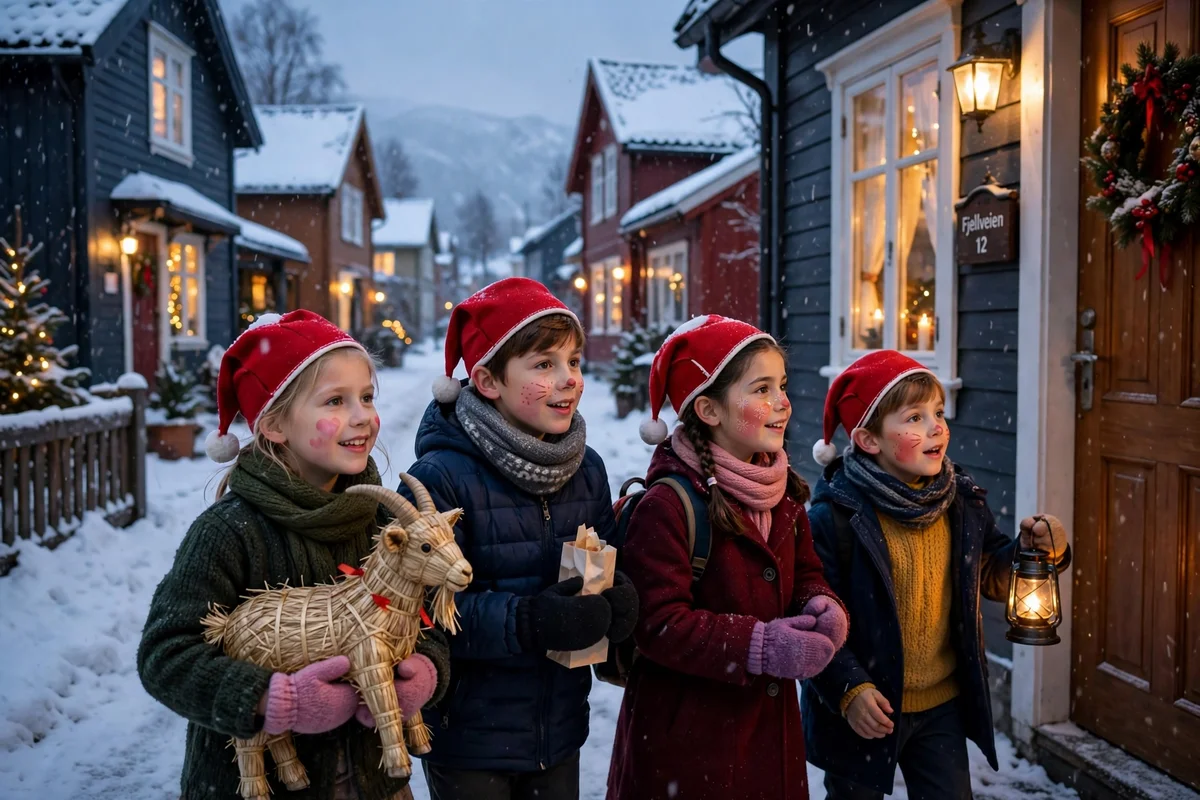
The julebukk, the straw Yule goat, is the oldest-looking thing in a Norwegian Christmas, and making one is a classic children’s craft for the start of December. Ask what straw figure symbolizes ancient norwegian christmas traditions and the answer is this goat: a small figure plaited from straw, often tied with red ribbon, made at the beginning of December and used as a Christmas ornament.
Its history reaches back before Christianity in Scandinavia. Folklore links the goat to Thor’s goats, Tanngrisnir and Tanngnjóstr, who pulled his chariot across the sky. That link is folklore and interpretation rather than proven fact. The goat has other roots too: the last sheaf of grain from the harvest was saved for Yule and shaped into a goat. Tell children the Thor story as a story, not as history.
To make one, tie a bundle of clean straw tightly in the middle with string to make the body, then divide each end into two legs, tying each leg near the end. Bend a smaller bundle over the top for the neck and head, tie it in place, and add two short straw horns. Finish with a red ribbon round the neck. Bought straw goats are sold in shops all through December, so a family short on time can buy one instead.
Going julebukk: Norway’s door-to-door singing
The same word, julebukk, names a custom as well as the straw goat. Å gå julebukk, to go julebukk, means dressing up and going from house to house singing Christmas songs in exchange for sweets. It is Norway’s answer to trick-or-treating, and it runs in romjul, from 25 December to New Year.
Children usually dress in a red nisse cap with painted cheeks, or as angels, shepherds and other Christmas figures, and go with friends or family to the neighbours’ doors. They sing a Christmas song, the neighbours try to guess who is under the disguise, and the singers are given cakes, sweets, clementines or nuts. In some places the visiting children give out sweets as well as receiving them.
The custom is strongest in smaller towns and residential neighbourhoods, and less common in big city centres. It is a daytime and early-evening custom, and children go with an adult or in a group, to houses they know. In Bergen there is a local variant, nyttårsbukk, on New Year’s Eve instead of in romjul.
Advent, St Lucy’s Day and baking
Advent starts on the fourth Sunday before Christmas Eve, and children usually have an Advent calendar from 1 to 24 December, with one small gift for each day. Many families read a chapter of a Christmas book each evening as well.
One date to know is 13 December, St Lucy’s Day. Schools and kindergartens often hold a Lucia procession, with children in white carrying candles and singing. One child leads as Lucia, in a white dress with a wreath and candles on her head.
Baking is the other Advent job for children. Pepperkaker, the thin spiced gingerbread biscuits, are baked through Advent, hung in windows and on the tree, and used to build gingerbread houses. Many families also aim to bake syv slag, seven kinds of Christmas cookies, though there is no official list.
The julenek belongs here too: a sheaf of grain, usually oats, hung high for the birds, traditionally on Christmas Eve, so that all God’s creatures are treated well at Christmas.
Christmas Eve through a child’s eyes
Julaften, 24 December, is the centre of the Norwegian Christmas, and for children it is a long day of waiting. Lunch is often the rice porridge with the hidden almond. At 5pm, church bells ring across the country to mark the start of the holiday, a moment Norwegians call å ringe julen inn, ringing Christmas in.
In the east and centre, ribbe, roast pork rib with crisp crackling, is the Christmas Eve dinner. In the west and north, pinnekjøtt rules: salted and dried sheep ribs, soaked and steamed over birch sticks. In a SIFO survey of how Norwegians celebrated Christmas in 2018, 49 percent ate ribbe and 40 percent ate pinnekjøtt on Christmas Eve.
After dinner, the family holds hands and dances around the Christmas tree, singing carols, the best known being Så går vi rundt om en enebærbusk. Only then are the presents opened, and in many homes the julenisse himself knocks at the door to hand them out. Children often sing a song before they receive theirs, and the presents are opened one by one, with the whole family gathered to watch. In the morning, many children watch Christmas television: Three Wishes for Cinderella, a 1973 Czechoslovak fairy tale dubbed in Norwegian, is shown every Christmas Eve morning on NRK, and Snøfall, the NRK advent series for children, is a newer favourite. Christmas Day itself, 25 December, is quiet and mostly spent at home.
Pepperkakebyen: the gingerbread city children build
The single best Christmas outing for children in Norway is Pepperkakebyen, the Gingerbread City, in Bergen. Since 1991, Bergen’s schoolchildren, families and businesses have baked a miniature town, complete with houses, churches, trains, ships and the Bryggen wharf houses, and the result is billed as the largest gingerbread town in the world. Children do not just visit it. They build it.
In 2026 it is on show from 14 November 2026 to 10 January 2027 at byROMMET, Kong Oscars gate 24 to 26. Adult tickets cost NOK 199, students NOK 149, and children aged 3 to 15 pay NOK 49 at weekends and enter free on weekdays. It is closed on Christmas Day and New Year’s Day.
Go in daylight, when children can see the detail: the fun is in spotting the tiny Bryggen houses, the trains and the ships. A taste of Bergen’s own gingerbread hearts is served at the end of the visit. The Bergen Christmas Market fills Festplassen nearby from 20 November to 22 December 2026, with free entry, so the two can be done together in one afternoon.
On Mount Fløyen, the traditional lighting of Advent candles takes place on the four Sundays leading up to Christmas, 29 November and 6, 13 and 20 December 2026, with candle lighting at 13:00 and activities for children before it. Watching the candle lighting is free. Oslo runs its main Christmas market at Spikersuppa.
Christmas books about Norwegian Christmas
This section answers the second keyword behind this article, the book about Norwegian Christmas traditions. There is no single official book of Norwegian Christmas traditions for children. What there is, instead, is a small shelf of real books that Norwegian children grow up with, so parents can find them.
The Christmas Mystery, by Jostein Gaarder, is the book to start with for older children. Published in Norwegian as Julemysteriet in 1992, it has one chapter for each day of Advent. A boy called Joachim finds a strange old Advent calendar in a bookshop, and behind its doors is the story of a girl called Elisabet, who disappeared fifty years earlier and travelled back through time to Bethlehem. Read a chapter a day from 1 December, and it finishes on Christmas Eve.
Snekker Andersen og julenissen, by Alf Prøysen, is the classic for younger children. First published in December 1957, it tells of Carpenter Andersen, who dresses up as the julenisse for his three children, and on his way to put on the costume meets another man in a nisse costume who says he is the real julenisse. The two swap places for the evening. The story has been filmed, in 2016, and staged in theatres across Norway. Prøysen’s companion story, Den vesle bygda som glømte at det var jul, the little village that forgot it was Christmas, first published in 1958, is the other one to look for.
Who’s That Knocking on Christmas Eve?, by Jan Brett, is the English-language picture book for small children. Published in 2002, it retells a Norwegian folktale first collected by Asbjørnsen and Moe, Kjetta på Dovre, the cat on the Dovrefell. A boy from Finnmark and his ice bear stop at a hut, where Kyri and her father lose their Christmas Eve meal to hungry trolls every year, until the bear is mistaken for a cat and chases them away.
The Christmas Pine, by Julia Donaldson, is the picture book about a real Norwegian tradition. Every year the Mayor of Oslo gives London a Christmas tree, a gift that goes back more than seventy years and thanks Britain for its support during the Second World War. Donaldson wrote the poem for the 2020 tree.
The Christmas Wish, by Lori Evert and photographed by her husband Per Breiehagen, is a photographic fairy tale about a little girl in a bunad, the Norwegian national costume, who straps on her skis to become one of Santa’s helpers, helped by reindeer, polar bears and other Arctic animals. Their daughter Anja is the model for the photographs. It is not a Norwegian book in the strict sense, it was made by an American family with Norwegian roots. Read these books in December, not in a rush on Christmas Eve.
The books Norwegians give at Christmas
Parents searching for a book about Norwegian Christmas traditions sometimes mean something else: the books Norwegians give each other at Christmas. Norway has no single book-giving tradition at Christmas of the kind Iceland has, where people give each other books on Christmas Eve and read all night, a custom called Jólabókaflóð, the Christmas book flood. That is an Icelandic tradition, not a Norwegian one.
What is true is simpler. Books are a normal Christmas gift in Norway, for children and for adults, and a Christmas book for a child is usually chosen the same way as any other gift: for that child, not from a traditional list.
Planning a Christmas trip with children
The best time to visit with children is Advent, from late November to 22 or 23 December, when the markets are open and the lights are up. Christmas Eve and Christmas Day are private: shops close and public transport runs a reduced service. Plan to be settled somewhere comfortable for those two days, ideally with a hotel that serves Christmas dinner.
Start in Bergen if you can. The market at Festplassen, Pepperkakebyen and the Bryggen wharf in the dark make the strongest Christmas first impression in Norway, and the city is compact enough to do all three in a day with children. Our Bergen guide has the practical detail, and our best time guide works through what December feels like. Oslo is the alternative, with its market at Spikersuppa, and our Oslo guide covers it. December days are short, so plan one main outing a day.
Frequently asked questions
What are norwegian christmas traditions for kids?
The main ones are the Advent calendar from 1 to 24 December, the St Lucy’s Day procession on 13 December, baking pepperkaker, leaving porridge out for the fjøsnisse, making a straw julebukk, the julenisse knocking at the door on Christmas Eve, dancing round the tree, going julebukk in romjul, and visiting Pepperkakebyen in Bergen.
Who is the julenisse, and who is the fjøsnisse?
The julenisse is the Norwegian Santa Claus: he arrives on Christmas Eve, knocks at the door and hands out presents. The fjøsnisse is the older barn spirit who lives in the barn all year, guards the animals and gets a bowl of porridge, nissegrøt, on Christmas Eve.
Why do Norwegian children leave porridge out at Christmas?
For the fjøsnisse, the barn nisse. A bowl of rice porridge with a pat of butter is put out in the barn, or on the doorstep, on Christmas Eve, to thank him for looking after the animals. Folklore says that if he is forgotten he takes revenge with mischief.
What is going julebukk, and when do children do it?
Å gå julebukk means dressing up and going from house to house singing Christmas songs in exchange for sweets, like trick-or-treating. Children do it in romjul, from 25 December to New Year, usually in the daytime or early evening, in groups, to houses they know. In Bergen the local version is nyttårsbukk, on New Year’s Eve.
What is Pepperkakebyen, and is it worth visiting with children?
Pepperkakebyen is Bergen’s Gingerbread City, a miniature town built from gingerbread by the city’s schoolchildren, families and businesses since 1991, and billed as the largest gingerbread town in the world. In 2026 it runs from 14 November 2026 to 10 January 2027 at byROMMET, Kong Oscars gate 24 to 26. Children aged 3 to 15 enter free on weekdays and pay NOK 49 at weekends. It is closed on Christmas Day and New Year’s Day.
Which Christmas books about Norwegian Christmas should I read with my child?
For older children, The Christmas Mystery by Jostein Gaarder, published in Norwegian as Julemysteriet in 1992, with one chapter for each day of Advent. For younger children, Snekker Andersen og julenissen by Alf Prøysen, first published in December 1957, about a carpenter who swaps places with the julenisse. For small children, Who’s That Knocking on Christmas Eve? by Jan Brett, published in 2002, retells a Norwegian folktale about a boy, an ice bear and Christmas Eve trolls. The Christmas Pine by Julia Donaldson tells the true story of the Oslo tree given to London each Christmas.