
Norwegian Christmas Food: Ribbe, Pinnekjøtt, Lutefisk and the Seven Cookies
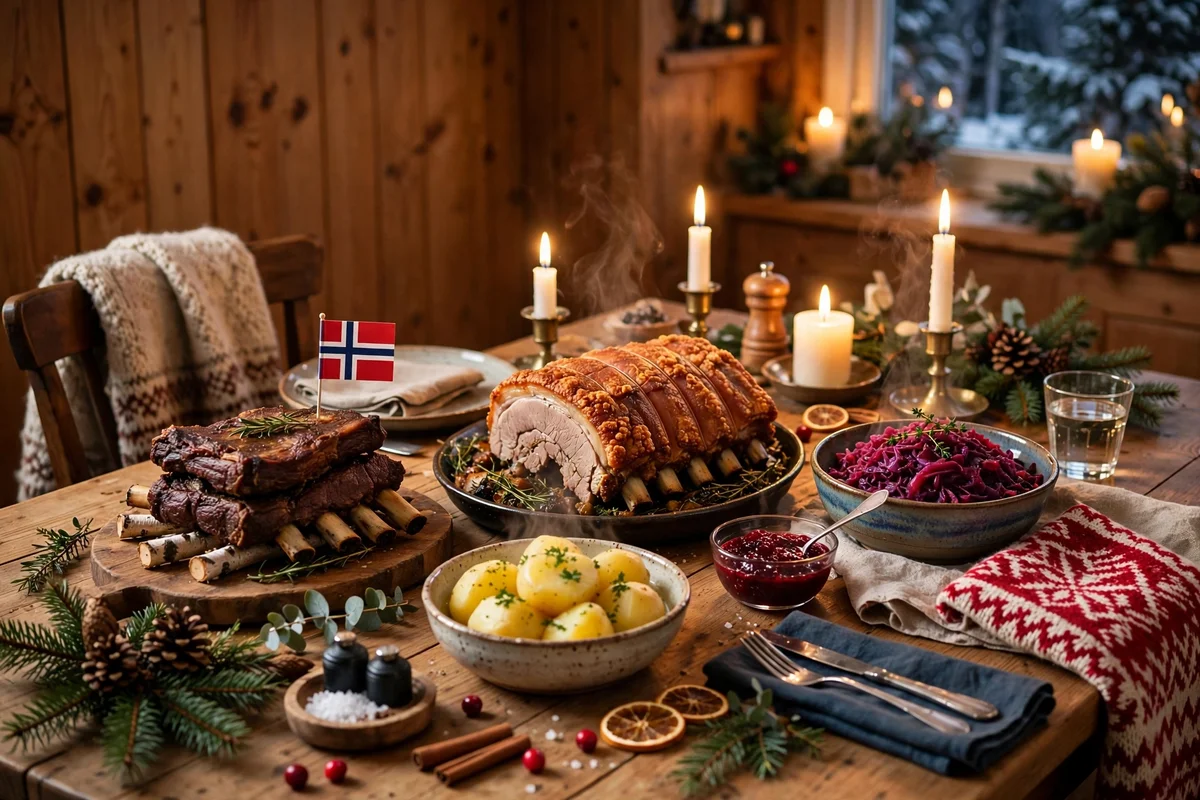
If you want to understand norwegian christmas traditions food, start with Christmas Eve dinner. In Norway, Christmas Eve, 24 December, is the main celebration, not Christmas Day, and the meal that evening is the one Norwegians argue about, plan for weeks and remember from childhood. The short answer is that most families eat one of two dishes: ribbe, roast pork rib with crisp crackling, or pinnekjøtt, salted and dried sheep ribs steamed over birch sticks. A survey by SIFO, Norway’s Consumption Research institute, of how Norwegians celebrated Christmas in 2018 found that 49 percent ate ribbe and 40 percent ate pinnekjøtt on Christmas Eve.
Ribbe vs pinnekjøtt: the east-west split
Ask a Norwegian what the proper Christmas dinner is and the answer usually depends on where they grew up. Ribbe rules in the east, around Oslo and the towns of Eastern Norway, while pinnekjøtt rules in the west, along the fjords and the coast of Western Norway. The split is old and it is friendly but firm: families that grew up with one dish often cannot imagine Christmas tasting of the other. In Western Norway about three quarters of people choose pinnekjøtt, while in the east ribbe dominates. The north sits between the two, and fish dishes hold their ground there and along the southern coast.
Ribbe is a cut of pork belly or pork rib, salted and seasoned, roasted slowly in the oven until the meat is tender and the skin turns into crisp crackling. The crackling is the point: a good ribbe has skin that shatters when you cut it, and many families judge the whole meal on it.
Pinnekjøtt starts much earlier. The ribs are salted, dried and sometimes lightly smoked, a way of keeping meat through the winter that goes back centuries. Before cooking they are soaked in water to draw out some of the salt, then steamed until tender over a lattice of birch sticks, which is where the name comes from: pinnekjøtt means stick meat. The steam filling the kitchen is, for many western Norwegians, the smell that says Christmas has started.
| Dish | What it is | Where it is eaten | What is served with it |
|---|---|---|---|
| Ribbe | Roast pork rib or pork belly with crisp crackling | Christmas Eve, especially in Eastern Norway | Surkål, rødkål, boiled potatoes, medisterkaker, Christmas sausages, brown gravy |
| Pinnekjøtt | Salted, dried, sometimes smoked sheep ribs, soaked then steamed over birch sticks | Christmas Eve, especially in Western Norway and the north | Kålrabistappe, boiled potatoes, sausages, akevitt |
| Lutefisk | Dried white fish, usually cod, soaked in lye then rinsed and cooked | Christmas season, strongest in Trøndelag and Møre | Bacon, mushy peas, mustard, boiled potatoes |
| Juletorsk | Fresh cod, the Christmas cod | Christmas Eve, especially in Southern Norway and the north | Boiled potatoes, carrots, melted butter |
What is served with each dish
The side dishes are not an afterthought. For many Norwegians they matter as much as the meat, and the sides are fixed by tradition, so a ribbe plate and a pinnekjøtt plate look different on the table.
Ribbe comes with surkål, a sweet and sour sauerkraut made with shredded cabbage, sugar and vinegar, and often rødkål, sweet red cabbage, as well. Boiled potatoes soak up the brown gravy, and medisterkaker, small pork meatballs, and medisterpølse, Christmas sausages, sit alongside the pork.
Pinnekjøtt is served more simply. The classic partners are kålrabistappe, mashed swede (rutabaga), and boiled potatoes, with sausages on the side. The sweet mash balances the salt of the meat.
Lutefisk, cod and the other Christmas Eve dishes
Lutefisk is the dish visitors hear about most and Norwegians argue about most. It is dried white fish, usually cod, that is soaked in water, steeped in a lye solution, then soaked again to rinse the lye out and cooked. The result is a soft, jelly-like fish with a mild taste and a texture that people either love or cannot face. Only about 1 percent of Norwegians ate lutefisk on Christmas Eve itself in the SIFO 2018 survey, but it stays a favourite at julebord parties and through the season. It is usually served with bacon and mushy peas, and some serve it with a brown cheese sauce instead.
Fresh cod has a quieter but older place on the table. Juletorsk, Christmas cod, is the Christmas Eve dish in parts of Southern Norway and in the north, where fish was always the food at hand. It is served simply, with boiled potatoes, carrots and melted butter, sometimes with a rich butter sauce. Halibut, julekveite, is the luxury fish of the season, baked or steamed and served with cucumber salad, carrots and potatoes.
Turkey, ham and vegetarian dishes sit far behind the big two in the surveys, at around 5 percent for turkey. The days after Christmas Eve have their own rhythm: the 25th and 26th are for leftovers, cold cuts, Christmas ham, cured meats, pickled herring and lefse, the soft potato flatbread, eaten slowly with family and visitors dropping by.
Dessert, porridge and the marzipan pig
Christmas Eve lunch is lighter than dinner, and it has its own tradition: risgrøt, rice porridge, served with sugar, cinnamon and a pat of butter, often with a single almond hidden in the pot. Whoever finds the almond wins a marzipan pig, a small pink pig made of marzipan, or another small prize.
Dessert after the Christmas dinner is usually riskrem, cold rice cream made from leftover rice porridge, whipped with cream and served with a red berry sauce. The same almond game is often played again: one almond is hidden in the riskrem, and the person who finds it wins the marzipan pig. In the north, multekrem, whipped cream folded with cloudberries, is the favourite instead.
Norwegian christmas traditions food: the seven cookies (syv slag)
After dessert, the coffee comes out, and with it the cookies. Many Norwegian families aim to bake syv slag, seven kinds of Christmas cookies, through December, keeping them in tins for whoever stops by. There is no official list, and every family and region has its own seven, but the seven named most often are these:
- Pepperkaker, thin spiced gingerbread, cut into hearts, stars and little figures, sometimes decorated with icing.
- Krumkaker, thin crisp cookies baked on a patterned iron and rolled into cones while still warm, often filled with whipped cream.
- Sandkaker, delicate buttery almond cookies pressed into little fluted tins, with a sandy, crumbly texture.
- Berlinerkranser, rich little wreath-shaped butter cookies made with cooked egg yolks, often topped with pearl sugar.
- Sirupsnipper, diamond-shaped spiced syrup cookies, usually with a blanched almond on top.
- Goro, crisp cardamom wafers baked in a decorative iron, thinner and richer than krumkaker.
- Fattigmann, twists of cardamom dough, deep fried and dusted with sugar, whose name means poor man’s cookies.
The number seven was traditionally seen as lucky, and a full cookie tin was a sign of plenty and hospitality in a season when butter, cream and fine flour were saved for Christmas. The tins still come out with the coffee all through romjul, the days between Christmas and New Year.
What to drink: juleøl, gløgg, julebrus and akevitt
What Norwegians drink at Christmas matters as much as what they eat, and December has its own drinks. Juleøl, Christmas beer, is a dark, rich, malty beer brewed for the season, stronger and fuller than the lagers Norwegians drink the rest of the year. It is the drink that sits beside the Christmas dinner.
Gløgg is the warm drink of the season. It is red wine or fruit juice heated gently with cinnamon, cardamom, cloves, ginger and orange, and served with raisins and chopped almonds in the glass. It is drunk at Advent gatherings, at Christmas markets and at office parties, and the alcohol-free version made with juice is just as common, so children drink it too. The one rule is never to let it boil.
Julebrus, Christmas soda, is the soft drink of the season, and it comes in two camps, red or brown. Norwegians are loyal to their local brand and their colour, and asking which is better is a reliable way to start a friendly argument. Akevitt, the caraway and dill spirit, is served in small glasses with the Christmas dinner and with lutefisk, sipped slowly through the meal.
The julebord: Norway’s Christmas party table
Before Christmas Eve, most of December belongs to the julebord, the Christmas table. It is a party, usually a buffet, held by workplaces, clubs and groups of friends through Advent. The table is loaded with the dishes of the season: ribbe and pinnekjøtt, lutefisk, pickled herring, Christmas ham, cured meats, pork terrine, lefse and salads. It is where many Norwegians eat lutefisk, even if they do not serve it at home on Christmas Eve. If you are invited to a julebord, expect a long evening, a lot of food and a toast or two.
Christmas market food in Oslo, Bergen and Tromsø
The easiest way for a visitor to taste Norwegian Christmas food is at a Christmas market. Markets open across the country from late November, and the food stalls are a large part of them.
In Oslo, Jul i Vinterland takes over Spikersuppa, the park strip along Karl Johans gate between the National Theatre and the Parliament, from 7 November 2026 to 3 January 2027, closed on 24 December. The stalls sell gløgg, smultringer, warm doughnut rings scented with cardamom, cured meats, salmon, cheese, waffles and candied almonds. Our Oslo guide covers the city in full. A second, older-fashioned stop is the Christmas fair at the Norsk Folkemuseum, on the weekends of 5 to 6 and 12 to 13 December 2026, where Hardanger lefse is baked on griddles in the old cookhouses.
In Bergen, the Christmas market fills Festplassen, the square by the Lille Lungegårdsvann lake, from 20 November to 22 December 2026. There is a heated tent for hot chocolate and gingerbread. The market runs alongside Pepperkakebyen, the gingerbread city, a miniature Bergen built every year from gingerbread by local children, schools and companies, open from 14 November 2026 to 10 January 2027. Our Bergen guide covers the city, and our best time guide explains what December in Bergen feels like. The farmers’ market at the fish market, Bondens marked, runs on Saturdays 28 November and 5, 12 and 19 December 2026, from 10:00 to 16:00, with Christmas food from regional producers.
In Tromsø, there is no single market square. The whole downtown turns into Christmas Town Tromsø, with fairs at several locations, including Stortorget, through late November and December, including the Juleglede market at the Nerstranda shopping centre. Food leans Arctic here: cloudberry jam, Arctic char, smoked reindeer and fish dishes, with gløgg to warm your hands. Our Tromsø Northern Lights guide covers visiting the city in the dark season.
At any of these markets, the food to look for is the same short list: a cup of gløgg first, then smultringer warm from the fryer, a lefse folded with butter, sugar and cinnamon, pepperkaker by the bag, and, if a stall is serving hot food, a plate of pinnekjøtt or ribbe.
What a visitor can actually eat
Christmas food in Norway is home food, so the honest answer is that a visitor eats it in three places: at a market, in a restaurant, or at someone’s table.
In Bergen, start at the fish market, Fisketorget. The indoor hall, Mathallen, is open year round, while the outdoor stalls run in the summer season. In December it is a warm lunch stop for fish soup, prawns, smoked salmon and fish cakes. The hall closes on 25 December, so plan around it. In December, pinnekjøtt appears on Bergen restaurant menus from late November through early January, and it is the dish to order if you only order one.
You can book the Bergen Food and Culture Walk on Viator.
Restaurants serving Christmas menus book up early. If you want a Christmas dinner in a restaurant on Christmas Eve or Christmas Day, book weeks ahead, not days, and expect a set menu rather than a choice. Many restaurants close entirely over Christmas, and those that stay open often serve only a fixed Christmas menu at a fixed seating. Ask when you book whether the menu is ribbe or pinnekjøtt, because in the west it will usually be pinnekjøtt and the choice is made for you.
If you are invited to a Norwegian Christmas dinner, the rules are simple. Bring a small gift for the host, such as flowers, chocolates or a bottle, and arrive on time. The meal is served at a set hour, often around 5pm, after the church bells ring Christmas in. Save room for dessert and coffee, because the cookies come out after the riskrem. If you are offered akevitt, sip it; nobody expects you to finish it in one go. And if you find the almond in the porridge or the riskrem, accept the marzipan pig with the honour it deserves.
Practical advice for visitors at Christmas
Book ahead, then book again. Christmas dinner in a restaurant, a table for Christmas Eve, and a hotel room over the Christmas week all need booking well in advance, and the most popular places fill first. Our cost guide explains what eating out in Norway costs.
Plan for the shutdown. The 25th and 26th of December are public holidays in Norway, and most shops close on both days. On Christmas Eve, 24 December, shops close early in the afternoon, and most restaurants and attractions close or shorten their hours over 24 to 26 December. Buy any food, supplies or gifts you need before Christmas Eve, and check the opening hours of anything you plan to visit rather than assuming it is open.
Eat the season while it lasts. The markets close before Christmas, the Christmas beers and sodas leave the shelves in January, and the pinnekjøtt and ribbe disappear from menus after the first week of January. December is the one month when all of this food is easy to find, and the markets are the simplest place to start.
Frequently asked questions
What is norwegian christmas traditions food?
It is the food Norwegians eat at Christmas, above all the Christmas Eve dinner: ribbe, roast pork rib with crisp crackling, or pinnekjøtt, salted and dried sheep ribs steamed over birch sticks. Around them sit surkål and rødkål, boiled potatoes, kålrabistappe, sausages, lutefisk and cod, then riskrem for dessert, the seven Christmas cookies with coffee, and juleøl and gløgg to drink.
What is the difference between ribbe and pinnekjøtt?
Ribbe is roast pork rib or pork belly, cooked in the oven until the skin becomes crisp crackling, and it is the Christmas dinner of Eastern Norway. Pinnekjøtt is salted, dried and sometimes smoked sheep ribs, soaked in water and then steamed over a lattice of birch sticks, and it is the Christmas dinner of Western Norway. Ribbe is served with surkål, rødkål, potatoes and medisterkaker; pinnekjøtt is served with kålrabistappe, potatoes and sausages.
Do Norwegians really eat lutefisk at Christmas?
Some do, but far fewer than visitors expect. Only about 1 percent ate lutefisk on Christmas Eve itself in the SIFO 2018 survey. It is much more common at julebord parties and through the Christmas season than as the Christmas Eve main dish, and it is strongest in Trøndelag and Møre. If you want to try it, a julebord or a restaurant serving a Christmas menu is the easiest place.
What are the seven Christmas cookies?
Syv slag, the seven kinds, is the tradition of baking seven types of Christmas cookies through December. There is no official list, and families choose their own seven, but the seven named most often are pepperkaker, krumkaker, sandkaker, berlinerkranser, sirupsnipper, goro and fattigmann. They are served with coffee after dessert on Christmas Eve and all through romjul.
What do Norwegians drink at Christmas?
With dinner, juleøl, a dark seasonal beer, and small glasses of akevitt. Gløgg, warm spiced red wine or juice with raisins and almonds, is the drink of Advent gatherings and Christmas markets. Julebrus, a Christmas soda in red or brown, is the alcohol-free favourite.
Can a visitor eat a Norwegian Christmas dinner?
Yes, and the simplest way is at a Christmas market, where stalls serve gløgg, smultringer, lefse and often hot plates of pinnekjøtt or ribbe. Restaurants serve Christmas menus from late November, but book weeks ahead, because many close over 24 to 26 December. In Bergen, the fish market hall is a good December lunch stop, and pinnekjøtt is on menus across the city through the season.

3 Comments