Can You See the Northern Lights on a Summer Fjord Cruise?
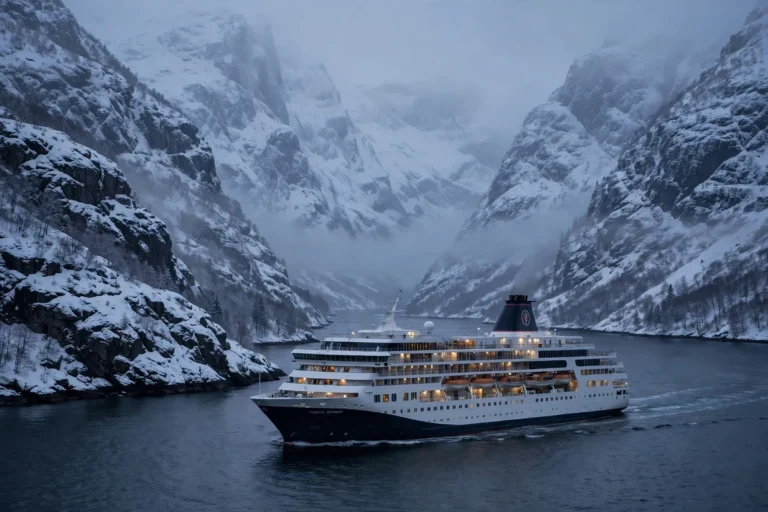
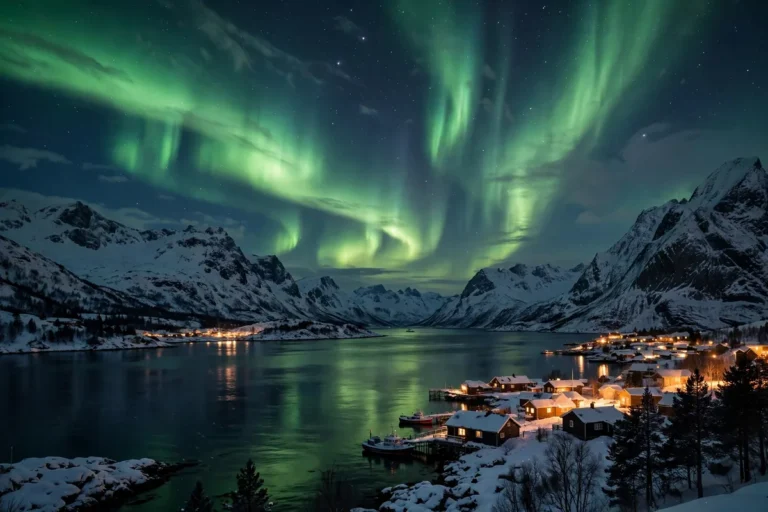
No, you cannot see the northern lights on a summer fjord cruise. Not in June, not in July, and not on any sailing that stays in the bright summer months. If you are asking “can you see northern lights on a summer fjord cruise” because a brochure photo showed green curtains over a fjord, that photo was taken in winter. Summer in Norway is the season of the midnight sun, and the two cannot share the same sky.
That is disappointing if the aurora was the reason you picked Norway, but it is better to hear it now than to stand on deck at midnight in July wondering why the sky is still bright. This guide explains why the answer is no, what darkness means at different latitudes, when your first realistic chance comes, and how to plan the right trip for the sky you want.
Why the Northern Lights Need a Dark Sky
The northern lights are caused by charged particles from the sun colliding with gases in the upper atmosphere. Oxygen and nitrogen glow green, pink and red when those particles hit them. The key point is that this never stops for the summer. The aurora is still happening above Norway in June and July, in broad daylight. You simply cannot see it, because the sky is too bright.
Think of it like trying to see stars at noon. The stars are still there, but the sun washes them out. The aurora is far fainter than the sunlit sky, so it loses the same contest. For the lights to show, the sun has to be well below the horizon and the sky properly dark.
Cloud matters too, but on a summer cruise it is not the problem. Daylight is. No forecast or camera setting will fix that.
The aurora is never guaranteed on any night. It needs solar activity, clear skies and darkness all at once. A winter sailing gives you all three. A summer sailing gives you none of the darkness.
The Midnight Sun Is the Reason
The midnight sun is the other side of the same coin. The Earth tilts on its axis by about 23.5 degrees, and in the northern summer the North Pole leans toward the sun. Above the Arctic Circle, at about 66.5 degrees north, that keeps the sun above the horizon around the clock for part of the summer. It dips low toward the northern horizon around midnight, turns gold and pink, and climbs again without setting.
The further north you sail, the longer this lasts. Tromsø, at about 69.6 degrees north, has midnight sun from about 20 May to 22 July according to Visit Norway, and most other sources give the same dates, give or take a day or two depending on the year and on how the dates are calculated. At the North Cape, at about 71.2 degrees north, the season runs from about 14 May to 29 July. Bodø, just above the Arctic Circle, has a shorter window, from about 4 June to 8 July, and Svolvær in Lofoten runs from about 28 May to 14 July. Mid-June to early July is the safest window, because every point above the Arctic Circle has midnight sun around the solstice on 21 June.
Midnight sun dates along the coast
| Place | Latitude | Midnight sun, approximately |
|---|---|---|
| North Cape | 71.2° N | 14 May to 29 July |
| Tromsø | 69.6° N | 20 May to 22 July |
| Svolvær, Lofoten | 68.2° N | 28 May to 14 July |
| Bodø | 67.3° N | 4 June to 8 July |
| Bergen | 60.4° N | No midnight sun |
Dates shift by a day or two between years and sources, and mountains or cloud can hide the sun even when it is technically above the horizon. The pattern is clear: the further north the ship sails, the longer the bright season lasts, and the longer the aurora stays out of reach.
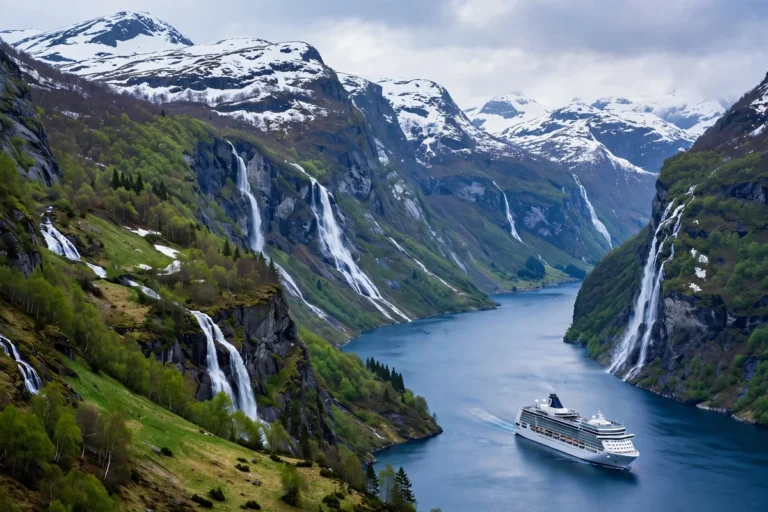
If your cruise stays in the classic fjords around Bergen, Geiranger and Ålesund, you will not see the midnight sun at all. Bergen sits at about 60.4 degrees north, well south of the Arctic Circle. Around the solstice it has about 19 hours of daylight, with the sun setting at around 11pm and rising again before half past four, and the hours in between are a long, pale twilight.
What “Darkness” Means at Different Latitudes
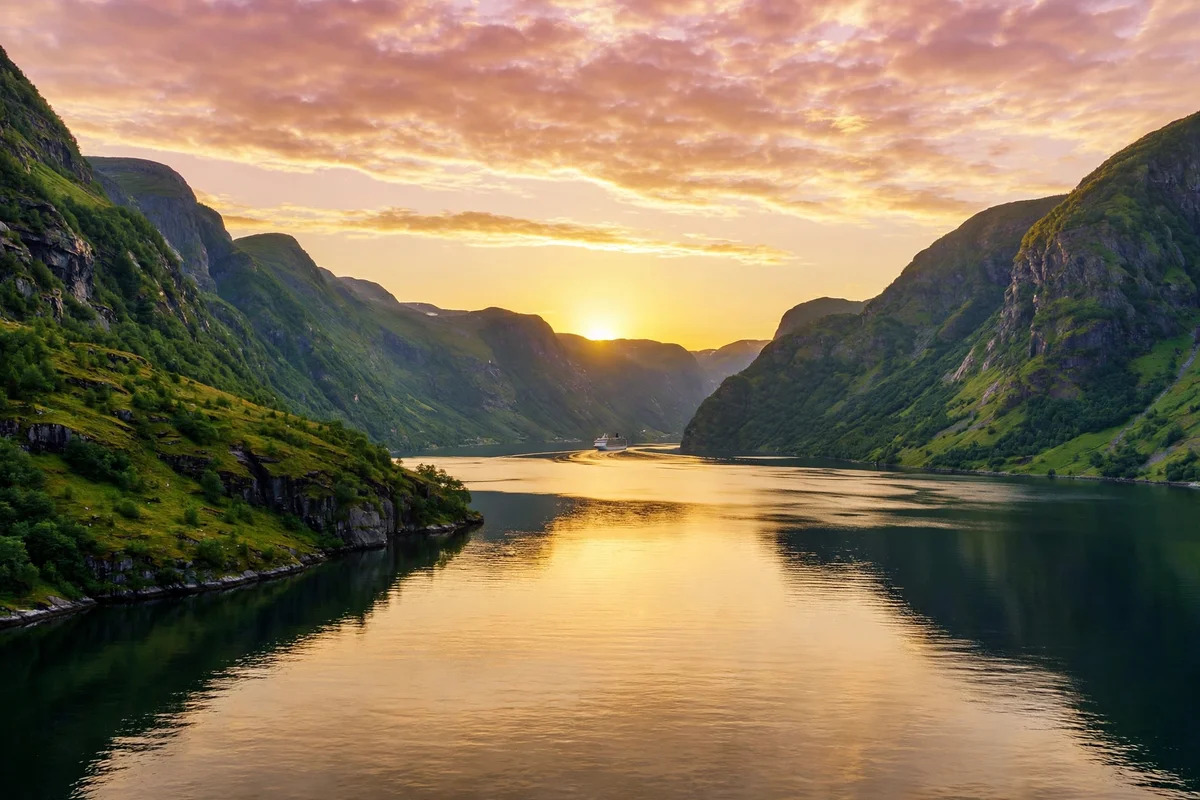
In Bergen and the southern fjords, the sun sets every night, even in June, but it barely dips below the horizon. A long sunset melts into a long sunrise, with a few hours of dusky blue in between. You can walk around deck at 1am without a light, and the aurora has no chance.
In Tromsø and the Lofoten Islands, the sun does not set at all from late May to late July. There is no sunset and no twilight, only a sun circling low all night. At midnight it sits just above the northern horizon, and the light holds the warm colour of late evening for hours. This is the midnight sun at its best, and the brightest possible night. The aurora is completely washed out.
At the North Cape the same thing lasts even longer, from mid-May to late July. The cape is also famous for fog, which can hide the sun at midnight, but fog makes the sky grey, not dark.
South of the Arctic Circle, darkness returns sooner, but that does not help. Bergen gets properly dark nights again by late August and September, yet it sits well south of the auroral oval, the band of sky where the lights appear most often. The lights can occasionally reach that far south during a strong storm, but that is rare, not something to plan a cruise around.
In short, in June and July no part of the Norwegian coast is dark enough for the northern lights. In the north, the sun never sets. In the south, it sets but the twilight never ends.
When Darkness Returns, and Your First Real Chance
Darkness comes back gradually. After the midnight sun ends in Tromsø around 22 July, the sun starts setting again, but at first it only dips a little below the horizon. Through August the nights lengthen, and by late August the sky can get dark enough for a faint aurora on a clear night, at least in theory.
Visit Tromsø puts the potential season in the city from late August to early April, provided the sky is dark and clear. Visit Norway gives the main season for Northern Norway as late August or September through late March. Late August is the earliest edge of what is possible, not the start of reliable viewing. The first displays are usually faint and short, and they need a clear sky, a dark spot away from the ship’s lights, and luck with solar activity.
September is the first month in which the odds look like a real plan. The nights are properly dark again, the autumn colours are out, and the weather is milder than in midwinter. A late September sailing gives you a genuine, if modest, chance, and the chance grows with every week into October.
Hurtigruten draws its own line a little later. Its Northern Lights Promise, a complimentary coastal voyage if the aurora is not officially sighted from the ship, applies to voyages of 11 days or more sailing between 20 September and 31 March. An operator that has sailed this coast since 1893 starts its promise on 20 September, not in August. Treat late August as possible, September as the start of the real season, and late September onwards as the point where a lights cruise starts to make sense.
If the aurora is the priority, take September over late August. The fjords will still be there, the autumn colours will be better, and the nights will be dark enough to give the lights a fair chance. See our best time to visit the fjords guide for the seasons side by side.
Can One Cruise Catch Both the Midnight Sun and the Aurora?
No, not in any practical sense. The midnight sun and the northern lights need opposite skies. One needs the sun above the horizon at midnight. The other needs it well below the horizon. There is no week of the year in which both are on offer in the same place.
Catching the last midnight sun around 22 July and the first faint aurora in late August would mean staying in the north for a month. A cruise lasts a week or two, and no itinerary can stretch across that gap.
Some travellers split the difference with a trip in late August or early September, hoping for long light evenings and a first glimpse of the aurora. You will not see the midnight sun, because it ended weeks earlier, and your aurora chance will be slim. What you will get is a lovely shoulder-season sailing: long days, autumn colour, fewer crowds and the first dark nights of the year. Book it on those terms, not as a lights trip.
If you truly want both, plan two trips: sail the fjords in June for the midnight sun, then come back to Tromsø between late September and March for the aurora.
What to Do Instead on a Summer Fjord Cruise
A summer fjord cruise without the northern lights is a different kind of trip, and for many travellers it is the better one.
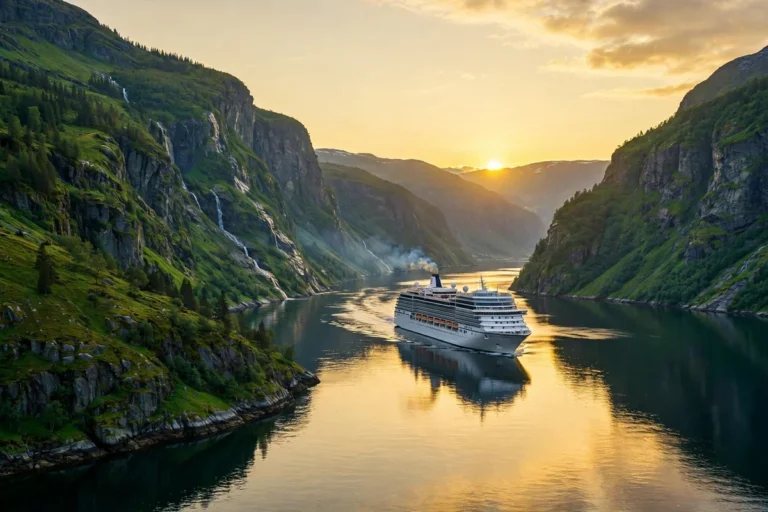
Go out on deck at midnight. In Tromsø in late June the sun is still above the horizon, hanging low over the water in the north, and the fjords are lit in gold. Photographers call this the golden hour, and in the Arctic summer it lasts for hours.
You can book the Tromsø: Summer Evening Cruise with Activities on Viator.
Use the long evenings. Hikes, kayaking and small-boat trips can run late into the night, and villages that would be dark by 9pm at home are still bright at 11pm. Evening sailings through narrow fjords feel unhurried because no darkness is chasing you into port.
Sleep properly, because the light will try to stop you. Cabins with blackout curtains help, and an eye mask is one of the most useful things you can pack. Our packing list covers the summer essentials, including the eye mask and the layers you will want on deck late at night.
None of this replaces the aurora. It is the summer fjords on their own terms: long light, warm colour, green mountains and calm water.
How to Plan a Winter Lights Trip Instead
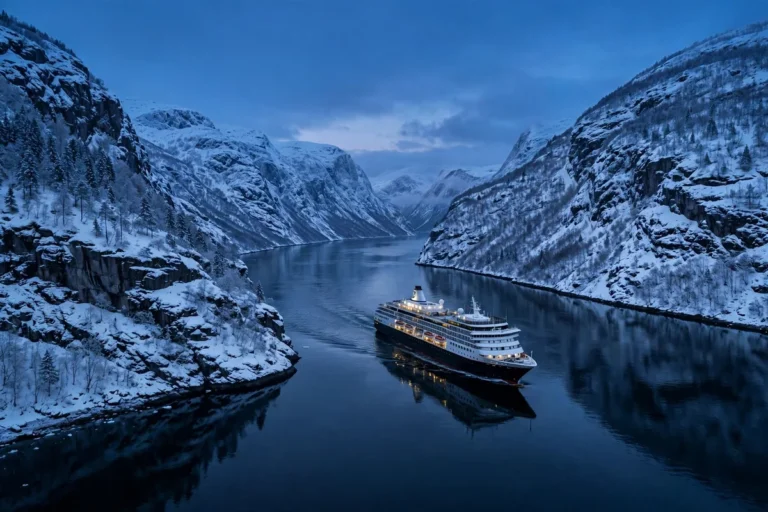
If the aurora is the reason you want to go, plan a winter trip around darkness. The main season in Northern Norway runs from late September to late March, according to Visit Norway, with the potential season around Tromsø stretching from late August to early April.
Late September and October give you dark nights without the deepest cold, plus autumn colours and lakes that are still open. November to February gives you the longest nights, including the polar night in Tromsø from about 27 November to 15 January, when the sun does not rise at all. February and March are popular because the nights are still dark enough while the days have come back far enough to do things with. Activity is often higher around the equinoxes, in September and October and again in March, according to guides citing Visit Norway.
Give yourself time. The aurora is never guaranteed, so three or four nights under dark skies gives you far better odds than one. A longer coastal sailing helps: the ship keeps moving, so it can sail away from cloud, and the crew announce sightings at any hour. If you would rather base yourself on land, Tromsø is the easiest starting point, with an airport, hotels and evening tours that drive to darker skies. Our Tromsø northern lights guide covers the land-based side in detail.
The Bergen to Kirkenes coastal express is the classic way to chase the lights by sea. The full round trip takes 12 days and calls at 34 ports, sailing right under the auroral oval, and the Northern Lights Promise covers voyages of 11 days or more between 20 September and 31 March.
Check the cloud forecast on yr.no, the Norwegian weather service, in the afternoon before you go out, because cloud matters more than almost anything else. The aurora forecast, often given as a Kp index from 0 to 9, tells you how disturbed the Earth’s magnetic field is, and in Tromsø a Kp of 2 or 3 is often enough on a clear night. Dress far warmer than you think you need, and bring a tripod if you want photos.
Winter sailings, flights and hotels price differently from summer, so read our cost and budget guide before you book.
Choosing Your Cruise by the Sky You Want
The simplest way to decide is to work backwards from the sky. Pick the phenomenon first, then pick the month, then pick the sailing.
If you want the midnight sun, sail above the Arctic Circle between late May and late July, aiming for mid-June to early July. A North Cape sailing gives you the longest season; a Tromsø and Lofoten sailing gives you the same midnight sun with easier access.
If you want the northern lights, sail between late September and late March, stay at least three or four nights in the north, and choose a sailing that spends most of its time above the Arctic Circle. Late September and October are milder and quieter, February and March give you more daylight, and December and January give you the most darkness.
If you want both, accept that it takes two trips. There is no sailing that delivers both, and any itinerary that claims to is selling you a photograph, not a sky.
Before you book, check our best time to visit guide and the Norway fjord cruises overview. Our fjords road trip guide shows the coast from the road in summer, and our sustainable cruising guide explains how to keep a summer sailing light on the fjords.
Summer is for the midnight sun, winter is for the northern lights, and the fjords are worth seeing in both. Pick the sky you want and book the season that holds it.
Frequently asked questions
Can you see northern lights on a summer fjord cruise?
No, not in practice. The aurora is still happening high above Norway in summer, but the sky never gets dark enough for it to show. Above the Arctic Circle the midnight sun keeps the sun above the horizon around the clock from late May to late July, and further south the nights are a long, bright twilight. The question “can you see northern lights on a summer fjord cruise” has the same answer on every route: the lights need a dark sky, and summer in Norway does not have one.
Can you see the northern lights in Norway in August?
Only just, at the very end of the month. Visit Tromsø puts the potential season from late August, once darkness returns after the midnight sun ends around 22 July. The first displays are usually faint and short, and September is the first month with a realistic chance.
What is the best month to see the northern lights in Norway?
Late September to late March is the main season. September and October give you dark nights, milder weather and autumn colours. February and March add longer days for daytime trips. December and January give you the most hours of darkness. Give yourself at least three or four nights, because the aurora is never guaranteed on any single night.
Can you see both the midnight sun and the northern lights on one cruise?
No. The two need opposite skies, and no week of the year offers both. The midnight sun runs from about 20 May to 22 July in Tromsø and about 14 May to 29 July at the North Cape. The aurora season runs from late September to late March, and the gap between the two seasons is more than a month. To see both properly, you need two trips.
Why do photos show the northern lights over the fjords in summer?
They do not, or at least not honestly. Photos of green aurora over a fjord were taken in the dark months, usually between late September and late March, and then used to sell summer sailings. Some are composites, with a winter sky placed over a summer landscape. Treat such a brochure as a picture of the fjords in winter, not a promise about your sailing.
Do I need to go to Tromsø to see the northern lights?
No, but Tromsø is the easiest base for a first trip. It sits under the auroral oval, has an airport and hotels, and has many evening tours that drive to darker skies. You can also see the lights from a coastal sailing between Bergen and Kirkenes, or from Lofoten, Senja, Alta and Kirkenes. Wherever you go, you need a dark sky, a clear sky and solar activity, and the season has to be right.