Norway Cruises from Southampton: No-Fly Guide
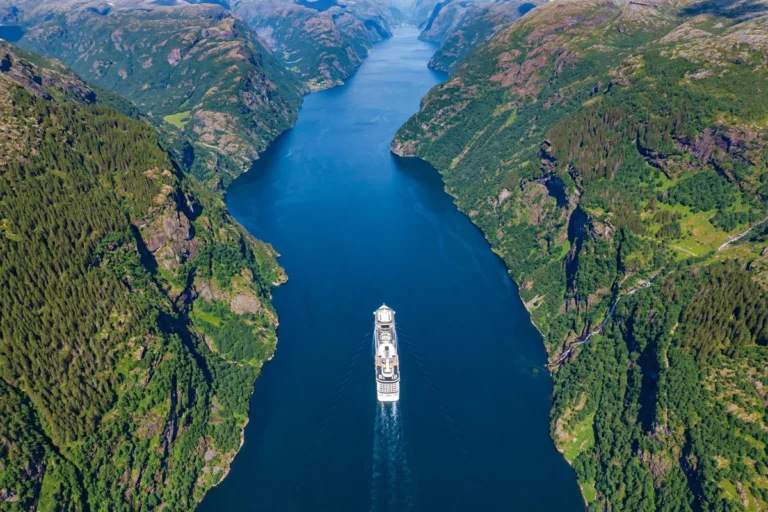
A Norway cruise from Southampton is the simplest way for a UK traveller to reach the fjords without flying. You drive or take the train to the south coast, board the ship in the afternoon, and wake up after a day at sea on the Norwegian coast. There is no airport queue, no transfer at the other end, and no hotel night in Bergen before the cruise starts.
That simplicity needs a clear-eyed plan. The North Sea crossing takes a day or more each way, so a 7-night cruise gives you about four or five days in Norway, not seven, and the ships are mostly large resort ships.
What no-fly means, and who it suits
No-fly means the cruise starts and ends at a UK port, in this case Southampton, and you reach the ship by road or rail. Your luggage travels with you in the car or on the train rather than through an airport baggage system. That matters most for travellers who do not want to fly, travellers with a lot of luggage, and families who would rather drive to the port than manage children, bags and airport timings in one morning.
It also suits anyone who likes a slow start. You arrive in your allotted check-in window, hand over your bags, and you are on board in time for lunch and the afternoon sailaway.
No-fly does not mean no paperwork: Norway is outside the EU, and a UK passport is needed. ETIAS, the planned European travel authorisation for visitors from visa-free countries including the UK, is not in operation and has no start date.
Which cruise lines sail from Southampton to Norway
Southampton has the widest choice of Norway sailings of any UK port. Ship deployments change from year to year, so treat the ship names below as the pattern for a typical season, and confirm the ship and itinerary on the cruise line’s own listing.
P&O Cruises has the biggest Southampton fleet and the longest fjord season here, listed as March to November 2027, with calls at Stavanger, Olden, Alesund, Flam, Skjolden and Hellesylt. The newest ships, Iona and Arvia, each carry about 5,200 guests and run on liquefied natural gas, with a covered SkyDome pool area. Britannia, at about 3,600 guests, is the middle option, and Aurora, at about 1,800 guests, is the smaller, adults-only ship. P&O sails year-round from Southampton, so it also has the most winter Norway options.
Cunard sails from Southampton year-round, with Queen Anne, Queen Mary 2 and Queen Victoria based at the port at different times of the year. Its Norway sailings are generally longer than the standard 7-night week, often 12 nights, and they reach further north, with calls at Trondheim, Tromso and Narvik on the northern lights routes checked for this guide. Cunard is a formal, traditional line.
Fred. Olsen Cruise Lines sails smaller ships, Balmoral, Borealis and Bolette, from Southampton as well as from Liverpool and Newcastle. These ships can enter narrow fjords and call at small ports the large ships cannot reach, including the Lysefjord and Skjolden, Leirvik and Eidfjord. Its Southampton fjord sailings in the examples checked ran for 8 to 10 nights.
Princess Cruises sails seasonally from Southampton, roughly March to October, with Sky Princess and Majestic Princess based at the port for the 2027 season and about 45 Southampton departures between them, each ship carrying about 3,600 guests. Its 7-night fjord sailings called at Haugesund, Alesund, Skjolden and Stavanger, and its longer sailings reached the Arctic Circle and Tromso.
MSC Cruises, Royal Caribbean and Celebrity Cruises all run seasonal fjord sailings from Southampton in summer: MSC Meraviglia, Royal Caribbean’s Freedom of the Seas and Celebrity Apex, with 7 to 14-night sailings to the fjords and the Arctic Circle. These three lines are international rather than British in feel. Ambassador Cruise Line needs a correction: it does not sail from Southampton. Its ships, Ambience and Ambition, sail from London Tilbury, with Ambience carrying about 1,400 guests and Ambition about 1,200. Its fjord sailings are adults-only, and its Tilbury departures are a genuine no-fly alternative if Tilbury is closer to you.
How long: 7, 10 and 14 nights compared
Most no-fly fjord cruises from Southampton are 7 nights. That is the minimum that works, because the North Sea crossing takes about a day each way. Shorter fjord cruises from Southampton are rare to the point of not existing: a 4 or 5-night round trip cannot reach the deep fjords and return, so if you see a short sailing advertised as a Norway cruise, check whether it actually calls in Norway.
| Length | Sea days | Days in Norway | Typical ports | Best for |
|---|---|---|---|---|
| 7 nights | 2, one each way | 4 to 5 | Stavanger, Haugesund, Bergen, Alesund, Olden, Skjolden, Flam | First fjord cruise, a week off work, families |
| 10 nights | 2 to 3 | 6 to 7 | As above, plus Geiranger, Eidfjord, Kristiansand, Andalsnes | A second visit, more fjord time, smaller ships |
| 14 nights | 3 to 4 | 8 to 10 | As above, plus Oslo, Tromso, Trondheim, Honningsvag | Northern lights, Arctic Circle, a slow trip |
A 7-night sailing is the classic first fjord cruise. Our 7-day itinerary guide walks through one in day-by-day detail, and our 7, 10 and 14-day comparison covers the trade-offs in full. A 10-night sailing is the sweet spot if you want Geirangerfjord as well as the southern fjords, and a 14-night sailing reaches Tromso and the North Cape in summer, or the northern lights in winter.
Typical ports of call
A single sailing visits three to five of the ports below, not all of them, so use this section to judge an itinerary, not to plan a day in a port you may not visit.
Stavanger is usually the first Norwegian call, and it is the easiest first day: the ship docks close to the old town, and the white wooden houses of Gamle Stavanger are a short walk from the quay. The main excursion is the Lysefjord and Preikestolen, the Pulpit Rock, but that is a long day. Bergen, the fjord capital, works well as a self-guided day, with the Bryggen wharf, the fish market and the Floibanen funicular all within walking distance of the port. Haugesund is a smaller, quieter call, with a walkable centre and excursions to the Langfoss waterfall. Our Stavanger guide and our Bergen guide cover both cities.
Alesund is the Art Nouveau town on the coast, rebuilt in stone after a fire in 1904, and it is the base for Geirangerfjord on sailings that do not call at Geiranger itself. The Aksla viewpoint, reached by 418 steps, gives the view over the town and the islands. Olden, at the head of Nordfjord, is about the landscape: the Briksdal Glacier and the Loen Skylift. Flam, at the end of Aurlandsfjord, is the Flam Railway port: the railway climbs to Myrdal in about an hour, and it is the single most booked excursion on the fjord routes, so book it through the ship or in advance. Our Alesund guide, our Nordfjord and Olden guide and our Flam Railway guide cover all three.
Skjolden and Hellesylt are the two small villages at the heads of the longest fjords. Skjolden, at the end of Lustrafjorden, is the base for the Urnes Stave Church. Hellesylt, at the head of Sunnylvsfjord, is the gateway to Geirangerfjord, and many ships sail from Hellesylt through Geirangerfjord rather than docking at Geiranger. Our Hellesylt and Skjolden guide covers both. One correction if you plan an independent trip from either village: the Hellesylt to Geiranger crossing still runs and still carries cars, on Vestlandske ticketed sailings sold through Norway’s Best, in about 65 minutes, with a vehicle space to be booked ahead and arrival at the quay 30 minutes early. The public Fjord1 car ferry has been suspended since 4 September 2026, but the crossing itself has not closed.
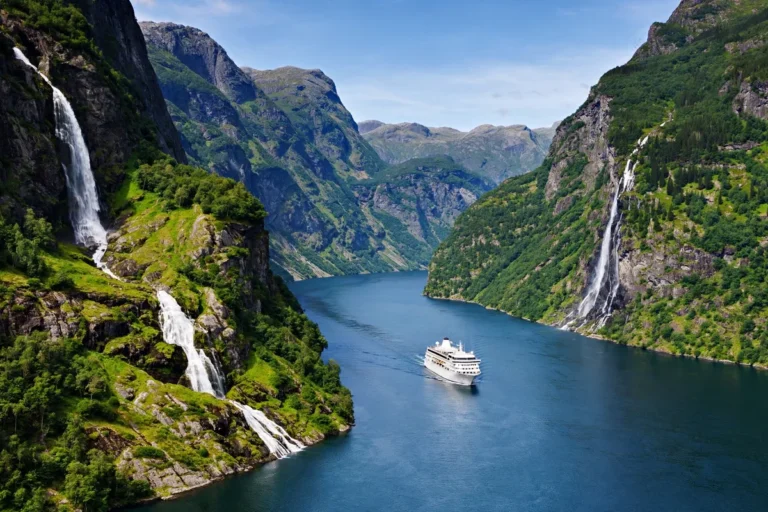
Geiranger is the most famous fjord village in Norway, at the end of Geirangerfjord, and it is the call that sells the longer sailings. The ship sails in past the Seven Sisters waterfall, and the viewpoints at Flydalsjuvet and Dalsnibba are the main excursions. Eidfjord, in Hardangerfjord, is the base for the Voringsfossen waterfall. On longer sailings the ports go further north: Trondheim, Tromso and Honningsvag, the port for the North Cape. Our Geirangerfjord guide covers the fjord.
The North Sea crossing
Southampton to Stavanger, the usual first Norwegian port, is roughly 550 to 600 nautical miles, and the ship takes about 24 to 36 hours to cover it, depending on speed and conditions. That means one full day at sea on the way out and one on the way back, with the ship arriving on the Norwegian coast on the second morning. The crossing is usually calm in summer, but the North Sea can be rough in spring, autumn and winter. If you are prone to seasickness, choose a cabin low down and near the middle of the ship, and bring remedies with you. Use the sea days to learn the ship, book excursions, and rest before the port days, which start early and run long.
When to go: the fjord season from Southampton
The fjord season from Southampton runs roughly from March to November, with the bulk of sailings between May and September. June and July are the warmest and lightest months, but also the busiest. May and September are quieter, and the waterfalls are still strong in May. Our best time to visit guide covers the southern fjord seasons, and our season tracker gives the month-by-month picture.
Spring sailings, in March and April, are the quietest, but also the most weather-dependent, and some mountain roads may still be closed. The midnight sun belongs to the far north, around Tromso and the North Cape, rather than to the southern fjords. Our midnight sun guide gives the dates and the places where it applies.
Winter is a different trip. From late September to March the nights are long enough for the northern lights, and the winter sailings from Southampton are longer, usually 12 to 14 nights, because they have to reach Tromso or Alta. Our northern lights guide covers those sailings. Christmas is a special case: our Southampton and Dover Christmas cruise guide found only one Southampton departure in December 2026 that put a large ship in a Norwegian port on Christmas Eve, so check the itinerary, not the headline. For the heritage fjords, Geirangerfjord, Nærøyfjord, Aurlandsfjord, Sunnylvsfjord and Tafjord: from 1 January 2026, passenger ships under 10,000 gross tons must be zero-emission in those five World Heritage fjords, and ships of 10,000 gross tons and over only from 1 January 2032. Our zero-emission guide explains the rule.
Southampton embarkation: getting there, parking and check-in
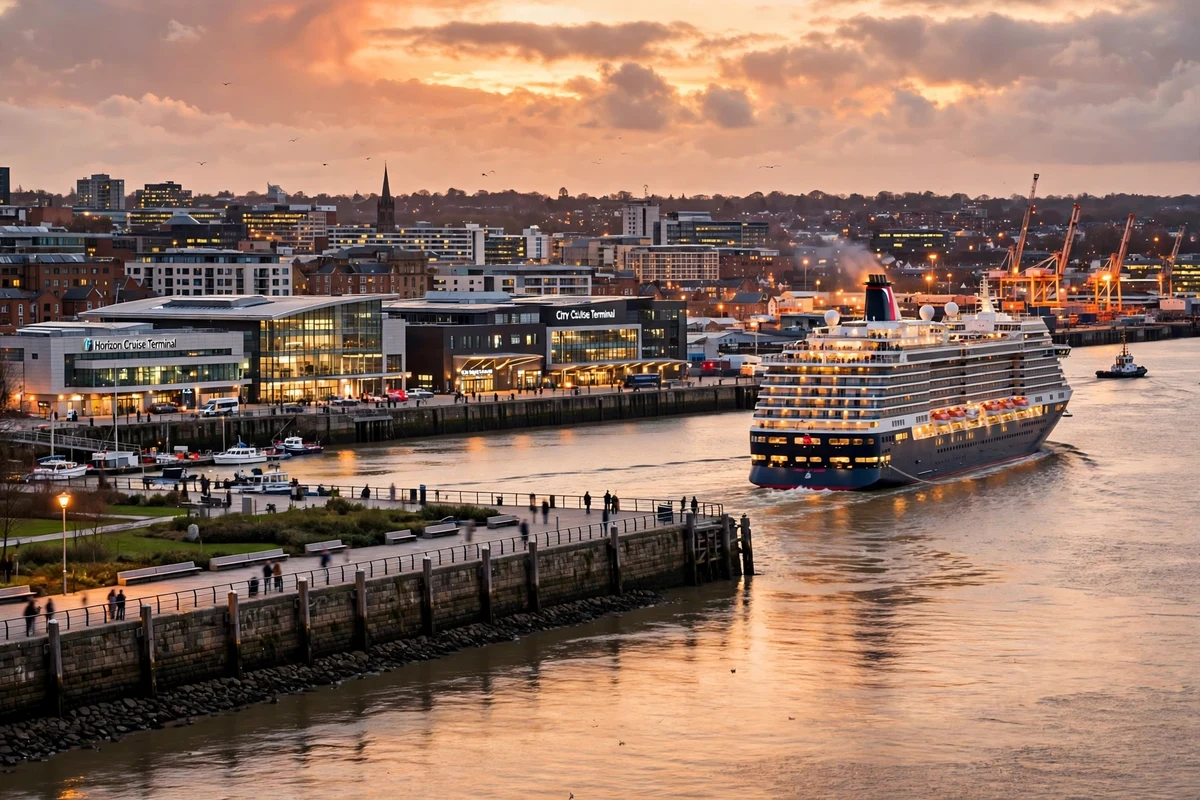
Southampton is the UK’s busiest cruise port, with five cruise terminals across two dock areas, and the most common avoidable mistake on embarkation day is going to the wrong one. The Ocean and QEII terminals are in the Eastern Docks, reached through Dock Gate 4. The City, Horizon and Mayflower terminals are in the Western Docks, reached through Dock Gates 8, 10 and 20. The two dock areas are about three miles apart by road, so a mix-up means a taxi across Southampton. Your boarding pass names your terminal, and that is the only source to trust.
Southampton Central station is close to the Western Docks terminals: City is about 0.6 miles from the station, roughly 15 minutes on foot, and Horizon is about half a mile. The Eastern Docks terminals are further, Ocean about 1.5 miles and QEII about 2.5 miles, so take a taxi for those. Trains from London Waterloo take about 1 hour 12 minutes to 2 hours, and Heathrow is about 70 miles by car, roughly 1 hour 20 minutes to 1 hour 45 minutes. Give your taxi driver the dock gate number rather than just the terminal name.
Parking needs to be booked in advance: the port has its own ABParking, CPS handles parking for P&O and Cunard, and there are off-site meet-and-greet operators as well. Turning up without a booking is the most common mistake on the day, after forgetting documents. Check-in works to a time slot, from 10am to 1 to 2pm, and arriving much earlier than your slot has no benefit. Allow 1 to 2 hours from arriving at the terminal to boarding on a busy day. Bring your passport and boarding pass, and do not pack anything sharp in your checked bags. Staying the night before in Southampton is worth considering if you are travelling a long way, because it removes the one risk that can spoil a no-fly cruise: a delayed journey on the morning of sailing.
No-fly or fly-cruise: how the two compare
The alternative is to fly to Bergen or Oslo and join a ship there. A direct flight from London Gatwick to Bergen takes about 1 hour 55 minutes, but the flight time is not the journey time. Add the trip to the airport, check-in and security, the transfer from Bergen airport to the port, and a hotel night if the ship sails early, and the fly-cruise is a full travel day, often with a night in Bergen at either end.
The fly-cruise has two real advantages: time in Norway, since a ship that starts in Bergen is in the fjords on the first morning, so a 7-night fly-cruise gives you six or seven days in Norway rather than four or five; and choice, since the coastal ships, Hurtigruten and Havila, sail from Bergen to Kirkenes and back. Our coastal express guide covers that route.
The no-fly sailing has the advantage on luggage, cost and simplicity: no airline baggage allowance, no liquid limit, and no risk of a missed connection. For a family, or for anyone who does not want to fly, that is often the deciding factor. For a traveller who wants the most fjord time in a week, the fly-cruise is the better use of the same seven nights.
Planning a cruise day in Norway
Port days are short, usually 6 to 10 hours, and the ship’s all-aboard time is the one time that matters. Plan each day around it, with a margin of at least an hour, because the ship will not wait for an independent excursion that runs late.
Book the excursions that sell out first. The Flam Railway, the Briksdal Glacier, the Loen Skylift and the Geiranger viewpoints fill up on cruise days, and a ship excursion has an advantage: if it runs late, the ship waits for it. For the walkable ports, Bergen, Stavanger, Alesund and Haugesund, a self-guided day works well. For the fjord villages, the excursion is the day, so book one per port and do it properly rather than trying to fit two.
Pack in layers, with a waterproof jacket and comfortable walking shoes; our packing list covers the details. Bring binoculars for the scenic cruising days.
Frequently asked questions
Which cruise lines sail from Southampton to the Norwegian fjords?
P&O Cruises, Cunard, Fred. Olsen, Princess, MSC, Royal Caribbean and Celebrity all run fjord sailings from Southampton in the seasons checked for this guide. P&O has the biggest fleet and the longest season, from March to November, while Princess, MSC, Royal Caribbean and Celebrity are seasonal, roughly May to October. Ambassador does not sail from Southampton; its fjord sailings leave from London Tilbury.
How long is a Norway cruise from Southampton?
Most are 7 nights, with two sea days crossing the North Sea and four or five days in Norway. Ten-night sailings add Geirangerfjord and more fjord time, and 14-night sailings reach Oslo, Tromso and the North Cape in summer, or the northern lights in winter. Shorter fjord cruises from Southampton are rare, because the crossing takes about a day each way.
How long does the North Sea crossing take?
About 24 to 36 hours each way, so a 7-night sailing has one full day at sea on the way out and one on the way back. Southampton to Stavanger is roughly 550 to 600 nautical miles. The crossing is usually calm in summer but can be rough in spring, autumn and winter, so choose a low, mid-ship cabin if you are prone to seasickness.
Which ports do Southampton fjord cruises visit?
The most common calls are Stavanger, Haugesund, Bergen, Alesund, Olden, Flam, Skjolden and Hellesylt, with Geirangerfjord and Eidfjord on longer sailings. A single 7-night sailing visits three to five of them, not all of them, so check the itinerary rather than the line. Longer sailings add Oslo, Trondheim, Tromso and Honningsvag.
How does embarkation work at Southampton?
Your boarding pass names one of five terminals: Ocean and QEII in the Eastern Docks through Dock Gate 4, or City, Horizon and Mayflower in the Western Docks through Dock Gates 8, 10 and 20. Arrive in your allotted check-in window, usually from 10am, allow 1 to 2 hours on a busy day, and book parking in advance. Bring your passport and boarding pass, and label your bags before you leave home.
Is a no-fly cruise better than flying to Bergen?
It depends on what you want. A no-fly sailing from Southampton is simpler, with no airport, no baggage allowance and no transfer, but a 7-night sailing gives you four or five days in Norway. Flying to Bergen takes about 1 hour 55 minutes direct from London Gatwick, and a ship starting in Bergen is in the fjords on the first morning, so a fly-cruise gives you more fjord time in the same week.