Tromsø Cruise Port Guide: Arctic Cathedral, Cable Car & City Dock
Tromsø is the most northerly city most cruise passengers will ever visit, and it is also one of the easiest Arctic ports to enjoy on foot. The city sits at about 69 degrees 40 minutes north, more than 300 km north of the Arctic Circle, on the island of Tromsøya in the Tromsøysundet strait. The centre is compact, and the Arctic Cathedral, the Fjellheisen cable car and the Polar Museum are all within a short walk or a short bus ride of the dock.
Tromsø is the largest city in northern Norway. The town itself had a population of 42,782 in 2024, while the wider municipality had about 80,000 people in 2026. The centre sits on the east side of Tromsøya, facing Tromsdalen across the strait. A bridge and a tunnel link the island to the mainland, and another bridge links it west to Kvaløya. For a cruise passenger, that matters in one practical way: the centre is on the island, and the cathedral and the cable car are on the mainland, across the water.
Where cruise ships dock: Prostneset or Breivika
Tromsø has two cruise berths, and which one your ship uses decides how your day starts. Check your cruise line’s information as soon as you board, because the two berths are very different.
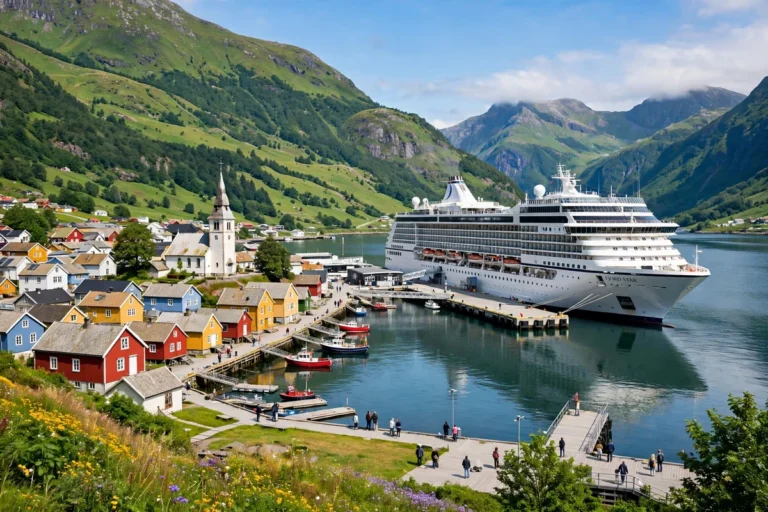
Prostneset, quay 8, is in the city centre, beside the terminal used by the coastal ships. Smaller and mid-sized ships tie up here, and the Hurtigruten and Havila coastal ships dock here too. From Prostneset you walk straight into the centre: the harbour promenade, the main square Stortorget and the main shopping street Storgata are all within about 5 to 10 minutes on foot.
Breivika, quay 21, is about 4 km north of the centre. Larger ships use Breivika, which takes ships up to 365 metres long, against about 230 metres at Prostneset. Breivika is a working port area with little of interest beside the quay, and the walk into town is not practical on a short call. Most cruise lines run a shuttle bus between Breivika and the centre on call days, and city bus 42 also runs between Breivika and the centre. From the quay, use the underpass to reach the bus stop on the other side of Stakkevollvegen, then take route 42 towards Eidkjosen.
The coastal ships are a different kind of call. Hurtigruten and Havila sail the Bergen to Kirkenes coastal route, and Tromsø is one stop on a much longer voyage. Their calls can be brief, sometimes closer to 15 to 30 minutes at a single berth rather than a full day. Our guide to the Bergen to Kirkenes coastal express explains how those sailings work. An ocean cruise call, by contrast, is commonly around 8 hours, which is enough for the centre, the cathedral and the cable car.
The Arctic Cathedral: the white triangle across the water
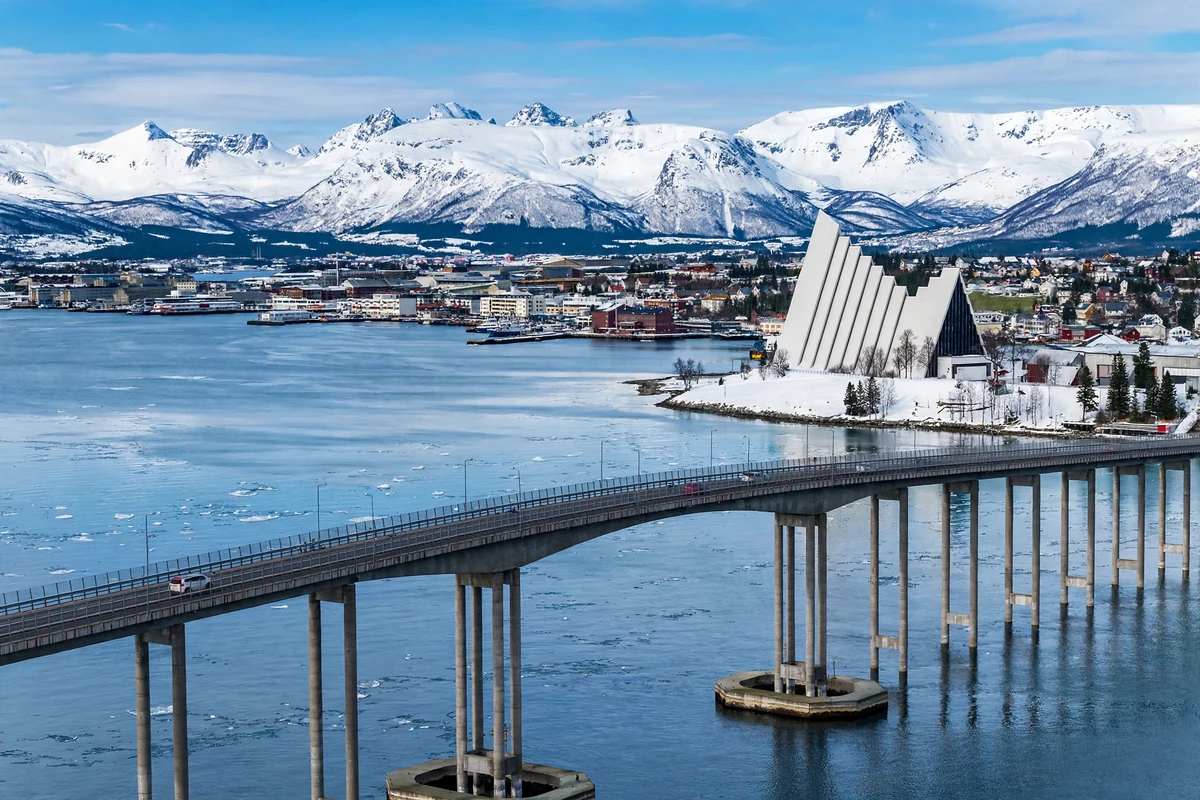
The Arctic Cathedral, known in Norwegian as Ishavskatedralen, is the building every visitor photographs first. Its official name is Tromsdalen Church (Tromsdalen kirke). It is a parish church, not a cathedral in the formal sense, despite the nickname. It stands in Tromsdalen, on the mainland, at the far end of the Tromsø Bridge, and its white triangular shape is visible from the harbour, from the bridge and from the cable car above.
The church was designed by architect Jan Inge Hovig and inaugurated on 19 November 1965, after ground was broken on 1 April 1964. The building is made of 11 aluminium-coated concrete panels on each side of the roof, stepped like a stack of ice floes and rising to a glass front with a cross 35 metres high. The church seats about 600 people, though some sources give about 650. Inside, the main features are the glass mosaic on the eastern wall, the oak pews, the large prism chandeliers, the altar rail and the pulpit. The glass mosaic was installed in 1972 and was created by artist Victor Sparre. It shows the hand of God, from which three rays of light emerge, one through Jesus, one through a woman and one through a man. The organ was built in 2005 by Grönlunds Orgelbyggeri, with 42 stops and 2,940 pipes.
Do not confuse the Arctic Cathedral with Tromsø Cathedral, the Domkirke, in the city centre. Tromsø Cathedral is a yellow wooden church in the Gothic Revival style, completed in 1861 and designed by Christian Heinrich Grosch. It is the only Norwegian Protestant cathedral built of wood, and probably the northernmost Protestant cathedral in the world, with seating given as 618 in one source and about 800 in another. If your ship’s excursion says “cathedral”, check which one it means.
From Prostneset, walk across the Tromsø Bridge, which opened on 3 July 1960 and is 1,036 metres long, with 58 spans and a clearance of 38 metres above the water. It was the first cantilever bridge built in Norway and, at its opening, the longest bridge in Northern Europe. The walk takes about 15 minutes from the centre. Buses also cross the bridge, and a taxi takes about 10 minutes. The cathedral is at Hans Nilsens vei 41 in Tromsdalen. Allow about 30 to 45 minutes for the visit.
Fjellheisen cable car: the view from Storsteinen
The Fjellheisen cable car is the single best use of an hour in Tromsø on a clear day. In about four minutes it lifts you from Tromsdalen to the Storsteinen ledge at 421 metres above sea level, and the whole island city, the sound, the bridge, the cathedral and the ring of mountains and fjords lie spread out below. On a clear night it is also one of the easiest places in the city to watch the northern lights, above the worst of the town lights.
Fjellheisen opened on 22 February 1961. It was built by the shipping company Brødrene Jakobsens Rederi, and in April 2016 it reopened with new gondolas and new machinery. Each cabin carries up to 28 people along a 752-metre cable. The lower station stands at 50 metres above sea level at Solliveien 12 in Tromsdalen, and the upper station, Fjellstua, is at 421 metres, with a café and a large terrace. The cable car runs daily from 09:00 to midnight, with departures every full and half hour, and the café is open until 23:30. In strong wind it can close at short notice, so check on the day.
The cable car is in the middle of a rebuild, called “Nye Fjellheisen”, and it stays open during the work. During the works there is no parking at the lower station and no wheelchair access. Check fjellheisen.no for the current state of the works before you go.
The adult return fare was NOK 645 in 2026, with children aged 3 to 15 at NOK 310, according to several guides checked in November 2026 that cite the operator’s own pages. A one-way ticket was NOK 415. Older guides still list lower figures, around NOK 415 for a return, so confirm the fare on the operator’s site on the day. The value of the ticket depends on the weather: in thick cloud the view from the top is little more than grey, and the money is better spent in the centre. On a clear day or a clear night, it is the best money you will spend in Tromsø.
To reach the lower station, take city bus 26 from Torgsenteret and get off at the stop called “Fjellheisen”, take a taxi in about 10 minutes, or walk in about 45 minutes. Buses do not take cash, so pay in the Svipper app or by card. The cathedral and the cable car are about 15 minutes’ walk apart.
If you prefer to walk up, the Sherpa Stairs, Sherpatrappa, climb the same slope on foot. The staircase has more than 1,200 stone steps, built by Sherpas from the Khumbu region of Nepal, and the climb takes at least 40 to 60 minutes in the snow-free season, usually from late spring until autumn. The steps start behind the Arctic Cathedral, not at the cable car station. Visit Tromsø advises against the stairs when they are covered in snow or ice. On a cruise day, the stairs only make sense if you have a long call and good weather.
The Polar Museum and the harbourfront
The Polar Museum, Polarmuseet, is the best indoor stop in Tromsø and the right choice on a wet or cold day. It stands at Søndre Tollbodgate 11, at the northern end of the downtown harbourfront, a short walk north along the water from Stortorget. It is part of the Arctic University Museum of Norway, run by UiT, and it tells the story of Tromsø as a gateway to the Arctic.
The museum occupies a restored wooden customs warehouse built in 1830, one of the oldest surviving wooden structures in the city, and it has been open as a museum since 18 June 1978. Its exhibitions cover polar history from the 17th century to the present day, with a focus on sealing, overwintering in Svalbard, and the expeditions of Fridtjof Nansen and Roald Amundsen. The displays are artefact-heavy: original expedition equipment, trapping cabins, boats, furs and photographs, including material from Nansen’s Fram expedition of 1893 to 1896.
Allow 1.5 to 2 hours for a proper visit, or about an hour if you move briskly through the seven permanent exhibitions. The museum is open daily, with hours given as 10:00 to 18:00 in most 2026 guides, though one source gives 11:00 to 18:00 and another gives summer hours of 09:00 to 17:00 from 1 June to 15 August, so check the museum’s own site on the day. It is closed on 1 May and 17 May. The adult entry was NOK 130 in 2026, with students and seniors at NOK 100 and under-18s free.
Midnight sun, northern lights and the polar night
Tromsø’s seasons are ruled by light, and the date of your call changes what the day feels like more than the temperature does. The city sits under the auroral oval, and the northern lights season runs from late August to early April, with displays most often between about 20:00 and 02:00. A daytime cruise call in winter will not show you the lights, but an evening call, or a call that runs late into the polar night, can. Our Tromsø northern lights guide covers the season, and our northern lights cruise guide covers aurora cruises in general.
The midnight sun runs from about 18 May to 26 July, according to the Norwegian Meteorological Institute’s sunrise data. Some sources give slightly different dates, from 18 May to 25 July or 20 May to 22 July, because they count the sun above a flat horizon rather than above the mountains. In practice, come between late May and mid-July for the midnight sun, and go to the outer coast or up to Storsteinen to see the sun at midnight. Our midnight sun cruise guide covers the season across Norway.
The polar night runs from about 27 November to 15 January, when the sun does not rise above the horizon at all. Some sources give the span as 28 November to 14 January. It is not completely dark at midday: expect a few hours of blue twilight around the middle of the day.
The cruise season in Tromsø runs all year, which is unusual for a Norwegian fjord port. Summer calls are for the midnight sun and the long days. Winter calls are for the northern lights, the polar night and the whale season, and the weather is wilder: wind or snow can close the cable car at short notice, and the Sherpa Stairs are not recommended in snow or ice.
Getting around from the dock
From Prostneset, Tromsø is a walking city. The centre is flat along the harbour, and the cathedral, the Polar Museum, Storgata and Stortorget are all within about 10 minutes on foot. The bridge to Tromsdalen takes about 15 minutes each way and is exposed to the wind. Taxis are available at the terminal and in the centre.
From Breivika, do not try to walk. Take the cruise line shuttle if one runs, or city bus 42 towards Eidkjosen from the stop across Stakkevollvegen, reached through the underpass. Check the return times before you leave the quay, and leave a wide margin for the trip back. City buses do not take cash: pay in the Svipper app or by card. Bus 26 from Torgsenteret is the bus for the cable car, and bus 42 is the bus for Breivika.
The two berths at a glance
| Berth | Where it is | Best for | Getting to the centre |
|---|---|---|---|
| Prostneset, quay 8 | City centre, beside the coastal ship terminal | Walking straight into town, short calls, coastal ships | On foot, 5 to 10 minutes |
| Breivika, quay 21 | About 4 km north of the centre | Larger ships, up to 365 metres | Shuttle bus or city bus 42 towards Eidkjosen, roughly every 30 minutes |
Planning a cruise day in Tromsø
With about 4 hours from Prostneset, stay in the centre and cross the bridge once: walk the harbourfront to the Polar Museum, walk back through Stortorget and Storgata, cross the bridge to the Arctic Cathedral, and return. That is a full morning without rushing, and it leaves time for coffee and a look at the shops. With about 4 hours from Breivika, allow an hour for the return journey in total and keep the plan to the centre and the cathedral, or the centre and the museum, not both plus the cable car.
With 6 to 8 hours from Prostneset, the classic day is the centre, the cathedral and the cable car. Start with the Polar Museum, cross the bridge to the Arctic Cathedral, then take bus 26 or a taxi to Fjellheisen and ride up to Storsteinen. Allow 1 to 2 hours at the top, and check the weather before you pay: if the top is in cloud, spend the time in the centre instead.
With a full day, add a fjord boat trip from the harbour in summer, or an evening northern lights outing in winter if your ship stays late enough. Our best shore excursions guide covers the kinds of trips that work from a Norwegian port, and our Lofoten cruise guide covers the next port south for many Arctic itineraries.
Three practical points apply to every plan. First, confirm your berth before you plan anything: Prostneset and Breivika change what is reachable. Second, check the cable car on the morning of your call, because wind can close it at short notice and the rebuild works change the access. Third, keep a margin for the return to the ship, and a wider margin from Breivika than from Prostneset.
Frequently asked questions
Where do cruise ships dock in Tromsø?
At Prostneset, quay 8, in the city centre, or at Breivika, quay 21, about 4 km north of the centre. Smaller and mid-sized ships and the Hurtigruten and Havila coastal ships use Prostneset, within a 5 to 10 minute walk of the centre. Larger ships use Breivika, and cruise lines usually run a shuttle bus into town, with city bus 42 as the other option.
How do I get from Breivika cruise port to Tromsø city centre?
Take the cruise line shuttle bus if one runs, or city bus 42 towards Eidkjosen. From the quay, use the underpass to reach the bus stop on the other side of Stakkevollvegen. Check the return times before you leave the quay and allow a wide margin for the trip back.
Is the Arctic Cathedral the same as Tromsø Cathedral?
No. The Arctic Cathedral, officially Tromsdalen Church, is the white triangular church across the Tromsø Bridge in Tromsdalen, inaugurated in 1965. Tromsø Cathedral, the Domkirke, is the yellow wooden church in the city centre, completed in 1861. Both are worth seeing, but they are in different places and from different centuries.
How long does the Fjellheisen cable car take, and is it worth it?
The ride takes about four minutes each way, from the lower station at 50 metres to Storsteinen at 421 metres above sea level. It is worth it on a clear day or a clear night, when the whole island city, the bridge, the cathedral and the mountains lie below you. In thick cloud or driving snow, skip it and spend the time in the centre instead, because the view from the top is little more than grey.
What is the Polar Museum, and how long should I allow for it?
The Polar Museum, Polarmuseet, is at Søndre Tollbodgate 11 on the northern harbourfront, in a wooden customs warehouse built in 1830. It covers Tromsø’s polar history from the 17th century to today, including sealing, overwintering in Svalbard and the expeditions of Nansen and Amundsen. Allow 1.5 to 2 hours for a proper visit, or about an hour if you move briskly.
Can I see the northern lights or the midnight sun from a Tromsø cruise?
It depends on the date and the time of day. The midnight sun runs from about 18 May to 26 July, so a summer call gives you daylight around the clock, best seen from Storsteinen or the outer coast. The northern lights season runs from late August to early April, most often between about 20:00 and 02:00, so a daytime winter call will not show you the lights, but an evening call or a late stay in the polar night can. Our Tromsø northern lights guide has the full season detail.