
Norwegian Christmas Traditions: Julaften, the Nisse, Julebukk and Romjul
Christmas in Norway centres on Julaften, Christmas Eve, not Christmas Day. That is the first thing to understand about norwegian christmas traditions, and it changes how the whole season works. The main meal is eaten on the evening of 24 December, the presents are opened the same night, and Christmas Day itself is quiet, private and mostly spent at home with family. If you arrive on 25 December expecting a busy celebration, you will find closed shops, empty streets and families behind closed doors. Come on the 24th, or in the weeks before it, and you will see the season at its best.
The Norwegian word for Christmas is jul, the same word as the English Yule, and the season keeps traces of the old midwinter feast alongside its Christian meaning. This is an overview of traditional norwegian christmas traditions and rituals, from Advent through Julaften and romjul to New Year. Some will look familiar: a decorated tree, gingerbread, a gift-bringer in a red suit. Others are the weird norwegian christmas traditions visitors ask about first: a barn spirit who wants porridge, a straw goat tied to Thor, and children in costume going from door to door singing for sweets.
Norwegian Christmas Traditions at a Glance
| Part of the season | When | What happens |
|---|---|---|
| Advent | Fourth Sunday before Christmas Eve to 24 December | Advent calendars, candles, baking, julebord parties |
| Lille julaften | 23 December | Tree decorated, last preparations |
| Julaften | 24 December | Church bells at 5pm, family dinner, dancing round the tree, presents |
| First Christmas Day | 25 December | Quiet family day, Christmas Day lunch |
| Romjul | 25 December to New Year | Visiting, leftovers, children going julebukk |
| New Year | 31 December to 1 January | Dinner party, fireworks at midnight |
| End of Christmas | 6 or 13 January | Epiphany, decorations come down |
Advent: the slow start to jul
Advent starts on the fourth Sunday before Christmas Eve, and the season builds slowly from there. December days are short, especially in the north, and the light in the south is low and blue by mid-afternoon. So Norwegians light their way through it: candles in windows, electric lights in gardens, stars and lanterns in shops and homes.
Children usually have an Advent calendar from 1 to 24 December, with one small gift for each day. It is a domestic, unhurried kind of preparation, and it is where much of the baking happens. Pepperkaker, the thin spiced gingerbread biscuits, are baked in Advent, and gingerbread houses are built and decorated with sugar frosting.
One date to know is 13 December, St Lucy’s Day, when schools and kindergartens often hold a Lucia procession, with children in white carrying candles and singing. Advent is also when the julebord season starts: the parties begin in November, so by Julaften many Norwegians have already eaten several Christmas dinners with colleagues and friends.
Julaften: Christmas Eve, the main event
Julaften, 24 December, is the centre of the Norwegian Christmas. It is not a public holiday, but most workplaces close early, shops shut in the afternoon, and the country turns towards home.
Lunch is often risengrynsgrøt, rice porridge with butter, sugar and cinnamon. A single blanched almond is hidden in the pot, and whoever finds it wins a prize, usually a marzipan pig. Leftover porridge becomes riskrem, rice cream with a red berry sauce, served as dessert after dinner.
Many families go to a Christmas Eve church service in the afternoon. At 5pm, church bells ring across the country to mark the start of the holiday, a moment Norwegians call å ringe julen inn, ringing Christmas in. Dinner is usually served at about that time.
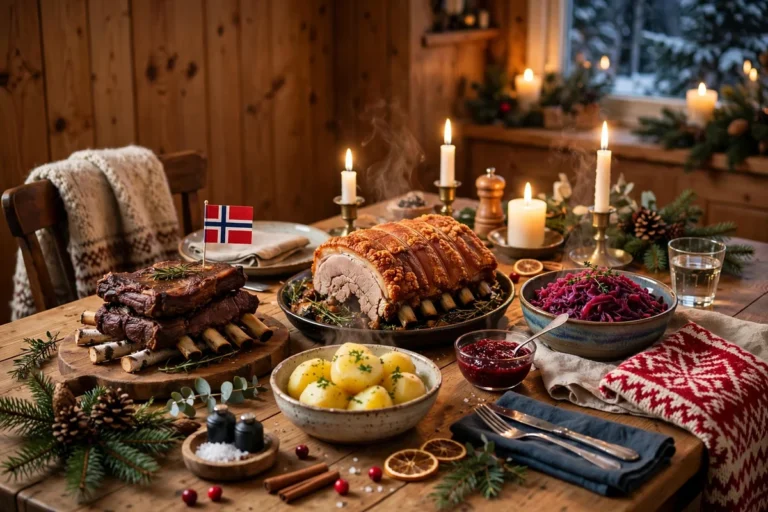
What is on the table depends on where you live. In the east and centre, ribbe, roast pork rib with crisp crackling, is the Christmas Eve dinner, served with pork meatballs and sausages, potatoes and gravy. In the west and north, pinnekjøtt rules: salted and dried sheep ribs, soaked and steamed over birch sticks, served with mashed swede, boiled potatoes and strong mustard. In a SIFO survey of how Norwegians celebrated Christmas in 2018, 49 percent ate ribbe and 40 percent ate pinnekjøtt on Christmas Eve. Only 1 percent had lutefisk on Christmas Eve itself, though it remains a favourite at julebord and through the season.
After dinner, the family holds hands and dances around the Christmas tree, singing carols, the best known being Så går vi rundt om en enebærbusk. Only then are the presents opened, and in many homes the julenisse himself knocks at the door to hand them out.
The julenisse and the fjøsnisse: two very different gift-bringers
Norway has two very different Christmas figures called nisse. The julenisse brings the presents on Christmas Eve. Today he looks much like the international Santa Claus: red suit, black boots, white beard, red hat. He knocks at the door in the evening and asks whether there are any good children here, then hands out the presents. In some families a relative plays the part, and children sing a song before they get their gift. The julenisse as a Santa figure only became part of Norwegian tradition towards the end of the 1800s.
The fjøsnisse, the barn nisse, is far older and entirely Norwegian: a small, shy farm spirit who lives in the barn, looks after the animals and calms the horses at night. He wears a long red cap and a long white beard, but otherwise bears little resemblance to Santa Claus. On many farms a bowl of porridge, nissegrøt, is still put out in the barn on Christmas Eve. If he is forgotten, folklore says he takes revenge with mischief.
| Figure | Where he lives | What he does | What he looks like |
|---|---|---|---|
| Julenisse | Arrives from outside on Christmas Eve | Brings presents, knocks at the door | Like Santa Claus, red suit and white beard |
| Fjøsnisse | In the barn, all year | Guards the farm animals | Small, long red cap, long white beard |
The fjøsnisse is the older tradition. He comes from the farming year, and his porridge is a reminder that Christmas was once about keeping the farm, the animals and the household safe through the darkest part of winter. The julenisse is the newer face on top of that older belief, and modern Norwegian Christmas keeps both.
The julebukk: the straw goat that answers an old question
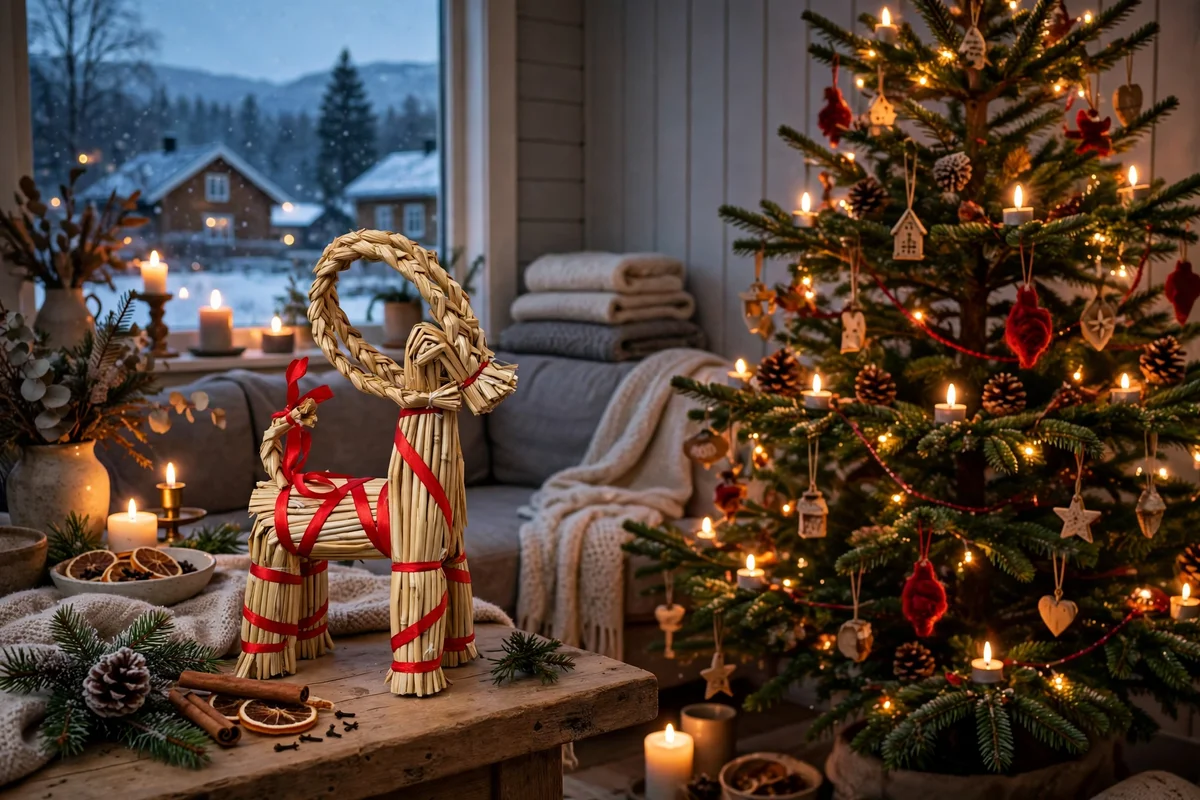
If there is one object that sums up old norwegian christmas traditions, it is the julebukk, the straw Yule goat. Ask what straw figure symbolizes ancient norwegian christmas traditions and the answer is this goat: a small figure plaited from straw, often tied with red ribbon, made at the beginning of December and used as a Christmas ornament. You will see it in windows, on trees and on doorsteps all over Norway, and it is the oldest-looking thing in a modern Norwegian Christmas.
Its history reaches back before Christianity in Scandinavia. The Yule goat’s oldest representation is that of Thor’s magical goats, which would lead him through the night sky. Thor rode in a chariot drawn by two goats, Tanngrisnir and Tanngnjóstr, and in the old stories he could slaughter them to feed his companions and bring them back to life the next day, as long as their bones were laid carefully together. Folklorists have long linked the goat to the Yule celebrations that predate Christmas in Norway, but the link is folklore and interpretation rather than proven fact. The goat has other roots too: the last sheaf of grain from the harvest was saved for Yule, shaped into a goat and believed to hold the spirit of the harvest.
The julebukk was also once a living custom, not just an ornament. During romjul, adults dressed in animal masks and skins and went from house to house in a practice called hoodening, singing and offering blessings in exchange for food and drink. The straw goat on the windowsill is the tame descendant of that masked visitor.
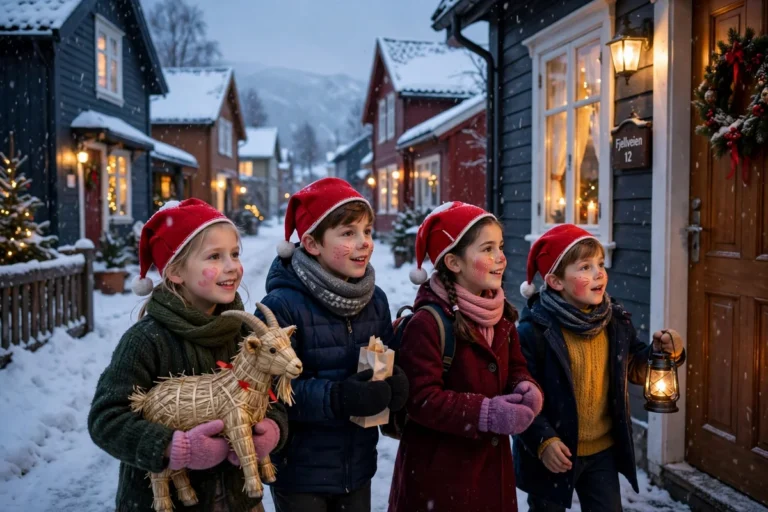
The custom survives as å gå julebukk, to go julebukk. In romjul, children dress up, often in a red nisse cap with painted cheeks, and go from house to house singing Christmas songs and asking for cakes or sweets. It is Norway’s answer to trick-or-treating, running from 25 December to New Year. In Bergen there is a local variant, nyttårsbukk, on New Year’s Eve instead.
Julenek: a sheaf of grain for the birds
The julenek is a quieter tradition, and one of the most beautiful. A sheaf of grain, usually oats, is hung high on a pole or in a tree for the birds. Tradition said it should be large and of the best grain, and it was hung on Christmas Eve. The idea was simple: all God’s creatures should be treated well at Christmas. The horses got extra oats, the cows a handful of flour and extra fine hay, and the birds got the best sheaf of the harvest.
The julenek appears in Norwegian writing as early as 1753, and some priests in the 1700s tried to ban it, which suggests it may have been a pre-Christian tradition. It may also have been food for the birds in the hardest month, or a thank-you for the harvest. Today sheaves ready to hang are sold in shops through December. Like the julebukk, the julenek is made from the harvest, and both carry the older, farming meaning of jul into a modern Christmas.
Julebord: the Christmas table
Julebord, the Christmas table, is a holiday banquet, often a buffet of traditional Christmas foods and drinks. The season begins in November and overlaps Advent. Its roots are in the communal parties of medieval Norway, but the modern julebord is mostly a work party: employers invite staff, sometimes clients, to a restaurant or hall for an evening of Christmas food, drink and speeches.
The food at a julebord is the full Christmas spread: ribbe, pinnekjøtt, lutefisk, cured meats, smoked salmon, pickled herring, cheeses and Christmas cakes, with Christmas beer, julebrus and aquavit. For a visitor, a julebord is the easiest way to taste the whole Norwegian Christmas at once, and many restaurants in Bergen, Oslo and Stavanger run public julebord evenings in December that anyone can book. Book ahead: the popular nights sell out weeks in advance.
Gingerbread, pepperkaker and the seven cookies
Gingerbread is everywhere in a Norwegian December. Pepperkaker, the thin spiced biscuits, are baked through Advent, hung in windows and on the tree, and used to build gingerbread houses decorated with sugar frosting.
The baking tradition has a formal shape: syv slag, seven kinds of Christmas cookies. Many families still aim to bake seven kinds, though there is no official list and the choice varies by family and region. Common choices include pepperkaker, krumkaker, goro, sandkaker, berlinerkranser and sirupsnipper. Seven was traditionally a lucky number, and in earlier times families made as many as nine or eleven kinds. The full story belongs to our guide to Norwegian Christmas food, so this article keeps it brief: if you are offered a tin of home-baked julekaker with coffee, say yes.
Christmas markets
Christmas markets are the most visitor-friendly part of the Norwegian Christmas, and Bergen does them best. The Bergen Christmas Market fills Festplassen in the city centre from 20 November to 22 December 2026, open 12:00 to 21:00 on weekdays and 10:00 to 21:00 at weekends, with free entry. Expect wooden stalls, food cabins, gløgg, crafts, a Ferris wheel and a big tree, all a short walk from the harbour.
A few minutes away is the reason many families come to Bergen at Christmas: Pepperkakebyen, the Gingerbread City, billed as the largest gingerbread town in the world. Since 1991, Bergen’s schoolchildren, families and businesses have baked a miniature town, complete with houses, churches, trains, ships and the Bryggen wharf houses, on show from 14 November 2026 to 10 January 2027 at byROMMET, Kong Oscars gate 24 to 26. Adult tickets cost NOK 199, students NOK 149, children aged 3 to 15 pay NOK 49 at weekends and enter free on weekdays. It is closed on Christmas Day and New Year’s Day.
Oslo runs its main Christmas market at Spikersuppa, and Ålesund and Stavanger hold smaller markets through December. Markets close before Christmas Eve, so do not leave a visit until the last days: Bergen’s closes on 22 December.
Gifts: a brief word
Gifts in Norway are opened on Christmas Eve, after dinner and after dancing round the tree, and that timing is the main thing to know. The julenisse brings them, or a family member playing the part, and children often sing before they receive theirs. If you are invited to a Norwegian home for Julaften, bring a small gift for the host.
What a visitor can see and do at Christmas in Norway
Christmas in Norway is a family season, and a visitor should plan around that rather than against it. The best time to visit is Advent, from late November to 22 or 23 December, when the markets are open, the lights are up and the cities are at their most welcoming. Christmas Eve and Christmas Day are private: shops close and public transport runs a reduced service. Plan to be settled somewhere comfortable for those two days, ideally with a hotel that serves Christmas dinner.
Start in Bergen if you can. The market at Festplassen, Pepperkakebyen and the Bryggen wharf in the dark make the strongest Christmas first impression in Norway, and the city is compact enough to do all three in a day. Our Bergen guide has the practical detail. Oslo is the alternative, with its market at Spikersuppa, and our Oslo guide covers it. If you are planning norwegian christmas traditions holidays that also include the fjords, remember December days are short and the weather is wet rather than reliably snowy: our best time guide works through the months, and our cost guide covers what a winter trip costs.
Look for the small traditions as well as the big ones: a julenek on a pole, a straw julebukk in a window, children in red caps going julebukk in romjul. Walk a residential street in the evening, when the candles are lit and the trees glow behind the windows, and you will see the season as Norwegians live it.
Frequently asked questions
What are some norwegian christmas traditions?
The main ones are Advent with calendars and baking, Julaften on 24 December with the family dinner at 5pm, the julenisse bringing presents, the fjøsnisse getting porridge in the barn, the straw julebukk, the julenek sheaf for the birds, the julebord Christmas table, pepperkaker and the seven kinds of Christmas cookies, and children going julebukk in romjul.
Why is Christmas Eve, not Christmas Day, the main day in Norway?
Because Christmas Eve has long been the start of the feast in Norway, as it is for Midsummer Eve: the celebration begins on the evening before the feast day. That is why the main meal and the presents are on 24 December, and why 25 December is a quiet, private family day.
What is the difference between the julenisse and the fjøsnisse?
The julenisse is the Norwegian Santa Claus: he arrives on Christmas Eve, knocks at the door and hands out presents. The fjøsnisse is the older barn spirit who lives in the barn all year, guards the animals and gets a bowl of porridge on Christmas Eve.
What straw figure symbolizes ancient norwegian christmas traditions?
The julebukk, the straw Yule goat: a small goat plaited from straw, often tied with red ribbon, made at the beginning of December and used as a Christmas ornament. Folklore links it to Thor’s goats, Tanngrisnir and Tanngnjóstr, who pulled his chariot across the sky, and to the last sheaf of grain from the harvest, saved for Yule and shaped into a goat. The same word names the custom of going julebukk in romjul.
What do Norwegians eat on Christmas Eve?
It depends on the region. In the east and centre, ribbe, roast pork rib with crisp crackling, is the Christmas Eve dinner. In the west and north, pinnekjøtt, salted and dried sheep ribs steamed over birch sticks, is the main dish. Lunch is often rice porridge with a hidden almond, and dessert is riskrem. In a SIFO survey of Christmas 2018, 49 percent ate ribbe and 40 percent ate pinnekjøtt on Christmas Eve.
Can I visit Norway at Christmas as a tourist?
Yes, and Advent is the best time: late November to 23 December, when the markets are open and the cities are lit. Bergen is the strongest choice, with its market at Festplassen and the Pepperkakebyen gingerbread town. Plan for Christmas Eve and Christmas Day to be quiet, with shops closed and reduced transport, and book a hotel that serves Christmas dinner.

5 Comments