Hellesylt & Skjolden: Two Quiet Fjord Villages
Hellesylt and Skjolden are the two villages most travellers pass through without stopping, and both reward a stop. Hellesylt is the waterfall village at the head of the Sunnylvsfjord, where the ferry to Geiranger leaves from. Skjolden is the village at the very end of the Sognefjord, where the fjord stops and the mountains begin. They are about 100 km apart by road, through some of the quietest fjord country in western Norway, and they share the same character: small, working villages that happen to sit at the ends of two of Norway’s great fjords. This guide covers both, the crossing between Hellesylt and Geiranger, and the stave church and mountain pass that make Skjolden worth the drive.
The two villages are linked by the fjords themselves. Hellesylt sits at the head of the Sunnylvsfjord, a branch of the Storfjord, and the Geirangerfjord runs from Hellesylt to Geiranger, 15 km of UNESCO-listed water with the Seven Sisters and the Suitor waterfalls on its walls. Skjolden sits at the head of the Lustrafjord, the inner arm of the Sognefjord, and the Sognefjord runs 205 km from the sea to Skjolden, the longest fjord in Norway. A traveller who visits both villages has seen the two ends of the fjord system: the narrow World Heritage fjord in the north, and the longest fjord in the country in the south.
Hellesylt: the waterfall in the middle of the village
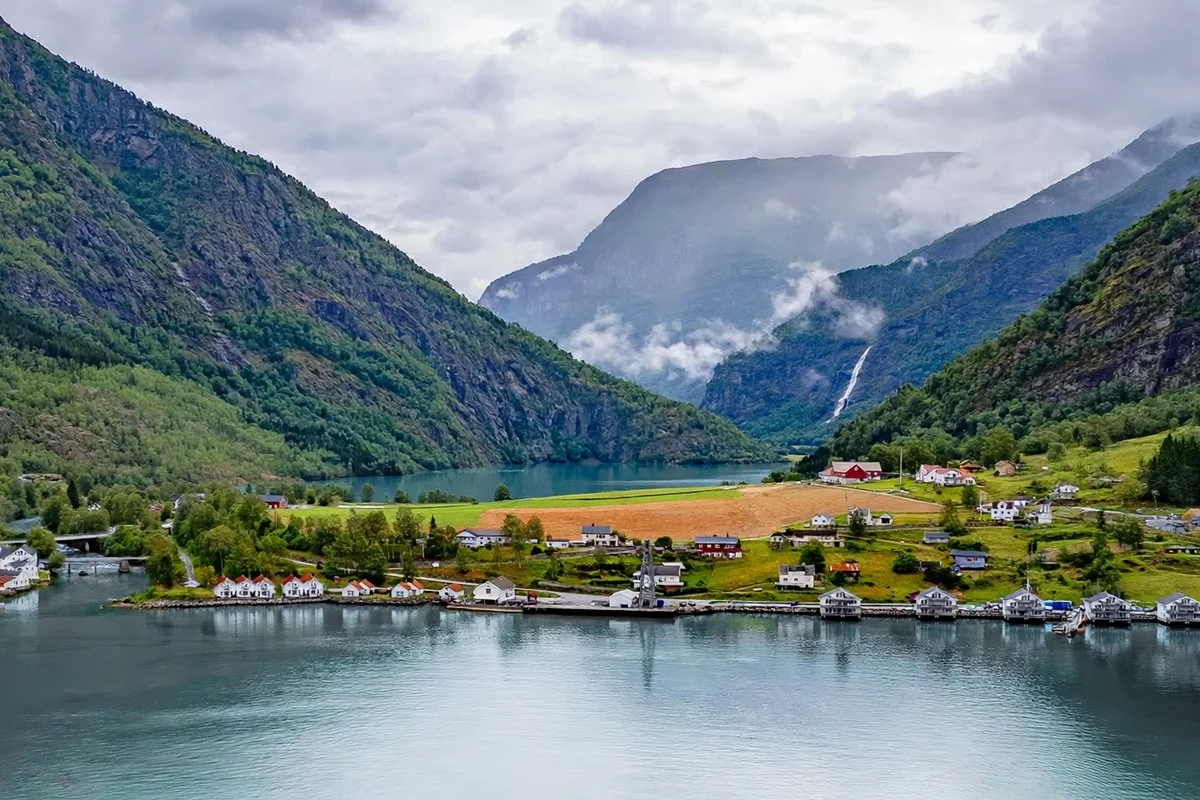
Hellesylt is a small village of about 250 people in Stranda municipality, in Møre og Romsdal, at the head of the Sunnylvsfjord. The first thing you notice is the waterfall. Hellesyltfossen drops about 20 m right through the centre of the village, between two old bridges, the Hellesylt bridge from 1902 and the Høge bridge from 1907, and falls straight into the fjord. It is at its most powerful in early summer, during the snowmelt, and quieter by late August. You can hear it from almost anywhere in the village, and it is the reason the village centre looks the way it does: the water divides the town in two, and the road crosses it on the old bridges.
The village is small enough to explore on foot in about an hour. There is a supermarket, a petrol station and a few souvenir shops near the pier, and the Sunnylven Church, built in 1858 from local timber, stands above the fjord and seats around 270 people, enough for the entire village. The harbour area keeps the character of its past as a historic port: Hellesylt was an old Viking port, and the village and its surroundings are part of the UNESCO World Heritage area of the West Norwegian Fjords. The mountain Åkerneset, above the Sunnylvsfjord, is monitored for rockslide risk, which is a reminder that the steep fjord walls here are not just scenery.
Hellesylt is a cruise port, and cruise ships are the village’s main source of visitors. Ships dock right in the centre of the village, there is no cruise terminal, and the village centre is only about 200 m from the dock. On busy days, when more than one ship is in, passengers come ashore by tender instead. The cruise season runs from May to October. Many ships stop at Hellesylt only briefly, to let excursion guests off, and then sail on to Geiranger, where the excursions meet the ship again. If your ship does that, check whether you have time ashore in Hellesylt or not: a short stop is enough for the waterfall and a walk around the village, but not for the ferry to Geiranger as well.
For a traveller arriving by road, Hellesylt is on the Fv60, the road that runs from Stryn through Olden and Loen to the Geiranger area, and it is the natural stop on the way between the Nordfjord and Geirangerfjord. The village has a few cafes and a small shop, and most visitors eat on board or in Geiranger, but the waterfall and the walk around the harbour are worth the stop on their own.
The crossing to Geiranger: what runs now
The crossing from Hellesylt to Geiranger is one of the most famous ferry rides in Norway, and it is also the one where the information changed most recently. Here is the position as it stands, checked in November 2026.
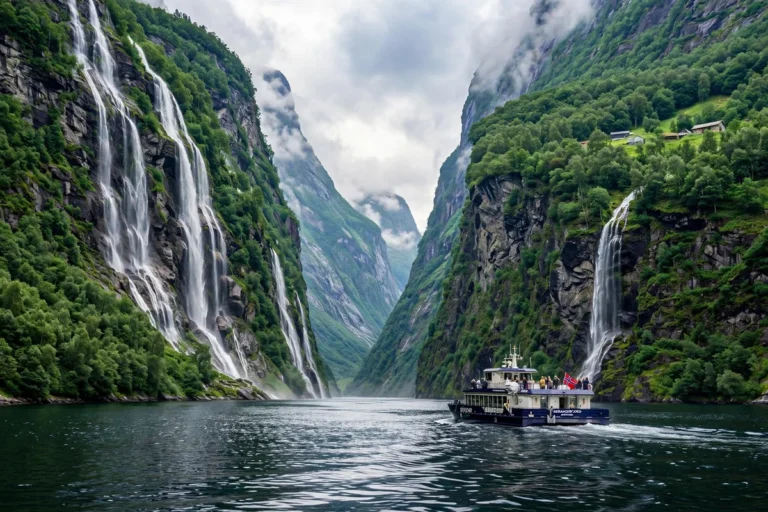
Fjord1’s public car ferry on this route has been suspended since 4 September 2026, after a court ruling on the Geirangerfjord zero-emission rule, and Fjord1 is appealing. But the crossing itself still runs, and it still carries cars. Vestlandske, also known as Fjord X, runs the crossing as a ticketed sailing, sold exclusively through Norway’s Best, and its boats carry cars as well as foot passengers. The sailing takes about 65 minutes, 1 hour and 5 minutes on every departure, in both directions, and it passes the Seven Sisters, the Suitor and the Bridal Veil waterfalls, and the old cliff farms on the fjord walls.
The timetable is seasonal. In summer there are 8 departures each way, running to 30 September. In October there are 3 departures each way: from Hellesylt at 09:00, 12:00 and 15:00, and from Geiranger at 10:30, 13:30 and 16:30. From 1 November to 15 December there are 2 departures each way, and again in March. There are no sailings from mid-December to the end of February. The boats on the route in 2026 were the older ferries, including the MF Skånevik, a protected historic vessel, and the MF Røsund, which carries about 120 cars, and the larger MF Hjørungavåg, with room for 120 car units, and the MF Jotunheim, with room for 35. Vestlandske’s new electric ferries were still under construction in September 2026.
Three practical points matter for anyone planning around this crossing. First, car space is limited, so book a vehicle space in advance, especially in the high season of July and August, and be at the quay 30 minutes before departure. The driver is included in the vehicle ticket, and one car package covers the vehicle, the driver and up to four passengers. Second, every passenger needs a ticket, including foot passengers, and the fares are priced as an excursion, not as a subsidised road crossing: this is not part of the AutoPASS ferry payment system used on most Norwegian road ferries, and tickets are sold only through Norway’s Best. Third, check the current timetable before planning around the crossing, because the number of departures changes with the season, and the winter gap means there is no sailing at all from mid-December to the end of February.
The crossing is the way to see the Geirangerfjord from the water without joining a sightseeing cruise. It is also the practical link between the two villages: Hellesylt and Geiranger are the two ends of the same fjord, and the sailing is the direct route between them. Our Geirangerfjord guide covers the fjord itself in detail, including the viewpoints and the boats that run from the village.
Sunnylvsfjord: the fjord between the villages
The Sunnylvsfjord is the stretch of water that Hellesylt sits at the head of, a branch of the larger Storfjord, running about 20 km between Geiranger and Hellesylt. It is bordered along its length by high cliffs and mountains, and it is the fjord the ferry crosses on its way out of Hellesylt before it enters the Geirangerfjord proper. The Geirangerfjord is the inner 15 km of the same water, and the Sunnylvsfjord is the outer reach, so the two names describe one fjord system, not two separate fjords.
The Sunnylvsfjord is quieter than the Geirangerfjord. The cruise ships pass through it on their way to Hellesylt and Geiranger, and the sightseeing boats run it, but there are no villages on its shores between the two ends, and no road along it. The best way to see it is from the ferry, or from the water on a RIB trip from Hellesylt, which runs through the Geirangerfjord with its waterfalls. From the road, the fjord is visible from the viewpoints above Hellesylt, where the water opens out towards the Storfjord and the mountains close in behind the village.
Skjolden: where the Sognefjord ends
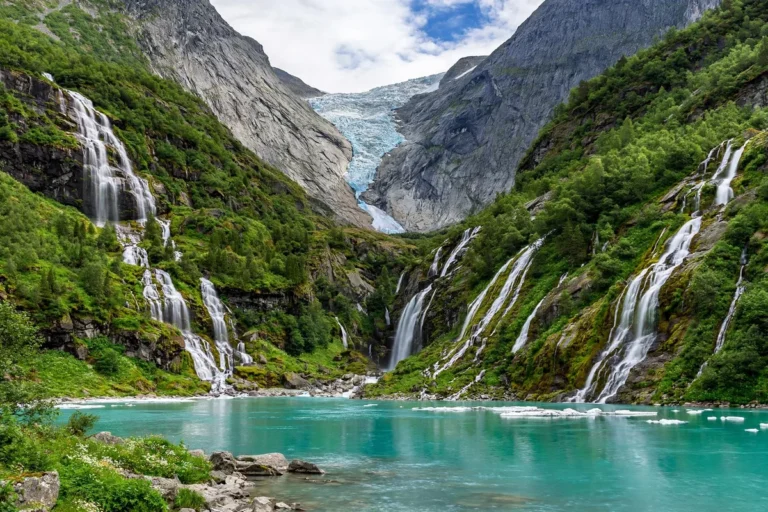
Skjolden is the innermost village of the Sognefjord, at the end of the Lustrafjord in Luster municipality, Vestland. It is a small village at the point where the fjord stops: a quay, a cluster of houses, and no further to sail. A ship that calls at Skjolden sails all 205 km of the Sognefjord in and all 205 km out again, so the fjord is the sea day rather than a detour from it, and the sail-in is the experience. The last reach of the fjord, the Lustrafjord, is turquoise with glacial meltwater, rock ground to flour by the ice, and the ship passes the Feigefossen waterfall on the way in, 218 m of free fall, one of Norway’s highest unregulated waterfalls.
Skjolden sits where three national parks meet the sea: Jotunheimen, Jostedalsbreen and Breheimen. The village is the base for the mountain roads inland, and the excursions from the quay go in three directions: the ice, at the Nigardsbreen glacier, about an hour and a quarter away; the altitude, up the Sognefjellet road to the first viewpoint in about 45 minutes; and the Viking age, at the Urnes Stave Church across the water. Coaches wait 70 to 100 m from the gangway, and the village itself can be walked in under an hour, with a visitor hub, hiking maps, souvenirs and an indoor climbing wall.
The walk to the Sengaberget viewpoint, above the village, is the best short walk from the quay: a moderately steep climb with sweeping views of the village, the fjord and the valley. The village centre is small, with colourful gardens and traditional houses, and the river runs through it to the fjord. Kayaks and RIB boats are available from the shore, and the water is calm enough for a paddle in good weather.
Skjolden’s quiet history is part of its character. The philosopher Ludwig Wittgenstein built himself a hut above the lake Eidsvatnet in 1914 and returned throughout his life, and the work he did there fed into his Tractatus. The village was a Viking-age centre too: the Ornes shore across the water was a power centre with a great ship burial mound, and the mountain passes above the fjord have given up horse tack and arrows from the Viking age as the ice melts. The long-fibred pine of the Urnes shore was prized mast timber, and a link has been proposed between Luster timber and a Viking ship found at Roskilde, though that remains an open research question.
Urnes Stave Church: across the water
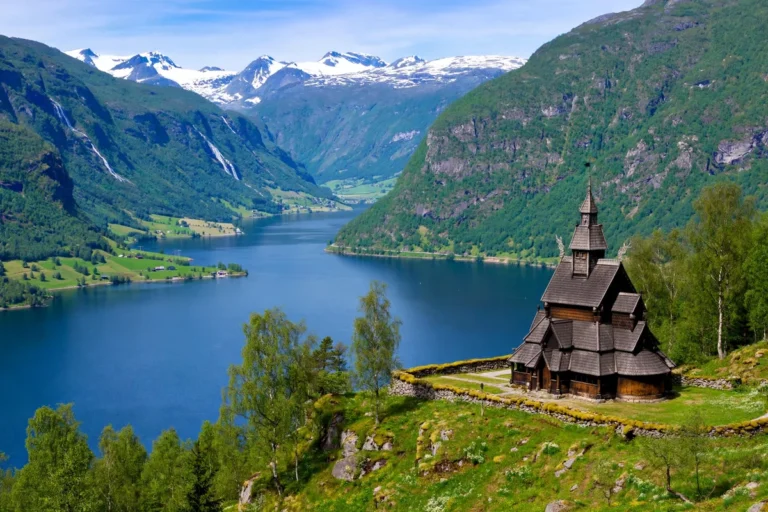
The Urnes Stave Church stands across the Lustrafjord from Skjolden, on the Ornes shore, and it is the oldest stave church in Norway, built around 1130, and on the UNESCO World Heritage List since 1979. Its north portal was carved around 1070 and reused from an older church that stood on the same ground, and the style it gave its name to, the Urnes style, is the last chapter of Viking art: serpents and beasts interlaced, set into the wall of a Christian church. The church is reached from Skjolden by road, about 30 km on the FV331, or by the small ferry from Solvorn to Ornes, which runs 9 times a day in summer and 4 times in winter across the fjord.
The church is open from early May to the end of September, and it can only be visited on a guided tour, which gives very good information but limited freedom to look around on your own or take photographs inside. Plan accordingly, and allow time for the walk up the small hill the church stands on. The Lustrafjord is more than 600 m deep at Urnes, and the water below the church is the deep green of the glacial fjord.
Urnes is the reason many cruise passengers come to Skjolden, and it pairs with the Sognefjellet drive as the two halves of a day ashore: the church in the morning, the mountain pass in the afternoon, or the other way round. Our Borgund and Urnes stave churches guide covers both churches in detail.
Sognefjellet: the highest mountain pass in Norway
The road inland from Skjolden is the Sognefjellet, the mountain pass on National Tourist Route 55 between Lom and Sogndal, and at 1,434 m it is Norway’s highest public road. It is closed in winter, and it is the road that links the fjord to the inland, crossing the Jotunheimen mountains and the Hurrungane ridge, the wildest alpine ridge in Jotunheimen, with Store Skagastølstind at its head, first climbed by W. C. Slingsby in 1876.
The drive from Skjolden climbs within minutes of leaving the village, passing through forest and then above the tree line into a snowy wilderness, even in early June. The viewpoint at Oscarshaug, at over 1,100 m above sea level, gives a panorama of the surrounding peaks and plateaus, and it takes its name from King Oscar II, who crossed the mountain in 1860 and is commemorated by a cairn there. Galdhøpiggen, the highest mountain in Northern Europe, stands in the same range, and the view from the pass is the high alpine Norway that the fjords hide from the water.
The Sognefjellet is a summer road, and it is the excursion most cruise passengers choose from Skjolden, because it is the most dramatic change of scenery in a single day: from the fjord at sea level to the high mountains in under an hour. The road is a National Tourist Route, which means it is maintained as a scenic drive, with viewpoints and rest areas along it.
Hellesylt and Skjolden at a glance
| Village | Where it sits | Population | Main sight | Best for |
|---|---|---|---|---|
| Hellesylt | Head of the Sunnylvsfjord | About 250 | Hellesyltfossen waterfall, about 20 m | The Geiranger ferry, a short stop |
| Skjolden | End of the Lustrafjord, inner Sognefjord | Small village, no published figure | Urnes Stave Church across the water | A full day: church, glacier, mountain pass |
Planning a day in Hellesylt and Skjolden
Neither village is a place to rush, and neither rewards a tight timetable. In Hellesylt, the day is the waterfall, the walk around the harbour and, if the time fits, the ferry to Geiranger and back. The ferry is the main event, and it needs the timetable checked in advance, a vehicle space booked if you are driving, and a 30-minute margin at the quay. A short cruise stop is enough for the village; a half day is enough for the ferry as well.
In Skjolden, the day is the sail-in, the church and the mountain pass. A normal port call is long enough for two of the three: the Urnes Stave Church and the Sognefjellet drive, or the Nigardsbreen glacier and the church. A full day covers all three, with the glacier first, because it is the furthest point, and the church last, because it is closest to the quay. The village itself fills the time between excursions, and the Sengaberget viewpoint is the walk to do if there is an hour to spare.
The two villages are about 100 km apart by road, through Stryn and over the mountains, and they are best visited on separate days, or as the two ends of a longer fjord trip. Hellesylt belongs with Geirangerfjord and Ålesund; Skjolden belongs with the Sognefjord and the Lustrafjord. Together they show the fjords at their quietest: not the famous viewpoints or the big cruise ports, but the villages where the fjords end, and where the water meets the mountains and the road runs out.
Frequently Asked Questions
Does the Hellesylt to Geiranger ferry still run?
Yes. Fjord1’s public car ferry has been suspended since 4 September 2026, but the crossing still runs with Vestlandske, as a ticketed sailing sold exclusively through Norway’s Best. The boats carry cars as well as foot passengers, and the sailing takes about 65 minutes. Car space is limited, so book a vehicle space in advance and be at the quay 30 minutes before departure.
How many sailings are there between Hellesylt and Geiranger?
In summer there are 8 departures each way, running to 30 September. In October there are 3 each way, from 1 November to 15 December there are 2 each way, and again in March. There are no sailings from mid-December to the end of February. Check the current timetable before planning around the crossing, because the number of departures changes with the season.
Can you take a car on the Hellesylt to Geiranger ferry?
Yes. The Vestlandske boats on the route carry cars, including the MF Røsund with room for about 120 cars and the MF Hjørungavåg with room for 120 car units. Book a vehicle space in advance, especially in July and August, and be at the quay 30 minutes before departure. The driver is included in the vehicle ticket, and one car package covers the vehicle, the driver and up to four passengers.
What is there to see in Hellesylt?
The Hellesyltfossen waterfall, which drops about 20 m through the centre of the village between two old bridges, is the main sight, and the village can be explored on foot in about an hour. The Sunnylven Church, built in 1858, stands above the fjord. Most visitors also take the ferry to Geiranger, or join a RIB trip through the Geirangerfjord.
What is there to see in Skjolden?
Skjolden sits at the end of the Sognefjord, at the head of the Lustrafjord, and the sail-in along the turquoise fjord is the first sight. From the quay you can visit the Urnes Stave Church across the water, drive up the Sognefjellet mountain pass at 1,434 m, or go to the Nigardsbreen glacier, about an hour and a quarter away. The Sengaberget viewpoint above the village is the best short walk.
How old is the Urnes Stave Church?
It was built around 1130, which makes it the oldest stave church in Norway, and it has been on the UNESCO World Heritage List since 1979. Its north portal was carved around 1070 and reused from an older church on the same ground. It is reached from Skjolden by road, about 30 km, or by the small ferry from Solvorn to Ornes, and it can only be visited on a guided tour.