Nordfjord & Olden: Briksdal Glacier Guide
Olden is the fjord village where the cruise ships stop for the ice. The village sits at the inner end of the Nordfjord, a long fjord in western Norway, and two short valleys run south from it straight into the largest glacier in mainland Europe. One valley holds the Briksdal Glacier, the most visited glacier tongue in Norway. The other holds a green lake, a cable car and a mountain with the longest uphill walk in the country. This guide covers the Nordfjord, the village of Olden, the glacier walk and the neighbouring village of Loen, and how to fit them into a day ashore.
The Nordfjord is the sixth longest fjord in Norway, 106 km long and 565 m deep at its deepest, running from the island of Husevågøy at its mouth to the village of Loen at its inner end. It flows through the municipalities of Stryn, Gloppen, Stad, Bremanger and Kinn in Vestland county, and its shores hold the town of Måløy near the mouth, the villages of Nordfjordeid, Sandane and Stryn, and, at the inner end, Olden and Loen. The fjord has no road or rail crossing, but it has three regular ferry crossings, including the E39 crossing from Anda to Lote. It is a working fjord as well as a scenic one: in 2023 there were 263 cruise calls between the ports of Nordfjordeid, Olden and Måløy, carrying 621,560 passengers, and 90 percent of that traffic fell between May and September.
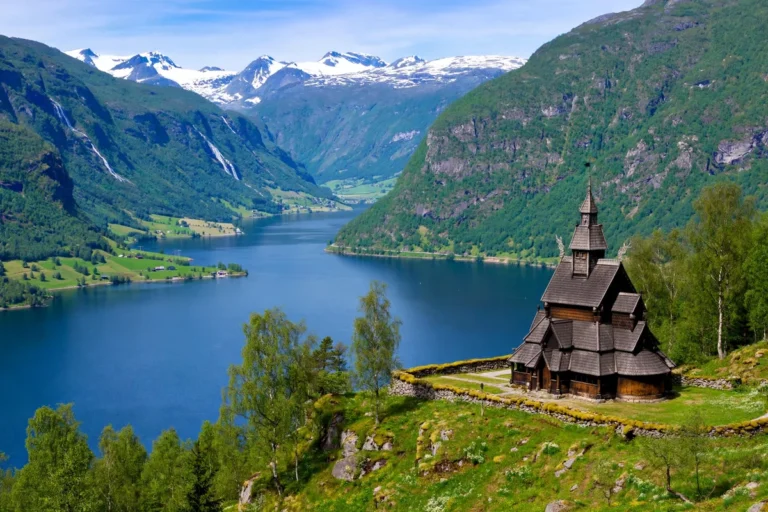
The Nordfjord is the fjord for glaciers. The Jostedalsbreen ice cap, the largest glacier in mainland Europe, lies above its inner end, and its arms spill down into the valleys behind Olden and Loen. The fjord’s scenery changes as you go inland: open water and rocky coast near the mouth, then mountains rising steeply above the water and valleys leading to the ice. That change is the reason to come here rather than to the more famous fjords further south: nowhere else in Norway does a cruise ship dock so close to a glacier you can walk to.
Olden: the village at the end of the fjord
Olden is a small village of about 480 people (2019 figure) at the inner end of the Nordfjord, in Stryn municipality. It is the gateway to the Briksdal Glacier and an important cruise port, and on a summer day the village exists for the ships: coaches wait at the quay, and the road into Oldedalen fills with visitors heading for the ice. The village itself is quiet, with a shop, a handful of places to eat and stay, and the Olden Old Church, a small red wooden church about 1 km from the port, which is the easiest short walk from the ship.
Olden sits where the fjord ends and the valley begins. Behind the village, the Oldedalen valley runs south for 22 km along the lake Oldevatnet to Briksdalen, at the foot of the glacier. The lake is long and green-blue, held between steep mountains, and the drive along it is an experience in itself, with waterfalls falling from the valley sides and glaciers visible on the peaks above. The valley is the reason Olden works as a cruise port: the glacier is a drive and a walk away, not a long expedition, and the whole outing fits inside a normal port call.
The other thing to know about Olden is that it is a base, not a destination in itself. There is little to do in the village beyond the church and the waterfront, and the day is made by the valley behind it. Plan the glacier first, and let the village fill the time around it.
The Briksdal Glacier: the walk, the troll cars and the retreat
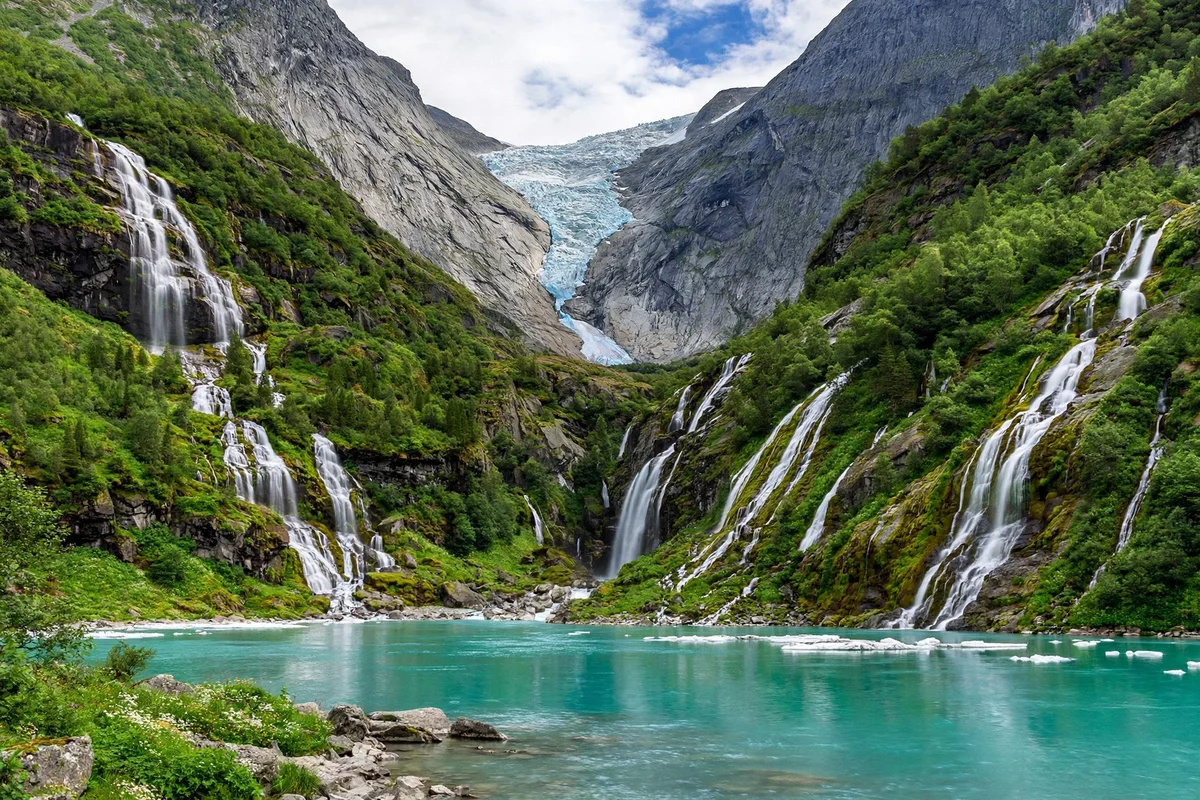
The Briksdal Glacier, Briksdalsbreen, is an arm of the Jostedalsbreen ice cap, and it is one of Norway’s most famous glaciers. It hangs down from the ice cap at the end of the Oldedalen valley, above a small glacier lake, surrounded by steep mountains, waterfalls and wild rivers. The hike from Briksdalen to the glacier is one of Norway’s most scenic walks, and it is the reason most cruise passengers come to Olden.
The walk starts at Briksdalsbre Mountain Lodge, at the innermost part of the valley, about 20 km from Olden. The waymarked path is about 2.5 km each way, and it takes 40 to 60 minutes uphill, or about 2 hours there and back including time at the viewpoint. The trail climbs about 200 m, from around 160 m above sea level at the lodge to about 350 m at the glacier lake, past the Kleivafossen waterfall and along a rushing river. It is graded easy, and it is open all year, according to Fjord Norway, though winter conditions can make it icy and the glacier is at its best from late spring to early autumn. The trail ends at the glacier lake: do not walk further along the lake, because the terrain is steep and there is a risk of landslides and avalanches from the glacier above.
For those who would rather not walk the full distance, the troll cars are the alternative. They start beside the souvenir shop at Briksdal and run up the valley road to a stand about 700 m from the glacier, a ride of about 10 to 15 minutes one way, and the whole outing takes about 1 to 1.5 hours including the final walk. The last stretch, under 1 km, is on foot in either case: there is no vehicle access to the glacier itself.
One honest warning belongs in any current guide to Briksdal. The glacier has retreated significantly in recent years, and its front is no longer as impressive as it once was. It advanced about 200 m between 1990 and 1994, and has since lost around 800 m, and the ice now hangs steep above the lake rather than reaching down to it. You can still see the glacier clearly from the viewpoint, and the walk through the valley is spectacular in its own right, but a visitor expecting the glacier of the old photographs will find a smaller tongue of ice. The valley, the waterfalls and the lake are the experience now, with the glacier as the end of the walk rather than the whole of it.
The glacier is part of Jostedalsbreen National Park, and the usual rules apply: never walk on the glacier without a guide, and never walk up to the ice front. Guided glacier walks are available in the area, including a five-hour trek on the Bødalsbreen glacier from the Loen side, but those are separate trips from the Briksdal viewpoint walk, and they need booking ahead.
Loen and the Skylift: the fjord from 1,011 metres
Loen is the neighbouring village to Olden, about 8 km away along the fjord, and it is the second half of the Nordfjord glacier day. Its attraction is the Loen Skylift, a cable car that runs from the water’s edge at Loen to the top of Mount Hoven, 1,011 m above sea level, in about five minutes. It opened in 2017 and is one of the world’s steepest cable cars, with two cars named Hugin and Munin. From the top, the view takes in Skåla and Lake Lovatnet to the east, the Jostedalsbreen glacier and Olden to the south, and the Nordfjord stretching west towards Stryn.
The Skylift is the easy way to get the high view that the Briksdal walk does not give. At the top of Hoven there are waymarked trails for all levels, a restaurant, and two ziplines, 125 m and 95 m long. The mountain above Loen also holds the Via Ferrata Loen, a climbing trail secured by wire all the way to the top of Hoven, with what is described as Europe’s longest via ferrata bridge. That is a separate, demanding activity, not part of a normal cruise day, but it shows how seriously Loen takes its mountains.
Loen’s other claim is Skåla, the mountain that rises from the fjord to 1,848 m in about 7 km, described as Norway’s longest uphill climb, starting at just 30 m above sea level. At the top stands the Skålatårnet tower, where you can stay overnight, and the Skålabu cabin. The climb takes about five hours for an experienced hiker, and it is not a cruise-day walk, but it is the reason Loen is known among Norwegian hikers, and the view from the Skylift gives a sense of the scale of it.
Lodalen and Lovatnet: the green lake and the lowest glacier
Behind Loen, the Lodalen valley runs south to the lake Lovatnet, one of the most beautiful valleys in Norway. The lake is about 11 km long, lies only 52 m above the sea, and is up to 138 m deep, and its green colour comes from clay particles and rock dust carried down by the rivers from the glaciers. At the head of the valley the road splits: Kjenndalen runs on to the snout of the Kjenndalsbreen glacier, a quarter of an hour on foot from the car park, and Bødalen turns east to the Bødalssætra farm. Kjenndalsbreen is the lowest-lying glacier arm of the Jostedalsbreen, and it is the easiest glacier in the area to reach on foot.
Lodalen is also a valley with a tragic history, and it is worth knowing before you go. Rock avalanches from the mountain Ramnefjellet fell into the lake in 1905 and again in 1936, sending waves that destroyed farms and killed people on the lake shore. The valley is quiet now, with the summer farm at Breng, a popular stopping spot, and the Kjenndalsstova cafe at the inner end of the lake, but the history is part of why the valley feels the way it does: beautiful, and with the mountains very close.
The lake can be explored by kayak or stand-up paddleboard, and the canal boat MS Kjenndal crosses it in summer. A walk along the southern shore of Lovatnet, about 6.5 km, takes about two hours, and the valley road is one of the most exposed and scenic drives in the area. For a cruise passenger with a full day, Lodalen pairs with the Briksdal walk: the glacier in the morning, the lake in the afternoon, and the Skylift in between if the timing works.
Getting to Olden and Loen
Olden and Loen sit between Bergen and Ålesund, in the northern part of Vestland county. From Ålesund it is a long day trip by car, and from Bergen it is a full day’s drive, so most visitors arrive by cruise ship or by staying in the area. The nearest towns are Stryn, about 25 km inland from Olden, and Nordfjordeid, the commercial hub of the Nordfjord, further out the fjord towards Måløy. The road into the fjord is the Fv60, which runs along the shore from Stryn through Loen and Olden, and the roads in the valleys, in Lodalen and Oldedalen, are narrow and exposed, with steep drops and few passing places.
Public transport exists but needs planning. A bus runs daily from mid-May to mid-September from Stryn bus terminal through Loen and Olden to Briksdalsbreen, and returns the same way. For a cruise passenger, the practical choice is a ship excursion or a local tour: the glacier, the Skylift and the lake are all reached by road, and the coaches are timed to the ship’s call. Driving yourself is possible, but the distances are longer than they look, and the valley roads are slow.
The best time to visit is May to September, when the bus runs, the glacier path is at its best and the cruise ships call. The Briksdal walk is listed as open all year, but winter brings ice on the path and short days, and the valley is quiet. June and July are the warmest and busiest months; May brings the strongest waterfalls, and September brings the autumn light and fewer people. Our best time to visit guide covers the seasons for the southern fjords, and the same pattern holds here, a month later in spring and a month earlier in autumn.
The glacier day at a glance
| Stop | What it is | Time needed | How to get there |
|---|---|---|---|
| Briksdal Glacier | Glacier tongue above a lake, 2.5 km walk | 2 to 3 hours return | 20 km from Olden, bus or coach |
| Troll cars | Ride to 700 m from the glacier | 1 to 1.5 hours with the final walk | From the shop at Briksdal |
| Loen Skylift | Cable car to Hoven, 1,011 m | 1 to 2 hours | Loen, 8 km from Olden |
| Lovatnet | Green glacier lake, Kjenndalsbreen | Half a day | Lodalen valley behind Loen |
| Olden Old Church | Small red wooden church | 30 minutes | About 1 km from the port |
Planning a cruise day in Olden
A normal port call in Olden is long enough for one big outing and one small one. The classic day is the Briksdal Glacier in the morning, with the walk or the troll cars, and then the Loen Skylift or a drive along Lovatnet in the afternoon. A short call is enough for the glacier alone, or for the Skylift alone, but not for both with comfort. A full day covers the glacier, the Skylift and a stop at Lovatnet, in that order, because the glacier is the furthest point and the Skylift is on the way back.
Three practical points matter. First, the glacier walk is easy but it is still a mountain path: wear proper shoes, and take a layer, because the wind at the lake is cold even on a warm day. Second, the troll cars are popular and the queue builds up on days when several ships are in, so go early if you want the ride rather than the walk. Third, check the weather before choosing between the Skylift and the valley: the view from Hoven is the point of the cable car, and in low cloud the glacier walk is the better use of the time.
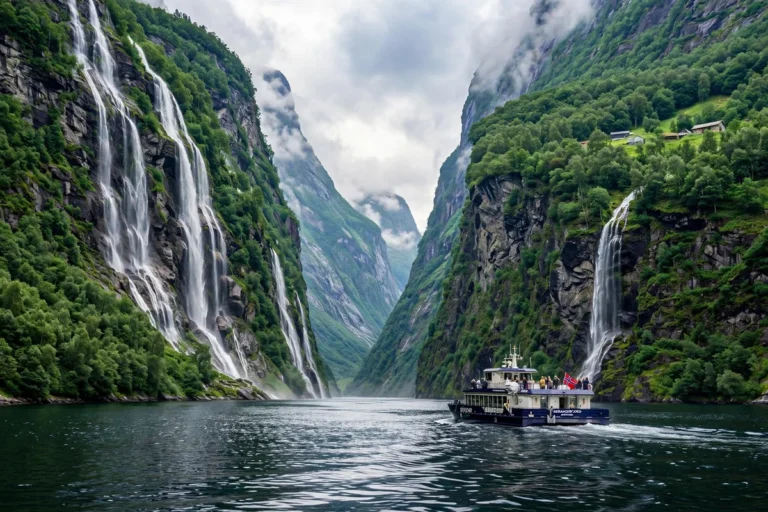
Compared with the fjords further south, the Nordfjord is a quieter call. Geirangerfjord has the waterfalls and the viewpoints; Sognefjord has the scale. The Nordfjord has the ice, and Olden is the only cruise port in Norway where a glacier walk, a cable car to 1,011 m and a green glacier lake are all within a single day ashore. That is the reason to get off the ship here.
Frequently Asked Questions
How long is the walk to the Briksdal Glacier?
The waymarked path is about 2.5 km each way from Briksdalsbre Mountain Lodge, and it takes 40 to 60 minutes uphill, or about 2 hours there and back including time at the viewpoint. The trail climbs about 200 m to the glacier lake at about 350 m above sea level. The troll cars shorten the walk to about 700 m from the glacier.
Can you still see the Briksdal Glacier?
Yes, but it has retreated significantly. The glacier advanced about 200 m between 1990 and 1994 and has since lost around 800 m, so the ice now hangs steep above the lake rather than reaching down to it. You can still see it clearly from the viewpoint, and the walk through the valley, with its waterfalls and the lake, is spectacular in its own right.
What is the Loen Skylift?
The Loen Skylift is a cable car from the water’s edge at Loen to the top of Mount Hoven, 1,011 m above sea level, in about five minutes. It opened in 2017 and is one of the world’s steepest cable cars. From the top you can see Skåla, Lake Lovatnet, the Jostedalsbreen glacier, Olden and the Nordfjord stretching west towards Stryn.
How far is the Briksdal Glacier from Olden?
About 20 km by road, along the Oldedalen valley past Lake Oldevatnet to Briksdalen. A bus runs daily from mid-May to mid-September from Stryn bus terminal through Loen and Olden to the glacier. Most cruise passengers go by ship excursion or local coach, timed to the ship’s call.
Is Olden a good cruise port?
Yes, for a glacier day. Olden is the gateway to the Briksdal Glacier, and Loen, about 8 km away, has the Skylift and the Lovatnet valley. A normal port call is long enough for the glacier in the morning and the Skylift or the lake in the afternoon. The village itself is small, with the Olden Old Church about 1 km from the port as the easiest short walk.
What is the Nordfjord?
The Nordfjord is the sixth longest fjord in Norway, 106 km long and 565 m deep at its deepest, running from the island of Husevågøy at its mouth to the village of Loen at its inner end. It is the fjord for glaciers: the Jostedalsbreen ice cap, the largest glacier in mainland Europe, lies above its inner end, and its arms spill down into the valleys behind Olden and Loen.