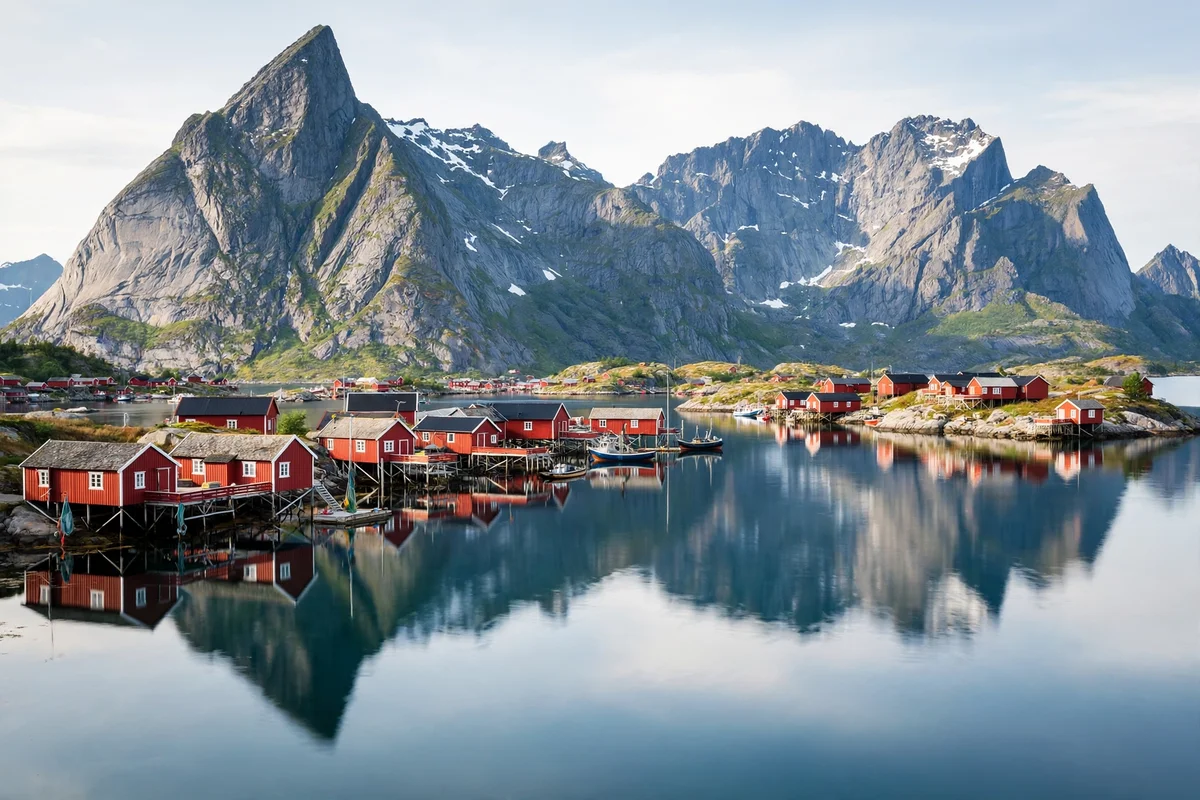
Lofoten Islands Cruise Guide: Leknes, Reine & Svolvær
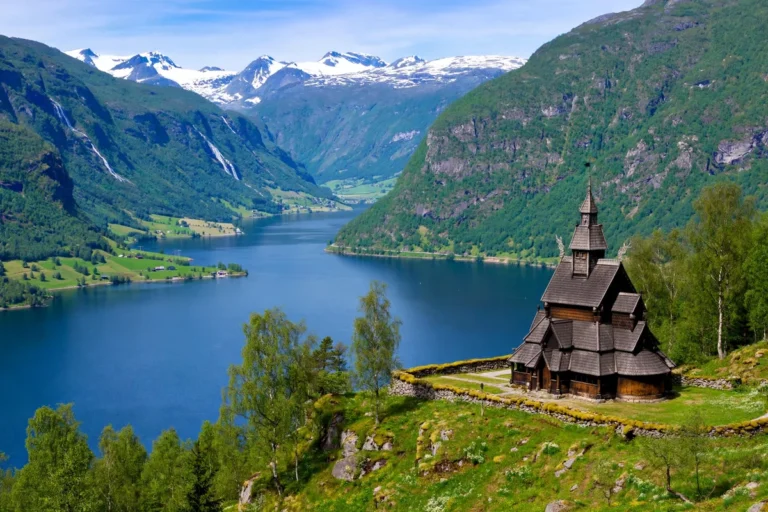
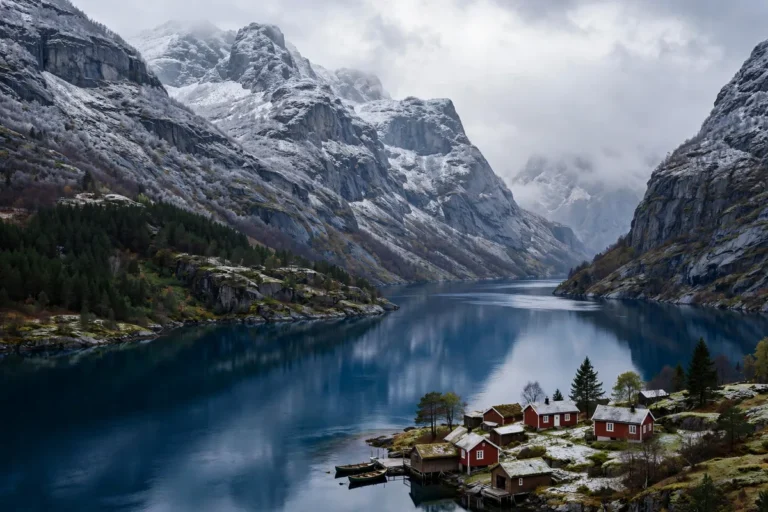
Lofoten is the fjord country turned sideways. Instead of one long fjord cutting inland, the islands are a wall of granite peaks rising straight from the sea, with fishing villages tucked into the gaps between them. The archipelago sits at about 68 degrees north, above the Arctic Circle, and it is the furthest north this site’s fjord guides go. Cruise ships call here for the landscape: the red cabins, the white beaches, the narrow Trollfjord and the midnight sun. This guide covers the three places a cruise passenger needs to understand, Svolvær, Leknes and Reine, plus the boat trip that makes the call worth it.
Lofoten is a chain of islands off the coast of Nordland in northern Norway, about 1,227 square kilometres in area with around 25,000 residents. The main islands run from north-east to south-west: Austvågøya, with Svolvær, Kabelvåg and Henningsvær; small Gimsøya; Vestvågøya, with Leknes and Stamsund; Flakstadøya, with Nusfjord and Ramberg; and Moskenesøya, with Reine, Hamnøy and Å. One road, the E10, threads them all together by bridge and tunnel and ends at Å, the last village in the west. The Lofoten mainland connection, known as Lofast, opened in 2007 and links the islands to the mainland road network near Narvik, so the whole archipelago can now be reached by road without a ferry.
The first thing to understand about a Lofoten cruise call is that the port shapes the day. Svolvær and Leknes are different calls, and Reine is not a port at all for most ships, it is a drive from Leknes or a long drive from Svolvær. The islands look small on a map, but the E10 is a narrow two-lane road with endless photo stops, and locals budget an average of 50 to 60 km per hour on it. Pick one direction for the day and do it properly, rather than trying to cross the whole archipelago and back before the ship sails.
Svolvær: the working town and the Trollfjord
Svolvær is the largest town in Lofoten, with a population of 4,736 in 2023, and the administrative centre of Vågan municipality. It sits on the southern coast of Austvågøya, on the Vestfjord, and it is the town where the coastal ships dock, the Hurtigruten and Havila vessels call, and most of the Trollfjord boats leave from. Svolvær was granted town status in 1918, on the strength of its fishing industry, and fishing is still the base of the town: Atlantic cod, above all the migrating skrei that arrive from the Barents Sea between January and April to spawn, has shaped Lofoten for a thousand years.
A cruise call at Svolvær puts you straight into a walkable town. The harbour is in the centre, and the town square, the galleries and the waterfront are all within a few minutes on foot. The landmark above the town is the Svolværgeita, the Svolvær Goat, a rock pinnacle with two horns that climbers jump between, a local test of nerve that has become one of the town’s symbols. The town has the widest choice of hotels, restaurants and boat trips in the islands, and it is the best base for a traveller arriving without a car.
Svolvær is also the starting point for the Trollfjord. The fjord lies just across the Raftsundet strait, north of the town, and every boat trip to it leaves from Svolvær harbour. The trip is the single best use of a short call here: a RIB safari takes about 2 hours, a slower sightseeing boat about 3 to 3.5 hours, and both run through the strait and into the fjord mouth, where the cliffs close in on both sides. Hurtigruten coastal ships also detour into the Trollfjord when conditions allow, so a coastal voyage passenger may see it without leaving the ship.
The other short trip from Svolvær is Henningsvær, about 25 km by road to the south-west. Henningsvær is a fishing village of 507 people (2023) spread across small islands joined by bridges, with a working harbour, art galleries, cafes and the football pitch on the rocks that became famous in photographs in 2017. It is the most visited village near Svolvær, and it works as a half-day trip from the port. Kabelvåg, a few kilometres west of Svolvær, is the oldest fishing village in the area, and its large wooden church is known as the Lofoten Cathedral.
Leknes: the practical base for the west
Leknes sits on Vestvågøya, the largest island in Lofoten, and has about 2,700 residents. It is the administrative centre of Vestvågøy municipality and the practical middle of the archipelago: a town with supermarkets, an airport and a harbour, rather than a sight in itself. A cruise call at Leknes, at the Gravdal harbour on the Buksnesfjord, is a springboard call. The value of Leknes is where it puts you: Reine, Hamnøy and Nusfjord to the south-west, the beaches of the north coast within a short drive, and the Viking museum at Borg about 14 km north on the E10.
The Lofotr Viking Museum at Borg is the best use of a short Leknes call. It stands on the site of a chieftain’s farm from the Viking Age, and its centrepiece is a reconstructed longhouse, the largest Viking house found in Norway, with exhibitions, a film and guided tours. A visit takes about 90 minutes, and in midsummer a Viking ship sails several times a day. The museum is the one place in Lofoten where the thousand years of history behind the fishing villages is laid out in a single building.
The other Leknes option is the beaches. Haukland beach, about 10 km from Leknes, is the classic curve of white sand below steep mountains, and Uttakleiv, just over the hill beyond it, is rockier and a favourite place to watch the midnight sun and the northern lights. Unstad, further north on Vestvågøya, is the surf beach. These are Arctic beaches: the sand is white, the water is cold, and the mountains rise straight behind them. They are worth a stop on a drive, and they are the best place in Lofoten to see the sun stay up at midnight, because the mountains to the north do not block the view from the outer coast the way they do from Svolvær or Leknes themselves.
From Leknes, Reine is about 57 km by road, roughly an hour each way, and the drive itself is the sightseeing: the E10 crosses from Vestvågøya to Flakstadøya through the Nappstraum tunnel, passes Ramberg and Nusfjord, and reaches Moskenesøya with its wall of peaks. A half-day call at Leknes is enough for the museum or the beaches; a full day is enough for Reine and back, with stops.
Reine, Hamnøy and the end of the road
Reine is the village on the postcards: red and yellow fishermen’s cabins, called rorbuer, standing on stilts above the water, with sharp granite peaks rising behind them. The village has about 300 residents and sits on Moskenesøya, at the western end of the E10. Beside it, Hamnøy and Sakrisøy are strung along the bridges over the Reinefjord, and the whole cluster is the most photographed stretch of coast in Norway. The cabins were built for the winter cod fishery, when fishermen came from all along the coast to fish the skrei, and many of them are now rented to visitors.
The walk above Reine is Reinebringen, the most famous hike in Lofoten. The mountain rises 448 m directly above the village, and the route is a stone staircase of 1,978 steps built by Nepalese sherpas between 2016 and 2021, after the old path eroded so badly that it was washing down into the village and injuring hikers. The steps end at about 402 m, and a short stretch of bare path leads to the ridge, from where Reine, Hamnøy and Sakrisøy lie spread out below and the Reinefjord runs between the rock walls. The climb takes 1.5 to 3 hours return, and the season runs from mid-May to the end of September: outside the season the staircase is chained off, because the icy steps have cost lives. It is a steep, crowded walk in summer, so start early in the morning.
Beyond Reine, the E10 ends at Å, about 10 km further west, the last village on the road. Å is a preserved fishing village with the Norwegian Fishing Village Museum, and the stockfish racks around it are part of the working landscape: every winter, Arctic cod are hung to dry on wooden racks called hjell, and the dried fish is one of Lofoten’s oldest exports. Nusfjord, on Flakstadøya, is another preserved fishing village, with fishermen’s houses and rorbuer mostly built around 1800, and it is one of the best-preserved fishing villages in Norway. Note that Nusfjord is not a UNESCO World Heritage Site, despite what some tour listings claim; it is protected as a cultural environment in Norway, which is a different thing.
Reine is not a cruise port for most ships, and the few that anchor off it use it as a tender stop. For most cruise passengers, Reine is a shore excursion from Leknes, or a long day trip from Svolvær, about 121 km each way. That distance is the reason to plan carefully: a Reine excursion from Svolvær is a substantial round trip that leaves little room for anything else, while from Leknes it is a comfortable half day.
The Trollfjord: the fjord you can only reach by boat
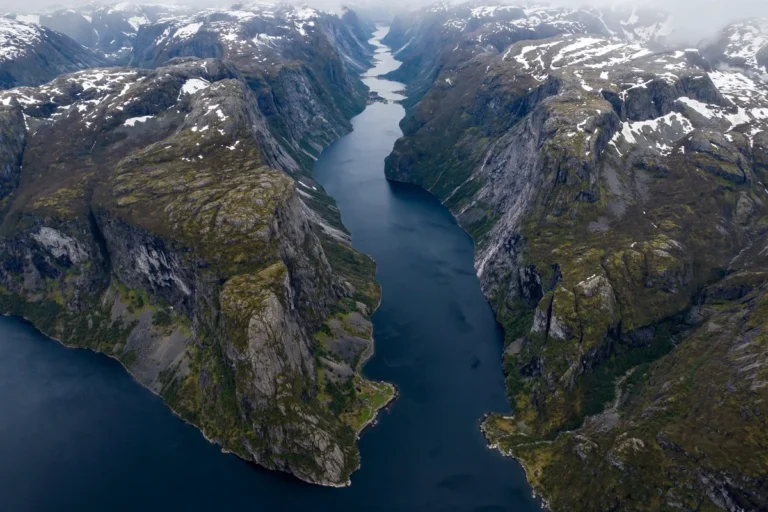
The Trollfjord is the fjord most cruise passengers in Lofoten actually see, and it is unlike the fjords further south. It is about 2 km long, only 100 m wide at its mouth where it joins the Raftsundet, and 65 to 72 m deep, with cliffs rising to around 1,000 m on both sides. It cuts into Austvågøya, and it is only accessible by boat, unless you want to hike 10 km over very rugged terrain. There are no settlements on its shores, no road and no quay: the boat turns in the pool at its inner end and comes back out.
The trip from Svolvær is short and dramatic. RIB boats take about 2 hours return and stop to look for white-tailed sea eagles, which nest on the cliffs and are fed by the boat crews, so an eagle sighting is likely rather than a hope. Slower sightseeing boats take 3 to 3.5 hours, with indoor lounges and outdoor decks, and some serve fish soup on the way back. The fjord is at its best in summer, from May to early September, when the weather is mildest and the boats run most often. In winter the fjord can be blocked by snow-slide risk, and the boats cruise the Raftsundet instead.
The Trollfjord is small enough that large cruise ships cannot enter it, but the coastal ships do: Hurtigruten vessels detour into the fjord on the sailing between Stokmarknes and Svolvær when conditions allow, and the largest ship to have entered it is the Hurtigruten ship MS Otto Sverdrup, at 138.5 m long. The fjord also has a place in Norwegian art: Gunnar Berg’s painting of the Battle of Trollfjord, from 1890, hangs in the gallery on Svinøya in Svolvær, and the fjord was a filming location for the 2016 film Downsizing.
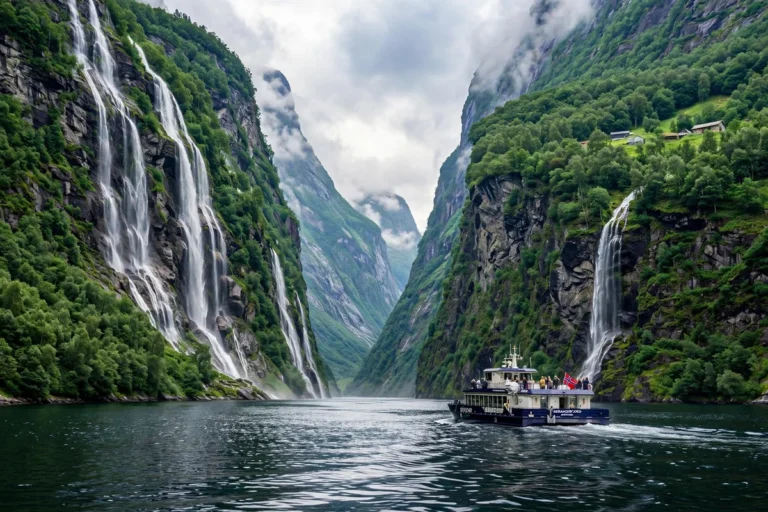
Compared with the fjords further south, the Trollfjord is a different scale of experience. Geirangerfjord is 15 km long with waterfalls and viewpoints; the Trollfjord is 2 km long and is a single narrow passage. It is the narrowest water most travellers will ever sail, and that is the point of it.
When to go: midnight sun, northern lights and the short winter
Lofoten’s seasons are ruled by light, more than by temperature. The midnight sun season runs from about 28 May to 14 July, according to Visit Lofoten, and the sun stays above the horizon through the night in that window. Figures from other sources run slightly longer, to 17 or 18 July, because they count the sun above a flat horizon rather than above the mountains. In practice, come between late May and mid-July for the midnight sun, and go to the outer coast, such as Haukland, Uttakleiv or Hov, to actually see the sun at midnight, because the mountains block it from Svolvær and Leknes themselves.
The northern lights season runs from September to mid-April, with the best viewing from late September to March, when the nights are long and dark. Lofoten sits at 68 degrees north, under the auroral oval, and the lights are visible from the islands on clear nights. The polar night in Svolvær is short, from 7 December to 5 January, with about five hours of twilight around midday rather than full darkness.
The cruise season runs roughly from February to October, with most calls between May and September. June and July are the warmest months, with July averaging 13.3 degrees Celsius at Svolvær airport, and the driest, but also the busiest, with Norway’s main holiday falling in July. May and September are quieter, with the waterfalls at their strongest in May and the autumn light in September. Winter calls are for the northern lights and the skrei fishery, and the weather is wilder: wind or swell can stop tender operations, and a small share of calls, roughly 3 to 7 percent according to one cruise port source, is missed for weather.
Our best time to visit guide covers the seasons for the southern fjords in detail; Lofoten’s dates run later than Bergen’s or Geiranger’s, because it is so much further north.
Getting there and around
Most cruise passengers arrive by ship, but Lofoten is also reachable independently, and the options matter for anyone combining a cruise with extra days. The fastest route is to fly to Bodø, about 1.5 hours from Oslo, then take a 20 to 30 minute onward flight to Leknes or Svolvær, both served by Widerøe’s small aircraft several times a day. Harstad/Narvik airport at Evenes is the other gateway: it is about 166 to 170 km by road to Svolvær, around two and a half hours, with an airport bus running all year.
The sea routes are slower and, for many visitors, part of the trip. Car ferries sail year-round from Bodø to Moskenes, near Reine, in about 3 to 3.5 hours, and express boats link Bodø, Svolvær and Skrova daily. The coastal voyage ships are the scenic option: Hurtigruten calls daily at Stamsund and Svolvær, and Havila Voyages also calls at the same ports. Both lines sell short port-to-port journeys, so a Lofoten stop can be built into a coastal sailing between Bodø and Tromsø.
Once on the islands, the E10 is the only road that matters. It runs about 163 km from Fiskebøl to Å, and there are no car ferries between the main islands. A rental car gives the most freedom, but cars at the small island airports are limited in summer, so book early. Buses run along the E10 spine between Svolvær, Leknes and Å, including the route 300 buses from Narvik and Evenes airport, but they are slow and sparse off the main route. For a cruise day, a ship excursion or a small-group tour is the safer choice than gambling on the bus timetable.
The three ports at a glance
| Base | Best for | Distance to Reine | Distance to Trollfjord | Character |
|---|---|---|---|---|
| Svolvær | Trollfjord boats, town, Henningsvær | About 121 km, 2 hours each way | Boats leave from the harbour | Largest town, most restaurants and trips |
| Leknes | Reine, museum, beaches | About 57 km, 1 hour each way | About 68 km to Svolvær | Practical base, airport, supermarkets |
| Reine | Reinebringen, the postcard villages | On the spot | About 121 km to Svolvær | Small village, about 300 residents |
Planning a cruise day in Lofoten
The right plan depends on the port and the hours ashore. With about 4 hours, stay close: from Svolvær, walk the town and take a RIB or slow boat to the Trollfjord; from Leknes, visit the Lofotr Viking Museum or the Haukland beach area. With 5 to 6 hours, pick one direction: from Leknes, Reine and Hamnøy to the south-west, or the museum plus the beaches; from Svolvær, Henningsvær and the town, or a Trollfjord trip with time to spare. With a full day, the drive from Leknes to Reine and back, with stops at Nusfjord and Hamnøy, is the classic Lofoten day, and from Svolvær a full-day guided tour can cover Reine and the Trollfjord, though it leaves little slack.
Three practical points apply to every plan. First, allow a margin: the E10 has no fast alternative, and weather can slow a return trip without warning, so a shore excursion built with too little slack is the most common regret from a Lofoten call. Second, book the Trollfjord boat a day ahead in summer, and check the weather on the morning of the trip. Third, visit the busy spots outside the 10:00 to 16:00 window if you can: Reinebringen and the Reine viewpoints are at their quietest early in the morning and late in the evening, and the light is finest then too.
Lofoten is not a fjord to tick off in a morning. It is an archipelago where the fjords are short and the mountains are the point, and a day here works best when it has one clear aim: the
Trollfjord from Svolvær, Reine from Leknes, or the light on the outer coast. Pick the aim that fits your port and your hours, and the islands do the rest.
Frequently Asked Questions
Which Lofoten port do cruise ships use, Svolvær or Leknes?
Both. Svolvær is the main town and the port for the Trollfjord boats, with a walkable centre right off the ship. Leknes, at the Gravdal harbour, is the springboard for Reine, Hamnøy, Nusfjord, the beaches and the Lofotr Viking Museum. Your itinerary names the port, and the right day plan depends on which one it is.
Can you visit Reine on a cruise day?
Yes, from Leknes. Reine is about 57 km by road from Leknes, roughly an hour each way, so a half-day excursion covers it with stops at Hamnøy and Nusfjord. From Svolvær it is about 121 km each way, so a Reine trip from Svolvær is a full-day excursion that leaves little room for anything else.
How long does the Trollfjord boat trip take?
A RIB safari from Svolvær takes about 2 hours return, and a slower sightseeing boat takes about 3 to 3.5 hours. Both sail through the Raftsundet strait into the fjord, which is only 100 m wide at its mouth, and both stop to look for white-tailed sea eagles. Book a day ahead in summer.
What is the best time to visit Lofoten?
For the midnight sun, come between late May and mid-July; Visit Lofoten gives 28 May to 14 July. For the northern lights, come between September and mid-April. June and July are the warmest and busiest months, while May and September are quieter. The cruise season runs roughly from February to October, with most calls between May and September.
How do you get to Lofoten without a cruise?
Fly to Bodø, about 1.5 hours from Oslo, then take a 20 to 30 minute onward flight to Leknes or Svolvær. Or fly to Harstad/Narvik airport at Evenes and drive about 166 km to Svolvær, around two and a half hours. Or take the car ferry from Bodø to Moskenes, near Reine, in about 3 to 3.5 hours. The coastal ships Hurtigruten and Havila also call at Svolvær and Stamsund.
Is the Reinebringen hike suitable for a cruise passenger?
Only on a long call, and only in season. The climb is 1,978 stone steps to 448 m above Reine, taking 1.5 to 3 hours return, and the staircase is open from mid-May to the end of September and chained off outside the season. It is steep and crowded in summer, so start early, and leave a wide margin for the drive back to the ship.