Geirangerfjord vs Nærøyfjord: Which UNESCO Fjord to Choose
Geirangerfjord and Nærøyfjord are the two fjords on UNESCO’s World Heritage List, inscribed together in 2005 as the West Norwegian Fjords, and they are the two fjords most visitors have to choose between. They are listed together for a reason: they show the same story from two sides, one wider and full of waterfalls, the other narrower and steeper. But they are very different trips. One is a destination with viewpoints, hikes and a village to stay in. The other is a boat ride through the narrowest fjord in Norway, and the boat is the whole point.
This guide compares them directly: size, scenery, the boat trips, the viewpoints, the villages, how to get there, the crowds, the cruise ships and winter. It ends with a verdict for each kind of trip.
The two fjords at a glance
| Geirangerfjord | Nærøyfjord | |
|---|---|---|
| Length | 15 km | About 18 km |
| Depth | About 260 m | Not published as a water depth |
| Width | About 500 m to 1.5 km | 250 m at its narrowest |
| UNESCO listed | 2005, with Nærøyfjord | 2005, with Geirangerfjord |
| Main villages | Geiranger, Hellesylt | Gudvangen, Bakka, Styvi, Dyrdal |
| Best way to see it | Sightseeing boat from Geiranger, 75 minutes | Boat from Flåm to Gudvangen, about 2 hours |
| Big cruise ships | Yes, Geiranger is a major cruise port | No, small boats only |
| Nearest base | Ålesund | Flåm, or Bergen via Flåm |
Geirangerfjord: the famous one
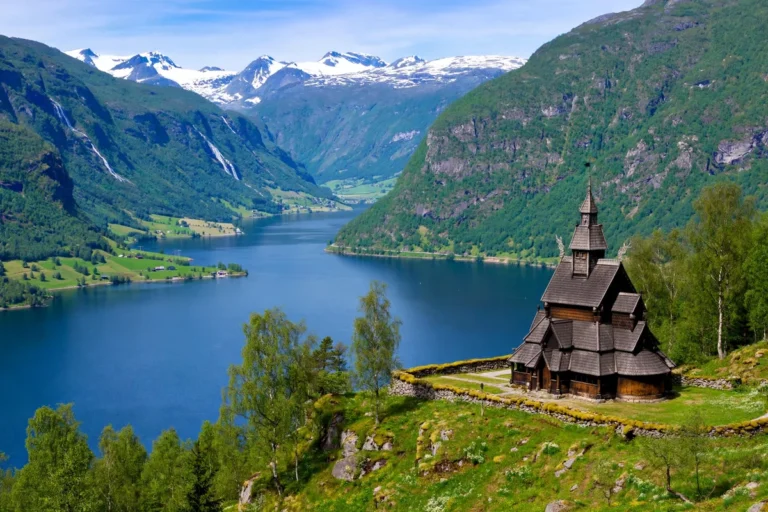
Geirangerfjord is a branch of the Storfjord in Møre og Romsdal, running 15 km from Hellesylt to the village of Geiranger at its eastern end. It is about 260 m deep at its deepest, and about 500 m to 1.5 km wide. It has been on the UNESCO World Heritage List since 2005, together with the Nærøyfjord, and it is one of the most visited natural sites in Norway.
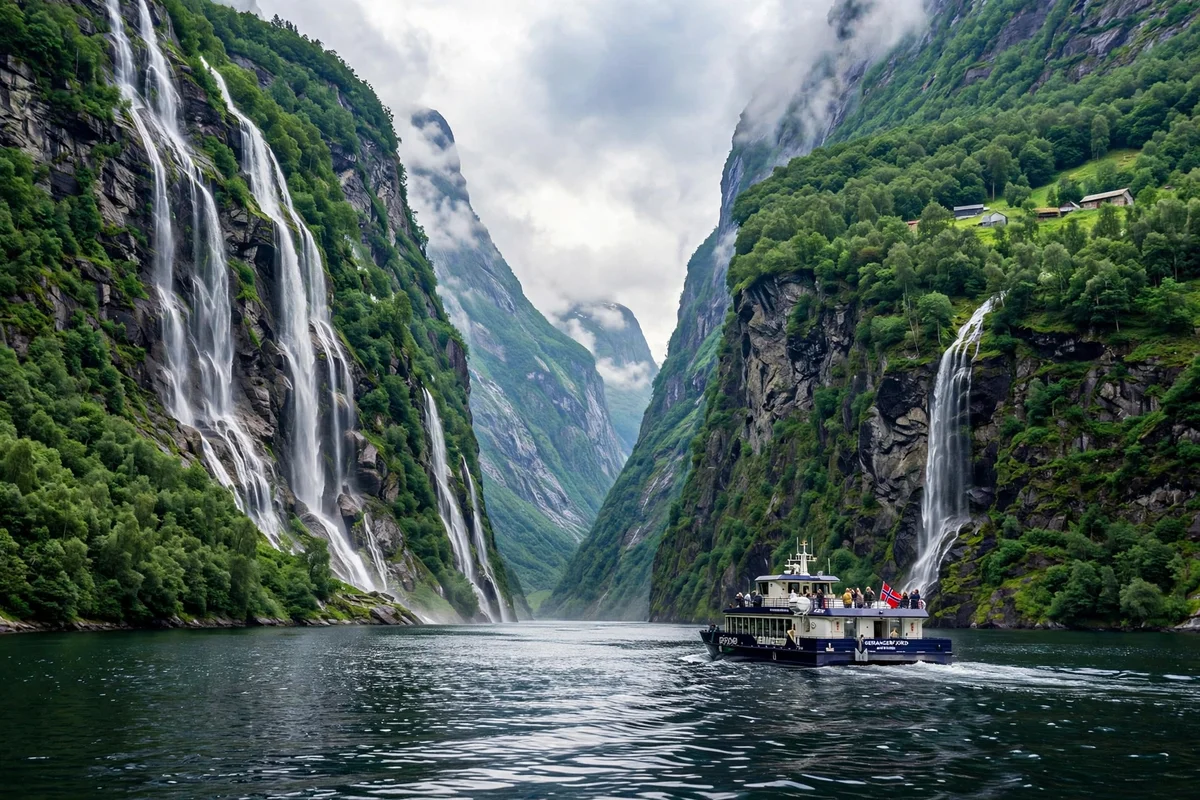
The waterfalls are what make it. The Seven Sisters fall in seven streams down the north wall, about 6.5 km west of Geiranger village, with the longest single drop about 250 m within a total descent of about 410 m. Directly opposite, on the south wall, is the Suitor, a single broad fall. Further along the fjord is the Bridal Veil, a thin fall that catches the afternoon light. The old cliff farms are part of the picture too: Skageflå sits about 250 m above the water on the south side, and Knivsflå faces it beside the Seven Sisters. Both were farmed until the early 1900s and reached only by ladder from boats.
Geirangerfjord is also the fjord with the most to do. Three viewpoints give three different versions of it, all on roads out of the village: Flydalsjuvet, about 4 km from the village, with a straight-down view of Geiranger and the ships below; Ørnesvingen, the Eagle Bend, at 620 m on the Eagle Road, the highest of the road’s eleven hairpin bends; and Dalsnibba, at 1,476 m above sea level, with a glass-floored skywalk, the highest fjord viewpoint in Europe you can drive to. On the water there are the sightseeing boats from the village, a 75-minute classic cruise or a 2-hour cruise on a hybrid-electric catamaran, plus RIB safaris of about 75 minutes and guided kayak tours of about 3 hours. The village itself has the Norwegian Fjord Centre, the visitor centre for the World Heritage site, and about 200 residents.
The cost is the crowds. Geiranger is one of Norway’s busiest cruise ports, and more than 500,000 cruise passengers called at Geiranger and Hellesylt in 2024. On a summer day the village, the viewpoints and the boats fill up between 10:00 and 15:00. Stay overnight if you can: the fjord empties of day-trippers in the evening, and the early morning is the best time to see it. The season runs from May to September, and the waterfalls are strongest in May and June.
Nærøyfjord: the narrow one
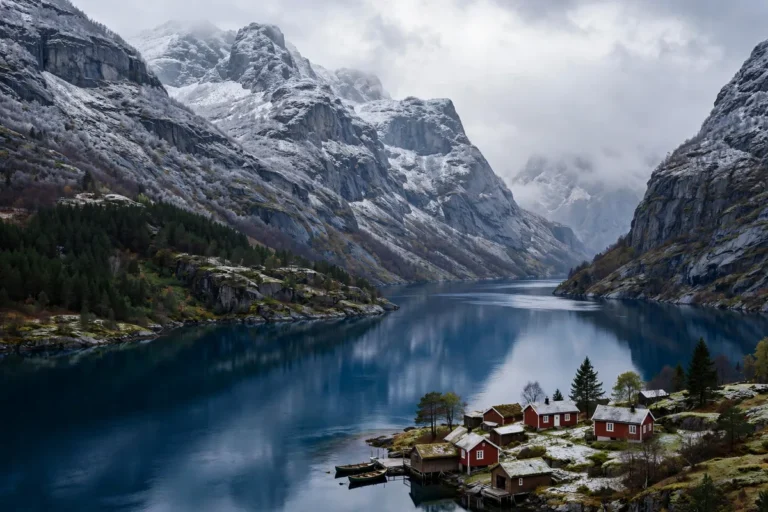
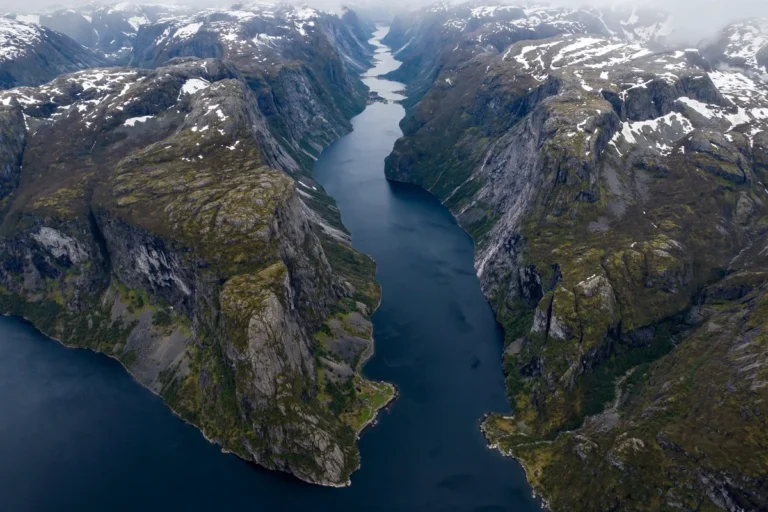
The Nærøyfjord is an arm of the Sognefjord in Vestland, running from the Aurlandsfjord near Flåm to the village of Gudvangen. It is about 18 km long, and at its narrowest point, near the village of Bakka, it is only about 250 m wide. UNESCO gives the width range as 250 m to 2.5 km. The rock walls rise steeply on both sides, the water is calm, and the waterfalls fall straight into the fjord from the farms above. It has been on the UNESCO World Heritage List since 2005, together with Geirangerfjord.
The practical fact about the Nærøyfjord is that it is a boat route before it is anything else. There is no road along it, and the villages on its shores were reached only by water until a few decades ago. The villages directly on the fjord are Gudvangen, at its head, and the small settlements of Bakka, Styvi and Dyrdal. Flåm, Aurland and Undredal are stops on the same boat route, but they sit on the Aurlandsfjord, not on the Nærøyfjord itself, and that distinction matters when you are planning where to stay: Flåm is the busy end of the route, with the railway and the hotels, while the Nærøyfjord itself has almost nowhere to stay.
The way to see it is the scheduled boat between Flåm and Gudvangen, about 2 hours each way, running year-round. The fare is roughly NOK 520 to 595 one way, and the operator uses dynamic pricing with no fixed published fare, so the price you see on the booking page for your date is the price. The boats on this route are electric, and since 1 January 2026 passenger ships under 10,000 gross tonnes must operate without direct carbon dioxide or methane emissions in the World Heritage fjords, so the crossing is quiet: you hear the waterfalls and the birds instead of an engine. Four stops on the route are request-only, Aurland, Undredal, Dyrdal and Styvi, and the boat will only stop if a passenger has booked it before departure.
What the Nærøyfjord has beyond the boat is at its two ends. At Gudvangen there is Njardarheimr, a reconstructed Viking settlement where craftspeople demonstrate Viking-age skills, and the Stalheim viewpoint above the valley, on the road between Gudvangen and Voss. At the Flåm end there is the Flåm Railway, 20 km from Flåm to Myrdal in about 55 to 60 minutes, climbing about 866 m at a gradient of 5.5 percent, one of the steepest standard-gauge adhesion railways in the world, with no rack. The Stegastein viewpoint, 650 m above the water with a platform that juts 30 m out, looks down over the Aurlandsfjord, not the Nærøyfjord itself. Near Gudvangen, Kjelfossen is one of Norway’s highest waterfalls, though its height is disputed, with sources giving 705 to 840 m.
Nærøyfjord guide · Flåm Railway guide
Size and scenery, head to head
Geirangerfjord is the shorter fjord, 15 km against about 18 km, and the wider one, about 500 m to 1.5 km against 250 m at the Nærøyfjord’s narrowest. It is also the fjord with more in it: more waterfalls, more viewpoints, more hikes, and a village at its head with hotels and restaurants. The Nærøyfjord is the more intense fjord: narrower, steeper, and seen from a boat that sits low in the water with the walls close on both sides. The difference is between a fjord you visit and a fjord you pass through.
The waterfalls favour Geirangerfjord. The Seven Sisters, the Suitor and the Bridal Veil are three named falls in one short stretch of water, and they are the most photographed waterfalls in Norway. The Nærøyfjord has waterfalls too, including Kjelfossen near Gudvangen, but they are not the reason people come: the narrowness is. The cliffs favour the Nærøyfjord for closeness and Geirangerfjord for variety: the Nærøyfjord’s walls are the ones that make people stop talking, while Geirangerfjord’s walls hold the farms, the viewpoints and the roads.
Neither fjord’s cliff height should be quoted as a single settled figure. UNESCO gives the fjord walls of the World Heritage property as rising up to 1,400 m above the water, while the peaks around the Nærøyfjord are reported at over 1,700 m, up to about 1,761 m, and in some sources up to 1,800 m. The difference is between the walls and the peaks, and the sources do not agree on one number. This guide does not use a cliff-height figure for either fjord.
The boat trips, head to head
The two boat trips are the heart of the comparison, and they are very different.
The Geirangerfjord sightseeing boat leaves from Geiranger village and returns there. The classic cruise takes 75 minutes; the longer cruise on a hybrid-electric catamaran takes 2 hours and covers the full length of the fjord. Both pass the Seven Sisters, the Suitor and the Bridal Veil. There is also a crossing from Hellesylt to Geiranger, about 65 minutes, which is a way into the fjord rather than a round trip. The boats are small, the departures are frequent in summer, and the trip is one part of a day that also includes viewpoints and a hike.
The Nærøyfjord boat is a scheduled service, not a sightseeing cruise: it carries passengers between Flåm and Gudvangen in about 2 hours each way, as part of a longer journey. It is the essential trip, and for most visitors it is the only way to see the fjord. The boat is electric, quiet and low in the water, with panoramic windows on the newer vessels, and the crossing is the leg of the Norway in a Nutshell loop that most people remember. It runs year-round, though on a reduced winter timetable, and in winter the route may switch to a return trip from Flåm instead of a crossing to Gudvangen, so the timetable for your date needs checking.
Which boat trip is better depends on what you want. The Geirangerfjord boat is the better sightseeing trip: shorter, more waterfalls, and part of a fuller day. The Nærøyfjord boat is the better fjord experience: narrower water, closer walls, and a silence that the electric boats make possible. If you only have time for one boat trip, the Nærøyfjord crossing is the more memorable two hours on the water. If you want the most complete day, Geirangerfjord’s boat plus its viewpoints wins.
Viewpoints and walks, head to head
Geirangerfjord wins this one clearly. It has three viewpoints on roads out of the village, Flydalsjuvet, Ørnesvingen and Dalsnibba, plus short steep hikes to the cliff farms at Skageflå and to the Storseterfossen waterfall, which you can walk behind. The viewpoints are the reason to have a car in Geiranger, and they are the reason to stay overnight: the light is better and the crowds are gone before 10:00 and after 15:00.
The Nærøyfjord has almost no viewpoints of its own, because there is no road along it. The one place to see it from above is Stalheim, on the road between Gudvangen and Voss, where the hotel sits on a ledge above the valley with a view down the fjord. The Stegastein viewpoint belongs to the Aurlandsfjord, not the Nærøyfjord, though it is a 30-minute drive from Flåm and most visitors to the Nærøyfjord see it as part of the same day. The walks on the Nærøyfjord are the kayak tours from Flåm, about 3 hours, and the trails from the request-stop farms at Dyrdal and Styvi, which start where the boat drops you off.
If viewpoints matter to you, Geirangerfjord is the choice. If you are happy to see a fjord from the water and nothing else, the Nærøyfjord’s boat is enough.
Getting there, head to head
The Nærøyfjord is far easier to reach from Bergen. The usual route is the train to Myrdal, the Flåm Railway down to Flåm, the boat to Gudvangen, the bus to Voss and the train back to Bergen, the full Norway in a Nutshell loop, which takes a day. It is public transport all the way, it runs year-round, and it needs no car. From Bergen it is the obvious day trip.
Geirangerfjord is easier from Ålesund, and harder from everywhere else. By car from Ålesund it is 108 km, 2.5 to 3 hours including the Eidsdal-Linge ferry, down the Eagle Road into the village. There is also a quiet fjord cruise from Ålesund, from Skutvika, 3 to 3.5 hours one way and 9 hours as a return day trip, and a winter trip from November to May that is also 9 hours, with a bus up to Flydalsjuvet and a visit to the Norwegian Fjord Centre. By bus, Ålesund to Geiranger takes 5.5 to 6 hours with changes. There is no train to Geiranger, and the village is at the end of a mountain road.
The Hellesylt crossing needs care in planning. Fjord1’s public car ferry from Hellesylt stopped sailing on 4 September 2026 and is suspended until further notice, after a court ruling on the fjord’s zero-emission rule. The crossing still runs: Vestlandske sails Geiranger to Hellesylt in about 65 minutes, with tickets through Norway’s Best, and its boats carry cars as well as foot passengers. The summer timetable runs to 30 September, with fewer sailings in October and November, and none from mid-December to the end of February. Check the current timetable before planning around the crossing, because the operator and the timetable have both changed, and Fjord1’s own pages still show the old ferry text.
Best fjord day trip from Ålesund · Best fjord day trip from Bergen
Cruise ships, crowds and winter
Big cruise ships call at Geirangerfjord and not at the Nærøyfjord, and that shapes both fjords. Geiranger is one of Norway’s busiest cruise ports, and the ships anchor in the fjord and tender passengers ashore. Since 1 January 2026, passenger ships under 10,000 gross tonnes must operate without direct carbon dioxide or methane emissions in the World Heritage fjords, and the sightseeing boats in Geiranger are now electric or hybrid. Larger ships have until 1 January 2032, so big cruise ships can still call at Geiranger for now.
The Nærøyfjord takes small boats only. It is too narrow for large ships, and the shallow sill at its mouth keeps big ships out; the largest ships are restricted by the narrowness of the passage, and they call at Flåm, on the Aurlandsfjord, instead. That is part of the appeal: the fjord belongs to the electric day boats, and the water stays quiet.
The crowds follow the ships. Geirangerfjord is busy from 10:00 to 15:00 on summer days, and the village has no bypass road, so the crowds are felt everywhere. The Nærøyfjord boat is busy too, especially in July and August, when the popular departures sell out, but the fjord itself never feels crowded: the boat is the only traffic, and the villages on its shores are small and quiet. In winter, the Nærøyfjord boat still runs on a reduced timetable, while Geirangerfjord’s sightseeing boats stop and the village is reachable only by ferry, with very little open. For a winter trip, the Nærøyfjord is the practical choice.
The verdict
Choose Geirangerfjord if you want the most complete fjord visit: the waterfalls, the viewpoints, the hikes, the village and the boat, all in one place, and you have two or three days and a base in Ålesund. It is the bigger day out, and the better choice for a first fjord if you can give it the time.
Choose the Nærøyfjord if you have one day from Bergen, if you want the narrowest fjord in Norway from a quiet electric boat, or if you are travelling on the Norway in a Nutshell route anyway. It is the easier trip, the more intense two hours on the water, and the better choice for a traveller without a car.
Choose both if you can. They are listed together for a reason, and they are different enough that seeing one does not replace the other. The practical way to do both is to base the Nærøyfjord day in Bergen or Flåm, and the Geirangerfjord days in Ålesund, with a travel day between them. Two UNESCO fjords in one trip is the reason the listing covers them together, and it is the best answer to the question this guide asks.
For when to go, see our best time to visit guide. For the boats in detail, see our best fjord cruise guide. For how the two fjords compare with the rest of the country, see our Sognefjord vs Geirangerfjord guide.
Which is better, Geirangerfjord or Nærøyfjord?
It depends on your trip. Geirangerfjord is the more complete visit: the waterfalls, three viewpoints, hikes and a village to stay in, and it suits two or three days from Ålesund. The Nærøyfjord is the more intense two hours on the water: the narrowest fjord in Norway, seen from a quiet electric boat, and it suits one day from Bergen on the Norway in a Nutshell route. If you can, see both: they are listed together for a reason, and one does not replace the other.
Can you visit both fjords in one trip?
Yes. Base the Nærøyfjord day in Bergen or Flåm, and the Geirangerfjord days in Ålesund, with a travel day between them. The Nærøyfjord day is the train to Flåm, the boat to Gudvangen and the bus back; the Geirangerfjord days are the sightseeing boat, the viewpoints and a night in the village. Two UNESCO fjords in one trip is the best answer to the choice between them.
How long does each fjord take?
The Nærøyfjord boat takes about 2 hours one way, Flåm to Gudvangen, and the full loop from Bergen takes a day. The Geirangerfjord sightseeing boat takes 75 minutes for the classic cruise or 2 hours for the longer hybrid-electric cruise, and a full day lets you add two viewpoints and a hike. Two days, one night in Geiranger village, is the version worth planning, because the evening and early morning are when the fjord is at its best.
Which fjord is easier to reach?
The Nærøyfjord is far easier from Bergen: train, Flåm Railway, boat and bus, all public transport, running year-round, with no car needed. Geirangerfjord is easier from Ålesund: 108 km by car, 2.5 to 3 hours, or the quiet fjord cruise from Skutvika, 3 to 3.5 hours one way and 9 hours as a return day trip. There is no train to Geiranger, and by bus from Ålesund it takes 5.5 to 6 hours.
Do big cruise ships go to both fjords?
No. Big cruise ships call at Geirangerfjord: Geiranger is one of Norway’s busiest cruise ports, and the ships anchor in the fjord and tender passengers ashore. Large ships can still call for now, because the zero-emission rule that started on 1 January 2026 applies to passenger ships under 10,000 gross tonnes, and larger ships have until 1 January 2032. The Nærøyfjord takes small boats only: it is 250 m wide at its narrowest, and the largest ships are restricted by the narrowness of the passage. Big ships call at Flåm, on the Aurlandsfjord, instead.
Which fjord is better in winter?
The Nærøyfjord. Its boat runs year-round, though on a reduced winter timetable with two departures a day from Flåm, and in winter the route may switch to a return trip from Flåm instead of a crossing to Gudvangen, so check the timetable for your date. Geirangerfjord’s sightseeing boats stop in winter, the southern mountain road closes in October, and the village is reachable only by ferry, with very little open.