Zero-Emission Fjords 2026: Which Ships Can Still Sail Geiranger & Nærøy?
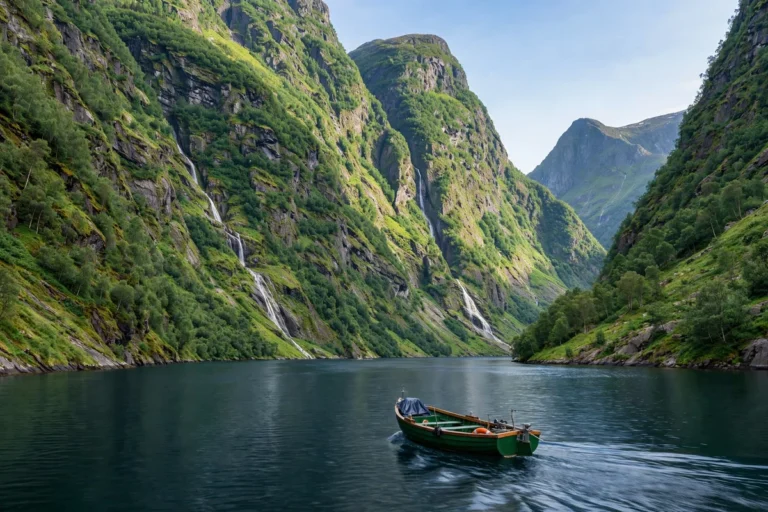
The zero-emission rule for Norway’s World Heritage fjords is the most misunderstood rule in Norwegian cruising. The short version most travellers hear is wrong: the fjords are not closed to cruise ships, and big ships are not banned. The rule works the other way round from what most people expect. Since 1 January 2026, the ships that must be zero-emission inside the fjords are the small ones, under 10,000 gross tons. The big ships, over 10,000 gross tons, are not covered until 1 January 2032, so they can still sail Geirangerfjord and Nærøyfjord as they did before.
This guide explains the rule as it stands in November 2026, which ships it affects, which ships it does not, and the one real casualty so far: the Hellesylt to Geiranger car ferry, suspended since 4 September 2026. For the practical side of planning a fjord trip around the rule, see our best fjord cruise guide and our Geirangerfjord guide.
The rule, plainly
The rule was set by the Norwegian Maritime Authority, known as Sjøfartsdirektoratet, on a mandate from the Ministry of Climate and Environment, as an amendment to the Regulations of 30 May 2012 No. 488 on environmental safety for ships. The amendment was adopted in April 2025 through Circular RSR 04-2025 and came into force on 1 January 2026.
It covers five fjords, the West Norwegian Fjords World Heritage site: Nærøyfjord, Aurlandsfjord, Geirangerfjord, Sunnylvsfjord and Tafjord. It applies to passenger ships: cruise ships, tourist boats, ferries and high-speed craft carrying more than 12 passengers. It applies whether a ship operates entirely inside the fjords or only passes through them.
The requirement is zero direct emissions of CO2 or methane while inside the fjords. In practice that means battery-electric operation, or an approved alternative fuel: biogas is allowed under strict conditions, and shore power is mandatory where facilities are available. The regulation does not require the authority to verify a ship’s actual emissions in the fjord; it sets the energy requirement and the documentation around it.
The dates are the part that confuses people. From 1 January 2026, the requirement applies to passenger ships below 10,000 gross tons. From 1 January 2032, the same requirement extends to ships of 10,000 gross tons and above. So in 2026, a 184,000-ton cruise ship can call at Geiranger, while a 500-ton sightseeing boat must run on batteries or biogas. That is the rule as written, not a loophole: the two-stage timetable was deliberate, giving the large ships six more years to convert.
There are temporary exemptions, but they are narrow. The Norwegian Maritime Authority may grant one for an individual passenger ship under 10,000 gross tons only if the ship operated in the fjords in 2024 and every year since, complies with the other fjord requirements, can document that zero-emission operation is impossible solely because shore-power access was refused, and has a plan to secure shore power. Exemptions last up to two years at a time and never beyond 31 December 2029. The authority had received a number of exemption applications, which were under consideration at its 2026 cruise conference. No published list of ships holding exemptions was available in November 2026, so this guide does not name any ship as exempt.
Big cruise ships: still sailing
If your cruise is on a mainstream ocean ship, the rule does not change your 2026 or 2027 sailing. Any ocean cruise ship over 10,000 gross tons, which is virtually all of them, can still call at Geiranger and Flåm until 2032. The largest ship in the fjords in 2026, MSC Euribia at 184,011 gross tons, called at Geiranger repeatedly through the season, including 20 June and 5, 12, 19 and 26 September 2026, with calls from 12:00 to 21:00. Our MSC Euribia guide covers her fjord sailings in detail.
The coastal ships are in the same position. Hurtigruten’s MS Richard With is 11,205 gross tons, and Havila’s four coastal ships are 15,519 gross tons each, so the 2026 requirement does not apply to them either; they are covered only from 2032. Hurtigruten’s Coastal Express detoured into Geirangerfjord in summer 2026 as usual, including sailings on 31 July and 22 August 2026 that list “Cruising Geirangerfjord” on day two. Havila sails Geirangerfjord from April, switching to Hjørundfjord in September and October. Havila’s ships run on LNG with batteries, and are described in secondary sources as sailing Geirangerfjord emission-free on battery power, but no Havila primary source confirming 2026 battery-only operation in the fjord was found, so treat that description as secondary. Our coastal express guide covers the Bergen to Kirkenes route and its fjord detours.
Geiranger’s cruise traffic did fall in 2026, but not because of a ban. The pilot authority’s operational plan listed 120 calls from 15 April to 7 November 2026, down from 137 in 2025, as reported in secondary sources. That figure is indicative only, and the fall is not attributed in the sources checked to the zero-emission rule alone. No operator announcement of a 2027 Geiranger withdrawal was found, and large ships are expected to keep calling in 2027 under the 2032 grace period.
The small boats: electric, hybrid, or caught by the rule
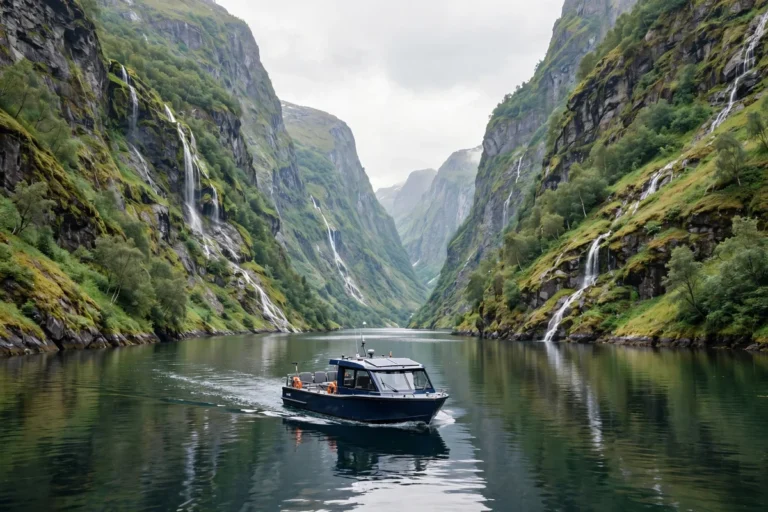
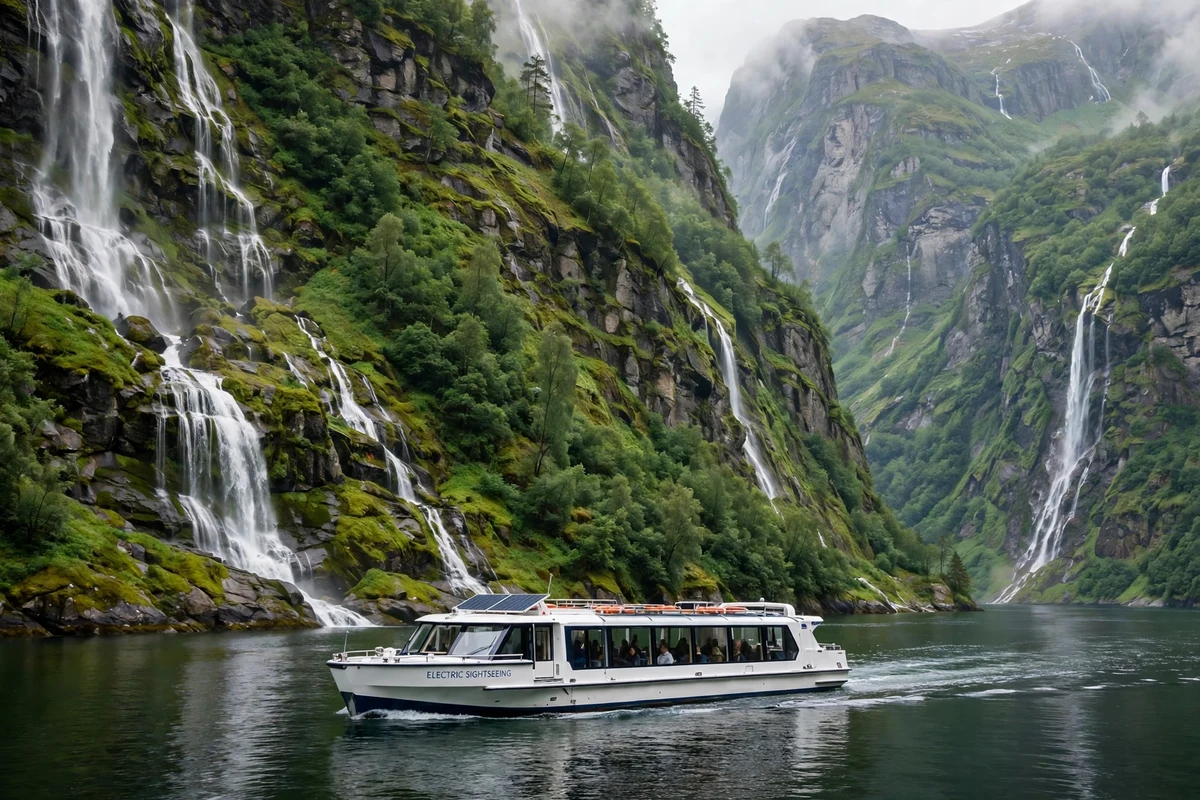
The ships the rule bites are the small ones, and most of the fjord sightseeing fleet was ready for it. On the Nærøyfjord between Flåm and Gudvangen, the operator The Fjords runs three purpose-built boats. Future of the Fjords is a fully electric carbon-fibre catamaran for about 400 passengers, with two 450 kW electric motors, in service since May 2018. Vision of the Fjords is a diesel-electric hybrid that runs on battery inside the World Heritage fjord. Legacy of the Fjords is all-electric, from 2020. The route runs year-round, on a winter timetable of two sailings each way daily from 16 October 2026 to 31 March 2027. Our Nærøyfjord guide and our Flåm Railway guide cover the Flåm to Gudvangen crossing.
You can book the Bergen: UNESCO NærøyFjord Cruise, Flåm & Stegastein tour on Viator.
On Geirangerfjord, the sightseeing operator Geiranger Fjordservice introduced MS Geirangerfjord III in 2026, a 46-metre carbon-fibre catamaran for 280 passengers, hybrid-electric and battery-electric, described by the operator as the first vessel built to meet the new World Heritage fjord requirements. It runs the two-hour “Silent” cruise. The older MS Geirangerfjord, with 165 passengers, still runs the 75-minute classic cruise, but its propulsion and compliance status could not be verified from a primary source, so this guide does not claim it is zero-emission.
You can book the Fjordcruise Ålesund to Geirangerfjord roundtrip on Viator.
The small cruise ships are the ones with the real problem. Any cruise ship under 10,000 gross tons must be zero-emission in the fjords from 2026, and the small luxury and expedition yachts are the category most affected. Secondary sources name SeaDream’s two yachts and Windstar’s smallest ships as affected, but their exact tonnages and whether any hold an exemption were not verified in this research, so this guide does not state them as fact. If you are booking a small-ship cruise that lists Geiranger or Flåm, ask the line directly how the ship complies with the 2026 rule, and get the answer in writing before you pay.
The Hellesylt to Geiranger car ferry: suspended
The one service the rule has stopped, so far, is the Fjord1 car ferry between Hellesylt and Geiranger. The crossing, about 65 minutes on the ferries MF Veøy and MF Bolsøy, has been suspended since Friday 4 September 2026, until further notice.
The sequence matters, because it shows the rule working through the courts rather than by a simple ban. On 8 May 2026 the Norwegian Maritime Authority granted a temporary exemption covering sailings to the end of October 2026 while a permanent application was processed. The Ministry of Climate and Environment later reversed that exemption after a complaint from a competitor. Fjord1 went to court, and on 3 July 2026 Oslo District Court allowed MF Veøy and MF Bolsøy to keep sailing under an injunction while the validity of the reversal was tested. The court subsequently lifted the injunction, operations stopped on 4 September 2026, and Fjord1 is appealing. No 2027 season has been announced: Fjord1’s own page said it would share more information about the 2027 season later, and nothing had appeared by 19 November 2026.
Do not plan a 2027 trip around this ferry until Fjord1 confirms a season. One caution on sources: when Fjord1’s official English Geirangerfjord ferry page was fetched on 19 November 2026, its text still described the April to October service and linked the 2026 timetable and prices, without showing the suspension notice, while other sources record the notice as present. The suspension itself is well corroborated by Fjord1’s press release and NRK reporting, but the state of Fjord1’s own page should be re-checked before citing it as the source.
The crossing is not entirely gone. A separate Geiranger to Hellesylt sightseeing sailing, sold through Norway’s Best and run by Vestlandske, is not part of the Fjord1 suspension and was still running in 2026: a summer timetable to 30 September, three sailings each way in October, two each way from 1 November to 15 December and again in March 2027, and none from mid-December to the end of February. It is a ticketed sightseeing sailing for foot passengers, about 65 minutes, with no car or bus connection, so it is not a replacement for the car ferry. In September 2026 the operator said its new electric ferries were still under construction and the route was being sailed by older ferries, Skånevik and Røsund. How those older vessels comply with, or are exempt from, the 2026 rule could not be verified from a primary source, so this guide does not state that they are zero-emission-compliant.
What changes in 2032
From 1 January 2032, the zero-emission requirement extends to ships of 10,000 gross tons and above. That is the date that matters for the big ships: after it, a conventionally fuelled cruise ship will not be able to enter Geirangerfjord, Nærøyfjord, Aurlandsfjord, Sunnylvsfjord or Tafjord. The cruise lines have six years from the 2026 start to convert, retrofit or redeploy, and no operator announcement about 2032 fjord sailings was found in the sources checked for this guide.
One thing that is sometimes confused with the rule is separate from it: a cruise passenger tax of NOK 100 per passenger per day in port is planned for 1 January 2027 and was still a proposal, not confirmed, in the sources checked. It has nothing to do with the zero-emission requirement, and this guide does not present it as decided.
For the wider picture of how the rule fits into sustainable fjord travel, see our sustainable fjord cruising guide. For when to go, see our best time guide.
The five fjords the rule covers
The rule covers five fjords, and they are not all the same kind of place. Nærøyfjord and Aurlandsfjord are the narrow arms at the inner end of Sognefjord, served by the Flåm to Gudvangen boats. Geirangerfjord is the big cruise destination, with large ships, coastal ships, sightseeing boats and, until September 2026, the car ferry. Sunnylvsfjord and Tafjord are the inner arms of the Geirangerfjord system, and the rule applies to them in exactly the same way, even though no separate cruise services are listed for them in this guide. Together the five make up the West Norwegian Fjords World Heritage site.
What matters for a traveller is not the list of names but which fjord your sailing enters. A Nærøyfjord cruise from Flåm is on an electric or hybrid boat and complies with the rule. A Geirangerfjord call on a large cruise ship is covered only from 2032. A Hellesylt to Geiranger crossing is the one service that has stopped. If your itinerary names a fjord you do not recognise, check it against the five names above: if it is not one of them, the rule does not apply to it at all.
What the rule does not do
The rule is narrower than the headlines suggest, and the gaps matter. It applies to passenger ships only: cruise ships, tourist boats, ferries and high-speed craft carrying more than 12 passengers. It does not cover cargo ships or private boats. It applies to a passenger ship whether it operates entirely inside the fjords or only passes through them, so a ship cannot avoid the rule by treating the fjord as a shortcut.
It does not require the authority to verify a ship’s actual emissions in the fjord. The regulation sets the energy requirement, biogas is allowed as an alternative fuel under strict conditions, and shore power is mandatory where facilities are available, but the regulation does not require verification of actual ship emissions, according to Lloyd’s Register’s summary. That is why the exemption conditions focus on shore-power access: a ship that cannot plug in cannot run on batteries, and the exemption exists for exactly that case, for a limited time.
And it does not ban any ship outright. It sets an energy standard with a two-stage timetable: under 10,000 gross tons from 2026, 10,000 gross tons and above from 2032. A ship that meets the standard can sail; a ship that does not must wait for its stage or hold a temporary exemption. That is the whole of the rule, and it is why the fjords are still open to cruise ships in 2026.
How to check your own sailing
Three checks cover most cases. First, check your ship’s gross tonnage: if it is over 10,000, the 2026 rule does not apply to it, and the 2032 date is the one to watch. Second, check the itinerary: if Geiranger or Flåm is listed as a port of call in 2026 or 2027, the line is sailing it under the current rule, and a large ship needs no exemption to do so. Third, if your ship is under 10,000 gross tons, or if the sailing is a small-boat sightseeing trip, ask the operator how the vessel complies with the 2026 requirement, and whether it holds a temporary exemption. The exemption conditions are public, but no published list of exemption holders was available in November 2026, so an operator’s own statement is the check that matters.
This article will need quarterly maintenance, not a one-off write: the Fjord1 appeal, the exemption applications under consideration, and the 2027 season announcements can all change the picture. The rule itself has not changed since it was adopted in April 2025, and no amendment, postponement or extension was found in the sources checked.
Frequently asked questions
Is Geirangerfjord closed to cruise ships?
No. Geirangerfjord is open to cruise ships. Since 1 January 2026, passenger ships under 10,000 gross tons must be zero-emission inside the fjord, and ships of 10,000 gross tons and above must meet the same requirement only from 1 January 2032. Large cruise ships called at Geiranger throughout 2026, and 120 calls were planned from 15 April to 7 November 2026.
Can big cruise ships still visit Geirangerfjord?
Yes, until 2032. Any ship over 10,000 gross tons can still call at Geiranger under the current rule. MSC Euribia, at 184,011 gross tons, called at Geiranger repeatedly in 2026, including 20 June and 5, 12, 19 and 26 September. Hurtigruten and Havila coastal ships, all over 10,000 gross tons, also still sail into Geirangerfjord in summer.
Which ships are zero-emission in the fjords now?
The purpose-built sightseeing boats: Future of the Fjords, a fully electric catamaran on the Nærøyfjord since 2018; Vision of the Fjords, a diesel-electric hybrid that runs on battery inside the fjord; Legacy of the Fjords, all-electric from 2020; and MS Geirangerfjord III, a new hybrid-electric and battery-electric catamaran on Geirangerfjord from 2026. The Flåm to Gudvangen route runs year-round on these boats.
Can I still take the car ferry from Hellesylt to Geiranger?
No, not since 4 September 2026. The Fjord1 car ferry, MF Veøy and MF Bolsøy, is suspended until further notice while Fjord1 appeals a court decision. No 2027 season has been announced. The alternative is the ticketed sightseeing sailing between Geiranger and Hellesylt, about 65 minutes, for foot passengers only, with no car or bus connection.
What about the Nærøyfjord boats from Flåm?
They run as normal, year-round. The Flåm to Gudvangen boats are electric or hybrid and comply with the 2026 rule, on a winter timetable of two sailings each way daily from 16 October 2026 to 31 March 2027. The crossing takes about two hours each way.
What happens in 2032?
From 1 January 2032, the zero-emission requirement extends to ships of 10,000 gross tons and above. After that date, a conventionally fuelled cruise ship will not be able to enter the five World Heritage fjords: Nærøyfjord, Aurlandsfjord, Geirangerfjord, Sunnylvsfjord and Tafjord. No operator announcement about 2032 fjord sailings was found in the sources checked for this guide.