Sustainable Fjord Cruising: Emissions, Overtourism & Responsible Choices
Sustainable fjord cruising in Norway starts with three choices: pick a smaller ship or a coastal sailing instead of the largest cruise ship, travel in May or September instead of July, and check that your sailing really enters the fjords it promises. No cruise is free of impact. The lowest footprint trip is usually the one that spends more time on the water in a small boat, or on a working coastal ship, and less time moving thousands of people through one small village in a few hours.
Norway has put a real rule behind that advice: since 1 January 2026, passenger ships under 10,000 gross tonnage must run with no direct carbon dioxide or methane emissions inside the World Heritage fjords. Larger ships get until 1 January 2032.
The rule that changes everything
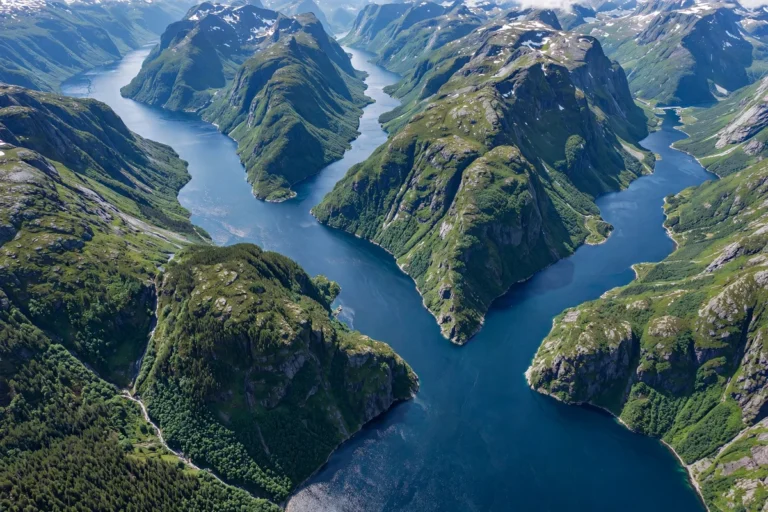
The West Norwegian Fjords, the Geirangerfjord and the Nærøyfjord, were inscribed on the UNESCO World Heritage List in 2005. The zero-emission rule covers those two fjords and their approach waters, the Aurlandsfjord, the Sunnylvsfjord and the Tafjord. Parliament resolved in 2018 that they should become a zero-emission zone by 2026, and the Norwegian Maritime Authority put the requirement into the regulations in 2025.
From 1 January 2026, every passenger ship under 10,000 gross tonnage carrying more than 12 passengers must use energy sources that produce no direct carbon dioxide or methane inside the World Heritage fjords. From 1 January 2032, the same requirement reaches ships of 10,000 gross tonnage and above. That second date matters for the big ocean cruise ships, because almost all of them are far above 10,000 gross tonnage. Until 2032 they can still sail into Geirangerfjord and Nærøyfjord, but they must meet the other rules that already apply, including low-sulphur fuel limits and shore power where available.
Zero emission does not always mean battery power. Biogas counts as an alternative fuel, under conditions set by the Norwegian Maritime Authority. Shore power is mandatory where a port has installed it. Temporary exemptions can be granted for individual ships under 10,000 gross tonnage, but only under strict conditions, for up to two years at a time and not beyond 31 December 2029.
If you book a small ship, a day boat or an expedition sailing under 10,000 gross tonnage into Geirangerfjord or Nærøyfjord, ask how it complies. A compliant answer names the technology: battery, biogas or shore power. Our Geirangerfjord guide and our Nærøyfjord guide explain what each fjord is like on the water.
The options, compared
There is no single green ship: each type trades size, comfort and footprint differently.
| Way to see the fjords | Typical size | What powers it | Best for | Main drawback |
|---|---|---|---|---|
| Large ocean cruise ship | Thousands of passengers | Fuel or LNG, some shore power | Comfort, one unpacking, many ports | Largest footprint, crowds ashore at once |
| Coastal express ship | Hundreds of passengers | Hybrid battery, LNG, some biogas | Working coastal route, daily port calls | Simpler cabins, fixed route |
| Small expedition ship | About 200 to 500 passengers | Battery hybrid | Quiet sailing, landings, guides on board | Higher cost per day, fewer sailings |
| Electric day boat | Up to about 400 passengers | Battery electric | Silent sailing in the narrowest fjords | Short route only, no overnight stay |
| Small local boat or RIB | A dozen or so passengers | Battery, hybrid or outboard | Reaching a narrow arm big ships cannot enter | Weather dependent, short trips only |
A coastal sailing or a small expedition ship usually leaves the lightest footprint per passenger on a multi-day trip, because the ship is smaller and calls at working ports. An electric day boat leaves the lightest footprint on a single crossing. A large cruise ship is the heaviest option per sailing. Our best fjord cruise guide compares the boat types in more detail.
How the coastal lines are responding
Hurtigruten and Havila Voyages run the coastal express between Bergen and Kirkenes. Hurtigruten completed a multi-year fleet upgrade in 2025, an investment of about 150 million euros, which included the hybrid conversion of four vessels, MS Nordlys, MS Richard With, MS Finnmarken and MS Kong Harald. The hybrid ships carry large battery packs, so they can run quieter in sensitive waters and plug into shore power in port. Hurtigruten is also working on Sea Zero, a project to build its first electric, zero-emission ship for the Norwegian coast by 2030: a plan, not a ship you can book today.
Havila Voyages runs four purpose-built ships on the same route: Havila Capella, Havila Castor, Havila Polaris and Havila Pollux. Each has a 6.1 megawatt-hour battery pack and LNG engines, letting it sail for up to four hours with zero emissions, and connect to shore power where available. Each ship has 179 cabins and can carry up to 640 guests. In late 2025, Havila Polaris completed a 12-day voyage on renewable biogas and battery power, cutting lifecycle carbon dioxide emissions by more than 90 percent, according to Bergen Engines.
HX Expeditions, the separate expedition company spun off from Hurtigruten, sails the hybrid flagships MS Roald Amundsen and MS Fridtjof Nansen, in service since 2019 and 2020. Their batteries let them run on battery power alone for up to 45 to 60 minutes.
Hybrid and battery technology is real, but it does not make any of these ships zero emission for a whole voyage. LNG burns cleaner than heavy fuel oil, but it still produces carbon dioxide, and unburned methane can escape. That is why the 2032 date matters. Our Bergen to Kirkenes coastal express guide compares the northbound, southbound and round-trip options.
The small electric boats already doing it
The clearest example of zero-emission sailing in Norway is already running, and it is not a cruise ship. It is a day boat. Future of the Fjords is a 42-metre, all-electric catamaran carrying up to 400 passengers on the Flåm to Gudvangen route through the Aurlandsfjord and the Nærøyfjord, with no exhaust and almost no engine noise. Its sister ship, Vision of the Fjords, is a diesel-electric hybrid from 2016, and Legacy of the Fjords followed in 2020 as another all-electric boat. Charging happens at a floating PowerDock at Gudvangen, a 2.4 megawatt-hour battery station that recharges the boat in about 20 minutes.
Geiranger has followed the same path, with a new hybrid-electric catamaran, MS Geirangerfjord III, in service for 2026, carrying 280 passengers on a two-hour silent cruise. Brim Explorer runs hybrid-electric sightseeing in Svolvær, on the Silent Trollfjord Cruise, and in Tromsø and Oslo. These boats are small, local and specific to one fjord. Our Aurlandsfjord guide covers Flåm, Stegastein and the boat to Gudvangen.
You can book the Fjordcruise Ålesund to Geirangerfjord roundtrip on Viator.
Overtourism in Geiranger and Flåm
Emissions are only half the story. The other half is what happens when several thousand people arrive in a village of about 250 year-round residents in the same few hours. On a busy summer day in Geiranger, the village fills with cruise passengers between late morning and mid-afternoon, the narrow roads back up with coaches, and the village then empties again in the evening. Flåm takes the same pressure from the railway, the road and the boats arriving together.
Norway has started to manage that pressure with limits and fees. Bergen, the largest cruise port in Norway, has limited cruise calls since 24 June 2022 to four vessels and a maximum of 8,000 passengers per day. Geiranger uses the SeaWalk, a floating pier in place since 2014 that lets passengers walk ashore instead of tendering, but it can take only one vessel at a time. Cruise calls at Geiranger have fallen from recent peaks, and some itineraries now skip Geiranger or call at a nearby port instead.
Norway also passed an Act on Visitor Fees in June 2025, in force from 1 July 2026, letting heavily affected municipalities charge up to 3 percent on commercial overnight stays. A separate cruise-passenger fee was still under consultation when this guide was checked.
What you can do about the crowds is simple. Travel in May or September, when the light is still good and the ships are fewer. Our best time to visit guide sets out the months in detail. Stay overnight in the fjord village instead of arriving and leaving on the same ship, so your money reaches the guesthouse, the cafe and the local guide. Walk out of the village centre for an hour: the crowds thin fast above the village. Check the port schedule for your date: if three ships are in Geiranger on the same day, pick another day.
Choosing a lower-impact trip
Start with the ship, then the season, then the shore day. The ship decides most of the footprint, the season decides how crowded it will be, and the shore day decides how much of your money stays local.
Ask what the ship runs on, whether it plugs into shore power, and whether it sails into the World Heritage fjords on battery or biogas. A coastal sailing on Hurtigruten or Havila, or a small expedition sailing on HX, will answer those questions in detail. A large cruise line may answer with a general sustainability page, and that is a weaker signal. Our MSC Euribia guide explains one large LNG-powered ship: Euribia runs on LNG, cleaner than heavy fuel oil but still a fossil fuel, and sails from Copenhagen and Kiel.
Shoulder season is the easiest win. May and September bring fewer ships and often better light, with the trade-off that some small boats and mountain roads run shorter seasons. July and August bring the warmest weather and the fullest timetables, and also the most coaches and the longest queues.
On shore, pick local over shipped-in. A local guide, a family-run boat, a farm cafe and a locally owned guesthouse keep more of your spending in the fjord community than a coach tour sold on board. Our best shore excursions guide compares ship excursions with independent options in Bergen, Flåm and Geiranger. Our Day 5 companions cover cycling the fjords, fjord swimming and sauna and ski and sail.
What to ask before you book
Before you pay, ask the line or the agent five questions, and keep the answers in writing. First, does this sailing enter the Geirangerfjord or the Nærøyfjord, and how does the ship comply with the 2026 rule for its size? Second, what fuel does the ship use in the fjords, and does it plug into shore power in Bergen, Ålesund or Flåm? Third, how many passengers does the ship carry, and how many ships will be in Geiranger or Flåm on the same day? Fourth, are the shore excursions run by local operators? Fifth, what happens if the Geiranger call is changed?
Good answers are specific: they name the ship, the fuel, the battery size or the biogas, and the port. Weak answers use words like eco, green, sustainable and responsible without a number or a name attached. If the agent cannot answer, ask the line directly. Check the port schedule again a few weeks before you travel, because Geiranger calls have changed as the emission rules have taken effect.
Green claims to read twice
Cruise marketing is full of green language, and much of it is incomplete. LNG is the most common example. It cuts sulphur and particles sharply, but it is still a fossil fuel, it still produces carbon dioxide, and methane can escape unburned. A ship described as LNG-powered is cleaner than a ship on heavy fuel oil, and it is not zero emission.
Hybrid is another word to read carefully. A hybrid ship has a battery pack, but the battery may cover only the quiet stretches and the time in port, while the engines do the rest of the sailing. Ask how long the ship can sail on battery alone: four hours on a Havila coastal ship is a different claim from 45 minutes on an expedition ship. Carbon offsetting deserves the same scepticism. An offset pays for a reduction somewhere else, and it does not remove the emissions from your sailing. The same applies to single-use plastic bans: good practice, and they say almost nothing about the fuel in the tanks.
The most reliable signals are boring and checkable: the ship’s gross tonnage, its fuel, its battery size, and whether it uses shore power.
What to skip
Skip a sailing that advertises Geirangerfjord or Nærøyfjord and then anchors outside the fjord or calls at a nearby port instead. Skip a small-ship sailing under 10,000 gross tonnage that cannot explain how it complies with the 2026 rule. Skip the largest ships in July if a quiet fjord is what you want. Skip coach tours that promise five viewpoints in three hours in Geiranger or Flåm. Skip offset-only green claims, and skip any line that calls LNG zero emission: it is not.
Finding your way around
Key map links for the places in this guide:
- Geiranger village, Geirangerfjord, the village at the head of the Geirangerfjord
- Flåm, Aurlandsfjord, the village at the head of the Aurlandsfjord and the start of the electric boat to Gudvangen
- Gudvangen, Nærøyfjord, the village at the head of the Nærøyfjord
- Bergen cruise port, the largest cruise port in Norway
- Ålesund cruise port, the Art Nouveau town and fjord base near the Geirangerfjord
- Hellesylt, Sunnylvsfjord, the village on the Sunnylvsfjord at the entrance to the Geirangerfjord
- Svolvær, Lofoten, the departure point for the Silent Trollfjord Cruise
Frequently asked questions
What is sustainable fjord cruising in Norway?
Sustainable fjord cruising means choosing the smallest ship, the cleanest fuel and the quietest season you can, and spending your shore time with local operators.
Can large cruise ships still sail into the Geirangerfjord in 2026?
Yes. The rule reaches ships of 10,000 gross tonnage and above only from 1 January 2032, so large cruise ships can still sail into the Geirangerfjord and the Nærøyfjord in 2026. Smaller ships under 10,000 gross tonnage must already be zero emission inside those fjords.
Which ships are the most sustainable way to see the fjords?
The electric day boats are the cleanest on a single crossing: Future of the Fjords and Legacy of the Fjords run on battery power between Flåm and Gudvangen. For a multi-day trip, the coastal ships of Hurtigruten and Havila Voyages, and the small hybrid ships of HX, leave a lighter footprint than a large ocean cruise ship.
Is LNG a green fuel for fjord cruises?
No, not in the sense of zero emission. LNG burns cleaner than heavy fuel oil on sulphur and particles, but it is still a fossil fuel, it still produces carbon dioxide, and methane can escape unburned. It is an improvement, not a solution.
When is the best time for a lower-impact fjord cruise?
May and September. The ships are fewer, the villages are quieter, and the light is still good. July and August bring the fullest timetables and the most pressure on Geiranger and Flåm.
How can I tell if a cruise line’s green claims are real?
Ask for specifics: the ship’s gross tonnage, its fuel, its battery size and how long it can sail on battery alone, and whether it uses shore power. A line that names the ship, the fuel and the fjord is giving you a checkable answer. A line that offers only the words eco, green and sustainable is not.