
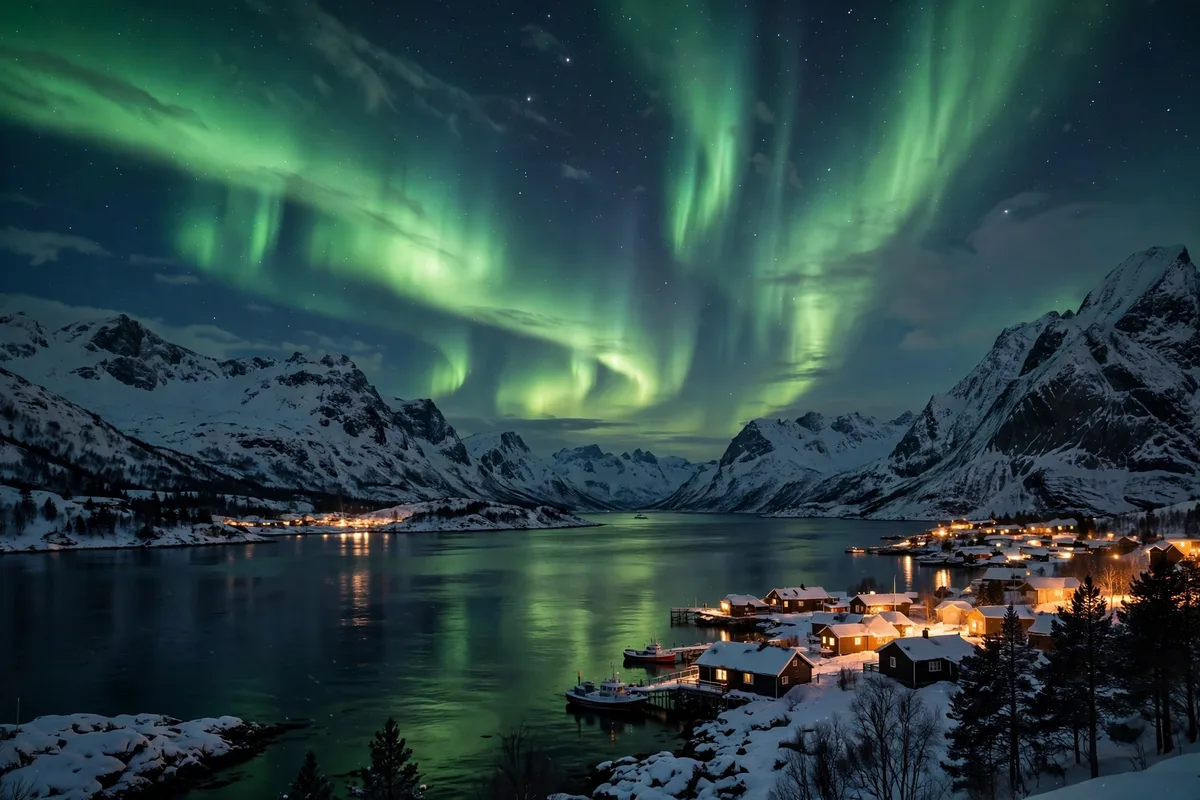
Tromsø Northern Lights Guide: When, Where & How to See Them
Yes, Tromsø is one of the best places in the world to see the northern lights. The city sits at 69 degrees north, well inside the Arctic Circle and directly under the auroral oval. The season runs from late September to early April. The best viewing hours are roughly 6pm to 2am, most often between about 8pm and 2am. Plan for at least three or four nights, check the cloud forecast every afternoon, and move away from the town lights.
Tromsø works because it is a real town, not a remote camp, with an airport five kilometres from the centre and dozens of evening tours leaving from the harbour every night in season.
Why Tromsø works as an aurora base
At 69 degrees north, Tromsø sits under the oval, so even a modest geomagnetic reading, a Kp of 2 or 3 on the 0 to 9 scale, can produce a good display overhead. Further south, the same reading would stay low on the horizon. The aurora forms at roughly 100 kilometres altitude, far above any cloud, so the lights are there on many nights. The question is almost always whether you can see them through the cloud.
When to go
September and October open the season, when the nights return after the midnight sun. Temperatures are milder than in midwinter, and activity often picks up around the autumn equinox. The drawback is fewer hours of darkness than in December.
November to January is the heart of the season. The polar night runs from 28 November to 14 January, when the sun does not rise above the horizon. The sun sets for the last time on 27 November 2026, and it returns on 15 January 2027. Midday is not pitch black: for a few hours around noon the sky turns a deep blue. November to February gives the longest nights and the most viewing hours. December and January are also the whale watching months. Expect roughly minus 6 to minus 1 degrees Celsius in December to February.
February and March bring snow, longer days, and often clear, cold nights. The season closes in early April, when the nights shorten. Do not plan an aurora trip for late April. From 20 May to 22 July the sun does not set at all.
The best viewing spots in town
You can see the lights from Tromsø itself on a strong night, but the town lights wash out faint displays. These three spots need no car and no tour.
Fjellheisen and Storsteinen
The Fjellheisen cable car climbs from Tromsdalen, on the mainland across the strait, to Storsteinen, 421 metres above sea level, in about four minutes. From the top you are above much of the town light and above low cloud on some nights. An adult return costs NOK 645, a child aged 3 to 15 pays NOK 310, and a family of two adults and two children pays NOK 1,360. One-way tickets cost NOK 415. The cable car runs daily from 09:00 to midnight. It closes in strong wind, sometimes for a whole day, so go on the first calm evening. Take bus 26 from the centre. There is no parking at the lower station during the rebuilding works, and no wheelchair access until the works finish.
Prestvannet
Prestvannet is a small lake on the high ground above the centre, about a 20-minute walk uphill from the harbour. The open ground cuts down the glare from the streets below. It is the easiest dark spot to reach on foot, but it is still inside the town glow, so it suits a strong display rather than a faint one.
Telegrafbukta
Telegrafbukta is a beach park at the southern tip of Tromsøya, about 3 km from the centre. It faces away from the town lights and gives an open view across the water. It is reachable on foot or by bus, but the shore is exposed.
The best viewing spots further out
If you have a car or a tour, the darker skies outside town are worth the drive. The coast is often cloudy, while the valleys inland can be clear on the same night.
Ersfjordbotn is a fjord head on Kvaløya, about 20 km away and roughly 30 to 45 minutes by road. Steep peaks ring the fjord, and on a calm night the lights reflect on the water. Kaldfjord and Grøtfjord, also on Kvaløya, offer similar dark shoreline.
Sommarøy is a small fishing village on the outer coast, about 57 km west of Tromsø and roughly an hour by road, with very little artificial light. Guides drive here when the sky is overcast everywhere else.
When the coast is solid cloud, the best clear sky is often inland, east towards Skibotn and the Finnish border. Guides will drive two hours or more that way if the forecast supports it. Do not attempt it on your own unless you are confident driving on snow and ice at night.
Guided tours vs going out on your own
Most first-time visitors should book at least one guided tour, then use the other nights on their own if the sky is clear over town. The guide adds a driver who reads the cloud forecast all evening and a vehicle that can cross into a different weather zone. Going on your own is cheaper, but you are limited to the spots you can reach on foot or by bus.
You can book the Tromsø: Small Group | Northern Lights Chase + All-Inclusive on Viator.
No tour can guarantee the aurora. What a good operator can offer is a free re-run on a later night, a partial refund, or a discount on a second attempt. Check those terms before you book, and book early in your stay so a re-run is still possible.
As a guide, a standard evening chase by minibus or coach costs roughly NOK 1,200 to 2,000 per person. Fjord Tours lists an electric northern lights cruise from NOK 1,290 for about three hours, a northern lights cruise from NOK 1,175, and an aurora safari by minibus from NOK 1,790 for about seven hours. A longer chase is listed from NOK 1,950.
You can book the Tromso Northern Lights Minibus Chase Small Group Tour with Photos on Viator.
Hurtigruten and Havila ships sail the Norwegian coast daily, calling at Tromsø, with a northern lights alert system that wakes you if the lights appear. Hurtigruten offers a Northern Lights Promise on voyages of 11 days or more departing between 20 September and 31 March: if the ship’s officers do not record and announce a sighting, you receive a free 6-day southbound or 7-day northbound Coastal Express voyage in the following season, in an inside cabin, claimed within 28 days of your return. Havila runs a similar promise. A ship cannot chase clear skies the way a minibus can. Our Bergen guide explains the southern end of that coastal route. If you are combining Tromsø with the fjords further south, our Norway in a Nutshell worth it? guide works through the classic southern route and its cost.
How to read the forecasts
Read two forecasts, in this order: cloud first, aurora second. A quiet aurora in a clear sky is visible, while a strong aurora behind cloud is not. Use the hourly cloud table on yr.no, from the Norwegian Meteorological Institute and NRK, which splits cloud into low, middle and high layers. Guides use the low-cloud figure, because low cloud blocks the view completely. Check it in the afternoon and compare Tromsø with Kvaløya and the valleys towards Skibotn.
Then check the aurora forecast. The Norwegian Centre for Space Weather at UiT, the Arctic University of Norway in Tromsø, publishes a nowcast and short-term forecasts of the auroral oval, with live all-sky cameras at Skibotn and Andøya. In Tromsø, a Kp of 2 to 3 is often enough, because the city sits under the oval. NOAA’s 30-minute OVATION forecast is a useful third check.
Moonlight matters too. A full moon washes out faint aurora, so the nights around the new moon give the darkest skies. The new moons in the 2026–27 season fall around 9 November and 9 December 2026, then 7 January, 6 February and 8 March 2027. A strong display still shows well in moonlight.
What to wear and how to photograph the lights
Dress for standing still in the cold, not for walking: thermal base layers, a warm mid-layer, then a windproof and waterproof outer jacket and trousers. Wear insulated winter boots with grip, thick socks, a warm hat, and mittens rather than gloves. Many tours lend thermal suits, but bring your own base layers. Keep your phone in an inside pocket, because cold drains the battery quickly.
For photographs, use a tripod, because exposures run for several seconds and a handheld shot will blur. Set your camera or phone to night mode, turn off the flash, and focus manually on a distant light or a bright star. The lights often look brighter in a photograph than to the naked eye.
Getting there and getting around
Fly to Tromsø Airport Langnes (TOS). A direct flight from Oslo Airport Gardermoen takes about two hours, covering roughly 1,115 km, with SAS, Norwegian and Widerøe flying the route. Our Oslo guide covers the capital if you are stopping there first.
The Flybussen coach waits outside arrivals and takes about 15 to 20 minutes to the central hotels and the harbour, for NOK 125 one way or NOK 200 return. City buses 40 and 42 also serve the airport and take 15 to 20 minutes into the centre, for NOK 50 for an adult single ticket, or NOK 30 off-peak on weekdays. Buy the ticket in the Svipper app or by contactless card, because cash is no longer accepted on Svipper buses. A taxi takes about 10 minutes and costs roughly NOK 250 to 400.
The centre is compact and walkable. Local buses run under the Svipper brand. A single adult ticket costs NOK 50 within one zone and is valid for 90 minutes including transfers, with a 24-hour ticket at NOK 140. Coastal ships call at Tromsø daily, and the harbour at Prostneset is within walking distance of the centre.
What to do in the daytime
The Arctic Cathedral (Ishavskatedralen), the pointed white church on the mainland across the Tromsø Bridge, is the town’s best-known landmark, a short walk from the Fjellheisen lower station. Polaria, the Arctic aquarium on the waterfront, is a good bad-weather option. In winter, whale watching runs from November to January.
How many nights to allow
Three nights is the minimum for a serious aurora trip. Some aurora occurs above Tromsø every other night on average, so three nights gives you a fair chance, but one cloudy stretch can still wipe out a short stay. Four to five nights is the sweet spot: a guided chase on the clearest night, a second night on your own, and a spare evening if the first tour comes back empty.
What to skip
Skip booking a tour for your only night in Tromsø. If the sky is cloudy that night, you have no second chance. Skip the large coach tour if you can afford a minibus, because a smaller vehicle can change direction faster. Skip driving yourself on your first night if you have never driven on snow and ice.
Finding your way around
Key map links for arrival day:
- Tromsø Airport Langnes, 5 km from the centre
- Prostneset, the harbour in the centre
- Fjellheisen, the cable car lower station, bus 26
- Storsteinen, the upper station at 421 metres
- Prestvannet, the lake above the centre
- Telegrafbukta, the beach at the southern tip of the island
- Arctic Cathedral, across the Tromsø Bridge
- Polaria, the aquarium on the waterfront
- Ersfjordbotn, the fjord on Kvaløya
- Sommarøy, the outer coast village
Guided tour vs going on your own, compared
| Option | Cost per person | Best for | Main drawback |
|---|---|---|---|
| Guided minibus chase | Roughly NOK 1,200–2,000 | First-timers, cloudy nights, no car | Fixed schedule, higher price |
| Guided coach chase | From about NOK 1,175 | Lower budget, large groups | Slower to change direction |
| Northern lights cruise | From NOK 1,290 | Seeing the lights from the water | Cannot chase clear sky inland |
| Coastal voyage (Hurtigruten/Havila) | Voyage fare, 11+ days for the Promise | Slow travel, whole coast | Cannot chase clear sky, long trip |
| On your own in town | Fjellheisen NOK 645 return, buses NOK 50 | Clear nights, flexible plans | Limited to spots near town |
Frequently asked questions
When is the best time to see the northern lights in Tromsø?
Late September to early April is the season. November to February gives the longest nights, with the polar night from 28 November to 14 January. February and March add snow and longer days. Stay at least three or four nights, because cloud decides any single night.
Can you see the northern lights in Tromsø without a tour?
Yes, on a clear night with a strong display. Walk to Prestvannet or Telegrafbukta, or take the Fjellheisen cable car to Storsteinen. You will see less than a guided chase on a cloudy night. Book at least one guided tour early in your stay.
What time of night is best for the northern lights in Tromsø?
The lights can appear at any time after dark, but they are most often active between about 8pm and 2am. Tours usually leave between 6pm and 7pm and return between midnight and 1am.
How cold does it get in Tromsø in winter?
Expect roughly minus 6 to minus 1 degrees Celsius in December to February, with wind chill making it feel colder when you stand still. Dress for standing still: thermal layers, a windproof outer layer, insulated boots, mittens and a warm hat.
How do I get to Tromsø from Oslo?
Fly direct from Oslo Airport Gardermoen to Tromsø Airport Langnes, about two hours, with SAS, Norwegian and Widerøe. The airport is about 5 km from the centre. Take the Flybussen coach for NOK 125 one way, or city buses 40 and 42 for NOK 50. There is no train to Tromsø. You can also arrive by coastal ship, which calls at Prostneset.
6 Comments