
Hjørundfjord Guide: Ålesund’s Quiet Fjord
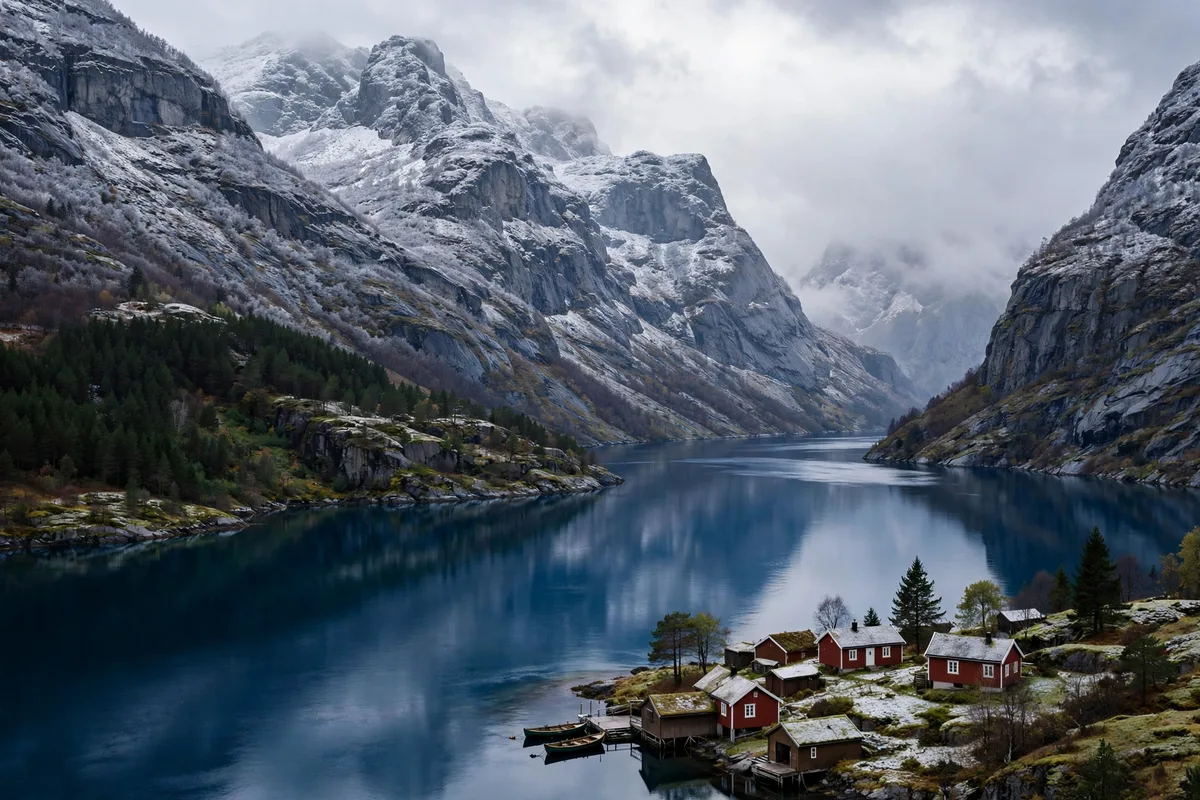
Hjørundfjord is the fjord for travellers who have already seen the famous ones and want the quiet version. It is about a 35 km arm of the Storfjorden, south of Ålesund, walled in by the Sunnmøre Alps, with peaks rising to 1,700 metres straight from the water. There is no road along most of it, no cruise-ship quay, and no queue at the viewpoint. The villages along its shores, Sæbø, Øye and Urke, are reached by boat or by a long drive around the mountains, and that is exactly why the fjord still feels the way the famous fjords felt a generation ago.
The best way to see it is by boat from Ålesund. A day trip takes about five hours, sails past the villages, and stops for about an hour at Øye, at the head of the fjord. If you would rather stay, Sæbø is the practical base, with a hotel, a shop and a campsite, and Øye has one of Norway’s most storied hotels. Hikers come for Slogen, the 1,564-metre peak above Øye that is one of the country’s classic climbs.
Hjørundfjord is a fjord for slowing down: a long boat ride, a village walk, a mountain above the water. If that sounds like your kind of day, it is the best fjord in Norway that most visitors never hear about.
Why Hjørundfjord is different
Most of Norway’s famous fjords are easy to reach, and that is their problem. Geirangerfjord and Nærøyfjord have roads, railways and cruise terminals, and in summer they are busy. Hjørundfjord has none of that. It cuts south from the Storfjorden into the Sunnmøre Alps, and the mountains that line it are so steep that a road was never built along its shores. The fjord is about 35 km long and roughly 2 km wide, and the peaks above it, Slogen, Saksa, Skårasalen and Jakta, rise to around 1,700 metres. The scale is alpine rather than pastoral: rock walls, hanging valleys and farms on ledges, with the water a deep green below.
The villages are small and old. Sæbø, at the southern end of the road from Ørsta, is the fjord’s main village, with a church, a shop, a school and a hotel. Øye, at the head of the fjord beneath the Norangsdalen valley, is a handful of houses around a famous hotel. Urke, on the eastern shore, is a farming village at the foot of the mountains. Trandal, Bjørke, Leira and Viddal are smaller still. None of them has a souvenir strip. What they have is the fjord itself, and the mountains above it.
That isolation is also the reason the fjord is quiet. The big cruise ships cannot come here: there is no deep-water terminal and no road for their buses. The day boats from Ålesund run in summer. For the rest of the year, the fjord belongs to the people who live there.
The boat from Ålesund
The simplest way to see Hjørundfjord is the day cruise from Ålesund, run by Cruise Service AS on the classic fjord boat MS Bruvik, a heritage vessel from 1949. The boat leaves from the floating pier at Rådhuskaia in the centre of Ålesund in the morning and returns in the afternoon, a round trip of about five hours.
The route threads through the outer islands of the Ålesund archipelago, then enters the Hjørundfjord near Sæbø and sails its full length, past Trandal, Sæbø and Urke, to Øye at the head of the fjord. The boat passes close under the peaks, and the crew point out the farms on the ledges and the waterfalls that drop straight into the fjord. At Øye there is a stop of about an hour, long enough to walk the village, see the hotel and stretch your legs before the return sailing.
There is also a longer hiking version of the same trip, with about six and a half hours ashore at Øye, which is enough time to climb Slogen and catch the boat back. The boat has open decks and large windows, and there is a snack bar on board. Book ahead in summer: the boat is small and the trip is popular with Ålesund’s cruise passengers.
A faster option is a two-hour RIB trip from Ålesund, which covers the outer fjord and the Sunnmøre Alps coastline at speed. It is a different experience, wind and spray rather than a slow cruise, and it suits travellers who want the fjord as an adventure rather than a day out.
The villages
Sæbø
Sæbø is the fjord’s working village, at the end of the road from Ørsta, and the best base if you want to stay overnight. It has the fjord’s main church, a shop, a café, a doctor’s surgery, a school and a small hotel, the Sagafjord Hotel, plus a campsite by the water. The view from Sæbø across the fjord to Slogen and Saksa is one of the best in the area, and the village is the starting point for the road down the fjord to Standal.
Øye
Øye sits at the head of the fjord, where the Norangsdalen valley opens out, and it is the prettiest village on the water. Its centrepiece is the Hotel Union Øye, a wooden hotel from 1891 that has hosted kings, writers and climbers for more than a century. The hotel is the reason most visitors stop here: it is a piece of Norwegian hotel history, with a garden running down to the fjord and the Sunnmøre Alps rising behind it. The village itself is small, a church, a few houses and the hotel. Øye is also the trailhead for Slogen, and the starting point for the road through the Norangsdalen valley to Hellesylt.
Urke
Urke is a farming village on the eastern shore, beneath the peak of Urkeegga, and it is the quietest of the three. There is no hotel here, just houses, farms and a quay, and the boat passes it without stopping on the standard trip. Urke is the trailhead for the walk up to the mountain farms above the fjord, and it shows what the fjord was like before tourism: a farming community reached only by water.
Trandal and the smaller villages
Trandal is a hamlet on the western shore, below the peak of Dalegubben, and the boat passes it on the way in. Bjørke, Leira, Viddal and Store-Standal are scattered along the shores, most of them no more than a few houses and a quay. They are not destinations in themselves, but they are the reason the boat trip feels the way it does: the fjord is lived in, not just looked at.
Hiking above the fjord
Hjørundfjord is one of the best hiking fjords in Norway, because the mountains rise straight from the water and the trails start at sea level. The classic climb is Slogen, the 1,564-metre peak above Øye. It is a steep, demanding hike, about five to six hours return from Øye, and it is one of the most famous summit views in the country: the fjord below, the Sunnmøre Alps in every direction, and on a clear day the sea. It is not a walk for beginners, and it needs good weather, proper boots and an early start. The hiking version of the boat trip, with six and a half hours ashore, is built around it.
Saksa, the peak above Sæbø, is a shorter and easier climb, with a clear path from the village and a wide view over the fjord from the top. It is the better choice if you want a mountain view without a full day on the trail. The area around Sæbø also has gentler walks along the shore and up the Bondalen valley, which are suitable for an afternoon.
Winter hiking here is for experienced mountaineers only: the Sunnmøre Alps are serious avalanche terrain, and the trails are not marked or maintained in winter.
Getting there by road
If you are driving, the fjord is reached from Ålesund by road and ferry. The drive from Ålesund to Sæbø is about 85 km and takes roughly two and a half hours: east from Ålesund to Solavåg, ferry across to Festøya, then south through Ørsta to Sæbø on the fjord’s western shore. From Sæbø, the road continues to Standal, and the small car ferry from Sæbø crosses to Leknes, sailing past Urke and along the Norangsfjord to Øye.
From the south, come from Volda by road to Sæbø, or from Hellesylt through the Norangsdalen valley to Øye, a narrow valley road between steep mountains.
There is no road along the fjord itself, and no bridge across it. That is the point. The only way to see the whole fjord is from the water, and the only way to reach Urke and Trandal is by boat. If you drive, plan on Sæbø or Øye as your base, and take the boat for the fjord itself.
Where to stay
Ålesund is the easiest base for a day trip: hotels, restaurants and the boat departure are all in the centre, and the Ålesund guide covers the city in full. If you want to stay on the fjord, Sæbø is the practical choice, with the Sagafjord Hotel, a campsite and a shop. Øye has the Hotel Union Øye, which is the most atmospheric stay in the area but needs booking well ahead in summer, and it is not cheap. There are also cabins and farm stays around Sæbø and Standal.
Book early for summer weekends: accommodation on the fjord is limited, and the boat fills up on cruise-ship days. Without a car, Ålesund is the better base.
How many days to allow
One day is enough for the boat trip from Ålesund, and that is how most visitors see the fjord. Two days lets you stay overnight at Sæbø or Øye, walk the village and take a shorter hike. Three days is the hiker’s trip: a day for the boat, a day for Slogen, and a day for the drive through the Norangsdalen valley or the road to Ørsta. Do not try to combine it with Geirangerfjord in the same day; the two fjords lie in different directions from Ålesund, and each deserves its own day.
What to skip
Skip trying to drive the fjord: there is no road along it, and the drive to Sæbø is the only way in by car. Skip the idea of a quick visit: the boat trip is five hours, and the drive is two and a half hours each way, so Hjørundfjord is a day, not a stop. Skip Slogen in bad weather; the mountain is steep and exposed, and the view is the whole point. And do not expect the facilities of Geirangerfjord: no big car parks, no viewpoint cafés, no crowds.
Best time to visit
May to September is the season. The day boats run from late spring, the hiking trails are open from June, and the long summer days give you time for the boat and a walk. July and August are the busiest, and the boat can sell out on cruise-ship days, so book ahead. June and September are quieter and the light is better. October to April is the low season: the fjord is still there, and the snow on the peaks is spectacular, but the day boats run less often, the hiking is for experts only, and many of the small hotels close. The best time to visit the Norway fjords guide covers the seasons in full.
Finding your way around
Key map links for the fjord:
- Rådhuskaia, Ålesund, the boat pier in the centre of Ålesund
- Sæbø, Ørsta, the fjord’s main village and best overnight base
- Øye, Ørsta, at the head of the fjord, home of Hotel Union Øye
- Urke, Norway, the farming village on the eastern shore
- Trandal, Norway, the hamlet on the western shore
- Hotel Union Øye, the historic hotel from 1891
- Slogen, Norway, the 1,564-metre peak above Øye
Ways to see Hjørundfjord, compared
| Way to see it | How it works | Time needed | Best for |
|---|---|---|---|
| Day cruise from Ålesund | MS Bruvik from Rådhuskaia, Øye stop | About 5 hours | First visit, no car needed |
| Hiking cruise from Ålesund | Same boat, 6.5 hours ashore at Øye | Full day | Climbing Slogen |
| RIB trip from Ålesund | Fast open boat, outer fjord | About 2 hours | Speed and spray, not a slow day |
| Drive to Sæbø | Car and ferry from Ålesund | About 2.5 hours each way | Staying overnight on the fjord |
Frequently asked questions
How do I get to Hjørundfjord from Ålesund?
Take the day cruise from Rådhuskaia in the centre of Ålesund, about five hours round trip with a stop at Øye. By car, drive about 85 km to Sæbø, roughly two and a half hours including the Solavåg to Festøya ferry.
How long is Hjørundfjord?
About 35 km, from the Storfjorden to Øye at its head. It is an arm of the larger Storfjorden, and the Sunnmøre Alps rise to about 1,700 metres on both sides.
Can I stay overnight on the fjord?
Yes, at Sæbø, which has a hotel, a campsite and a shop, or at the Hotel Union Øye, the historic hotel from 1891. Both need booking ahead in summer. Ålesund is the easier base if you are travelling without a car.
Is Slogen a difficult hike?
Yes. Slogen is 1,564 metres high and the climb from Øye is steep and demanding, about five to six hours return. It needs good weather, proper boots and an early start. Saksa above Sæbø is a shorter and easier alternative.
When is the best time to visit Hjørundfjord?
May to September. The day boats run from late spring, the trails are open from June, and the days are long. July and August are the busiest; June and September are quieter. Winter is for experts only.


2 Comments