Cycling the Fjords: Best Bike Routes in Fjord Norway
The best cycling in the Norwegian fjords comes down to five routes: Rallarvegen, the old navvies’ road from Finse down to Flåm; the Flåm valley descent from Vatnahalsen; the E10 through Lofoten from Svolvær to Reine and Å, which is the best multi-day coastal ride; the Dalsnibba climb from Geiranger; and the Aurlandsfjellet Snow Road from Aurland to Lærdal. All five are summer rides.
This guide covers the five routes with honest distances, climbing and seasons, plus bike hire, e-bikes, tunnels and what to pack. Figures are from the route guides, checked in November 2026.
The five routes at a glance
| Route | Distance | Climbing | Surface | Season | Difficulty |
|---|---|---|---|---|---|
| Rallarvegen, Finse to Flåm | About 55 km | About 1,350 m down | Gravel | Jul–late Sep | Moderate, demanding |
| Flåm valley, Vatnahalsen to Flåm | About 17 km | About 800 m down | Gravel and paved | May–Sep | Easy to moderate |
| Lofoten, Svolvær to Å | About 130 km | About 1,500 m total | Paved | Jun–Sep | Moderate |
| Dalsnibba, Geiranger return | About 42 km return | About 1,450 m | Paved | Jun–Sep | Strenuous |
| Aurlandsfjellet, Aurland to Lærdal | About 33 km one way | About 1,300 m | Paved | Jun–Oct | Strenuous |
Rallarvegen: the most famous ride in Norway
Rallarvegen, the Navvies’ Road, is the most famous cycle route in Norway. Built in the early 1900s for the Bergen Line, it runs from Haugastøl, on the edge of the Hardangervidda plateau, via Finse and Hallingskeid to the Aurlandsfjord. The full road is about 80 km. Most riders start at Finse, the highest station on the Bergen Line at 1,222 metres, and ride the roughly 55 km down to Flåm in five to six hours, climbing first to Fagervatnet, the highest point at about 1,343 metres. The surface is gravel, so take a hybrid, gravel or mountain bike. The last stretch drops about 800 metres in 17 km through 21 hairpin bends. The season is short, usually July to late September, so check the Rallarvegen report from Haugastøl before you go. There is no road to Finse, so arrive by train; bikes can be hired at Haugastøl, Finse and Vatnahalsen and returned in Flåm. It does not fit a cruise port day. Our Flåm Railway guide covers the train.
The Flåm valley: the best downhill ride
The Flåm valley ride is the easy half of Rallarvegen, and the best bike ride in the fjords for a traveller who wants the mountain scenery without the mountain effort. Take the Flåm Railway from Flåm up to Vatnahalsen or Myrdal, pick up a bike, and ride back down to the fjord. From Vatnahalsen the ride is about 17 km, mostly downhill, and takes about two hours with stops. Flåm Bike Rental hires bikes in Flåm, and bikes can also be rented at the Flåm Zipline valley station at Kårdal, even without a zipline ticket; pre-book online, because capacity is limited. Norway’s Best also offers a combined package: train up, walk about 3 km down to Kårdal, pick up the bike, and cycle the last 17 km back to Flåm. Snow may remain on the road well into May, especially between Myrdal and Vatnahalsen, so this is a May to September ride. It fits a cruise port day in Flåm better than any other ride here, because the train and the ride down take about half a day. Our Aurlandsfjord guide covers Flåm.
Lofoten: the best multi-day coastal ride
Lofoten is the best place in Norway for a multi-day bike trip. The E10 threads the archipelago together on bridges and causeways, from Svolvær in the north to Å at the southern end of the road. The full run is about 130 km, split over two to four days, with stops in Henningsvær, Leknes, Nusfjord and Reine. The riding is rolling and the surface is paved throughout. Standard itineraries run 40 to 55 km a day: Svolvær to Hov is about 40 km; Hov to Leknes is about 50 km; Leknes to Reine is about 53 km, including a small bike ferry from Kremmervika to Nusfjord. The season runs from June to September. Traffic is the main warning: the E10 has no separated bike lane for most of its length, and it can be busy in summer, so ride on the right and stay visible. The single-lane tunnels are dark and narrow, and some tunnels in Norway are closed to cyclists altogether, so check each one before you ride. Bike hire is available in the main towns: Lofoten Aktiv in Svolvær hires bikes including e-bikes; Lofoten Rentals in Leknes hires modern electric bikes, with helmets and locks included; Reine Adventure in Reine hires bikes. Book early in summer, because rental stock is limited.
Geiranger and Dalsnibba: the hardest climb
The Dalsnibba climb from Geiranger is the hardest single ride in this guide, and one of the hardest road climbs in Norway. From the waterfront at Geiranger, at sea level, the road climbs to the Geiranger Skywalk at 1,500 metres, a gain of about 1,450 metres in 21 km, at an average gradient of about 7 percent, with sections reaching 12.3 percent. There are 35 hairpin bends, 11 of them on the Nibbevegen toll road at the top. The return is about 42 km, and the climb alone takes most riders two to three hours. Cyclists pass the toll barrier without paying: cyclists do not pay road tolls anywhere in Norway. At the top, the Skywalk gives the highest fjord view reachable by road in Europe. The Dalsnibba peak itself is 1,476 metres; the road and the platform top out at 1,500 metres. The season runs from June to September, and the road is fully paved. An e-bike changes the ride completely, and cruise lines run guided e-bike tours from the pier in Geiranger up to Dalsnibba, covering about 42 km with about 1,600 metres of climbing. Dalsnibba does not fit a short port day unless you are on an e-bike or a strong rider. Our Geirangerfjord guide covers the fjord.
You can book the Geiranger Sky to Fjord Downhill Biking Adventure on Viator.
The Sognefjord: Aurlandsfjellet and Sognefjellet
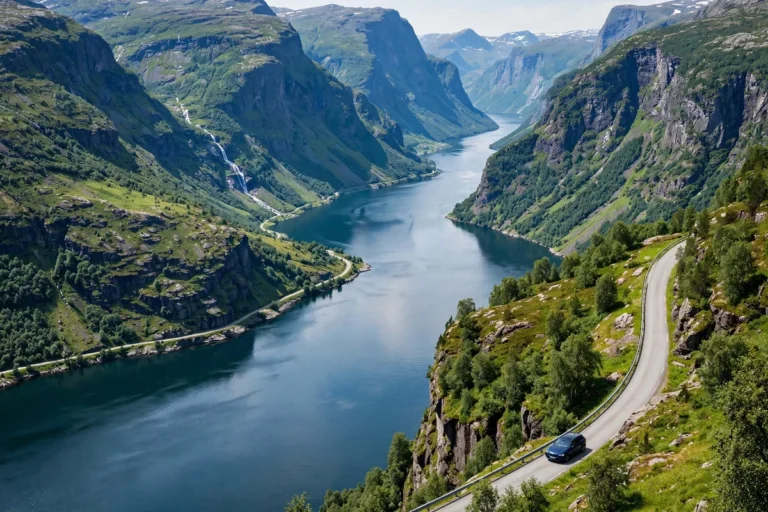
The Sognefjord has two great mountain passes for cyclists, and both are serious rides. The first is Aurlandsfjellet, the Snow Road, between Aurland and Lærdal. The scenic route runs 47 km between the two villages, and the cycling climb from Aurland is about 33 km with about 1,300 metres of climbing, topping out at about 1,306 metres. The Stegastein viewpoint, 650 metres above the fjord, arrives after about 7.5 km, and snow banks linger on the plateau into June and July. The season is June to October, and the stretch up to Stegastein stays open all year round. The second pass is Sognefjellet, the highest mountain pass road in Northern Europe, at 1,434 metres. From Skjolden, at the head of the Lustrafjord, the road climbs to Sognefjellshytta in 24 km, then descends to Turtagrø. From there the Tindevegen, free for cyclists, climbs 18 km from Øvre Årdal to about 1,315 metres. One route guide puts the combined loop from Skjolden at 129 km with 4,134 metres of climbing. The Lærdal Tunnel, at 24.5 km the longest road tunnel in the world, is closed to cyclists, so the Snow Road is the only cycling route between Aurland and Lærdal in summer. Our Sognefjord guide covers the fjord.
Bike hire and e-bikes
You do not need to bring a bike to Norway. The three hire bases in this guide are Flåm, Bergen and Lofoten. Flåm Bike Rental hires touring bikes and electric mountain bikes in Flåm, and bikes are also available at the Flåm Zipline valley station at Kårdal. Bergen Bike Rent, at Bontelabo 2, a five to ten minute walk from the Fish Market and near the cruise port, hires Scott off-road bikes and e-bikes, with a helmet, lock, map and tools included. In Lofoten, hire is available in Svolvær, Leknes and Reine, as covered above. A standard pedal-assisted e-bike in Norway has a motor of up to 250 watts, and the assistance stops at 25 km/h: you can still go faster on your own effort or downhill. Helmets are recommended for all cyclists in Norway but are not generally required by law for adults, although a hire operator or a guided tour may make one a condition of riding. If you bring your own bike, reserve a bike space on the train in advance: space is limited.
You can book the Bergen E-Bike Tour on Viator.
What to pack and when to go
The best months are June, July, August and September, and the high passes have a shorter window inside that. Rallarvegen is July to late September. Lofoten and Dalsnibba are June to September. Aurlandsfjellet is June to October. The Flåm valley is May to September, with snow possible into May on the high part. Pack for change: the weather on the high plateau can be cold, wet and windy while the fjord below is warm and calm, so bring layers, a waterproof jacket, and warm gloves even in July. A helmet, lights front and rear, and a reflective vest are essential: lights are mandatory in tunnels. Carry food and water for the whole ride on Rallarvegen and Dalsnibba: there is nowhere to buy anything on the plateau or on the climb.
Tunnels, traffic and safety
Norway has more than 1,000 road tunnels, and they are the single biggest safety issue for cyclists in the fjords. Most tunnels can be cycled through, but some are closed to cyclists, and you must not enter one that is banned. The ban is signed at the tunnel entrance, so look for the sign at every tunnel, and check the route in advance on Vegkart, the road authority map, or on the cycletourer tunnel map. Where cycling is allowed, lights front and rear are mandatory, and reflectors on the pedals and the rear are mandatory too. The fjord roads are narrow, with no cycle lane for most of their length, and summer brings camper vans, coaches and lorries. Ride on the right, ride in single file, wear bright clothing, and do not ride two abreast on a narrow road. Descending needs more care than climbing: the hairpins on Dalsnibba, Rallarvegen and the Snow Road are tight, the surface can be wet, and a hire bike with unfamiliar brakes is not the bike to test at speed. Start descents slowly and brake before the bend, not in it.
How to choose
Start with your time. Half a day in Flåm means the valley ride down from Vatnahalsen. A full day means Rallarvegen from Finse, or the Dalsnibba climb from Geiranger. Two to four days means Lofoten, from Svolvær to Å. A single hard day means Aurlandsfjellet or Sognefjellet. If you have not climbed 1,000 metres in a day, take an e-bike for Dalsnibba or the Snow Road. For cruise travellers, most of these rides do not fit a port day. The Flåm valley ride does, because the train and the ride down take about half a day, and a guided e-bike tour in Geiranger can fit a long port day. If your ship is in Bergen, a hire bike from Bergen Bike Rent is the best short ride from the port.
What to skip
Skip Rallarvegen in June: the high section may still be under snow, and the road may not be open. Skip Dalsnibba on a normal bike if you have not climbed before: 1,450 metres in 21 km is a serious climb, and the descent is not a rest. Skip the Snow Road before it opens: the plateau section is gated shut, and the Lærdal Tunnel is closed to cyclists, so there is no way through. Skip riding two abreast on narrow fjord roads.
Finding your way around
Key map links for the routes in this guide:
- Finse station, Rallarvegen start, the start of the Rallarvegen ride to Flåm
- Flåm station, the end of the Rallarvegen and Flåm valley rides
- Vatnahalsen station, the start of the Flåm valley descent
- Svolvær, the start of the Lofoten ride south
- Reine, Lofoten, the village near the end of the Lofoten ride
- Geiranger, the start of the Dalsnibba climb
- Dalsnibba viewpoint, the top of the Geiranger climb
- Aurland, the start of the Aurlandsfjellet Snow Road
- Stegastein viewpoint, the viewpoint on the Snow Road climb
- Bergen Bike Rent, Bontelabo, bike hire near the Bergen cruise port
The routes, compared
| Route | Distance | Time | Climbing | Season | Best for |
|---|---|---|---|---|---|
| Rallarvegen, Finse to Flåm | About 55 km | 5–6 hours | About 1,350 m down | Jul–late Sep | The classic ride |
| Flåm valley, Vatnahalsen to Flåm | About 17 km | About 2 hours | About 800 m down | May–Sep | Easiest mountain ride |
| Lofoten, Svolvær to Å | About 130 km | 2–4 days | About 1,500 m total | Jun–Sep | Multi-day coastal trip |
| Dalsnibba, Geiranger return | About 42 km return | 4–6 hours | About 1,450 m | Jun–Sep | Hardest climb |
| Aurlandsfjellet, Aurland to Lærdal | About 33 km one way | 4–5 hours | About 1,300 m | Jun–Oct | High mountain pass |
| Sognefjellet and Tindevegen, Skjolden loop | About 129 km | Full day | About 4,100 m | Jun–Sep | Expert riders only |
Frequently asked questions
What is the best route for cycling norwegian fjords on a first trip?
Rallarvegen from Finse to Flåm: about 55 km of gravel, mostly downhill, five to six hours, from the high plateau at 1,222 metres to the fjord. The Flåm valley ride down from Vatnahalsen is about 17 km and takes about two hours.
Can I cycle Rallarvegen from a cruise ship in Flåm?
Not the full ride. Rallarvegen starts at Finse, a train ride away from Flåm, and takes five to six hours, so it needs a full day on land. From a port day in Flåm, ride the valley down from Vatnahalsen instead.
Do I need an e-bike for cycling in the Norwegian fjords?
No, but it helps a lot. The climbs are long: Dalsnibba gains about 1,450 metres in 21 km, and the Snow Road gains about 1,300 metres in 33 km. Book early.
Can I cycle through tunnels in Norway?
Most tunnels, yes, but some are closed to cyclists, and the ban is signed at the entrance. Lights front and rear are mandatory in tunnels, and reflectors on the pedals and the rear are mandatory too. Check each tunnel on your route in advance.
When is the best time for cycling in the Norwegian fjords?
June to September, when the roads are clear of snow and the daylight is long. Rallarvegen needs July to late September, because the high section holds snow into July. Aurlandsfjellet opens around 1 June and closes in October. September is quieter.
Where can I hire a bike in the fjords?
In Flåm, at Flåm Bike Rental and at the Flåm Zipline valley station at Kårdal. In Bergen, at Bergen Bike Rent near the cruise port. In Lofoten, in Svolvær, Leknes and Reine. Hire shops include a helmet, lock and repair kit.