
Best Hikes in the Norwegian Fjords
The best hikes in the Norwegian fjords are five: Preikestolen, the flat cliff 604 metres above the Lysefjord, which is the best first fjord hike; Trolltunga, the rock tongue 700 metres above a mountain lake, which is the hardest; Kjeragbolten, the boulder wedged in a crevasse 984 metres above the fjord, which is the most exposed; Romsdalseggen, the ridge above Åndalsnes, which is the best ridge walk; and Reinebringen, the staircase of almost 2,000 stone steps above Reine, which is the best short climb. All five are summer hikes, and none of them is a casual walk.
This guide covers the five hikes with honest distances, times and seasons, plus the easier walks for travellers who want the fjord views without the mountain day. Distances and times are from the trail guides, checked in November 2026, and they vary with fitness and weather.
The five hikes at a glance
| Hike | Distance | Time | Climbing | Season | Difficulty |
|---|---|---|---|---|---|
| Preikestolen | About 8 km return | 4–5 hours | About 500 m | May–Sep | Moderate |
| Trolltunga | About 28 km return | 10–12 hours | About 800 m | Mid-Jun–mid-Sep | Strenuous |
| Kjeragbolten | About 11 km return | 6–8 hours | About 800 m | Jun–Sep | Strenuous |
| Romsdalseggen | About 10 km one way | 6–8 hours | About 970 m | Mid-Jun–early Oct | Challenging |
| Reinebringen | About 2 km of steps, return | 1.5–2.5 hours | 448 m | Late May–early Oct | Moderate, steep |
Preikestolen: the best first fjord hike
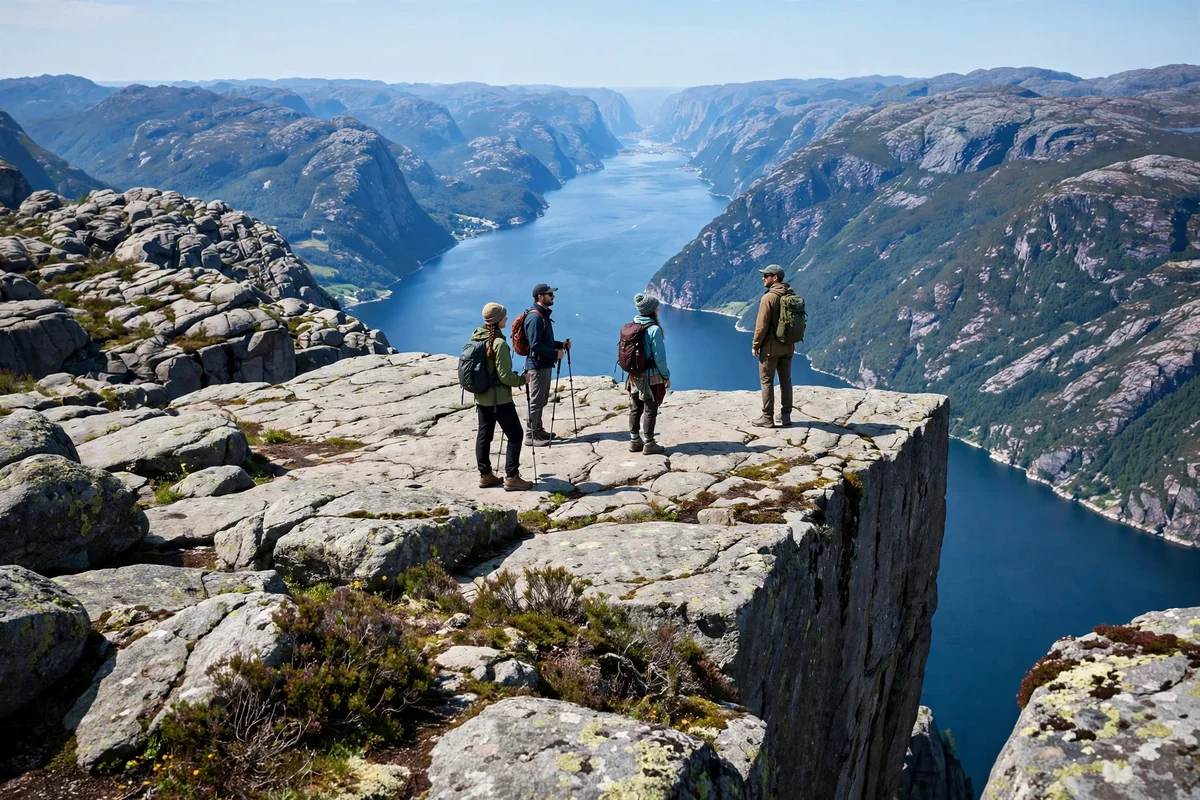
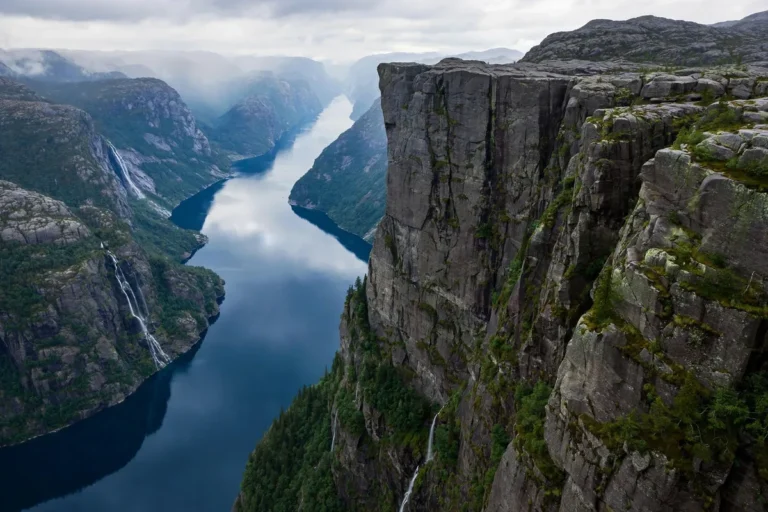
Preikestolen, the Pulpit Rock, is the best fjord hike in Norway for a first-timer, because it is dramatic and achievable. A flat rock platform, about 25 metres on each side, hangs 604 metres above the Lysefjord, with no railing at the edge. The trail is about 8 km round trip and takes most hikers four to five hours, with about 500 metres of total climbing. It is officially rated moderate, and it is the busiest mountain trail in the country, with more than 300,000 hikers a year.
The trail starts at the Preikestolen Mountain Lodge, near Forsand, reached from Stavanger by ferry to Tau and then by bus, or by a direct seasonal bus. The first part is a stone staircase through the forest, then the trail opens onto rock slabs and wooden walkways, and the last part is a scramble over boulders to the plateau. The climb up usually takes about two hours.
The best season is May to September, and the trail is busiest in July and August. Go early or late to avoid the crowds, and go on a clear day: the view is the point, and in cloud there is nothing to see. The plateau has no railing, so keep back from the edge, and keep children close. The parking at the trailhead is paid, and the trail itself is free.
Preikestolen suits fit walkers who want the classic fjord photograph without a full mountain day. It does not suit travellers with a fear of heights, or anyone with bad knees: the steps are steep and the descent is hard on the joints. If your ship is in port in Stavanger for under eight hours, do not plan an independent hike: the hike alone is four to five hours, on top of the transport to and from the trailhead. Our Lysefjord and Preikestolen guide covers the fjord and the cliff.
You can book the Guided hike to Pulpit Rock Preikestolen on Viator.
Trolltunga: the hardest day
Trolltunga, the Troll’s Tongue, is a narrow tongue of rock jutting out about 700 metres above the Ringedalsvatnet lake, near Odda on the Hardangerfjord. It is the hardest of the five hikes here, and the longest: about 28 km round trip from the P2 Skjeggedal car park, with about 800 metres of climbing, taking 10 to 12 hours of walking. It is not a hike to attempt on a cruise port day.
The hike starts at Skjeggedal, near Tyssedal, and climbs through forest, then across open mountain terrain, to the rock. A shuttle from the P2 car park up to the higher P3 Mågelitopp car park cuts about 4 km and two hours off the route. The rock itself is the photograph: a thin ledge over the lake, with a queue in high season.
The unguided season runs from about mid-June to mid-September. Outside that window, from October to May, the hike is guided only, on snowshoes or skis. Start between six and eight in the morning, carry food and water for the whole day, and check the weather and the trail status before you go: in spring 2026 the trail stayed shut until 8 June because of rockfall risk.
Trolltunga suits experienced hikers with the fitness for ten hours of walking and the sense to turn back if the weather turns. It does not suit first-time hikers, children, or anyone on a tight schedule.
You can book the Trolltunga Day Hike on Viator.
Kjeragbolten: the most exposed
Kjeragbolten is a boulder about five metres wide, wedged in a crevasse about 984 metres above the Lysefjord, on the Kjerag plateau. It is the most exposed of the five hikes: the route crosses three steep sections of smooth granite secured by fixed chains, and the boulder itself has no railing and a drop of nearly a kilometre on both sides. Stepping onto the boulder is optional, and in rain or wind it is strongly discouraged.
The hike is about 11 km round trip from the Øygardstøl car park, near Lysebotn, and it takes six to eight hours for most hikers, including a rest at the boulder. The total climbing is about 800 metres. The season runs from June to September, depending on snow and road conditions, and the road to Øygardstøl closes in winter. Stavanger is about two hours away by road.
Kjeragbolten suits experienced hikers who are comfortable with heights and with chains on rock. It does not suit anyone with vertigo, or anyone who wants a relaxed day: the trail is steep, the rock is smooth when wet, and fatal falls have happened here. Go on a dry day, start early, and do not step onto the boulder if the rock is wet or the wind is up.
Romsdalseggen: the best ridge walk
Romsdalseggen is the best ridge walk in the fjords: a 10 km traverse above Åndalsnes, with drops of about 1,000 metres to the Rauma river and the fjord on one side and the peaks of the Romsdal Alps on the other. It is a point-to-point hike, not a loop: it starts in Vengedalen, climbs about 970 metres to the ridge, follows the exposed ridge, and descends by steep steps to Åndalsnes. It takes six to eight hours, and it is rated red, which means challenging.
The hike starts with a bus from Åndalsnes to the trailhead in Vengedalen, and it ends in the town, where you can take the Romsdalsgondolen cable car down from Nesaksla, 708 metres above sea level, if your legs are done. The highest point on the route is about 1,222 metres at Mjølvafjellet, and the season runs from mid-June to early October.
Romsdalseggen suits experienced hikers who want a ridge walk without the crowds of Preikestolen. It does not suit anyone with a fear of heights, or anyone who has not hiked in steep terrain before: the ridge is exposed, the descent is steep, and the hike needs good weather and good boots. There is a longer, less exposed alternative route via Høgnosa, about 12 km.
Reinebringen: the best short climb
Reinebringen is the shortest hike here and the steepest: a staircase of almost 2,000 stone steps, built by Nepalese Sherpas between 2016 and 2021, climbing 448 metres from the road to the ridge above Reine. The steps themselves cover about 2 km return, and the climb takes one and a half to two and a half hours. The view from the top is the most photographed in Lofoten.
The trail starts on the western side of the Ramsvik tunnel, outside Reine, and the steps are wide and well built. The mountain was closed several times between 2016 and 2019 while the Sherpas worked, and it is closed through the winter: the chain came off in early May 2026. The best time is late May to early October, and the steps are steep and slick after rain, so wear grippy shoes and bring poles.
Reinebringen suits fit walkers who want a big view for a short climb. It does not suit anyone with vertigo: the drops on one or both sides are steep, and the steps are exposed. It is also the most crowded hike in Lofoten, so start early or late: the midnight sun makes a 7 am or 10 pm climb easy in June and July.
Easier fjord walks
Not every fjord walk needs to be a mountain day. The Fløyen walk in Bergen is the easiest fjord view in Norway: take the Fløibanen funicular from the city centre to the top of Fløyen, and walk the paths around the mountain, with views over the city and the fjords. It suits everyone, including children and older travellers.
The Skageflå farm walk in the Geirangerfjord is the best easy walk in the fjords: a farm perched about 250 metres above the water, reached on foot from Geiranger village. It is a few hours return.
The Stegastein viewpoint, 650 metres above the Aurlandsfjord, is a drive, not a hike, but the paths around it are an easy walk with a big view.
Hiking safety in the fjords
The Norwegian mountains are serious, and the fjord hikes are no exception. The weather changes fast, the rock is smooth when wet, and the trails are exposed.
First, check the weather and the trail status before you go, and turn back if it turns. The Trolltunga trail stayed shut until June in 2026 because of rockfall, and the Kjerag road closes in winter.
Second, wear proper boots with grip, and bring layers, a waterproof jacket, food and water. A phone and a power bank are essential: the cold drains batteries faster than you expect.
Third, start early. The big hikes take six to twelve hours, and the light goes early in September. Start between six and eight in the morning for Trolltunga, and before nine for Kjeragbolten and Romsdalseggen.
Fourth, know the grading. Norwegian trails are graded green for easy, blue for medium, and red for challenging. Romsdalseggen is red. Preikestolen is moderate, but it is still a mountain trail with no railing at the top. Do not attempt a red trail alone if you have not hiked in steep terrain before, and do not hike any of these trails in winter without a guide.
How to choose
Start with your time. Two hours means Reinebringen. Half a day means Preikestolen. A full day means Kjeragbolten or Romsdalseggen. A very full day means Trolltunga.
Then ask about your knees and your head for heights. Bad knees mean Reinebringen is hard and the descents of Preikestolen and Romsdalseggen are harder. A fear of heights rules out Kjeragbolten and the Romsdalseggen ridge.
Then ask about the season. All five hikes are summer hikes, from late May or June to September or early October. Outside that window, the trails are snow-covered, the roads close, and the hikes need a guide. In July and August, start early, and expect a queue at the Trolltunga rock and on the Reinebringen steps.
What to skip
Skip Trolltunga on a cruise port day: it is 10 to 12 hours, and the ship will not wait. Skip Kjeragbolten in rain or wind: the rock is smooth, and the boulder is not worth the risk. Skip the Reinebringen steps in winter: the mountain is chained shut, and the steps are icy. Skip hiking alone on the big trails if you have not done it before. And skip the idea that a shorter hike is an easier hike: Reinebringen is two hours and it is steeper than Preikestolen.
Finding your way around
Key map links for the trailheads:
- Preikestolen trailhead, Preikestolhytta, the start of the Preikestolen hike
- Trolltunga trailhead, Skjeggedal, the start of the Trolltunga hike
- Øygardstøl, Lysebotn, the start of the Kjeragbolten hike
- Vengedalen, Åndalsnes, the start of the Romsdalseggen hike
- Reinebringen trailhead, Reine, the start of the Reinebringen steps
- Fløibanen, Bergen, the funicular to Fløyen
- Stegastein viewpoint, Aurland, the viewpoint above the Aurlandsfjord
The hikes, compared
| Hike | Distance | Time | Climbing | Season | Best for |
|---|---|---|---|---|---|
| Preikestolen | About 8 km return | 4–5 hours | About 500 m | May–Sep | First fjord hike |
| Trolltunga | About 28 km return | 10–12 hours | About 800 m | Mid-Jun–mid-Sep | Experienced hikers |
| Kjeragbolten | About 11 km return | 6–8 hours | About 800 m | Jun–Sep | Heights and chains |
| Romsdalseggen | About 10 km one way | 6–8 hours | About 970 m | Mid-Jun–early Oct | Ridge walking |
| Reinebringen | About 2 km of steps, return | 1.5–2.5 hours | 448 m | Late May–early Oct | Short, steep climb |
| Fløyen, Bergen | Easy paths | 1–2 hours | Funicular | Year-round | Everyone |
| Skageflå, Geiranger | A few hours return | Half day | About 250 m | May–Sep | Easy fjord walk |
Frequently asked questions
What are the best hikes Norwegian fjords offer for a first-timer?
Preikestolen, for the classic fjord photograph on a moderate trail: about 8 km round trip, four to five hours, 604 metres above the Lysefjord. Reinebringen is the best short climb, and the Fløyen paths in Bergen are the best easy walk.
How long does the Preikestolen hike take?
About four to five hours round trip, including time on the rock, for the 8 km trail. The climb up usually takes about two hours. Fit hikers do it in three hours, and families with children take five to six.
Is Trolltunga too hard for most hikers?
For most hikers, yes. It is about 28 km round trip and 10 to 12 hours of walking, with about 800 metres of climbing. It is the hardest hike in this guide, and it is not suitable for a cruise port day or for first-time hikers.
When is the best time to hike in the Norwegian fjords?
Late June through September, when the snow has cleared from the higher trails and the daylight is long. Trolltunga and Kjeragbolten may still have snow in early June, so always check the trail status before you go.
Can I hike Preikestolen from a cruise ship in Stavanger?
Only from a long port day. The hike alone is four to five hours, on top of about two hours of transport to and from the trailhead. If your ship is in port for under eight hours, take the Lysefjord cruise instead.
Do I need a guide to hike in the Norwegian fjords?
No, for the five hikes in this guide in the summer season: the trails are marked, and the routes are well used. You need a guide for Trolltunga outside the summer season, from October to May, and for any glacier walk, which always needs a guide, crampons and a rope.
One Comment