
Norway Fjords Wildlife: Whales, Eagles & Puffins by Season
Norway fjords wildlife follows the seasons, and no single month has all of it. The whales come in winter: orcas and humpback whales follow the herring into the fjords around Tromsø from November to January. The eagles are there all year: white-tailed sea eagles hunt along the Lofoten coast in every season, and a RIB safari from Svolvær is the best way to see them. The puffins come in summer: Atlantic puffins nest on Runde island, near Ålesund, from April to early August, with the best sightings in May, June and July. If you want all three, you need two trips: one in winter for the whales, one in summer for the puffins, with the eagles as the year-round constant.
This guide covers the three headline animals, when to see each one, where to go, and what a trip actually involves. It gives no sighting guarantees: wildlife is wild, and any operator that promises a whale or an eagle on every trip is overstating it.
The wildlife year at a glance
| Animal | Where | Best months | How to see it |
|---|---|---|---|
| Orcas and humpback whales | Tromsø and Skjervøy | Nov–Jan | Boat tour, 5–8 hours |
| Sperm whales | Vesterålen, from Andenes | May–Sep | Boat tour, half day |
| White-tailed sea eagles | Svolvær, Lofoten | Year-round | RIB safari, 1.5–2.5 hours |
| White-tailed sea eagles | Runde, near Ålesund | Spring–summer | Boat tour or cliff walk |
| Atlantic puffins | Runde island | Apr–early Aug | Evening cliff walk or boat tour |
| Atlantic puffins | Bleiksøya, Vesterålen | Mid-Apr–early Aug | Boat tour from Bleik |
| Seals | Along the coast | Year-round | Seen from fjord boats |
Whales: orcas and humpbacks in the polar night
The whale season in northern Norway runs from November to January. Every autumn, vast shoals of Norwegian spring-spawning herring move into the fjords of Troms to spend the winter in the deeper water. Where the herring go, the whales follow: orcas arrive first, in October, and humpback whales arrive a few weeks later, in November and December. The season winds down in January as the herring move out to spawn.
The whales do not come to Tromsø itself. Since about 2017 the herring, and the orcas and humpbacks that feed on them, have spent the winter in the fjords around Skjervøy and Kvænangen, roughly 160 km north of Tromsø by road. The tours leave from Tromsø in the morning, drive or sail north, spend the day with the whales, and return in the evening: five to eight hours in total. The boats are heated, with an indoor cabin and an open deck.
The season runs in the polar night. In Tromsø the sun does not rise from 28 November to 14 January, and the midday light is a blue twilight. The whales surface regardless of the sun. Dress for the cold: the boats are heated inside, but the deck is open, and the wind on the water in December is bitter.
The two species behave differently. Orcas hunt in pods, driving the herring into a tight ball near the surface and slapping the fish stunned with their tails: a behaviour called carousel feeding, and the best month to see it is November. Humpback whales are larger and slower, and their numbers often peak in December.
No operator can guarantee a sighting, and you should not book with one that does. The whales follow the herring, and the herring move. In a good year the sighting rate in November and December is high, but late January is less reliable, and some operators warn guests the day before and offer a refund or a fjord trip instead. Book a tour with free cancellation, and book the earliest date in your trip.
In summer, the whale watching moves south to Vesterålen. Andenes, on the island of Andøya, runs summer sperm whale trips from May to September, and it is the classic summer whale trip in Norway. The trips are half a day by boat, in daylight on the open sea.
Our Tromsø northern lights guide covers the city, the polar night and the winter trips, and our best shore excursions guide covers whale watching as a shore excursion from Tromsø.
You can book the Tromsø Whale & Orca Safari on Viator.
Sea eagles: the year-round hunters
The white-tailed sea eagle is Europe’s largest bird of prey, and along the Norwegian coast it is a common sight rather than a rare one. It hunts fish and seabirds along the shoreline, and it is big enough to see from a boat at a distance: the wingspan is up to 2.65 metres. The eagles are there all year, which makes them the most reliable wildlife in the fjords.
The best eagle trip is the RIB safari from Svolvær in Lofoten, out through the Raftsundet strait to the Trollfjord. The tours run one and a half to two and a half hours, depending on the operator, and they follow the coastline the guides know well, approaching known perching spots and feeding the eagles with fish so they come close to the boat. The tours run all year, in most weather, and the boats are open, so dress for wind and spray.
You can book the Sea Eagle Safari from Svolvær to Trollfjorden on Viator.
The eagles are also common around Runde, near Ålesund, where it is usual to see five to ten individuals in spring and summer. The Runde eagle is a bonus on a puffin trip, not a trip of its own: take the boat tour to the bird cliffs, and watch for the eagles circling above the colony.
A word on the feeding: the Svolvær operators bring fish for the eagles, which is why the birds come so close. It is standard practice on these tours, and it is the reason to book a guided tour rather than looking on your own: the guides know where the eagles have been active in the preceding days.
No responsible operator guarantees an eagle on every trip. The odds are good, the coastal geography suits the species, and a guided trip aimed specifically at finding them makes far better use of a few hours than an unguided attempt, but the birds are wild and they move.
Puffins: Runde island in summer
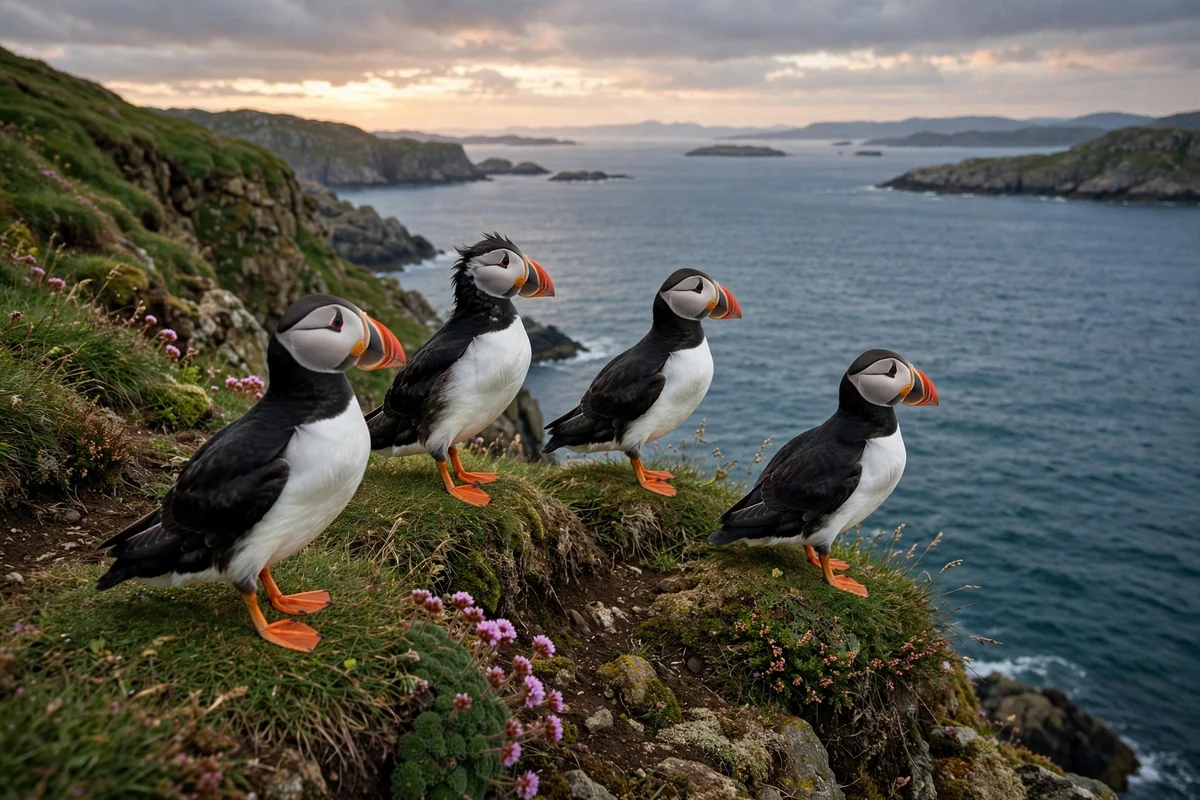
The Atlantic puffin is the most loved bird in Norway, and Runde island, about two hours by road from Ålesund, is the easiest place in the country to see it. The puffins nest in burrows on the grassy slopes of the bird cliffs on the west side of the island, and they are there from April to early August, with the best sightings in May, June and July. The Runde Environmental Centre gives the puffin population as around 32,500 breeding pairs, and the island holds around half a million seabirds in total during the breeding season.
The puffins spend the winter far out on the North Atlantic and come back to their burrows each spring. They lay a single egg from around the third week of April, the chicks hatch from mid-June, and the chicks leave for the sea from early to mid-August. The best time of day is the evening, between about 8 and 10 pm, when the puffins fly back to their burrows after feeding at sea.
The walk to the bird cliffs is about 2 km from the trailhead, steep in places and partly paved with handrails, with about 220 metres of climbing. The viewpoint is often crowded in July, so arrive early in the evening. Bring binoculars, warm layers, a waterproof jacket, a hat and gloves: the wind on the cliff is cold even in July. The Runde Environmental Centre runs guided evening walks and boat tours, and both are worth booking in advance in the summer.
The bird conservation area on Runde is closed to everyone except fieldworkers from 15 March to 31 August, which means you must stay on the marked trails and the viewing areas. The closure is there to protect the birds.
The other puffin island is Bleiksøya, off Bleik in Vesterålen, where about 80,000 puffin breeding pairs arrive in mid-April and leave in early August. The boat tours from Bleik get close to the colony. It is further north than Runde and harder to reach, but it is the bigger colony.
Our Ålesund guide covers the city and the road to Runde, and our best fjord day trip from Ålesund guide covers the Runde trip in full.
Other wildlife in the fjords
Seals are common along the whole coast, and you will see them from fjord boats in most seasons: grey seals and harbour seals hauled out on rocks and skerries, usually in small groups. They are shy, and the boat will not approach closely, so bring binoculars.
Reindeer are not a fjord animal, but you will see them in the north, around Tromsø and in Finnmark, especially in winter. They are semi-domesticated, owned by Sami herders: watch from the road and do not feed them.
Seabirds are everywhere in the fjords in summer: gulls, guillemots, cormorants and eiders, as well as the gannets and kittiwakes of the big colonies. The best seabird watching is on the boat tours to Runde and Bleiksøya.
How to plan a wildlife trip
Start with the season, because the season decides the animal. November to January means whales in Tromsø. April to early August means puffins on Runde. All year means eagles in Lofoten.
Then ask how much time you have. The eagle RIB is one and a half to two and a half hours, and it fits a port day. The puffin trip to Runde is a full day from Ålesund. The whale tour from Tromsø is five to eight hours.
Then ask about the weather. The whale tours and the eagle RIBs run in most weather, but the puffin cliff walk is miserable in rain and wind, and the boats to Bleiksøya cancel in rough seas. Book the wildlife trip for the first day of your stay, so you have a second chance if the weather cancels the first.
Book direct with the operator where you can, and book a tour with free cancellation. Wildlife trips cancel more often than sightseeing boats, because the animals and the weather decide, and a free cancellation means you can rebook rather than lose the money.
Practical tips
Bring binoculars. The whales are often a hundred metres away, the eagles circle above the boat, and the puffins are small birds on a big cliff. A phone camera is not enough for the whales.
Dress for the water, not the town. The whale boats are heated inside, but the deck is open and the wind in December is bitter. The eagle RIB is open, and the spray is cold in every season. Warm layers, a windproof jacket, a hat and gloves are the minimum.
Keep your distance. Do not approach seals on the shore, do not walk into the puffin colony, and do not feed wildlife except on the guided eagle tours, where the feeding is part of the trip.
If you are prone to seasickness, take the tablets before you board, sit low in the boat and near the middle, and look at the horizon. The whale tours sail on open water, and the RIBs are fast and bumpy.
What to skip
Skip any operator that guarantees a whale or an eagle on every trip. Skip the puffin trip outside April to early August: the colony is empty. Skip the whale trip from Tromsø outside November to January: the summer whales are in Vesterålen, not Tromsø. And skip approaching wildlife on your own: the guides know where the animals are.
Finding your way around
Key map links for the wildlife departures:
- Tromsø harbour, the whale watching departure
- Skjervøy harbour, the whale watching boats in the fjords
- Svolvær harbour, the eagle RIB safari departure
- Runde Environmental Centre, Runde, the puffin colony visitor centre
- Ålesund harbour, the start of the road to Runde
- Andenes harbour, the summer whale watching departure in Vesterålen
- Bleik, Andøya, the boat tours to the Bleiksøya puffin colony
The wildlife, compared
| Animal | Where | Best months | Trip length | Season |
|---|---|---|---|---|
| Orcas and humpbacks | Tromsø and Skjervøy | Nov–Jan | 5–8 hours | Nov–Jan |
| Sperm whales | Andenes, Vesterålen | May–Sep | Half day | May–Sep |
| White-tailed sea eagles | Svolvær, Lofoten | Year-round | 1.5–2.5 hours | Year-round |
| White-tailed sea eagles | Runde | Spring–summer | Full day from Ålesund | Apr–Aug |
| Atlantic puffins | Runde island | May–Jul | Full day from Ålesund | Apr–early Aug |
| Atlantic puffins | Bleiksøya | May–Jul | Half day from Bleik | Mid-Apr–early Aug |
| Seals | Along the coast | Year-round | Seen from fjord boats | Year-round |
Frequently asked questions
When is the best time to see whales in Norway?
November to January, from Tromsø, when orcas and humpback whales follow the herring into the fjords around Skjervøy. November and December are the best months, with both species present. In summer, the whale watching is in Vesterålen, from Andenes, for sperm whales from May to September.
Can I see puffins in Norway?
Yes, on Runde island near Ålesund, from April to early August, with the best sightings in May, June and July. Go in the evening, between about 8 and 10 pm, when the puffins fly back to their burrows. The other colony is Bleiksøya in Vesterålen, from mid-April to early August.
Where is the best place to see sea eagles in Norway?
Svolvær in Lofoten, on a RIB safari out to the Trollfjord. The tours run all year, last one and a half to two and a half hours, and the eagles are Europe’s largest bird of prey. Runde near Ålesund is the other good spot, in spring and summer.
Are whale sightings guaranteed in Tromsø?
No. The whales follow the herring, and the herring move. In November and December the sighting rate is high, and most trips see whales, but late January is less reliable, and some operators warn guests the day before and offer a refund or a fjord trip instead. Book a tour with free cancellation, and book the earliest date in your trip.
What is the best month for Norway fjords wildlife?
There is no single best month, because the animals peak in different seasons. December is the best month for whales and eagles together. June and July are the best months for puffins and eagles together. If you want all three, you need a winter trip and a summer trip.
Can I see whales, eagles and puffins on one trip?
Not in one season. The whales are a winter trip, the puffins are a summer trip, and the eagles are the year-round animal. A summer trip to Lofoten and Vesterålen gives you eagles, puffins and sperm whales. A winter trip to Tromsø gives you orcas, humpbacks and eagles.
One Comment